Read a brief article on the official rules for line calls in Pickleball to get some help and assistance as a newbie.
Pickleball is all fun and games unless you start playing it professionally. However, it is liked by many because it is not physically excruciating like other sports. If you are a new player who seems to develop an interest in the game like me, you can dig into the article below to look for some rules. These will help you increase your knowledge and improve the game.
I played the game for at least three months before breaking down the rules for line calls in Pickleball for you all. These are simple yet important to help you maintain the winning streak. Please read all the calling rules carefully before stepping onto the court. The information will help you have a competitive advantage over others in the game.
The Official Rules For Line Calls In Pickleball
If you are new to Pickleball, you should know some basic rules that will help improve the game and win against the opponents. Knowledge of the official rules is crucial for staying in the game and having a competitive advantage. I have been playing the game for two months and can break down the line call rules for all the newbies. Hence, the rules can be beneficial in the long run.

1. Serve Should Always Land In The Serving Court
The first and the most fundamental rule the entry-level player might know is that the serve should always land in the serving court. A ball entering the non-volley zone or the Kitchen is called “serve out.” You can hit anywhere on the centerline, sideline, or baseline as it will be considered as “serve in.” Hence, this is a basic rule that should be kept in mind if you serve.
2. Players Are Held Responsible For Calling Lines
The players on the court are held responsible for calling pickleball lines when standing on their side. All the players in the game have the right to review the decision or get a second opinion. The referee gives a second opinion to know if the ball is out or would get accepted.
3. Opponents Who Are Not Serving Will Get An Advantage
When going through the rules for line calls in Pickleball, the opponents who are not serving are always at an advantage. They benefit from the doubt because every team has to be treated equally in the game. Appeals are made before the serving team makes their next shot.
However, the pickleball ball can be observed when lined out. In pickleball doubles, one team can call out and wait for the referee to respond. If the ball were out, the opponent team would have an advantage.
Pickleball Rules
The following rules will help you when stepping on the pickleball court. You all might know that the court is 44 feet long and 20 feet wide. In this 20 feet, the 7 feet is dedicated as the “Kitchen” or the non-volley zone. The ball or the player cannot enter the Kitchen or the non-volley area. Now that you know when playing on the court, let’s dig into some pickleball line rules.
1. Begin With A Serve
This game can be played as a single player or in a team of two players. Whatever the case, the game will start from the team standing on either of the sides. The player on the right side will start serving, and the ball is hit diagonally. It has to be ensured that the ball does not fall into the Kitchen on your side of the court.
2. Position Of The Hand
The second and most important thing that can help you win points is to monitor the position of your hands. Keeping the hand below the waist area is mandatory when hitting the stroke. The arm must move upwards so that you move the ball out of the air. Some players drop the ball onto the court and hit it when it rises to their waist.
3. Serve Continues Until A Fault
If either team is serving, it continues until a fault is committed. The service is changed from one team to another after a fault. Most of the time, a serving player commits three types of faults. He might hit the ball into the pickleball net, or it might go beyond the baseline. Lastly, there are chances that the ball lands in the non-volley zone or the Kitchen area. All these will commit a fault, and the service will be transferred to another team.
4. Not Allowed To Stand In Kitchen
Any player cannot hit the ball or serve while standing in the non-volley zone. The players are not to step onto the line of the Kitchen. It is impermissible to enter that 7 feet when hitting the ball. This rule is great for gaining points against opponents. I used to hit the ball near the opponent’s Kitchen, so they had to cross the line, committing a fault.
5. Ball Must Bounce On Court
The ball must bounce on the court before the opposite team hits it back at you. This can be extremely difficult if you play pickleball singles, as one player cannot cover 20 feet of the court. However, the other members can cover near the baseline if you play as a team. I faced many issues when I started to play the game as a newbie because of this rule.
Frequently Asked Question
Can You Cross The Kitchen Line In Pickleball?
Yes, you can cross the Kitchen line in Pickleball if you are not serving. It is allowed to stand in the non-volley zone except for the time you serve.
What Is Not Allowed In Pickleball?
You cannot hit the ball when your hand is above the waistline. Moreover, you cannot stand in the Kitchen while making a shot.
Can Momentum Carry You Into The Kitchen?
Yes, momentum can unconsciously carry you into the Kitchen, which should be avoided at all costs. Even if you are not serving, stay out of the non-volley zone.
Is The Line In Or Out In Pickleball?
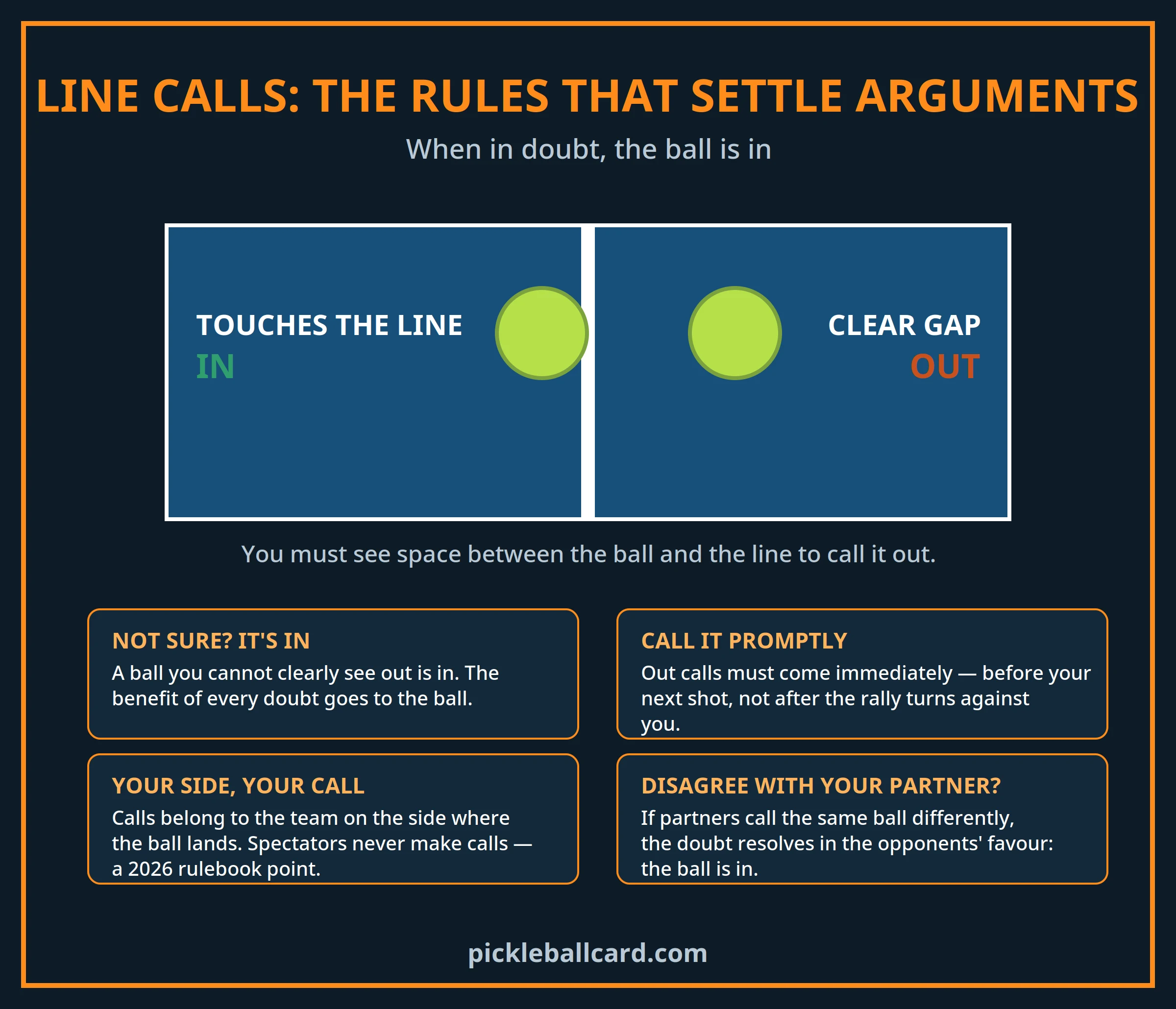
In pickleball, when a ball lands on a boundary line, is it considered “in” or “out” according to official rules? When there is a clear difference between the ball and the boundary line, it is considered “out.” On the other hand, when a ball touches any line except the kitchen or non-volley zone, it is considered “in.”
What Happens If You Hit An Out Ball In Pickleball?
The ball is still in the game, as you have to let it bounce first. Saying “out” after the ball touches the court line will be considered as “out.” You can’t hit the ball without letting it bounce once.
Is The Kitchen Line In Or Out In Pickleball?
The kitchen line is considered as “Out” in pickleball. You can’t hit the kitchen or non-volley zone line while serving. You can’t hit the volley without letting it bounce first. All other pickleball court lines of the service area are considered as “In.”
When You Are Not Sure: Give the Benefit of the Doubt
The official tiebreaker is simple: a ball is only ‘out’ when you clearly see space between the ball and the line. If you are unsure, the ball is in — and that applies to your team, so if one partner calls it out and the other sees it in, the ball is in. You may ask your opponents to help with a call on your side, and their view settles it; spectators, however, must never be consulted. Make the call promptly, before playing your return — the same standard runs through the fault rules and the pickleball rules themselves.
Conclusion
A brief article explaining Pickleball’s official rules for line calls is written for your guidance as a newbie. These rules can help you improve and have an advantage over competitors. You need to practice while keeping these basic rules in mind before stepping onto the court for the game. I hope the article explains some essential rules that will be handy during your next match.
Other Related Posts:
- Best Paddles For Pickleball
- Best Shoes For Pickleball
- Indoor Pickleball Courts
- Stacking In Pickleball
- Why Pickleball Is Popular?
Frequently Asked Questions
Who Makes Line Calls In Pickleball?
The players on the side of the court where the ball lands make the call. In doubles, either partner can call a ball out, and partners are expected to agree or the ball is in.
In refereed matches a referee can overrule a clearly wrong call, but in recreational play your opponents’ calls on their side stand. Your job is your own side only.
Is A Ball That Touches The Line In Or Out?
In. A ball that touches any part of a line is good, including on the serve, where hitting the centerline, sideline, or baseline counts as in.
The one exception is the kitchen line on a serve: a serve that lands in the non-volley zone or on its line is a fault. Everywhere else, line means in.
When Can You Call A Ball Out?
Only when you clearly see space between the ball and the line. If there is any doubt, the ball is in, and the benefit of the doubt always goes to your opponent.
Call “out” loudly and immediately, before you hit your next shot. A late call after the rally has moved on does not count, and play continues as if the ball were good.
What If Partners Disagree On A Call?
If one partner calls a ball out and the other calls it in, the ball is in. Doubles partners resolve disagreements in favor of their opponents, every time.
The same principle covers a player who simply did not see the ball land. An honest “I didn’t see it” means the ball is good unless your partner saw it clearly out.
Can You Ask Your Opponents To Make A Call?
Yes. If neither you nor your partner saw a ball land on your side, you may ask the opponents whether they saw it clearly.
If they give an opinion, you must accept it. What you cannot do is ask spectators in a formal match, or replay the point just because a call felt wrong. Replay is for genuine interference, not disagreement.

Jeena Noven is one of Pickleball Card’s main writers for rules, ratings and everyday play. She focuses on the questions players actually argue about on court — scoring, faults, ratings and match situations — and checks each answer against the current USA Pickleball rulebook before it goes live. Her guides are written for real club players: clear first, technical when it matters, and updated when the rules change.