
The following are the eight essential pickleball kitchen rules that one must follow when playing pickleball.
You might have heard the term pickleball kitchen a lot often. Before reading about its rules, you must know its meaning. A pickleball kitchen is a non-volley zone seven feet away from the net on both sides. Pickleball is a combination of various games, including badminton and ping-pong.
It is a two-player or a four-player sport in which each player has to stand on each side of the net and hit the ping pong ball with the racket-like paddles. A pickleball court has two portions, a volley zone and a non-volley zone. Players have to remain in the volley zone and hit the ball toward their opponents.
The non-volley zone of a pickleball court is known as a pickleball kitchen. If any player steps into this non-volley zone, his performance can be affected. A pickleball kitchen has some rules that one must follow. The following are further details about this portion of a pickleball court.
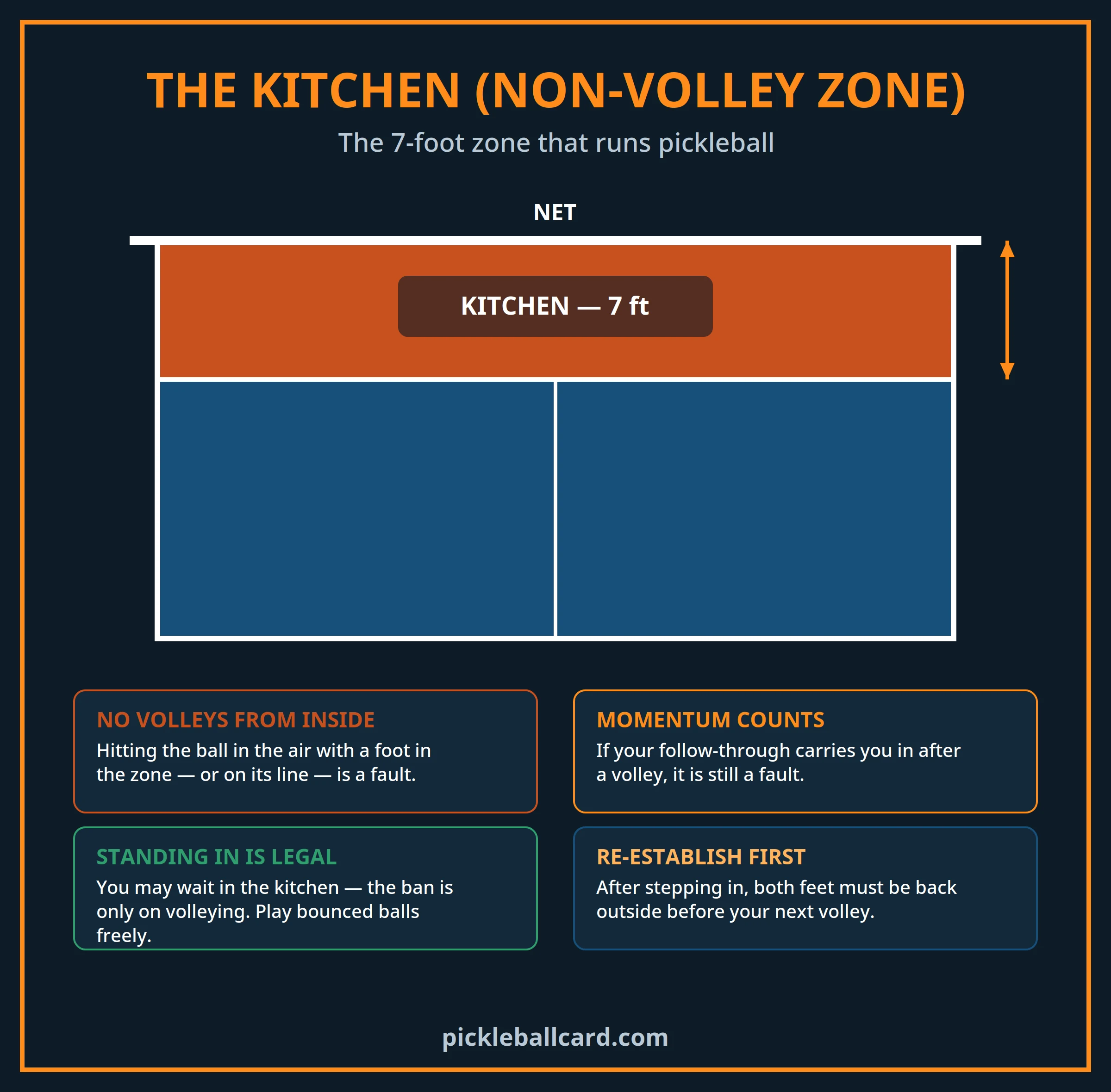
Pickleball Kitchen Rules

What Is The Kitchen In Pickleball?
By reading the above introduction, you must have known about the pickleball kitchen. A non-volley zone means the players are not allowed to enter this portion. This part of a pickleball court makes the game more fun to watch because if a player accidentally steps into the kitchen, you can shout “kitchen” to let him recognize his mistake.
Many people think a pickleball kitchen has only one rule stating that players are not allowed to hit the ball in this region. Well, this is not true. A kitchen has around eight complicated rules a player must follow when playing pickleball. The following guide has a detailed explanation of these pickleball rules.
Why Is It Called The Kitchen In Pickleball?
You might be wondering why it is called the kitchen in pickleball. Well, the actual reason for this name is unknown. Some factors might be a reason for naming the non-volley zone of the pickleball court as the kitchen. As I have mentioned above, pickleball is a mixture of several games, including badminton, tennis, and ping-pong. This term originated from the shuffleboard game. There might be another reason for this term, but it is unknown.
Size Of A Pickleball Kitchen
As you know, a non-volley zone is a prohibited portion of a pickleball court for the players. It is 7 ft from each side of the net. A player can only enter this area if they aren’t playing. In short, players are not allowed to step into this 7ft long kitchen during the match. Furthermore, you must be careful that your ball does not land in the kitchen, or it will be declared as a fault.
Significant Facts About Pickleball Kitchen
Before playing the sport, you must know some highlighting factors about a pickleball kitchen. With a distance of 7 ft from the net’s each side, the kitchen covers the entire width of a pickleball court.
Furthermore, the boundary line of a non-volley zone of a pickleball court is around 2 inches thick to enhance visibility. Some individuals assume that a kitchen or a non-volley area lies above the ground, which is invalid. A non-volley zone lies on the floor and not above it. In short, it is a portion of flat land.
Importance Of A Pickleball Kitchen
The most prominent question regarding the non-volley zone of a pickleball court is its importance. When you read about a pickleball kitchen, the first question that pops up in your mind is, what is its purpose? As this portion prohibits a player’s entrance, it allows them to stand far from the net and serve the ball.
If there is no prohibited area, players would go near the pickleball net and aim at the ball, which is incorrect. Therefore, a pickleball kitchen prevents them from doing such shots and helps them improve their performance by aiming at the ball away from the net. Every sport has its regulations.
The same is the case with pickleball. It is one of the most well-known sports and has some kitchen pickleball rules that a player must follow. Hitting the ball by standing close to the net affects your performance. Hence, a non-volley zone makes this sport challenging and fun.
The 8 Pickleball Kitchen Rules
As I’ve mentioned earlier, there are 8 rules for a pickleball kitchen that a player must follow. The following are the details about these rules. You can read the below guide to enhance your knowledge and performance in pickleball.
1. All Players Must Start Volleying From A Volley Zone
This rule states that all players must start volleying from a volley zone and avoid stepping into the non-volley area. It is the most common rule for playing pickleball. You might have seen some players on wheelchairs playing this sport. Well, there is a rule for them, too. This rule states that if a player uses a wheelchair, the front wheels can touch the kitchen line, but proceeding forward can result in a fault.
To follow this rule, all you need to do is stand at a distance from the kitchen. If you do so, your feet will not touch the kitchen line, and your performance won’t be affected. Beginners should avoid standing close to the non-volley zone. Some professional players manage to perform well while standing close to the kitchen. It is because they are more skillful than beginners.
2. Anything Related To A Player Should Not Touch The Kitchen Line
Then comes the second rule, which in turn has two sub-rules. This rule states that if the player or anything related to him touches the non-volley zone, the management will declare it a fault.
Some people assume that you only have to prevent the contact of your feet with the non-volley area, but this rule states their assumption is incorrect. Anything related to a player can not enter the kitchen or touch the kitchen line. If your paddle or hand enters this zone or touches the boundary line, it will be declared a fault.
3. A Player Must Serve The Ball That Should Cause Swing Or Momentum
This rule states that volleying includes some factors, including a swing, a follow-through, and momentum. The primary objective of this rule is that a player must serve the ball in such a way that it produces the swing, a follow-through, and momentum. A perfect shot comprises these factors.
3a. Player’s Paddle Should Not Touch The Non-Volley Zone
The main objective of this rule is that it will be a fault if a player’s paddle touches the non-volley zone. It means you must try your best to prevent contact with a paddle and the non-volley area. You can do so by standing at a distance from the kitchen. It will minimize the risks of fault during the match.
4. The Player Should Not Touches Or Enters The Kitchen After Volleying
The most common question of beginners regarding a pickleball kitchen is that if they have fallen into the kitchen after volleying, will it still be a fault? Yes, the third rule of a pickleball kitchen clears your confusion regarding this question. It is a fault if a player or his partner touches or enters the kitchen after volleying. This rule also has one sub-rule.
4a. Must Avoid Any Contact With The Kitchen During Game
This sub-rule states that if the pickleball ball is declared dead before the player touches the kitchen, it will be a fault. In short, you must avoid any contact with the kitchen during the game because a minor mistake can lead you to a flaw and affect your performance.
5. You Must Step Both Feet Out Of Prohibited Area And Then Volley
Most beginners commit mistakes when coming out of the non-volley zone during the match. They think that hitting the volley by jumping from inside the non-volley area toward the playable area will save their shot, but this isn’t true. If you hit the ball in this position, it will be your fault, and you won’t get any points. Hence, do not act smart in this sport and follow the proper regulations when coming out of the non-volley zone.
This rule summarizes that if a player comes in contact with the kitchen line or kitchen, he can not volley unless he comes out of the prohibited area. You must step both feet out of this prohibited area and volley, or else it will be a fault. One can obey all these official pickleball kitchen rules effortlessly by standing at a distance from the prohibited zone.
6. Don’t Come In Contact With Non-Volley Zone During The Match
Rule 11.A states that a player is allowed in the non-volley zone at any time except when volleying. It is a simple rule that everyone can follow. You must be careful and avoid contact with the non-volley area during the match.
7. Player Is Not Allowed In The Non-Volley Area When Volleying
This rule states that you can enter the ball before or after hitting the ball. It means that before volleying, you can enter the kitchen. Furthermore, you are allowed to enter the kitchen after volleying. In short, you aren’t allowed to enter the non-volley area when volleying.
8. A Player Enters The Non-Volley Zone After The Ball Is Bounced
Rule 11.A states that a player is permitted to remain in the kitchen and wait to return the bounced ball. In short, if a player enters the non-volley zone after the ball is bounced, he can stay in the prohibited area and wait to return the bounced ball.
9. A Player Can Return To Bounce The Ball When His Partner Is In The Kitchen
The last rule states that if a player returns the ball while his partner is in the non-volley zone, it will not be a fault. In short, a player standing in the playable area is allowed to return the bounced ball when his partner is inside the non-volley zone. You can follow these rules of the kitchen in pickleball by simply standing away from the kitchen.
Who Can Call Kitchen Fault In Pickleball?
In most sports, only the management, umpires, and referees can detect a mistake or a fault. In the case of pickleball, the rules are different. Your teammates or opponent team can call it a kitchen fault in pickleball. It helps you to improve by focusing on your mistakes and working on them. You can win league matches on professional platforms if you work on these faults and improve your performance.
Frequently Asked Questions
When Can You Step In The Kitchen In Pickleball?
As you know, a pickleball kitchen is a non-volley zone, and the players are not allowed to enter. Though they can not step into it when volleying, they can enter this area before or after the volley. Stepping into this non-volley area when hitting the ball is strictly prohibited.
Can You Step Into The Kitchen After Hitting The Ball?
Yes, you can step into the kitchen after the ball has been bounced. If you are returning a ball after it has bounced, you are free to enter into the pickleball kitchen. The only thing to be kept in mind is that you can hit the volley inside the kitchen.
Can A Pickleball Serve Hit The Kitchen Line?
Many people think that if the ball hits the kitchen line, it is not a fault, which is wrong. The hit depends on your performance. Your ball won’t hit the kitchen line if you perform well by creating more swing. In contrast, if you don’t develop enough swing, the ball can hit the kitchen line, leading to a fault.
Can Your Paddle Cross The Kitchen In Pickleball?
There are eight primary rules for a pickleball kitchen that every player must obey to improve their performance. One of these rules states that it will be a fault if a player or anything related to him touches the kitchen line or enters the non-volley zone. Even his hand and paddle can lead him to a fault.
What Are You Not Allowed To Do While Standing In The Kitchen Pickleball?
One of the eight pickleball kitchen rules states that if a player enters the non-volley zone and tries to come out by jumping and hitting the ball, the umpire or referee will declare it a fault. In short, you can hit the ball until you step out of the prohibited area and enter the playable area.
Can Momentum Take You Into The Kitchen In Pickleball?
According to one of the eight pickleball rules, one rule states that volleying includes some factors, including a swing, a follow-through, and momentum. Momentum is one of the prominent factors that affect your performance. Low momentum can cause the ball to hit the kitchen and affect your performance.
What Does Volley Mean In Pickleball?
When you hit the ball in the air without letting it bounce, it is called a volley. All volleying must be done without touching the kitchen line in the pickleball court. You can volley in the volley zone, which is a pickleball court area excluding the pickleball kitchen or non-volley zone.
What Is A Fault In Pickleball?
Any action that stops a pickleball match due to a violation of the pickleball rules is called a fault. Some examples of faults are a fault by receiving team results in points for serving the team. There are some common faults in pickleball games, including forgetting about the two-bounce rule, hitting out balls, foot faults, and service faults.
Why Is It Called The Kitchen In Pickleball?
The word is borrowed from shuffleboard, where a specific area is also called the kitchen or “10-off”. In shuffleboard, if a player landed in that area, there is they faced a 10-point deduction. Similarly, in pickleball, you should never land in the kitchen or non-volley zone.
Who Can Call Kitchen Foot Fault In Pickleball?
In pickleball, the opponent can call the kitchen or foot fault. But if they don’t agree on the fault, the point is to be replayed. If any part of the opponent’s foot touches the baseline during serving, it is called a foot fault in pickleball.
How Long Can You Stay In The Kitchen In Pickleball?
You can stay in the pickleball kitchen as long as you are not volleying. It is perfectly legal to stay in the kitchen zone during the game. You can not touch the kitchen zone or line while volleying the pickleball. You can enter and exit the kitchen freely during the game, but be mindful of the volley rules in that area.
What Are Official Pickleball Kitchen Dimensions?
In pickleball, the non-volley zone, commonly referred to as the kitchen, extended back 7 feet from the net and 20 feet wide parallel to the net, leaving the remaining service court area to be 20 x 15 feet.
Can you stand in the kitchen in pickleball?
Yes. You can stand in the non-volley zone at any time. The only thing you cannot do there is volley — hit the ball out of the air — while you or anything touching you is touching the zone or its line (Rule 11.A, 2026 USA Pickleball Official Rulebook).
Can momentum take you into the kitchen after a volley?
No — if your momentum from a volley carries you into the kitchen, it is a fault, even after the ball is dead (Rule 11.A.2). The fault stands until you have regained balance and control outside the zone. Once you have fully stopped outside the kitchen, walking in afterwards is legal.
The Rules Players Get Wrong Most Often
Three kitchen situations cause more arguments than everything else combined. First, the line is part of the zone: if your foot is on the kitchen line when you volley, it is a fault — the whole 7-foot area, lines included, counts. Second, momentum counts: if you volley from a legal position but your follow-through carries you into the kitchen — or your hat or paddle falls in — that is still a fault, even if the ball was already dead. Third, and most misunderstood: standing in the kitchen is perfectly legal. You may wait there as long as you like; the restriction applies only to volleying. The moment the ball bounces in the kitchen, step in and play it freely — just be back out, or re-established with both feet outside, before your next volley. New players should also read how to play pickleball and our explainer on what a volley is.
Kitchen Rules at a Glance
Pin this above the net in your mind: almost every kitchen dispute is one of five situations. Here they are with their verdicts.
| Situation | Verdict |
|---|---|
| You volley while touching the zone or its lines | Fault |
| Your momentum carries you into the zone after a volley | Fault |
| You step in to play a ball that has bounced there | Legal |
| A serve lands in the zone, or on its line | Fault |
| You stand in the zone between rallies | Legal |
Positioning around the zone is where rules turn into tactics. Our pickleball strategy guides cover where to stand and when to crowd the line.
Yes, You CAN Stand in the Kitchen
This is the single most misunderstood rule in pickleball, and it is worth a section of its own because most recreational players get it backwards.
You can stand in the kitchen whenever you like. You can walk into it before the ball arrives. You can stand in it between shots. You can stay in it after playing a bounced ball. The kitchen restricts volleys, not feet. The rulebook’s own summary puts it in one sentence: “A player may legally be in the non-volley zone any time other than when volleying a ball.”
What you cannot do is volley — hit the ball out of the air before it bounces — while you, or anything touching you, is touching the kitchen or its line. The line counts as part of the kitchen. That is the whole rule. Everything else in this article is a consequence of it.
Three situations that are legal, even though they look wrong to a beginner:
- You are standing in the kitchen when a dink comes to you, and you play it after it bounces. Legal. The ball bounced first, so it is not a volley.
- You step into the kitchen to reach a short ball, play it after the bounce, and stay there. Legal. There is no rule that says you must leave immediately.
- You are standing in the kitchen and your partner volleys from outside it. Legal, unless your partner is touching you while they volley — then their volley becomes a fault, because the contact travels through you (Rule 11.A.1).
Three situations that are faults, even though they look harmless:
- Your foot is on the kitchen line when you volley. Fault. The line is part of the zone.
- Your paddle tip brushes the kitchen surface during your volley swing. Fault. The paddle counts as part of you while you are volleying.
- Your partner is standing in the kitchen and you lean on them while you volley. Fault. Contact through your partner is still contact (Rule 11.A.1).
If you remember one sentence from this page, make it this one: the kitchen bans volleys, not standing.
The Momentum Rule (11.A.2): The Fault That Happens After the Ball Is Dead
What the momentum rule actually says
Rule 11.A.2 is the kitchen rule players get wrong most, and it is the one that decides the most arguments. In plain English: if you volley from outside the kitchen and your own momentum then carries you into the kitchen — or into contact with anything touching the kitchen, including your partner — it is a fault against you, even after the ball becomes dead.
There is no time limit on it. There is no three-second or five-second grace period. The rulebook defines the end of a volley by your movement, not by the clock: the act of volleying ends when your follow-through movement stops and you have regained balance and control outside the zone. Until then, you are still volleying for the purposes of this rule.
Four scenarios — fault or not?
| What happens | Fault or not? | Why |
|---|---|---|
| You volley a put-away from just behind the line, the ball lands out of reach, and your next step lands on the kitchen line as you fall forward. | Fault | Your momentum from the volley carried you in. The ball being dead does not save you (11.A.2). |
| You volley, regain your balance completely outside the kitchen, stop moving, and then deliberately walk into the kitchen to pick up the ball. | Not a fault | The volley is over. You are now just a player standing in the kitchen, which is legal. |
| You volley, stumble forward, and grab your partner’s arm to stop yourself — your partner is standing in the kitchen. | Fault | Contact through your partner counts as contact with the zone (11.A.1 + 11.A.2). |
| You jump to volley, land outside the sideline beside the kitchen (an Erne), and your landing foot never touches the kitchen or its line. | Not a fault | You never touched the zone during the volley. See what is an erne in pickleball?. |
How to stop committing momentum faults
Most momentum faults come from the same habit: lunging at a ball you should have let bounce. Two fixes work at every level. First, when the ball is low and close to the kitchen line, take the extra half-step back and let it bounce — a dink from inside the kitchen is legal, a volley from the line is not. Second, practise the “stick the landing” drill: have a partner feed you volleys at the kitchen line and freeze after each one. If either foot moves forward after contact, you would have faulted. Do ten in a row without moving, then add pace.
What if you drop your paddle into the kitchen?
If your paddle touches the kitchen during your volley or its follow-through, that is prohibited contact and it is a fault — the paddle counts as part of you while you are volleying. If you are playing a bounced ball from inside the kitchen and the paddle brushes the surface, that contact alone is not a kitchen fault, because you are not volleying. The dropped-paddle case in between — a paddle that leaves your hand during a volley and lands in the kitchen — is treated as a fault under the volley-contact rules. In recreational play, the practical advice is simple: if your paddle went into the kitchen as part of a volley, call the fault on yourself.
The “both feet out” rule (11.A.3)
After you have touched the kitchen, you cannot volley again until both feet have contacted the playing surface completely outside the kitchen. One foot out is not enough. This matters most after a dink exchange: you step in to play a bounced ball, the next ball comes back high, and you volley it with one foot still on the line. That is a fault, even if the volley itself was struck from outside the zone. Reset both feet first, then volley.
Conclusion
The above guide contains all the relevant details of a pickleball kitchen and its rules. By reading the above guide, you must know that a kitchen is also called a non-volley zone. The players are not allowed to play in this area. It might have gotten its name from the shuffleboard game because pickleball is a mixture of various sports.
A kitchen is 7 ft from each side of the net and covers the entire width of a pickleball court. You must follow the eight pickleball kitchen rules to improve your performance and enter the league matches on larger platforms. Before reading about its 2026 USA Pickleball Official Rulebook, you must know its meaning.
Other Related Posts
- Scoring In Pickleball
- Paddle Tennis Vs Pickleball
- Best Pickleball Shoes
- Pickleball Ranking System
- Different Pickleball Terms

Sadaf Awan writes Pickleball Card’s footwear and gear guides. With a background in biology, she looks at shoes the practical way players feel them — fit, support, cushioning, grip and how a shoe holds up on hard courts. She compares manufacturer specs with how each model is built, and flags when a guide is research-based rather than hands-on.