Your shoulder is the most commonly injured upper-body part in pickleball. In a 2026 survey of 1,758 players, 22% reported a shoulder injury or pain in the past year — the highest of any upper-extremity region, ahead of elbow (18%) and wrist (10%).
The problem behind most of those sore shoulders is the rotator cuff, the muscles and tendons that hold the upper-arm bone in its socket and power overhead shots. This guide explains what the evidence says and how to protect yours.
How Common Are Pickleball Shoulder Injuries?
Two studies give the same number from the same survey of 1,758 players.
The 2025 all-complaint analysis by Owoeye and colleagues found 68.5% of players reported at least one injury or complaint in the past year; the shoulder was second most affected at 22.2%, behind the knee at 29.1%.
The 2026 upper-extremity analysis, published in JOSPT Open, found the shoulder had the highest injury prevalence of any upper-extremity region at 22%. Overall, 39% — 689 people — reported an upper-extremity injury in the past year, mostly chronic overuse conditions (41.3%).
A 2026 Stanford study reviewed 164 pickleball injuries seen at its outpatient orthopaedic and physical medicine clinics in 2019–2023. The shoulder was the third largest group (23 cases), behind the knee (52) and wrist and hand (30).
Shoulder patients were typically older — mean age 67 — and 65% were men.
Baylor College of Medicine’s Dr. Bruce Moseley said in 2022: “The most common pickleball injury is a problem with the rotator cuff tendon in the shoulder.” See our common pickleball injuries guide for the wider picture.
What Stanford Found in 23 Shoulder Cases
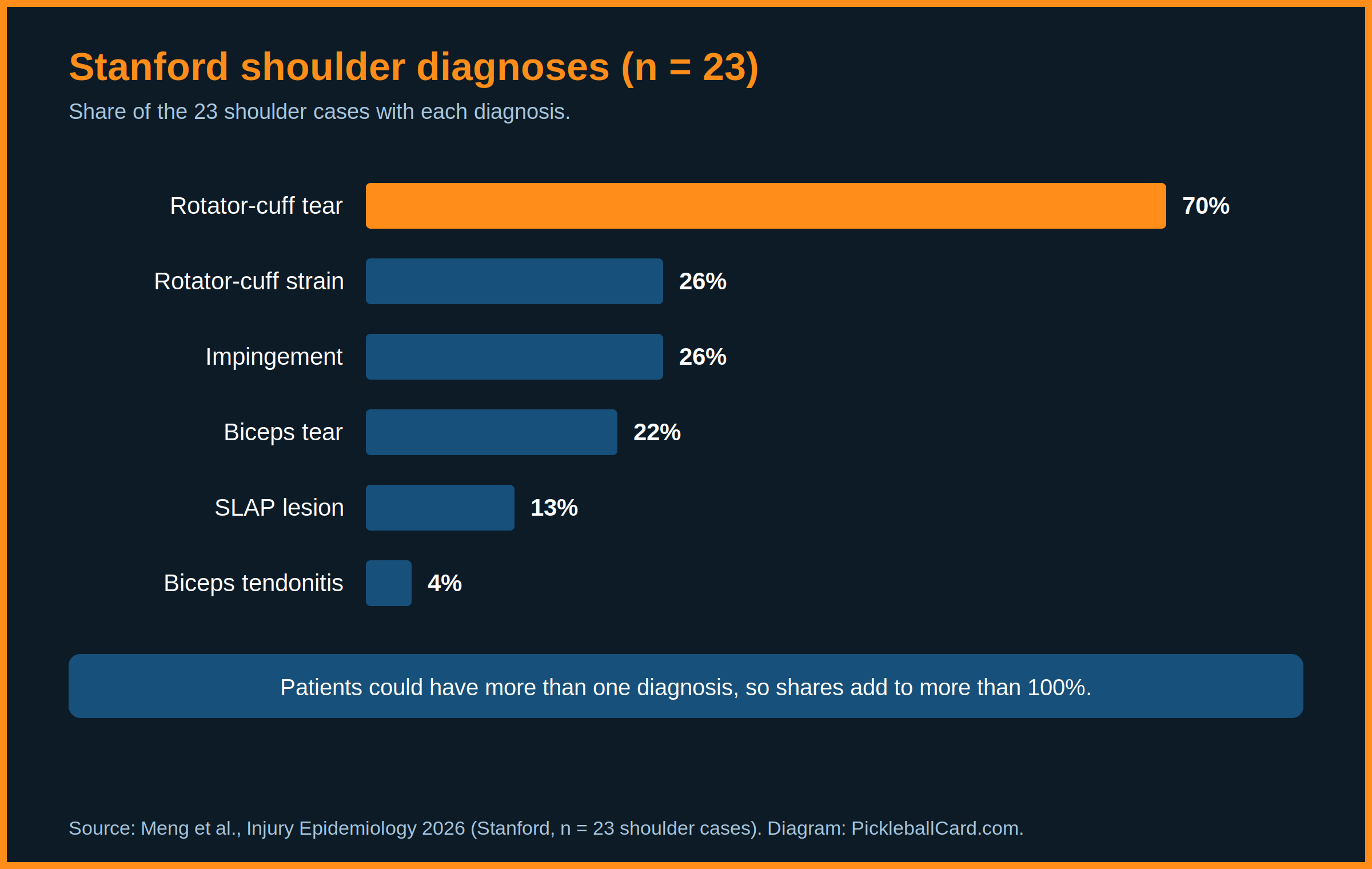
The Stanford breakdown is the most detailed picture of what goes wrong. Rotator-cuff tears were the most common diagnosis, at 70% of the 23 shoulder cases.
Rotator-cuff strain and impingement each appeared in 26%, biceps tears in 22%, SLAP lesions in 13% and biceps tendonitis in 4%. Those shares add to far more than 100% because patients could have more than one diagnosis.
| Diagnosis | Share |
|---|---|
| Rotator-cuff tear | 70% |
| Rotator-cuff strain | 26% |
| Impingement | 26% |
| Biceps tear | 22% |
| SLAP lesion | 13% |
| Biceps tendonitis | 4% |
Most did not go straight to surgery: 78% received conservative management, including physical therapy and injections (17%), while 35% received surgery, with some receiving both.
These are clinic patients at a single tertiary centre, so the surgery share runs higher than among all players. One figure needs care: the paper’s 87% paddle-side figure counts only cases where side was recorded — 13 of 15, side unknown in 9 of 23.
Why Pickleball Hurts Shoulders
Pickleball asks a lot of a joint built for mobility rather than strength: the rotator cuff must stabilise the shoulder through every serve, overhead and hard drive.
Princeton Sports and Family Medicine lists overhead reaching, trunk rotation and repeated gripping among the movements that put it at risk.
Three patterns show up in the research. First, frequency: in the JOSPT Open analysis, players who played three or more times a week had 64% higher odds of an upper-extremity injury than those who played twice a week or less (odds ratio 1.64).
The 2025 all-complaint analysis found 45% higher odds (odds ratio 1.45) for injuries overall — a different outcome, so do not mix the two up.
Second, experience: players with fewer than five years in the game had 50% higher odds of an injury or complaint (odds ratio 1.50). Third, age — and not as most people expect.
Players aged 33 to 47 had more than double the odds of an upper-extremity injury versus 18- to 32-year-olds (odds ratio 2.51), and those aged 48 to 62 had 2.29 times the odds. But players 63 and over had no higher odds than the youngest group.
Finally, attitude: players who rated injury prevention as low or moderate in importance had about double the odds of injury (odds ratio 2.02 in both analyses) — a cross-sectional finding, so it cannot prove cause and effect, but it is the most consistent predictor in the dataset.
Rotator Cuff, Impingement and the Rest
Rotator-cuff tear. The cuff is four small muscles and their tendons wrapping the top of the upper-arm bone. A tear means some tendon fibres have split, from one awkward overhead or from wear over time — the most common shoulder diagnosis at Stanford (70% of cases).
Only a clinician with imaging can say what kind a sore shoulder has.
Rotator-cuff strain and tendinopathy. A strain is an overstretched or irritated cuff muscle or tendon without a tear. Tendinopathy is the longer-term version: a tendon painful and less tolerant of load after weeks or months of overuse.
Typical ranges reported in player guides run 6 to 12 or more weeks — a guide’s typical range, not a promise.
Impingement. The cuff tendons or the bursa — the small cushion above them — get pinched under the bony roof of the shoulder when the arm is raised overhead. It appeared in 26% of Stanford’s shoulder cases, often alongside cuff problems.
Biceps and SLAP problems. The biceps tendon runs through the front of the shoulder, and a SLAP lesion is damage to the cartilage rim where it attaches. Biceps tears appeared in 22% of cases and SLAP lesions in 13%.
Symptoms overlap heavily, so a shoulder that does not settle deserves a clinician’s opinion, not a label from the internet.
How to Protect Your Shoulder
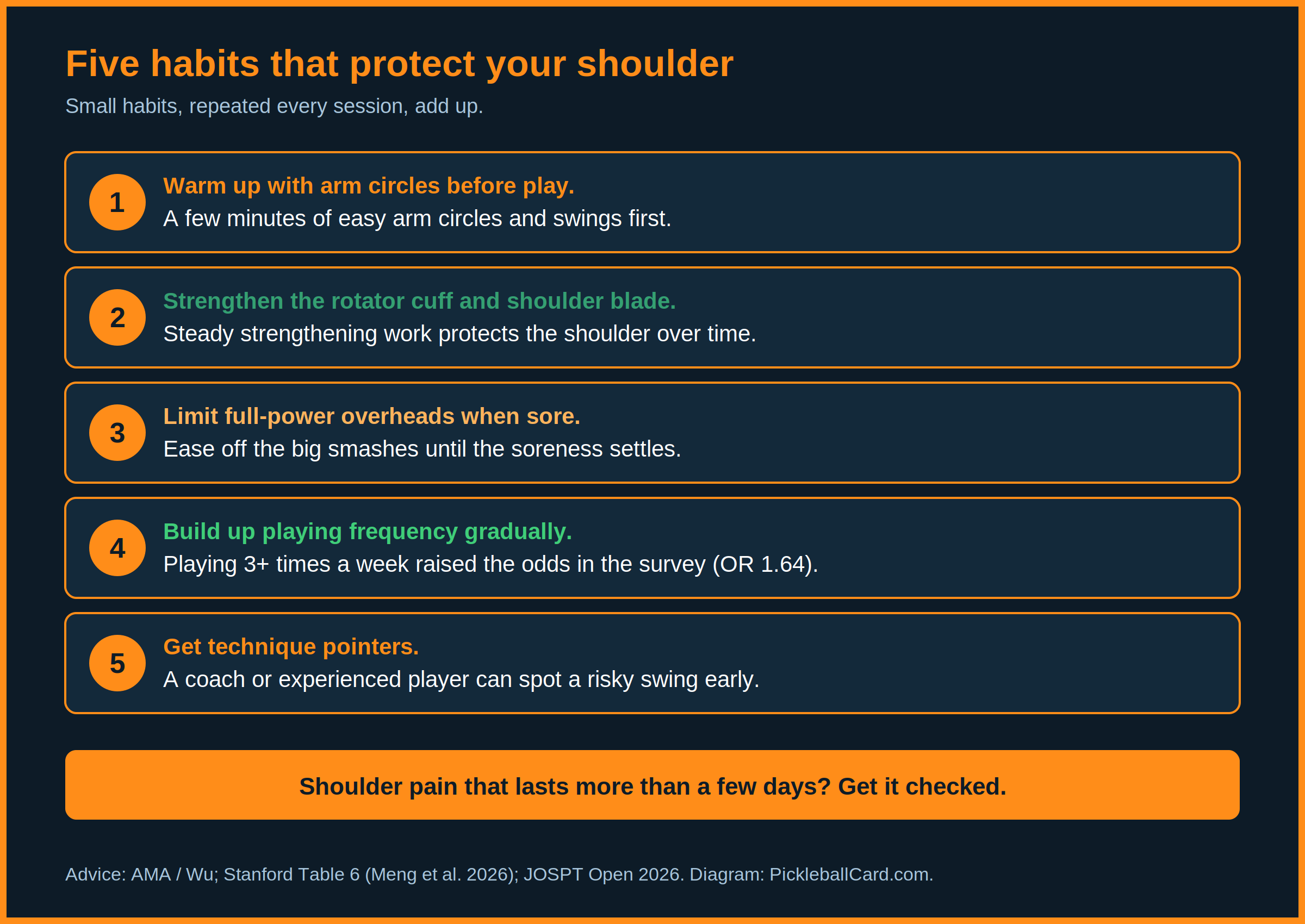
No pickleball-specific trial proves a particular shoulder routine prevents injury. What exists is good general evidence plus the Stanford authors’ prevention table — and both point the same way: get stronger, warm up, and build up gradually.
Strengthen the cuff and the shoulder blade. The Stanford authors’ prevention table recommends exactly that, plus fall prevention.
General sports evidence agrees: a 2014 BJSM meta-analysis of 25 randomised trials (26,610 participants) found strength training cut injuries to under a third (risk ratio 0.315) and multicomponent programmes by about a third (0.655). Stretching alone did not help.
Those are general-sport findings, not pickleball ones. Our pickleball strength training plan has a shoulders and rotator-cuff section — ask a clinician or physiotherapist to set the exercises and load.
Warm up every time. The AMA’s Dr. Christopher Wu recommends a dynamic warm-up — walking lunges, high knees and arm circles — enough to raise “a few drops of sweat on your forehead before your first match”, with static stretching saved for the cool-down.
Arm circles move the shoulder through its range before the first hard overhead. See our pickleball warm-ups and cool-downs guide.
Be careful with overheads. The Stanford table lists avoiding overheads as a shoulder-protection measure — not never hitting one, but not hammering them all session. If your shoulder is sore, let a lob bounce or play a controlled shot instead of a full-power smash.
Our overhead smash guide covers the technique, and our defending the lob guide covers what to do when the ball goes over your head.
Build up gradually. Strains often follow ramping up too quickly (AMA’s Dr. Wu). Returning after a break? Add sessions one at a time, not all at once.
Get your technique checked. Dr. Wu recommends lessons or pointers on technique. A relaxed grip, the paddle held correctly, and footwork that gets your body behind the ball instead of reaching all help — reaching loads the cuff at its weakest angles.
See our guide to how to hold a pickleball paddle and our footwork and agility drills.
Our pickleball tips for seniors cover positioning that reduces stretching and reaching.
If Your Shoulder Already Hurts
Most shoulder pain in pickleball is an overuse problem, and the first step is simple: back off the load that is irritating it. Play fewer sessions, hit fewer full-power overheads, and do not play through sharp pain.
Seek prompt medical care for new weakness, pain that wakes you at night, a shoulder that feels unstable or catches, numbness down the arm, or pain after a fall or a sudden pop.
If pain lasts more than a couple of weeks, keeps coming back, or stops you reaching into a cupboard, see a clinician or physiotherapist.
Shoulder and elbow pain often appear together, so our pickleball elbow prevention guide is worth a read, and our pickleball drills include low-impact options for lighter days.
A Note on This Article
This article is general information only — not medical advice, and it cannot diagnose or treat an injury. Figures come from the studies named in the text.
If you have shoulder pain or a previous shoulder injury, speak to a qualified health professional before starting a new exercise routine or returning to play.
Frequently Asked Questions
What is the most common pickleball shoulder injury?
A rotator-cuff problem. Baylor College of Medicine’s Dr. Bruce Moseley calls the rotator cuff the most common pickleball shoulder injury, and in the 2026 Stanford study rotator-cuff tears appeared in 70% of the 23 shoulder cases.
How common is shoulder pain in pickleball?
Very common. In a 2026 survey of 1,758 players, 22% reported a shoulder injury or pain in the past year — the highest of any upper-extremity region. Overall, 39% reported an upper-extremity injury of some kind.
Does a pickleball shoulder injury need surgery?
Often not. In the Stanford clinic series, 78% of shoulder patients received conservative management, including physical therapy, and 35% received surgery — some receiving both. Those are clinic patients, not all players.
Can I still hit overheads if my shoulder hurts?
Be cautious. The Stanford authors’ prevention table lists avoiding overheads as a shoulder-protection measure. If your shoulder is sore, let lobs bounce and play controlled shots until you have had advice from a clinician or physiotherapist.
How long does rotator-cuff tendinopathy take to recover?
Typical ranges reported in player guides run 6 to 12 or more weeks for rotator-cuff tendinopathy — a guide’s typical range, not a promise. A clinician who has examined your shoulder can give you a better sense of what to expect.
What warm-up helps protect the shoulder?
A dynamic warm-up that moves the shoulder through its range before the first hard shot. The AMA’s Dr. Christopher Wu suggests arm circles, walking lunges and high knees, enough to raise a light sweat before your first match.

Shoaib is the publisher of Pickleball Card. He oversees the site’s guides to pickleball rules, ratings, strategy and gear, all researched from primary sources — the USA Pickleball Rulebook, DUPR and manufacturer documentation — and updated as the game changes.