• Skip to primary navigation
  • Skip to main content
  • Skip to primary sidebar

Pickleballcard

All About Pickleball Gears

  • About Pickleball
    • How To Play Pickleball
    • Pickleball Rules
    • Pickleball Kitchen Rules
    • Serving Rules
    • Pickleball Ratings
    • Pickleball Tips
    • Pickleball History
  • Pickleball Shoes
    • Best Pickleball Shoes
    • Best Pickleball Shoes For Men
    • Best Pickleball Shoes For Women
  • Pickleball Paddles
    • Best Pickleball Paddles
    • Elongated Pickleball Paddles
    • Graphite Pickleball Paddles
    • Onix Pickleball Paddles
    • Pickleball Paddles for Women
    • Pickleball Paddles For Spin
  • Vs
    • Pickleball Vs Tennis
    • Paddle Tennis Vs Pickleball
    • Indoor Vs Outdoor Pickleball

Pickleball Safety And Eye Protection

October 30, 2026 by shoaib

Pickleball looks gentle from the sidelines. The court is small, the ball is light, and the rallies feel friendly.

That friendly look hides a real risk. At the kitchen line, players stand just fourteen feet apart, and a hard-driven ball can reach your face before you can react.

Eye injuries in pickleball are uncommon, but they can be serious. A scratched cornea heals, yet a torn retina can threaten your sight.

The good news is that most of these injuries are preventable. The right eyewear, a few court habits, and a sensible warm-up routine cover almost every common hazard.

This guide explains what to wear, what to watch for, and what to do if a ball or paddle ever strikes your eye.

Key Takeaways

  • Wear protective eyewear rated for racquet sports every time you play, even in casual games.
  • Ordinary glasses and sunglasses are not safety eyewear and can shatter on impact.
  • Look for shatter-resistant polycarbonate lenses and a snug, wrap-around frame.
  • Most eye impacts come from deflected balls and close-range kitchen exchanges, not serves.
  • Check the court surface, clear stray balls, and warm up before your first game.
  • After any eye impact, stop playing and get prompt professional advice, especially if vision changes.

Why Pickleball Puts Your Eyes At Risk

The kitchen line is where most eye danger lives. Four players crowd a small space, and fast exchanges leave almost no reaction time.

A pickleball serve can travel up to 40 miles per hour, according to research cited by the American Academy of Ophthalmology. Hands battles at the net can be faster still.

Speed alone is not the whole story. Deflections are the sneakier threat, because a ball glancing off a paddle can change direction without warning.

One ophthalmology resident who studies the sport put it plainly: injuries often happen when a ball bounces off your own paddle, or your partner’s, at an odd angle toward your face.

You cannot train your reflexes to cover that. No one reacts fast enough to a deflection from a few feet away, which is why a physical barrier matters more than quick hands.

Doubles adds another hazard: a partner’s paddle swing. In a fast exchange, a partner reaching across your body can bring a paddle edge close to your face.

The injuries reported by eye doctors range from mild to severe. Bruising and black eyes are common, and corneal abrasions are painful but usually heal.

More serious injuries include bleeding inside the eye, tears in the retina, and detached retinas. These are rarer, but they can require surgery and threaten vision.

Older players face extra risk. Reaction times slow with age, and pre-existing eye conditions can make an impact more dangerous.

Despite all this, many players still skip protection. A survey presented at the American Academy of Ophthalmology’s 2025 annual meeting found that only 20 percent of professional players wore protective eyewear.

Among amateur players in the same survey, 54.5 percent wore eye protection. Younger amateurs were the least likely group to wear it.

The most common reasons players gave were simple: they did not realise the risk, or they worried the eyewear would feel uncomfortable or hurt their game.

That gap between risk and habit is exactly what this guide aims to close. Protection is cheap, light, and easy to forget about once you are wearing it.

The American Academy of Ophthalmology’s survey of pickleball eye protection is a useful reminder that even experienced players underestimate the danger.

What Counts As Real Eye Protection

Not every pair of glasses protects your eyes. The distinction matters, because the wrong eyewear can fail exactly when you need it.

Real sports eye protection uses polycarbonate lenses. Polycarbonate is a strong, lightweight plastic that resists shattering on impact.

Ordinary prescription glasses usually use thinner, weaker materials. They can crack or break under a direct hit, turning the lens itself into a hazard.

Standard sunglasses have the same weakness. Dark lenses do nothing to stop a ball, and a broken fashion frame can cause cuts around the eye.

The survey mentioned above found that many players who believed they were protected were not. Of 67 players who endorsed protective eyewear, 41 were simply wearing their regular prescription glasses.

For racquet sports, look for eyewear that meets the ASTM F3164 standard. This is the safety standard developed for sports involving small, fast balls.

Check the product labelling before you buy. A genuine sports frame will state its standard clearly, and reputable sellers will list it in the specifications.

Fit matters as much as the lens material. A frame that slides down your nose or bounces during play will not be in place when a ball arrives.

Try this quick test in the shop: look down and shake your head firmly. If the frame shifts or lifts, the fit is wrong for sport.

Wrap-around frames offer the best coverage. They shield your eyes from angled shots and keep out glare from the sides.

Choose a lens tint that suits your playing conditions. Clear lenses work indoors, while amber or brown tints can improve contrast outdoors.

Avoid very dark lenses for evening or indoor play. If you cannot track the ball clearly, your reaction time suffers and your risk rises.

Finally, make eyewear part of your kit, not an afterthought. Put it on with your court shoes, before your first warm-up rally.

Prescription Options For Players Who Wear Glasses

Players who need vision correction have several good options, and none of them requires choosing between seeing clearly and staying safe.

Prescription sports glasses are the simplest choice. An optician fits polycarbonate prescription lenses into a sports frame rated for impact.

These frames grip better than everyday glasses. They use straps or curved temples that hold the frame steady during quick movement.

Some sports frames accept prescription inserts. A small prescription carrier clips behind a protective outer lens, giving you clear vision plus full impact protection.

Inserts cost less than a second full pair of glasses. They also let you swap outer lenses for different light conditions without changing your prescription.

Contact lens wearers can wear non-prescription protective goggles over their lenses. This combination gives sharp vision and a certified barrier in front of the eye.

Whichever route you choose, ask your optician about sports use specifically. Mention pickleball by name, and confirm the frame and lens combination meets a racquet-sport standard.

Never assume your everyday glasses qualify. If the frame was not designed for sport, it was not tested for a ball strike.

Body Shots And Kitchen-Line Risks

Most eye injuries do not come from serves. They come from the fast, close exchanges at the non-volley zone line.

At the kitchen line, the ball crosses the net in a fraction of a second. A speed-up aimed at your body can climb toward your face if it catches an edge.

Defensive blocks are another source of trouble. A hard shot blocked at close range can rebound at an unpredictable angle.

Your own paddle can betray you too. A ball striking the edge of your paddle may deflect upward, straight toward your eyes.

The safest response is boring but effective: keep your paddle up in front of your chest, and turn your face slightly away when a body shot arrives.

Ducking is a poor strategy at the net. A ball aimed at your body that you duck under can still clip your head, and you lose your balance in the process.

Instead, practise the defensive posture that keeps your paddle between you and the ball. A compact block, with the paddle face square, absorbs pace safely.

If you are learning that defensive game, our guide to the pickleball chicken wing shot explains the tucked-elbow block many players use against body shots.

Communication with your partner matters just as much. Call “mine” early, and agree who takes balls down the middle before the rally starts.

Most partner collisions happen when both players chase the same ball. A clear call prevents two paddles swinging into the same space.

Court manners help too. Aiming deliberately at an opponent’s head is poor sportsmanship, and most groups frown on it even in competitive play.

If you hit someone, apologise at once and check they are all right. Our guide to pickleball etiquette and the unwritten rules covers court courtesy in more depth.

Beginners deserve extra care. New players react late and often stand too close to the net, so experienced players should soften their shots in mixed games.

Finally, respect the pace of the game you are in. A friendly social rally is no place for full-power speed-ups aimed at someone’s face.

Falls And Court-Surface Hazards

Eye injuries are not the only safety issue on court. Falls are a leading cause of pickleball injuries overall, and a fall can injure your eyes as well as your wrists and hips.

Wet courts are the most obvious danger. Morning dew, light rain, and condensation on indoor surfaces all reduce grip without warning.

Check the surface before you play. Walk the court, look for damp patches, and wipe up standing water with a towel or squeegee.

Leaves, grit, and loose sand also cause slips. Outdoor courts near trees collect debris quickly, especially in autumn.

Stray balls are a tripping hazard that players constantly underestimate. A ball rolling underfoot during a rally can send you down hard.

Make it a habit: if a ball rolls onto your court, call “ball on court” loudly and stop the point at once.

Retrieve stray balls promptly, and never chase one across a neighbouring court while a rally is in progress there.

Footwear matters enormously. Court shoes with lateral support and non-marking soles grip during side-to-side movement far better than running shoes.

Running shoes are built for forward motion. Their high soles can catch during a lateral lunge, which is exactly how ankles roll.

Replace worn shoes before the tread goes smooth. A shoe that slides on a dusty indoor court is an accident waiting to happen.

Court surroundings deserve a glance too. Fences, benches, and net posts sit close to the playing area on many courts.

Leave a clear run-off zone behind the baseline where possible. Chasing a lob should not end with a collision against a fence.

Older players should pay special attention to balance and footing. Strength and balance training, even a few minutes a week, reduces fall risk noticeably.

For a fuller picture of what can go wrong, see our guide to common pickleball injuries and how to avoid them.

Warm Up Before You Play

Cold muscles tear more easily, and cold reactions are slower. A proper warm-up protects your body and sharpens your eyes for the first rally.

Start with five minutes of light movement. Walk briskly around the court, then jog gently or shuffle sideways along the baseline.

Add dynamic stretches next. Leg swings, arm circles, and gentle torso twists loosen the joints you will rely on during play.

Skip static stretching before games. Holding long stretches on cold muscles can temporarily weaken them, which is the opposite of what you want.

Move on to ball work. Begin with soft dinks at the kitchen line, then progress to volleys, groundstrokes, and finally a few serves.

This progression matters for eye safety too. Your tracking improves as your eyes adjust to the ball speed, so build up gradually rather than starting at full pace.

Include a few lateral shuffles and short sprints. Pickleball demands sudden stops and direction changes, and your ankles should be ready for them.

Hydration And Heat

Heat illness creeps up quietly, and a dizzy player is a danger to themselves and everyone on court. Hydration is a safety issue, not just a comfort issue.

Drink before you feel thirsty. Thirst lags behind actual fluid loss, so by the time you crave water you are already dehydrated.

Keep a water bottle at the side of the court and sip between games. Small, regular drinks beat a large gulp once an hour.

On hot or humid days, add electrolytes. Sweat carries away salts as well as water, and plain water alone may not replace them.

Watch for early warning signs in yourself and your partners. Headache, nausea, unusual fatigue, and confusion all signal trouble.

If someone looks unsteady or confused, stop play and move them into the shade. Cool them down and seek medical help if symptoms do not improve quickly.

Hazard And Prevention At A Glance

Hazard What Can Happen Prevention
Fast ball at the kitchen line Direct eye impact Wear ASTM-rated polycarbonate eyewear every game
Deflected ball off a paddle Unpredictable eye strike Wrap-around frames; keep paddle up in defence
Partner paddle swing Facial and eye contact Call shots early; agree middle-ball coverage
Wet or debris-covered court Slip, fall, head impact Inspect and dry the surface before play
Stray ball underfoot Trip and fall Call “ball on court” and stop the point
Wrong footwear Ankle roll or fall Wear court shoes with lateral support
Glare and poor lighting Missed ball, mistimed swing Choose suitable lens tint; avoid dark lenses indoors
Heat and dehydration Dizziness, collapse Drink regularly; rest in shade; avoid midday summer play
No warm-up Muscle strain, slow reactions Five minutes of movement plus progressive ball work

Your Court Safety Checklist

Run through this list before your first serve. It takes less than a minute, and it covers the hazards most players forget.
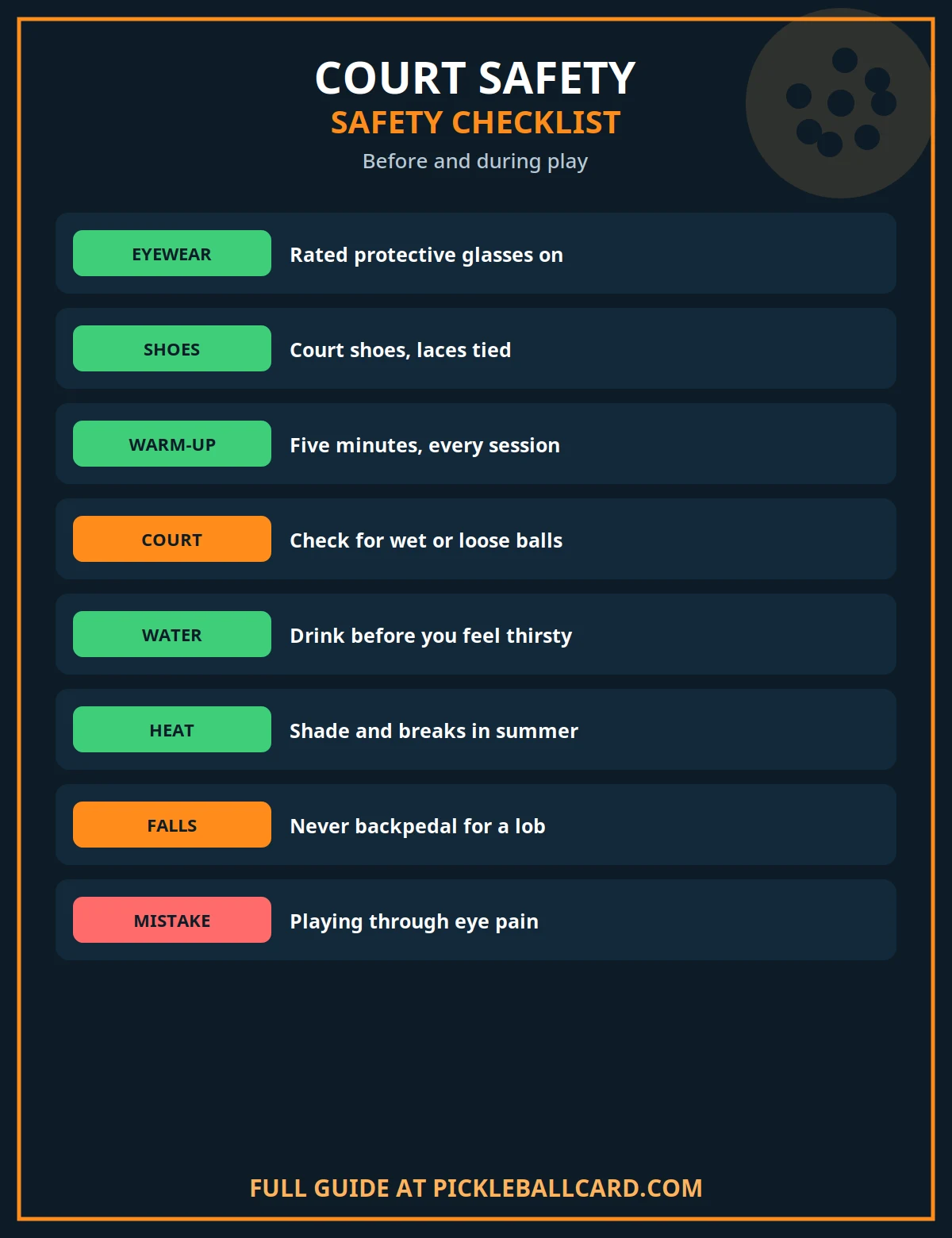
Eye protection checklist: rated eyewear, court habits, and what to do after an impact.
  • Protective eyewear on, fitted snugly, lenses clean and unscratched.
  • Court shoes laced, with good tread and lateral support.
  • Court surface checked for water, leaves, grit, and cracks.
  • Stray balls cleared from the court and surrounding area.
  • Water bottle filled and placed at the side of the court.
  • Warm-up completed: movement, dynamic stretches, progressive rallies.
  • Partner communication agreed: who takes middle balls, and clear calls.
  • First aid kit and phone accessible, with the court address known.
  • Weather checked: heat plan, shade breaks, and lightning rule agreed.
  • Any eye impact or dizzy spell means stop playing and get checked.

What To Do After An Eye Impact

Even with protection, impacts happen. What you do in the next few minutes can make a real difference to the outcome.

Stop playing immediately. Do not try to finish the game or “see how it feels” through another rally.

Do not rub the eye. Rubbing can worsen a scratched cornea and push debris deeper into the eye.

If you wear contact lenses, leave them in place unless a professional advises otherwise. Removing a lens can disturb an injured surface.

Cover the eye lightly with a rigid shield if one is available. A paper cup taped gently over the eye works as an improvised shield.

Apply a cold compress around, not directly on, the eye to reduce swelling. A bag of frozen peas wrapped in a towel does the job.

Seek professional advice promptly for any impact that causes pain, redness, or vision changes. Eye injuries can worsen quietly over hours.

Certain symptoms need urgent care. These include vision loss, double vision, flashes of light, new floaters, or a dark shadow across your vision.

Bleeding inside the eye, severe pain, a visibly misshapen eyeball, or an object stuck in the eye are emergencies. Call emergency services at once.

Even a mild impact deserves a check if symptoms linger beyond a day. Corneal scratches usually improve quickly, so worsening pain is a warning sign.

The CDC tracks eye injury prevention through its Vision and Eye Health Surveillance System, which monitors protective eyewear use in sports and other risky activities.

Frequently Asked Questions

Do I Really Need Eye Protection For Casual Pickleball?

Yes. Most injuries happen in ordinary social games, not tournaments, because casual players rarely wear protection and often stand close at the net.

Deflections are unpredictable at every level. A friendly rally can produce a ball strike just as easily as a competitive match.

Are Regular Prescription Glasses Good Enough?

No. Regular glasses are not tested for ball impacts, and their lenses can crack or shatter under a direct hit.

Prescription sports glasses with polycarbonate lenses give you both clear vision and genuine impact protection.

What Standard Should Pickleball Eyewear Meet?

Look for the ASTM F3164 standard for racquet sports, with shatter-resistant polycarbonate lenses and a secure, wrap-around fit.

Check the labelling carefully. If a product does not state its safety standard, treat that as a reason not to buy it.

Can I Wear Sunglasses Instead Of Safety Glasses?

Ordinary sunglasses are not a substitute. They lack impact certification, and their frames can break and injure the eye area.

If you need sun protection, choose sports eyewear with a tinted polycarbonate lens that also meets the safety standard.

What Should I Do If A Ball Hits My Eye?

Stop playing, avoid rubbing the eye, and cover it lightly with a rigid shield if one is available.

Seek professional advice promptly, and get urgent care for vision changes, severe pain, flashes, floaters, or bleeding inside the eye.

Is Eye Protection Required In Official Pickleball?

USA Pickleball does not currently mandate protective eyewear in its rulebook, so wearing it remains a personal choice in most play.

Eye doctors strongly recommend it anyway, and the absence of a rule should not be read as evidence that the risk is small.

Important Note: General Information Only

This article provides general information about pickleball safety and eye protection. It is not medical advice, and it does not replace professional guidance.

If you suffer an eye injury, have ongoing eye pain, notice vision changes, or have concerns about your eyes, see a qualified eye care professional promptly.

For serious symptoms such as vision loss, severe pain, or bleeding in the eye, seek emergency medical care immediately.

shoaib
shoaib

Shoaib is the publisher of Pickleball Card. He oversees the site’s guides to pickleball rules, ratings, strategy and gear, all researched from primary sources — the USA Pickleball Rulebook, DUPR and manufacturer documentation — and updated as the game changes.
pickleballcard.com

Filed Under: Health & Injuries

Pickleball Elbow: How to Prevent It (and What to Do If It Already Hurts)

October 15, 2026 by shoaib

Pickleball elbow is lateral epicondylitis — the same overuse tendon problem as tennis elbow. The forearm extensor tendons that attach at the bony bump on the outside of your elbow break down under repeated gripping and wrist extension, especially on backhands. The good news is that it is mostly preventable: build playing time gradually, warm up properly, use a grip size that does not force you to squeeze, loosen your grip pressure, use your shoulder and core instead of flicking with your wrist, and strengthen the whole arm chain. This guide explains what it is, why pickleball players get it, and exactly how to lower your risk — without selling you a paddle as a cure.

Disclaimer: This article is educational information only and is not medical advice. It does not diagnose any condition. If you have persistent elbow pain, weakness, or pain that does not settle with rest, see a qualified health care professional or physical therapist for an individual assessment.

Key Takeaways

  • Pickleball elbow is an overuse problem, not a single bad shot. Repeated gripping and wrist extension overload the tendon at the outside of the elbow.
  • The biggest risk is a sudden load spike — going from no play to long sessions, several days in a row, without building up.
  • Grip size and grip pressure matter. A handle that is too small forces you to squeeze harder on every shot.
  • Technique protects the tendon. A two-handed backhand shares the load, and using your shoulder and core reduces wrist flick.
  • Warm up, strengthen, and recover. A short warm-up, whole-chain strengthening, post-play stretching and icing are the habits Harvard Health and Mayo Clinic guidance point to most consistently.
  • Rest is part of prevention. If self-care — rest, ice and modifying the activity that hurts — does not ease pain and tenderness, see a health care provider.

What Pickleball Elbow Actually Is

When players say “pickleball elbow,” they usually mean pain on the outside of the elbow, around the bony prominence called the lateral epicondyle. The forearm muscles that straighten and raise your hand and wrist — the extensors — attach there through a common tendon. Every time you grip a paddle, stabilise your wrist at contact, or hit a one-handed backhand, those muscles pull through that attachment.

Repeated tensing of those muscles, without enough recovery or strength to handle the load, can degrade the tendon fibres over time. Pain may spread into the forearm and wrist, and grip weakness is a hallmark players describe: shaking hands, turning a doorknob, or holding a cup becomes uncomfortable. That description is a reason to get checked, not a diagnosis you should make yourself — other elbow problems can feel similar, and only an in-person assessment can tell them apart.

Outer Elbow vs Inner Elbow

Pickleball elbow / tennis elbow affects the outside of the elbow. Pain on the inside of the elbow involves a different tendon group (the flexors, sometimes called golfer’s elbow). The distinction matters because the exercises and load advice differ. If you are unsure which you have, do not guess from an article — get it assessed.

Symptoms Players Describe

  • Aching or burning pain around the outside bony bump of the elbow, sometimes spreading down the forearm
  • Pain that is worse when gripping, shaking hands, lifting with the palm down, or hitting backhands
  • Weak or painful grip — the paddle feels harder to control late in a session
  • Tenderness when you press on the outside of the elbow
  • Stiffness first thing in the morning or at the start of a session that eases, then returns afterwards

None of these on their own proves lateral epicondylitis. They are signals to reduce load and, if they persist, to seek care — especially if you have numbness, swelling, a recent fall or impact, fever, or pain that wakes you at night. Those features need prompt, individual medical attention.

Why It Happens: Four Loads That Add Up

1. A Sudden Spike in Playing Time

The classic pattern described by sports-medicine specialists is a player who goes from no play — or occasional play — to long sessions too fast, without physical preparation. Tendons adapt more slowly than enthusiasm. A three-hour debut, followed by three more days that week because the sport is fun, is exactly the spike that overloads an unprepared forearm.

2. Over-Gripping

If your grip is too small, or you simply hold the paddle in a death grip, your extensors work hard on every single shot — including the soft shots that should be relaxed. Over a two-hour session that is hundreds of unnecessary hard contractions. Grip pressure should rise for a drive and fall for a dink; many players keep it high for everything.

3. Wrist-Flick Technique

Hitting backhands mainly by flicking the wrist, leading with the elbow, or muscling the ball from the forearm alone concentrates force through the extensor tendon. Better mechanics move the work up the chain: turn your shoulders, step into the shot, and let the larger muscles of the shoulder, trunk and legs do more of it. A one-handed backhand hit late, behind your body, is a particularly common overload pattern — which is why a two-handed backhand is so often suggested as a load-sharing alternative.

4. Equipment Setups That Fight Your Arm

A head-heavy paddle, or a setup with high swing weight, is the configuration most likely to make your forearm work harder on every swing, because swing weight — not just the number on the scale — is what your forearm fights as the paddle moves. Vibration and repeated off-centre hits do not help either. Equipment is one factor among several, never the whole story — see the honest paddle-weight discussion below.

Prevention: The Habits That Matter Most

Ramp Up Gradually

Build court time over weeks, not days. Start with shorter sessions, leave at least a day between early sessions, and increase total weekly time modestly when the previous week felt comfortable during play and the next morning. If your elbow is talking to you the day after, that is information: hold or step back before you add more.

Warm Up Before You Play — Every Time

Warm up for about five minutes before play: walk or march in place to raise your temperature, circle your arms and shoulders, and move your wrists and elbows gently through their range. Then hit progressively — start with cooperative dinks and easy volleys before you drive hard. Our guide to effective stretches and warm-up exercises for pickleball walks through a full routine you can copy.

Get Your Grip Size Right — Then Loosen Your Grip

A handle so narrow that you must squeeze hard to control it overloads the extensors. The standard check is to measure from the middle crease of your palm to the tip of your ring finger — most adults land around 4 to 4.5 inches, matching typical paddle grip circumferences — and to cross-check with the finger-gap test in store. If you are between sizes, sizing down and building up slightly with an overgrip is the usual approach; an overgrip adds roughly 1/16 inch. Do not rebuild the whole decision here: our dedicated guide to how to measure your pickleball paddle grip size covers the measurement, the tests, and what to do if you are between sizes.

Size is only half of it. Consciously practise grip pressure: loose between shots, firm only at contact, loose again on soft shots. Between rallies, open and close your hand a few times to reset a creeping death grip.

Share the Load: Technique Changes That Help

  • Try a two-handed backhand. It shares the load across both arms instead of one forearm, and it is specifically recommended in Harvard Health’s pickleball injury guidance for players prone to elbow pain.
  • Use your shoulder and core. Turn, step, and rotate instead of flicking from the wrist and forearm.
  • Meet the ball in front. A contact point in front of your body, with a stable wrist, is kinder than a late, reaching backhand.
  • Take a lesson if pain is technique-linked. A short coaching session to fix a wrist-flick backhand can do more than any brace.

Strengthen the Whole Chain

Stronger bigger muscles unload the forearm. Harvard Health’s advice is to strengthen the whole chain — shoulder, arm, core, hips and legs — ideally with input from a trainer or physical therapist, rather than only squeezing a ball with the sore arm. For the forearm itself, gradual stretching and strengthening is the physical-therapy staple, and eccentric work — raising the wrist with help, then lowering it very slowly under control — is singled out in Mayo Clinic guidance as particularly helpful for tennis elbow. Do strengthening progressively and pain-guided; if an exercise sharply increases pain, stop and get individual advice.

Stretch and Ice After Play

Stretch shoulders, arms and wrists after play while you are warm. Icing the elbow after a session — even when it does not hurt yet — is a habit Harvard Health suggests for players who are building load, as a way to calm the tissue after work. Combine it with the simplest recovery rule of all: do not play hard on consecutive days while you are building up or while symptoms are settling.

The Paddle-Weight Question, Answered Honestly

Players will tell you two opposite things, and both camps sound certain. One argues a slightly heavier paddle helps because more mass gives more plow-through, so the paddle does more work and transmits less shock. The other argues lower swing weight is what reduces elbow strain, because swing weight is what your forearm fights on every swing.

The honest position is that the sources conflict, and this article will not pretend otherwise. What can be said safely is this: balance and swing weight matter more than the headline weight alone, and a head-heavy paddle is the risky configuration. If you have symptoms, demo before you buy, pay attention to how your elbow feels during play and the next morning, and stop if pain rises. Do not treat any paddle — at any weight — as a medical treatment, and do not buy your way out of a load or technique problem. For the specifications side of the decision, see our guide to how to choose the right pickleball paddle weight, including how static weight and swing weight differ.

Pickleball Elbow Prevention Checklist

Habit What to do Why it helps
Ramp up Short first sessions; build weekly court time gradually; rest days between early sessions Tendons adapt slowly; spikes are the classic trigger
Warm up About 5 minutes: walk/march, arm circles, gentle wrist and elbow movement, then progressive hitting Warm tissue tolerates load better than cold tissue
Grip size Measure palm crease to ring-finger tip (most adults ~4–4.5 in); finger-gap cross-check Too small = you squeeze harder on every shot
Grip pressure Loose between shots and on soft shots; firm only at contact Cuts hundreds of unnecessary hard contractions per session
Backhand Try two-handed; meet the ball in front; turn shoulders instead of flicking the wrist Shares load across both arms and larger muscles
Strengthen Whole chain — shoulder, arm, core, hips, legs — plus gradual forearm work, PT-guided if sore Stronger big muscles unload the forearm tendon
After play Stretch shoulders, arms and wrists; ice the elbow after sessions while building load Supports recovery before the next session
Equipment Avoid head-heavy / very high swing weight if prone; demo and judge by next-morning feel Balance and swing weight drive forearm effort
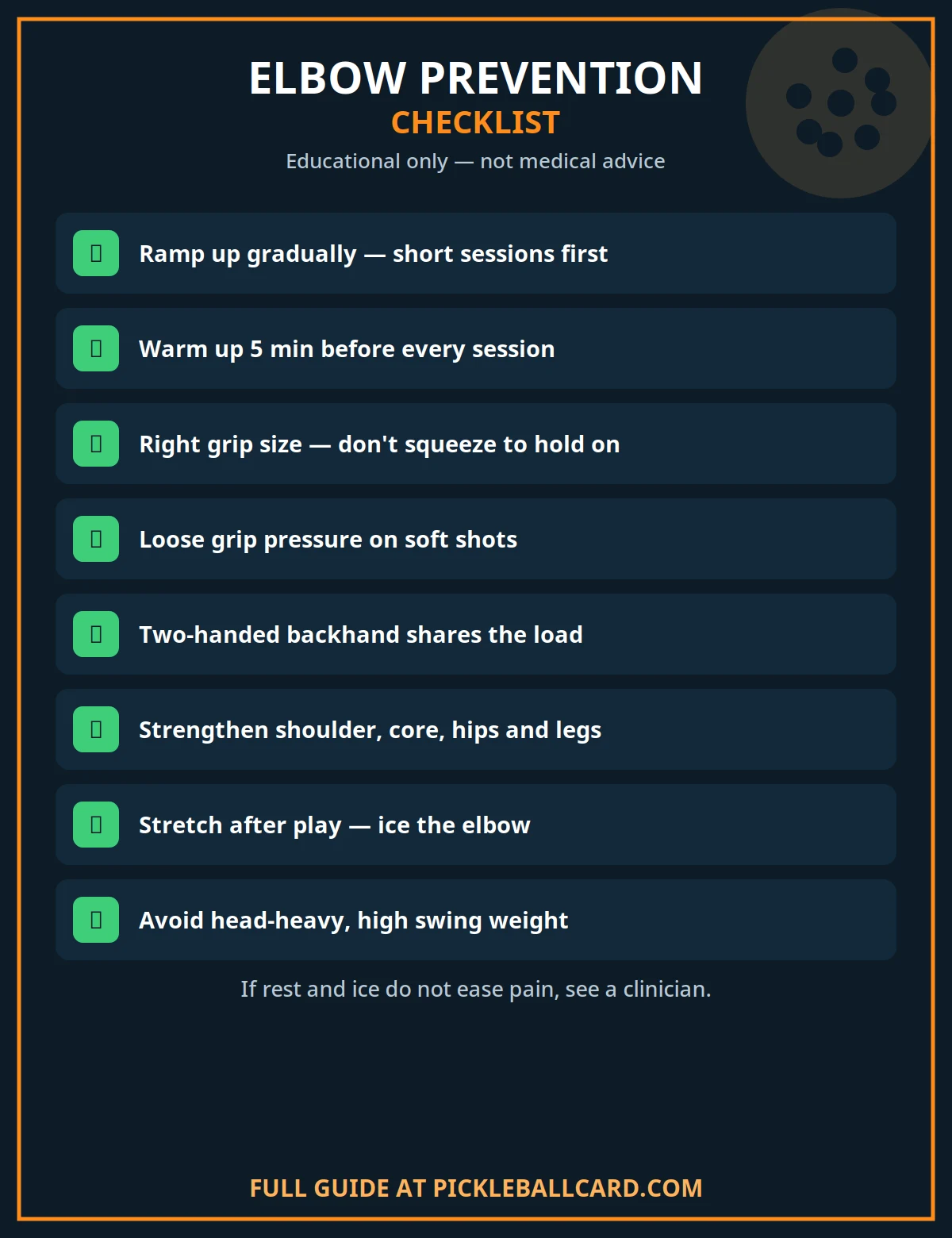
Checklist of pickleball elbow prevention habits: ramp up gradually, warm up, grip size, grip pressure, two-handed backhand, strengthening, stretching and icing
Pickleball elbow prevention checklist — the habits that protect your elbow, at a glance.

If It Already Hurts: Sensible First Steps

Mayo Clinic’s first steps for tennis elbow are straightforward: rest or modify the aggravating activity, use ice, and consider over-the-counter pain relief as directed on the label or by your clinician. “Modify” is the key word for most pickleball players — you may not need to stop entirely, but you do need to stop doing the exact load that keeps provoking it, at the same volume, while expecting a different result.

  • Cut the load first: shorter sessions, fewer days per week, no hard backhand drilling while it settles.
  • Ice after play and after any activity that provokes the ache.
  • Start gradual stretching and strengthening — ideally taught by a physical therapist, who can grade eccentric wrist work to your stage and check your technique and equipment at the same time.
  • A forearm strap or brace is an option some players use to reduce stress on the tendon during activity. Treat it as a support while you fix load and strength, not as a fix on its own.
  • Return gradually: when daily activities are comfortable and a short, easy session leaves no next-day flare, build time and intensity back in steps — the same ramp-up rules as prevention, just starting lower.

Do not play through steadily worsening pain to “test” it every day. Repeated provocation without recovery is how a manageable overload becomes a long layoff.

When to See a Doctor

Talk to a health care provider if self-care — rest, ice and pain relievers used as directed — does not ease the pain and tenderness. Seek care sooner if grip weakness is progressing, pain is interfering with work or sleep, you have numbness or tingling, there was a specific injury, or the elbow is swollen, red or hot.

A doctor may discuss a range of next steps depending on your examination, which can include physical therapy progression, injections, other procedures, and — only after many months (often 6 to 12 months) of failed conservative care — surgery. Those are decisions for you and your clinician, based on your elbow, not recommendations from this article. The article’s job is narrower: help you prevent the problem, recognise when home care is not enough, and arrive at that appointment able to describe your playing load, your technique and what you have already tried.

Frequently Asked Questions

Is pickleball elbow the same as tennis elbow?

Yes, in the usual case. Both names refer to lateral epicondylitis — overload of the forearm extensor tendon at the outside of the elbow. The sport that provoked it differs; the tissue and the load principles are the same, which is why tennis elbow guidance from medical authorities applies to pickleball players.

Can I play pickleball with elbow pain?

That depends on severity, and it is a question for your clinician if pain persists. As a general principle, modify rather than push through: reduce session length and frequency, avoid the shots that provoke it most, and stop if pain is worsening session to session or lingering longer each time. Pain that does not settle with rest and ice needs an in-person assessment.

Does a heavier paddle help pickleball elbow?

There is no settled single answer, and anyone who gives you one ideal weight as a medical fact is overselling. Balance and swing weight matter more than headline weight; a head-heavy paddle is the risky setup. Demo any change, judge it by how your elbow feels during play and the next morning, and fix load, grip and technique first — equipment is an adjustment, not a treatment.

Does a forearm strap or elbow brace work?

A strap can reduce stress on the tendon during activity and some players find it helpful as part of a broader plan. It does not replace load management, strengthening, or technique work, and it is not a proven cure on its own. If you rely on it for months without improvement, that is a sign to get assessed.

How long does pickleball elbow take to settle?

It varies widely with how long it has been building, how completely you modify the load, and your individual assessment — which is why this article gives no timeline or cure rate. Tendon problems are generally slow: expect gradual improvement over weeks to months with consistent load management and strengthening, not days, and seek care if you are not progressing.

What is the single best exercise for pickleball elbow?

There is no single best exercise for every elbow. Eccentric wrist work — lowering the wrist very slowly after raising it — is the exercise most often singled out in medical guidance, but the right starting point, load and progression depend on your stage. A physical therapist can teach it correctly in one session; guessing the dose from the internet is how players flare themselves up.

The Bottom Line

Pickleball elbow is rarely bad luck. It is usually a load story: too much gripping, wrist flick and court time, added too fast, on a tendon that was never prepared for it. Reverse that story and you prevent most cases — ramp up gradually, warm up for five minutes, size your grip so you do not have to squeeze, share the backhand load across two hands and bigger muscles, strengthen the whole chain, and ice and stretch afterwards. If it already hurts, cut the load, use the self-care steps above, and see a health care provider if rest, ice and pain relief do not ease it. Play the long game: a few sensible weeks now are what keep you on court for years.

Sources: Harvard Health Publishing, How to avoid this common pickleball injury; Mayo Clinic, tennis elbow (lateral epicondylitis) guidance on causes, self-care, therapy and when to seek care. This article is educational only and is not medical advice.

shoaib
shoaib

Shoaib is the publisher of Pickleball Card. He oversees the site’s guides to pickleball rules, ratings, strategy and gear, all researched from primary sources — the USA Pickleball Rulebook, DUPR and manufacturer documentation — and updated as the game changes.

pickleballcard.com

Filed Under: Health & Injuries

Top 10 Pickleball Health Benefits

October 3, 2026 by Jeena Noven

Explore the 10 physical and mental health benefits of playing pickleball, plus see in which conditions you should avoid playing pickleball.

Do you know how a slim paddle and a plastic ball hold the key to having a happier and healthier life? The majority of people say pickleball is a simple game that does not require effort, but it can make your mind sharp, ease your joint pain, and relieve your stress. You might have heard sports enthusiasts chanting the single sentence, “Pickleball changed my life.”

Health Benefits Of Pickleball

I have always believed that these people are bluffing, but when I started playing pickleball, it left a significant impression on my life. Today, I advise people to play pickleball at least once a week to stay happy and healthy for a long time. Pickleball is not only beneficial for a person’s health but also improves his social life; let’s explore the benefits of pickleball in terms of health and social life.

Pickleball Health Benefits

If you feel sluggish throughout the entire day and have nothing to do on vacation, then I have an idea for you: you can play pickleball with your friends. In case you claim that no friend is ready to play pickleball, you can go to the pickleball club, join pickleball societies, or participate in domestic-level pickleball matches. I am not forcing you to promote the game but to give you a healthy and happy life.

Before you dig into the details of pickleball’s benefits, I should inform you that research concluded that playing a sport can increase the lifespan of a person. It not only makes you a social personality but also keeps you healthy and helps relax your mind. If you are worried about your boss’s reprimands, spouse’s criticism, or doctor’s warning, then hold a paddle and come with me to the pickleball court.

Physical Health Benefits

1. Improves Hand & Eye Coordination

In pickleball, the most important part is to track the movement of the ball. When a person starts playing pickleball, his ability to spot something moving improves. Focusing on the ball consistently and judging the movements, speeds, and trajectories train our eyes to view things efficiently.

When the ability to see fast-coming things is enhanced, it directly improves the ability to react. Once we anticipate the movement of the ball and its speed, our nervous system sends signals to the hand to move quicker than usual, and we hit the ball. It not only improves the ability to anticipate the movements of coming objects and react but also strengthens the motor skills of our body.

2. Reduce Heart Disease Risk

Pickleball is a moderate, social form of exercise that can support cardiovascular fitness as part of an active lifestyle, and anyone with a heart condition should check with their doctor before starting. When we play pickleball, it elevates the heart rate for a moment. The sustained heart rate strengthens the heart muscle and pumps blood in a way that our body’s internal system works efficiently.

Here, you may critique that a pickleball player does not need to move much, nor does the game require tremendous effort, so how do the heart muscles improve functioning? Pickleball is a low-impact exercise in which a person does not need to put an extraordinary burden upon his body, and the slight movements are sufficient for our body to regulate the blood flow in the body.

Regular play improves blood flow and overall fitness, which supports heart health over time. It also decreases the bad cholesterol LDL in the body, which is the major cause of heart diseases, and improves the good cholesterol HDL.

3. Low Impact On Joints

It is one of the few versatile games that everyone from a young boy to an adult or an old lady can play due to its low-impact nature. Other games, such as volleyball, tennis, or badminton, require quicker movements, and they are slightly high-impact games, but pickleball is simple to play and slow compared to tennis or squash.

Therefore, experts label pickleball as a low-impact game that does not cause joint pain, nor can it evoke pain in the body. If you analyze, the pickleball paddle weighs 7 to 8 oz, while the ball’s average weight is about 0.78 oz. A player does not need to exert extra effort in the game; it does not require enormous energy to block the ball, but if you see other sports like tennis or squash, a player must be strong enough to hit the ball with tremendous force.

Additionally, the pickleball court is small, so one does not need to run for a long time, such as in football or basketball, and slower ball speed helps an individual spot the ball effortlessly. By all means, pickleball is a low-impact game that does not cause joint pain; instead, it improves the joints due to its less-impact nature.

4. Improves Balance

Aged people frequently complain that their ability to maintain balance during a walk is lost over time, so what should they do? It is a part of aging in which our body parts start decaying, and most importantly, the brain area that deals with the balance of the body degenerates. That’s why we lose the ability to maintain balance during walking; however, it is not an eternal problem, as we can improve our sense of balance by participating in activities like playing pickleball.

Pickleball is not only a less-impact game but also a wholesome exercise that improves our brains’ motor area functionality. Maybe you have seen paralyzed people who cannot walk because the left or right part of the body does not work. That is because the one-sided hemisphere of the brain does not function. But experts advise them to exercise as much as they can, which helps them improve their movements.

In this way, their working hemisphere and the internal pathway that connects both hemispheres strengthen, and they learn to maintain balance even when their brain’s motor area is not working efficiently. The same happens when you play pickleball; in this game, you stay focused and put an effort to hit the ball with a balanced body that directly impacts the brain regions of maintaining balance, and we relearn to stand straight, walk in a line, and independently move in all directions.

Not only this, but research has claimed that in young people who engage in games like pickleball, their motor areas decay at a very slow pace, which does not impact their ability to maintain balance. The more you play, the better you age and the more powerful your muscles can be. Playing pickleball improves agility, reaction time, and overall stability and reduces the risks of old-age motor degeneration.

5. Increased Activity

There is a list of the physical health benefits of playing pickleball, such as it improves the lungs, lowers blood pressure, burns fats, and strengthens the overall body muscles. In my opinion, we should not only consider the health benefits of pickleball, but we should also concentrate on the fact that it is a fun activity, and our bodies are not made for work but for fun.

Having fun out with new people, old friends, or family members can positively impact the body. Bundles of research have proved that having fun activities once a week at least slows down the aging process, improves the quality of life, enhances happiness, and encourages us to learn new activities.

Additionally, having physical activity can reduce the risk of obesity, diabetes, and plaque in the blood veins. When we work out or play games like pickleball, our body burns fat and uses glucose, whereas excessive amounts of glucose can cause diabetes, obesity, and plaque in the blood veins. Moreover, less-impact games like pickleball can lower insulin and insulin sensitivity, which reduces the chances of inflammation and improves cellular functioning.

Mental Health Benefits Of Pickleball

1. Reduces Stress

Scientists and experts claim that stress is the major cause of all kinds of diseases, whether it is diabetes, heart issues, or brain tumors. Our body releases excessive amounts of hormones during stress, and they negatively impact our stomach, heart, and brain. Whether you suffer from chronic stress or have acute stress problems, the chances of getting diabetes, heart issues, depression, and insomnia are high.

But it is a mere side of the picture as you can prevent these diseases by not taking stress. Here, you may add that there is no way to prevent stress because it has become part of our life. Experts say that instead of thinking about not taking stress, one should engage in fun activities, such as playing a less impactful game like pickleball, that can help them manage stress.

Whether you are suffering from a spouse conflict or having a bad week at work, playing pickleball will refresh your mind and reduce stress. Playing a game like a pickleball helps us to focus on other things, and for a moment, we stop thinking about our life issues. Additionally, it releases multiple hormones in the brain that enhance our happiness, such as dopamine and serotonin.

2. Keep Your Mind Sharp

Daily life issues badly impact our mental health and can disturb our cognitive abilities. For example, research claims high levels of stress can weaken the memory and executive functioning of the brain. But it is not the end, as experts claim, that playing a less impactful game like pickleball can help you improve your cognitive abilities.

Additionally, it also improves memory and helps us control impulsive behaviors. All this might seem imaginary but experiments have proven that people who engage in sports like pickleball have better cognitive and memory abilities compared to people who prefer activities other than sports. When it comes to pickleball, it directly impacts our ability to make decisions, an important component of executive functioning, and sharpens our minds.

3. Build A Social Circle

As I mentioned at the beginning of mental health benefits, stress is the leading cause of chronic and deadly diseases, and it is claimed that pickleball can reduce stress by having physical activity and focusing on other things rather than daily life issues. You should also add that a social circle is one of the leading solutions to reducing stress; having the social support of friends, spouses, or strangers can reduce stress in an individual during a calamity.

Scientists say that humans are made to socialize, build connections, and organize meetings. These meetings can be serious, but if they are related to fun, they will reduce stress and help us think outside the box. Pickleball helps us build a connection with other people, improves our ability to interact with strangers, and contributes to enlarging our social support circle.

It is observed that people who engage in social activities such as playing a game like pickleball are more prone to have positive communication, persuading their customers effortlessly, and efficiently interacting with people in case of a social calamity. Additionally, it enhances our ability to cooperate with other people, patiently deal with social issues, and lead teams.

4. Lower Depression

Depression is one of the biggest mental health issues our community is facing right now, and it has become one of the most deadly mental health disorders. The major symptom of depression is losing interest in any kind of activity, whether it is about fun or the office. However, fighting depression is nearly impossible without having a social activity, such as playing games like pickleball.

Pickleball helps us socialize with people and forces us to stop thinking about personal issues and concentrate on the game. People think that pickleball is a physical activity, but it is also about the mind, anticipating the ball, calculating the speed of the ball, creating a strategy, and quick reaction; all these improve mental activity. As a result, one is distracted from the negative thoughts and gets out of the depression temporarily.

Pickleball is also known as a mood booster, as it can change your bad mood into good and good into happy within a few seconds. We innately like to play simple games that we can play effortlessly and win competitions. Pickleball is a reflection of such a game, and that’s why it changes mood and helps us think positively.

5. Boosting Self Confidence

Another major mental health benefit of playing pickleball is that it boosts an individual’s self-confidence. When we play a game, win it, and experience success, our self-confidence improves; it not only helps us to perform in front of people but also impacts other areas of life, such as in the office, during a speech, or addressing a problem to a group of people.

When Should I Not Play Pickleball?

You have seen the benefits of pickleball, and they must have persuaded you to buy a paddle and go to organize a match. But before you get a paddle, you need to see when you should not play pickleball. There can be physical conditions in which we should avoid playing pickleball.

1. Unhealed Injuries

Pickleball does not always help; sometimes, it can cause problems if an individual plays it while suffering from unhealed injuries. If your feet are injured, your palms are painful, or you are suffering from a broken finger or having a strain or sprains, you should not play pickleball.

2. Severe Arthritis

Arthritis is a physical health problem in which your body parts, such as joints, bones, or muscles, are inflamed. It can occur because of high levels of uric acid in the body, bone wear and tear, or an unhealthy diet. In case you are suffering from arthritis, you should not play pickleball because it can evoke severe pain.

3. Uncontrolled High Blood Pressure

People who suffer from uncontrolled high blood pressure issues should not engage in games like pickleball. Playing a game can elevate blood pressure, and an individual may suffer from hypertension. Therefore, it is advised not to play pickleball if you are suffering from uncontrolled high blood pressure.

Frequently Asked Questions

How Can Pickleball Benefit Your Health?

Pickleball is a less impactful game, similar to aerobic exercise. It improves body and mind coordination, reduces inflammation, and supports overall heart health.

Is Pickleball Good For Mental Health?

Yes, pickleball is not only a physical activity but also an image of our mind. It improves memory, reduces stress, boosts happiness, and enhances self-confidence.

Does Pickleball Strengthen Your Bones?

Pickleball strengthens bones and muscles and slows down the natural aging, wear, and tear in the body.

Is Pickleball A Lifelong Sport?

Pickleball is a versatile sport at a young age, during adulthood, or in old age, whether you are in your 60s or 80s.

Is Pickleball Good For Memory?

Research claims that physical activity directly impacts cognitive power, such as executive functioning and memory. Additionally, pickleball enhances procedural memory and the ability to learn new activities.

Start Gently: The First Month Matters More Than Intensity

The health case for pickleball only holds if you are still playing it in six months, so the first month should feel almost too easy. Begin with two or three short sessions a week, and let the warm-up and cool-down be non-negotiable — most early aches come from skipping them, not from the rallies. Let your active minutes be what grows: longer rallies and fewer rests are how the calorie burn and fitness gains in this guide actually arrive. Anyone managing a heart condition or joint problems should check with their doctor first — then build up gradually.

Last Remarks

Pickleball has become one of the fastest-growing and most popular games in the U.S.A. due to its simple and less impactful nature. Pickleball improves physical health by improving blood flow, helping one manage body balance, and enhancing motor abilities.

Moreover, pickleball helps boost mood, reduces stress, refreshes the mind, improves cognitive ability, and strengthens the ability to execute a function. Apart from its benefits, it is a fun activity that increases well-being, helps us grow better, slows aging, and strengthens the body’s muscles. By all means, playing pickleball can be beneficial for the body and mind, as well as for coping with daily life issues.


Other Related Posts:
  • How Many Calories Do You Burn While Playing Pickleball?
  • Can You Play Pickleball On Tennis Court?
  • Ultimate Guide About Backyard Pickleball Court
  • Rally Scoring In Pickleball
  • Pickleball History


Jeena Noven, Pickleballcard Author
Jeena Noven

Jeena Noven is one of Pickleball Card’s main writers for rules, ratings and everyday play. She focuses on the questions players actually argue about on court — scoring, faults, ratings and match situations — and checks each answer against the current USA Pickleball rulebook before it goes live. Her guides are written for real club players: clear first, technical when it matters, and updated when the rules change.

Filed Under: Health & Injuries

Pickleball Warm-Ups And Cool-Downs To Boost Performance

September 10, 2026 by Jeena Noven

The following article includes pickleball warm-ups and cool-downs you should practice before every match.

Do you perform pickleball warm-ups and cool-downs before and after every game? If not, I must tell you how cruel you are to your body. Your body deserves respect and care, given how much it does for you daily.

Pickleball is a highly dynamic game that requires sharp body movements. These sudden movements could seriously harm your body, especially your muscles and joints. It could even jeopardize your pickleball career permanently.

So, to avoid that, you must develop pickleball warm-up drills and a quick cool-down regimen to get your body to do what you want but on its terms. If you don’t know what I am discussing, please follow my regimens, as mentioned in the following article. Just make sure you do what feels comfortable and slowly build up the tempo of your warm-ups. Likewise, gradually decrease the tempo of your cool-downs as well.

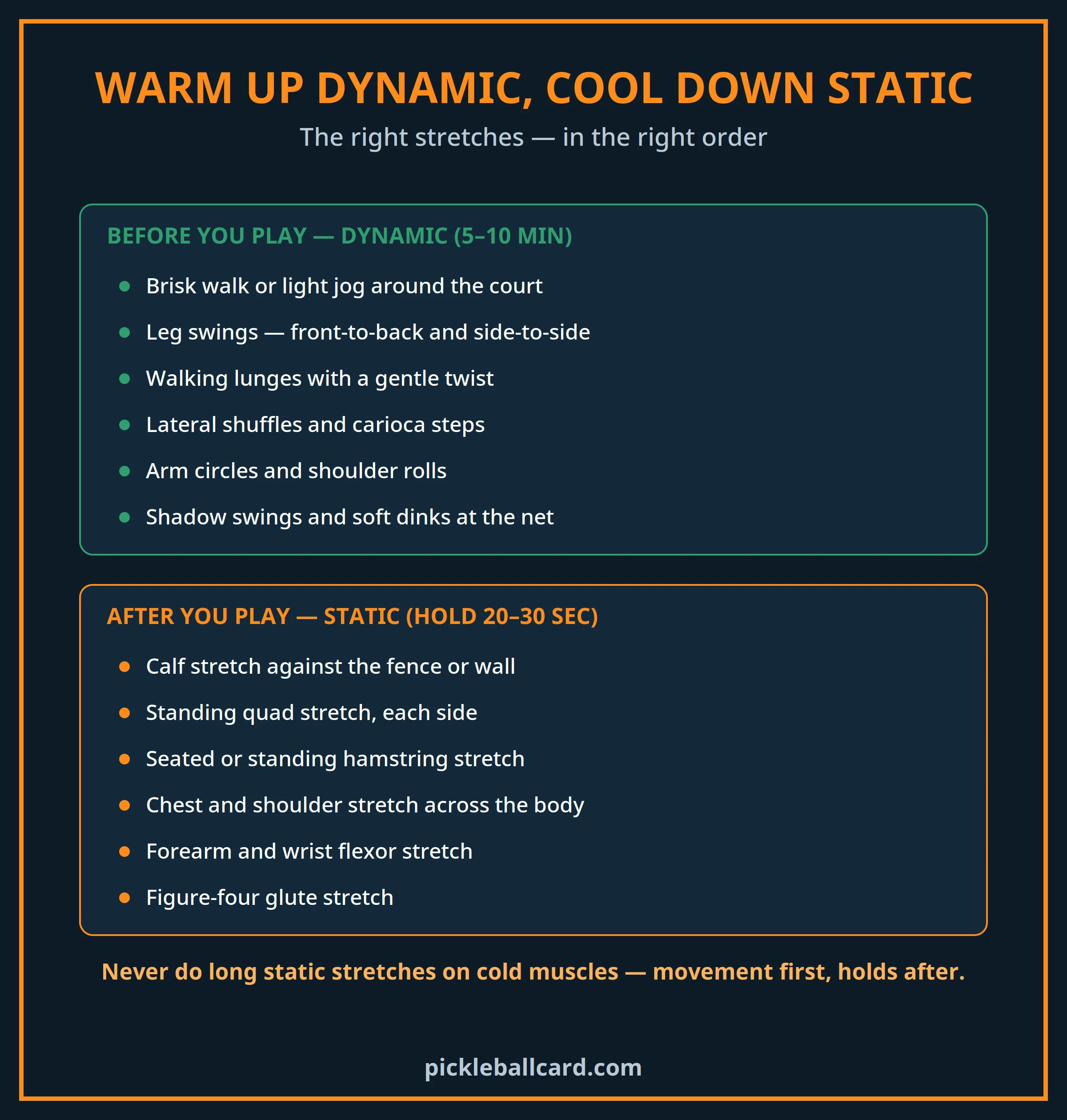
Pickleball warm-up and cool-down chart: dynamic stretches before playing, static stretches after
Dynamic before you play, static after — the right order.

Pickleball Warm-Ups And Cool-Downs

Pickleball Warm-Ups And Cool-Downs Exercises

Pickleball Warm-Up Exercises

1. Light Jogging

Light jogging is one of the most effective warm-up exercises for pickleball or any other sport. It gently speeds up the blood circulation in your body and activates your joints and muscles to prepare them for intensive exercise. It also helps raise your body temperature so that by the time you start playing pickleball, your body can cope with extreme temperature changes.

And you don’t have to go to any running track for your light jog. Sit around your pickleball court while they set up the portable net and prepare the courts for the main round. Just a single round of light jogging would be enough to warm up to start your game.

2. Side Lunge Returns – Knee Exercises For Pickleball

This is yet another very effective pickleball warm-up exercise. It specifically targets knee joints and opens up your hip bone for extra flexibility. It also gently stretches your leg muscles, reducing the chances of a leg pull while playing pickleball.

So, stand firmly on the ground with your feet shoulder-width apart to get started. Then, pull your belly in and step with one leg to the side, bending it outwardly. You must keep the opposite stationary leg unbent to feel the deep stretch in your under-thigh muscle. Repeat the same process for the other leg in three to four sets.

3. Step Through Lunges

The step-through lunges are a modified version of the side lunges. It is designated to target the hip flexors, quads, cores, and glutes. It activates these areas and loosens them up so that you feel more flexibility and enhanced movements when you play pickleball.

So, to perform this warm-up exercise, you need to stand straight with your feet shoulder-width apart. Then, step forward with one leg while bending your knee at a 90° angle. Keep your tummy pulled and your movements in control. Repeat on the other leg in sets of three to four each.

4. Side Shuffles

Side shuffles may look silly, but trust me; it is a dynamic warm-up exercise that increases your flexibility and opens up your hip flexors. It spikes your heart rate and quickly gets your blood warmed up and ready for an intense physical workout. You may perform side shuffles on the pickleball court in three to four sets on each side.

5. Shadow Deadlifts

If you want to enhance your movement and coordination of your muscles for a pickleball match, I highly recommend doing shadow deadlifts. It specifically targets the hamstrings, knees, and hips and prepares them for improved coordination.

So, to start, slide your hands down your legs while bending forward. Keep your core tight and push your tailbone backward. You must also keep your spine straight and your head in line with your back to avoid awkward positioning. Keep in mind that proper body posture is the key to this pickleball warm up exercise. These exercises to prevent pickleball injuries would be less effective if you are careless about your body posture.

6. Arm Circles

All the pickleball exercises I mentioned earlier were to warm up your lower body or core. However, it is imperative that you also loosen up your upper body, including shoulders and arms, so that you can take a better swing at the pickleball ball while playing pickleball. And for that, I would recommend arm circles.

To do pickleball shoulder exercises, firmly stand on the ground with your feet shoulder-width apart and knees unbent. Now, stretch your arms fully sideways and move them in small circles. Slowly increase the circumference of your arm circles to deepen the movement. Repeat this exercise ten times, both clockwise and in an anticlockwise direction.

Pickleball Cool Down Exercises

1. Light Jogging With Decreasing Tempo

You must cool down your body properly after you are done playing pickleball. This is because your body needs time to recover from the intensive physical exercise you get from pickleball. Just as it is important to slowly raise your body temperature, heart rate, breathing, and blood circulation, it is also super important to cool it down gradually.

So, you can perform some light cardio after your pack-up. So, instead of returning to your car, you might jog around the court briefly. Slowly reduce the speed and intensity of your jog until you slow down to walking speed.

2. Pickleball Stretching

Stretching after a pickleball game is a great way to cool down your body. This is because dynamic stretching makes the blood flow toward the muscles and away from them. Just ensure you stretch the most active muscles during the game because these regions require the most blood drainage.

3. Hydration

I can not stress this point enough. Hydration is essential to our cool-down routines; It helps replenish all your body’s lost water and electrolytes. But plain water would not suffice, mind you. Make sure that you drink electrolyte-rich salty fluids so that your body can recover from the extreme loss of fluids in the form of profuse sweating.

So, you must immediately drink water at the end of your pickleball game. You may as well drink between the games; however, you shouldn’t drink too much water in the middle of the game since it could overflow your stomach and cool down your hyperactive system. But drinking water at the end of the game to cool down your body is entirely different.

People Also Ask

How Does Warming Up Prevent Injuries?

It is a very good question. You all must know exactly how warming up your body prevents injuries. When you are inactive, your body tries to save energy by lowering the live reactions inside your cells. You need to awaken your body cells and organs gently to activate them.

So, you should start by stretching your muscles to increase blood flow towards and away from the muscles. And then move on to light cardio. These best exercises for pickleball prevent your muscles from getting shocked by a sudden movement, which could result in muscle tears and joint twists.

How To Warm Up For Pickleball?

Light jogging, side lunges, side shuffles, arm circles, and body squats are some effective pickleball warm-ups to prepare yourself before the match. These exercises help you to increase blood flow in your body and activate your body muscles and joints. One single round of pickleball warm-ups is enough to start your pickleball game.

What Are Some Pickleball Exercises For Seniors?

Exercises for seniors can include gentle warm-up stretches focusing on the shoulders, wrists, and legs to improve flexibility. Arm circles, Chair squats, Lunges, Side lunge returns, Standing hip abduction, High knees, Jogging, Seated Torso twists, and Side shuffles are some recommended pickleball exercises for seniors that enhance endurance and court mobility.

Why the Order Matters: Dynamic Before, Static After

The most common warm-up mistake in pickleball is also the most traditional: long static stretches on cold muscles before playing. Research on stretching consistently shows that holding static stretches before activity can temporarily reduce muscle power and does little to prevent injury, while static stretching after play is genuinely useful for maintaining flexibility. Before a match, choose dynamic movements instead — leg swings, arm circles, lateral shuffles, shadow swings and a few easy dinks — because they raise muscle temperature and rehearse the exact ranges of motion the game demands. Save the held stretches for the cool-down, when muscles are warm. This matters more in pickleball than in most recreational sports: studies of emergency-department data show pickleball injuries — strains, sprains and wrist fractures among them — have risen sharply alongside participation, and they concentrate in players over 50. Ten honest minutes of preparation is the cheapest injury insurance in the sport. Pair this routine with our dedicated stretches and warm-up exercises, and if you are just starting out, learn how to play pickleball first.

Summing It All Up

So, it is safe to conclude that warming up your body and then letting it properly cool down before and after the pickleball game is the most crucial and critical part of the game. You must pay extra attention to dynamic warm-up exercises for pickleball things because they ensure the safety of your body organs and joints throughout your career. Many players ignore these warm-up and cool-down routines and then suffer the consequences!

Let me stress the most important advantage of performing these routines. And that reduces the risk of possible injury. Without a proper warm-up routine, you put yourself at risk of serious muscle injuries and joint twists. You may even end up twisting your joints, pulling your muscles, or breaking your bones if you are not careful about these little things. So, pay attention!


Other Related Posts:
  • Pickleball Tips For Intermediate Players
  • How To Stay Calm On Pickleball Court?
  • Best Pickleball Shoes
  • Difference Between Pickleball & Tennis
  • Top Pickleball Courts Near You


Jeena Noven, Pickleballcard Author
Jeena Noven

Jeena Noven is one of Pickleball Card’s main writers for rules, ratings and everyday play. She focuses on the questions players actually argue about on court — scoring, faults, ratings and match situations — and checks each answer against the current USA Pickleball rulebook before it goes live. Her guides are written for real club players: clear first, technical when it matters, and updated when the rules change.

Filed Under: Health & Injuries

How Many Calories Do You Burn Playing Pickleball?

September 8, 2026 by Jeena Noven

Here is everything you need to know about how many calories you burn playing pickleball so that you can burn the required calorie amount.

Pickleball is one of my favorite fitness health games. It is a means of body exercise and burns calories and bad fats. A great number of people play pickleball, which helps them maintain their body weight and fitness. The best thing about pickleball is that it is suitable for people of all ages as it offers a workout necessary for preserving the required fitness level.

Do people lose weight while playing pickleball? Still, many people are unaware of how many calories you burn playing pickleball per session. Well, in this article, I will tell you the number of calories people burn while playing pickleball so that they can live a good and healthy life.

How Many Calories Do You Burn Playing Pickleball?

Why is pickleball so popular these days? People are investing their time in pickleball because it provides a great lifestyle. It increases their body fitness because, during the game, their whole body is involved. I used to go to the gym back to back just because I was gaining too many calories.

How Many Calories Do You Burn Playing Pickleball, Pickleball Calories Burned Calculator
Average Calories Burned Playing Pickleball

Last week, I was quite busy and could not go to the gym because I was caught up in playing pickleball for a few weeks with my friends in some sports tournament. I was so amazed that by the end of the month, I lost 3-4 kgs. Pickleball burned all my calories and reduced my bad cholesterol. The results inspired me, and I decided to continue playing pickleball to burn more calories until I reached the required BMI and fitness.

Pickleball is similar to an aerobic workout, which burns your body’s extra fats and calories after a few gaming sessions. The good thing about pickleball is that you enjoy playing pickleball and lose calories per hour. I am writing this article to everyone who wants to know how many calories you burn playing pickleball to gain the perfect calorie level.

How To Calculate Your Calories Burned In Pickleball?

Calculating the calories burned during a game of pickleball involves considering various factors such as your body weight, intensity of the game, duration of play, and your metabolic rate. Here’s a basic method to estimate the calories burned:

  1. Determine Your Weight: Knowing your weight is crucial as heavier people burn more calories.
  2. Estimate the Intensity of Your Game: Pickleball can range from light to vigorous intensity. If you’re playing a casual game, it’s likely light to moderate intensity. A competitive game would be more vigorous.
  3. Duration of Play: How long you play affects the total calorie burn.

Calculate Your Resting MET Rate Using Harris Benedict Equation

The Harris-Benedict Equation is a formula that estimates your Basal Metabolic Rate (BMR), which is the amount of energy expended while at rest in a neutrally temperate environment.

  • For men: 66.47 + (6.24 × weight in pounds) + (12.7 × height in inches) − (6.75 × age in years).
  • For women: 65.51 + (4.35 x weight in pounds) + (4.7 x height in inches) – (4.7 x age in years).

By Using The Metabolic Equivalent Of Task (MET) Method

MET is a unit used to estimate the amount of energy used by the body during physical activity, compared to resting. The study by the IJREP concentrated on middle-aged and senior players, influencing the overall results. Considering players of various ages, a more representative MET value for pickleball would be around 6.5. This places it in a more vigorous category than badminton, yet still not as demanding as tennis.

Calories Burned Per Minute = METs x 3.5 x (your body weight in kilograms) / 200

Number Of Calories Burn During Pickleball

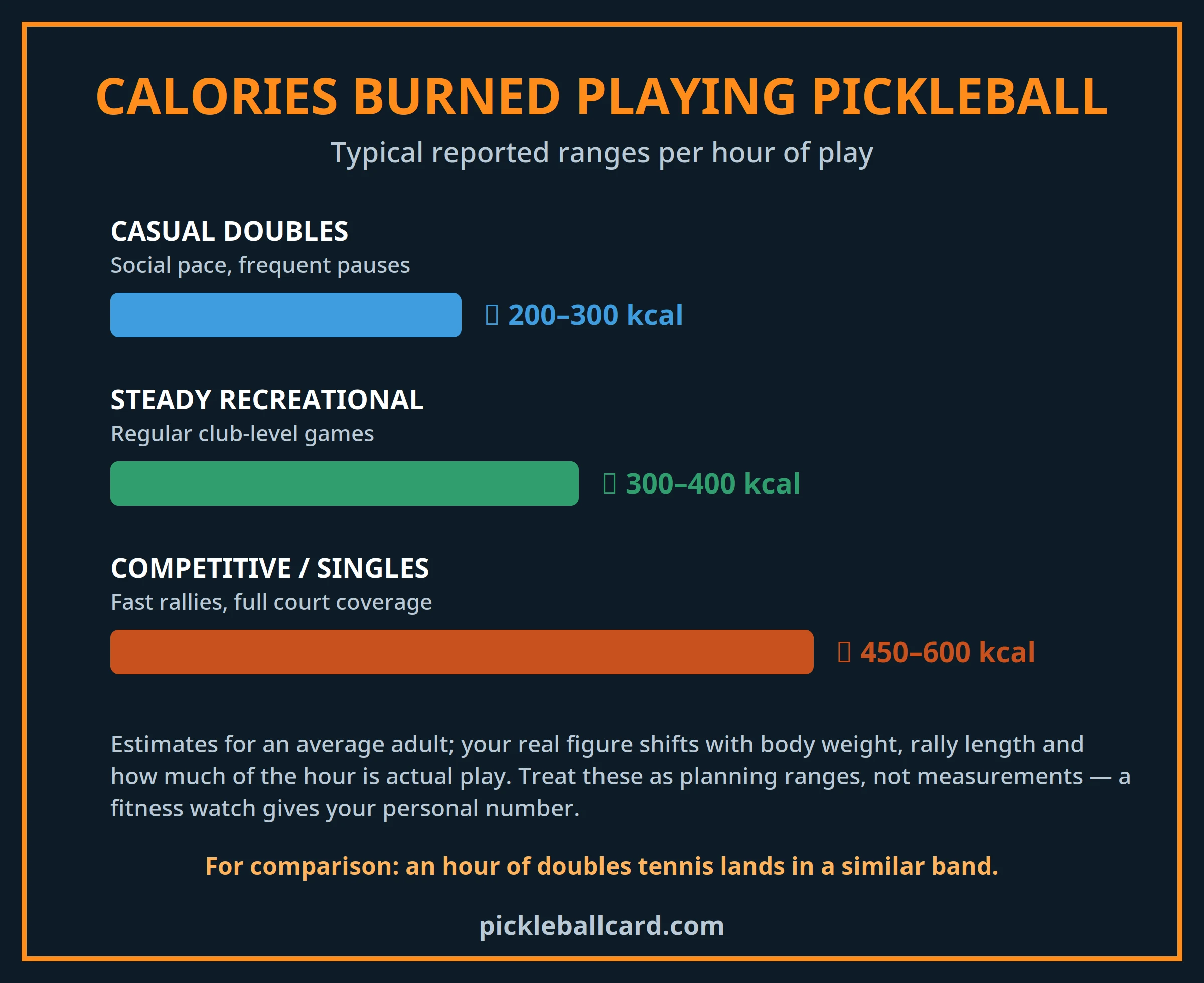
Calories burned playing pickleball per hour by intensity, from casual doubles to competitive singles
Typical reported calorie ranges per hour of play, by intensity.

Burning calories depends on factors like height, weight, and body mass. Also, calories burned depend upon how the person is playing the game and how much effort that person is putting in.

Sometimes, when the game becomes intense and people put in more effort, they burn more calories in less time. Sometimes, people remain relaxed during casual matches, which results in less calorie burn. Generally, if I talk about the common calorie rate that burns while playing pickleball is as follows;

  • People with 160 pounds can burn about 500 calories in an hour.
  • Also, people with 200 pounds are heavier, and with little effort, they can burn calories of about 700 per hour while playing pickleball.
  • Similarly, people with 160 pounds can lose 700 calories per hour after an intense game.
  • Also, people with 200 pounds can lose 900 calories in an hour after more effort.
  • The number of calories burned in pickleball depends upon your effort, which means that from 500-900, your step count range should be 4000-7000. And your steps count also depends upon your playing style and effort.

Sometimes, professional players check their pickleball calories burned after a few games. They get this information usually from the Racquet Sports Center, which knows different methods of calculating the player’s calories burned during pickleball. Also, you can track your calorie burn through certain trackers, which are Fitbits and Apple Watches, that will tell you the amount of calories you have burned in a certain amount of time.

Calories Burned In Pickleball Singles Vs Doubles

When comparing calories burned in singles vs doubles pickleball, the key difference lies in the game’s intensity and the amount of court each player covers. In singles, a player is responsible for the entire court, leading to more movement, higher intensity, and, consequently, a greater calorie burn. Conversely, in doubles, the court is shared between two players, which often results in less movement and a lower calorie burn.

For a rough comparison, an average person might burn about 20% to 30% more calories playing singles than playing doubles in the same duration. However, the exact difference depends on factors like the players’ physical condition, the game’s intensity, and the duration of play.

Calories Burned According To Body Weight

As I discussed earlier, calorie burn depends upon the individual body weight. So, here I will discuss the pickleball calories burned by different body weights per minute, 30 minutes, or an hour. This will help you understand more than how much your body burns calories depending upon your body weight.

  • If your body weight is 125 pounds, you will burn 6.5 calories in a minute, 195 calories in 30 minutes, and 390 calories in an hour.
  • With 150 pounds, you can burn 7.8 calories per minute, 232 calories in 30 minutes, and 464 calories in an hour.
  • People with 175 pounds will burn 9.0 calories per minute, 270 calories in 30 minutes, and their total calories burned will be 540.
  • If your weight is 200 pounds, your calorie burn per minute, 30 minutes, or an hour would be 10.3, 310, and 620, respectively.
  • Also, your calorie burn in a minute would be 11.6, 348 in 30 minutes, and 696 in an hour when your body weight is about 225 pounds.

I am sure you are a little clear that your calorie burn depends upon your body composition and matter. The more you put in the effort, the faster you notice calorie burn.

Weight Loss While Playing Pickleball

When a player’s calories are burnt during the game, it helps lose body weight. Any activity with intense body movement burns extra body fats and helps reduce weight. Calories burn results in weight loss, which leads to a good life. The body fats and calories are your stored food; when this food burns, it helps you maintain a suitable body weight.

To reduce the calculated weight, you should check how many calories you burn during pickleball. To check your calorie intake, you need to use basal metabolic rate (BMR), which tells you about the calorie intake even while sleeping.

Once you know the estimated calories burned, you can lose weight accordingly. But your weight loss depends upon your effort, age, sex, body mass, and calories burned. Males and females have different metabolic rates, meaning their calorie burn and weight loss differ.

Tips To Burn More Calories With Pickleball

  • Here are some tips that will help you burn more calories with pickleball.
  • Well, to burn more calories, you need to play for a longer period. Make your routine and put extra effort into burning more calories.
  • Increase your time if you are playing for 30 minutes, then extend your time to an hour. Extending your time will help you burn calories quickly.
  • Also, you can use a witness tracker, which will constantly help you know your calorie burn. It will also motivate you to play for longer to burn additional calories.
  • Play intense matches as more effort will reduce your weight and will burn your calories instantly.

Pickleball Health Benefits

Well, playing pickleball has numerous kinds of benefits for your health. Playing pickleball promotes cardiovascular health, which includes hypertension, heart attack, and stroke. Other than that, it provides energy to your muscles and joints, which reduces orthopedic problems.

Also, it impacts less stress on your joints too. Pickleball reduces depression by releasing hormones like bioamines and endorphins, which regulate mood. Another benefit of playing pickleball is that it provides a healthy connection with people, which helps you feel better (physically and mentally). Last but not least, it improves blood regulation, which prevents many health problems.

Calories Burned Pickleball Vs Tennis

Tennis is another important sport that helps in burning body calories. It also involves a body workout, which regulates the blood and burns all the body’s calories. To know which sports burn more calories, pickleball or tennis, my answer would be Pickleball. Pickleball involves more body movements, which burns calories quickly compared to tennis.

  • In Pickleball, a player burns roughly .08 calories per minute per pound of body weight.
  • In Tennis, a player burns roughly 0.056 calories per minute per pound of body weight.

Tennis also burns calories, but only on a large ground. Larger ground helps you cover more distance, so you put in more effort and lose calories quickly.

Mental Benefits Of Pickleball

Pickleball has various mental benefits on individual health. It aids in socialization, which allows people to communicate with different people, make new friends, and improve social relations. Sometimes, a good connection leads to honest friendship, which frees your mind from all worries and hardships. Secondly, it helps to improve the self-esteem of an individual.

People learn new skills from other people, which improves their gaming sessions and helps them to win the game easily. Winning the game boosts the individual’s confidence and self-esteem, which results in positive reactions and promotes good mental health.

Another important thing is that it helps people feel young as it reduces joint problems and other cardiovascular diseases. Also, playing pickleball combats depression, which relaxes your mind and makes you feel better. Throughout the game, people remain under mental challenge as they use different strategies to win it.

So, they remain involved in the game and forget about all their worries. Also, it is the best activity to reduce boredom as you can engage yourself in good activity, which will help you generate positive thoughts.

Frequently Asked Question

How Many Calories Do You Burn Playing 1 Hour Of Pickleball?

People who play pickleball daily for an hour have 500 calories per hour. Also, it depends upon the weight and body mass of an individual. People who are 200 pounds can burn almost 700 calories, while some people with the same weight can burn 900 calories.

Can I Lose Weight Playing Pickleball?

You can lose weight while playing pickleball because it burns many calories during play. Pickleball involves body involvement, which means that a person can burn 8 to 11 calories per minute, which makes almost 600 calories an hour.

Is Pickleball Good For Exercise?

Pickleball is similar to aerobics that you do in the gym. It is the complete body workout, which stresses your muscles and joints to remove the extra fats from your body. So, pickleball is good for exercise as you remain active and healthy during the whole game.

Does Pickleball Burn More Calories Than Tennis?

Yes, pickleball burns more calories than tennis because your whole body is in action during the game, which burns more calories than any other sport. Pickleball can burn up to 600-700 calories in an hour.

Is Pickleball A Lot Of Running?

No, pickleball is not a lot of running; it involves body movements, which stress out your muscles and burn calories.

What Are The Top Exercises For Pickleball?

The top exercises for pickleball involve body muscle movement, running, and walking. The person remains engaged during playing, which burns calories and maintains weight.

How Many Calories Do You Burn Playing Pickleball Doubles?

Playing pickleball doubles can burn 200 to 350 calories in 30 minutes. Pickleball doubles can be a great workout if played for a longer period. The most estimated range of calories is 8-10 per minute.

An Hour at the Courts Is Not an Hour of Burning

Calorie charts assume an hour of play, but an hour at the courts is never an hour of movement. Score-keeping, ball-chasing, water breaks and waiting between games all pause the burn, especially in social doubles. What drives your total is active rally time, so longer rallies mean more movement per hour — one more reason the patient dinking strategies that extend exchanges pay off. If you want a session that behaves more like a workout, fill the gaps between games with the short, purposeful work in our pickleball drills instead of standing at the fence.

Conclusion

Now you know how many calories you burn playing pickleball and how much it benefits human health and fitness. If you also tire of losing weight through diet, gym, or workout, you should try playing pickleball for a quick calorie burn.

Live a healthy and good life by playing pickleball to maintain your body weight and prevent weight gain. A healthy man remains active instead of feeling lazy all the time. Now, play pickleball daily to reach the highest level of body fitness.


Other Related Posts:
  • Dimensions Of A Standard Pickleball Court
  • Top Pickleball Shoes
  • Pickleball Skill Levels
  • Difference Between Pickleball Vs Tennis
  • Warm-Up & Cooldown Exercises For Pickleball


Jeena Noven, Pickleballcard Author
Jeena Noven

Jeena Noven is one of Pickleball Card’s main writers for rules, ratings and everyday play. She focuses on the questions players actually argue about on court — scoring, faults, ratings and match situations — and checks each answer against the current USA Pickleball rulebook before it goes live. Her guides are written for real club players: clear first, technical when it matters, and updated when the rules change.

Filed Under: Health & Injuries

  • Page 1
  • Page 2
  • Go to Next Page »

Latest Posts

  • Timeout Rules in Pickleball: Standard, Medical and Between-Game Timeouts
  • Pickleball Safety And Eye Protection
  • What To Wear To Play Pickleball: Shoes, Clothes, And Court Essentials
  • Pickleball Statistics: Participation, Growth, And The Numbers That Matter
  • Paddle Generations Explained: From Thermoformed To Foam (Gen 2, Gen 3, Gen 4)
  • Raw Carbon Fiber Pickleball Paddles Explained
  • Pickleball Court Surfaces Explained: Acrylic, Asphalt, Concrete, And More
  • How To Organize A Round Robin In Pickleball
  • What Is The PPA Tour? The Professional Pickleball Tour Explained
  • The Mental Game of Pickleball: Focus, Confidence and Composure
  • About
  • Privacy Policy
  • Terms And Conditions
  • Affiliate Disclosure

COPYRIGHT © 2026 · Pickleballcard.COM, ALL RIGHTS RESERVED.

PICKLEBALLCARD.COM IS A PARTICIPANT IN THE AMAZON SERVICES LLC ASSOCIATES PROGRAM, AN AFFILIATE ADVERTISING PROGRAM DESIGNED TO PROVIDE A MEANS FOR SITES TO EARN ADVERTISING FEES BY ADVERTISING AND LINKING TO AMAZON.COM. AMAZON, THE AMAZON LOGO, AMAZONSUPPLY, AND THE AMAZONSUPPLY LOGO ARE TRADEMARKS OF AMAZON.COM, INC. OR ITS AFFILIATES. AS AN AMAZON ASSOCIATE WE EARN AFFILIATE COMMISSIONS FROM QUALIFYING PURCHASES.