
Pickleball looks gentle from the sideline. On court it is short bursts, sideways shuffles, deep lunges and hundreds of swings, often above shoulder height.
Off-court strength training builds the muscle and control those movements ask for. Think of it as general conditioning for the game you already play, done twice a week at home.
Playing already does a lot for your fitness, as our health benefits of pickleball guide explains. This plan adds what court time does not target: deliberate strength work.
Read This First: Safety Basics
This guide is general fitness education, not medical advice. It does not treat, rehabilitate or promise to prevent any injury.
Check with a clinician before starting if any of these apply to you:
- You have a chronic condition such as arthritis, diabetes or heart disease. The CDC encourages activity with these conditions, but advises asking your doctor how yours affects what you can do.
- You have a disability. The CDC suggests talking with your doctor and, ideally, a professional experienced in activity and disability.
- You have been inactive for a long time. The CDC advises a doctor conversation before vigorous activity; moderate-effort exercise is considered safe for most people.
- You have a history of hip, knee, ankle, shoulder, elbow, wrist or spine problems. The OTRF pickleball program carries an explicit notice against starting with that history without medical clearance.
Two dosing rules run through this whole plan, both from the AAOS conditioning programs: choose loads you can move without pain, and progress only in small steps.
Stop a session if you feel discomfort or feel you are working beyond your current abilities. That stop rule comes straight from the OTRF program’s own safety notice.
If soreness persists, mobility stays limited, or your game declines despite hard work, Andrews Sports Medicine clinicians advise seeing a sports medicine physician. Small issues are easier to correct early.
Our overview of common pickleball injuries and our pickleball safety guide give more background on playing carefully.
What Pickleball Asks Of Your Body
Short bursts and lateral movement. Play is built on repeated bursts of speed and quick sideways movement over a small court, as clinicians at Andrews Sports Medicine note when mapping the sport’s demands.
Researchers call the skill change of direction. In a 2024 study of recreational players, Myers and Hanks found stronger hip abductors were associated with faster change-of-direction times.
Lunging, in several directions. Lunging is the signature court movement, used to reach dinks and wide balls. The same research team describes hip abductors and extensors controlling the pelvis during a lunge.
The quadriceps do the braking. They decelerate the lunge and reverse it, which is why this plan pairs hip work with quad work rather than treating legs as one block.
Context: in that 2024 survey of 92 recreational players, 42 percent reported a fall during play, with lunging and moving backward the leading circumstances. That is why controlled lunging matters here; it is not a promise that exercise changes your own risk.
Rotation for strokes. Groundstrokes, serves and volleys all rotate through the trunk. Clinicians at Andrews Sports Medicine recommend core work such as planks and medicine-ball twists to support that demand.
Shoulder endurance. Hundreds of swings per session ask the shoulder to work repeatedly rather than maximally. The AAOS shoulder program targets the deltoids and rotator cuff with light loads.
Grip and forearm. Every shot is gripped, and off-center hits twist the paddle in your hand. Andrews Sports Medicine names wrist strengthening as part of training for paddle control.
The low ready position, repeated. Andrews Sports Medicine also notes lower-body strength gives players the endurance to get down repeatedly for balls at the kitchen line.
The Plan At A Glance
The American College of Sports Medicine’s 2026 position stand sets the baseline this plan follows: train all major muscle groups at least two days per week.
CDC guidance for adults 65 and older matches it: strengthening on two or more days weekly, alongside aerobic activity and balance work. Court time counts toward the aerobic side.
The ACSM general-health template behind this plan uses 8 to 10 multi-joint exercises, 2 to 3 sets of 8 to 12 reps, at roughly 8-out-of-10 effort.
Equipment stays simple: your bodyweight, light-to-moderate dumbbells, a resistance band, a chair or wall, and a dowel with a light hanging weight. No gym is required: the ACSM review found benefits from band, bodyweight and home-based programs, with consistency mattering more than equipment.
Warm Up Before You Play
Mayo Clinic’s warm-up principles are simple: warm up immediately before activity, start with large muscle groups, then move to movements specific to your sport.
A dynamic warm-up rehearses the activity’s patterns at a slow pace that builds in speed and intensity. Expect mild sweating, not fatigue.
Save held stretches for after play, when muscles are warm. Mayo Clinic notes the evidence that stretching prevents soreness or injury is inconsistent.
The OTRF pickleball program’s pre-play sequence puts those principles into practice:
- Jumping jacks, 30
- Arm circles, 10 forward and 10 backward
- Wall calf stretch, 2 holds of 30 seconds
- Thoracic rotations, 2 sets of 10
- Wall slides, 15 to 20
- M/T/W band drill, 10
- Band diagonal pattern, 2 sets of 10
- Leg swings, 15 each direction
- Single-leg toe touches, 2 sets of 10
- Skipping, 30 feet forward and backward
- Forearm stretch, 2 holds of 30 seconds
Several movements reappear below as light strength and mobility work. For fuller routines, see our pickleball warm-ups and cool-downs guide.
Lower Body: Strength, Lateral Movement And Braking
Bodyweight Squat (Progress To Goblet Squat)
Trains quadriceps and glutes, the base for your ready position and low balls at the kitchen line. Stand with feet shoulder-width, sit hips down and back with chest up, track knees over toes, and stand fully between reps.
Step-Up
Trains single-leg quadriceps and hip strength, the same muscles that control and reverse a lunge. Use a low step, drive through the whole foot of the top leg instead of pushing off the floor leg, and lower under control.
Side-Lying Hip Abduction
Trains the gluteus medius and hip abductors tied to faster direction changes and pelvic control in lunges. Lie on your side, top leg straight but not locked, lift to about 45 degrees, hold briefly, and lower slowly without rolling the leg outward.
The AAOS hip program uses a 5-second hold here. It progresses this exercise in 1-pound steps, dropping back to 8 reps and rebuilding to 12 at each new weight.
Calf Raise
Trains the calves and ankles behind push-off in short bursts and repeated split-steps. Stand tall, holding a chair back if needed, press through the balls of your feet to lift your heels, pause at the top, and lower slowly.
Forward Lunge With Push-Off
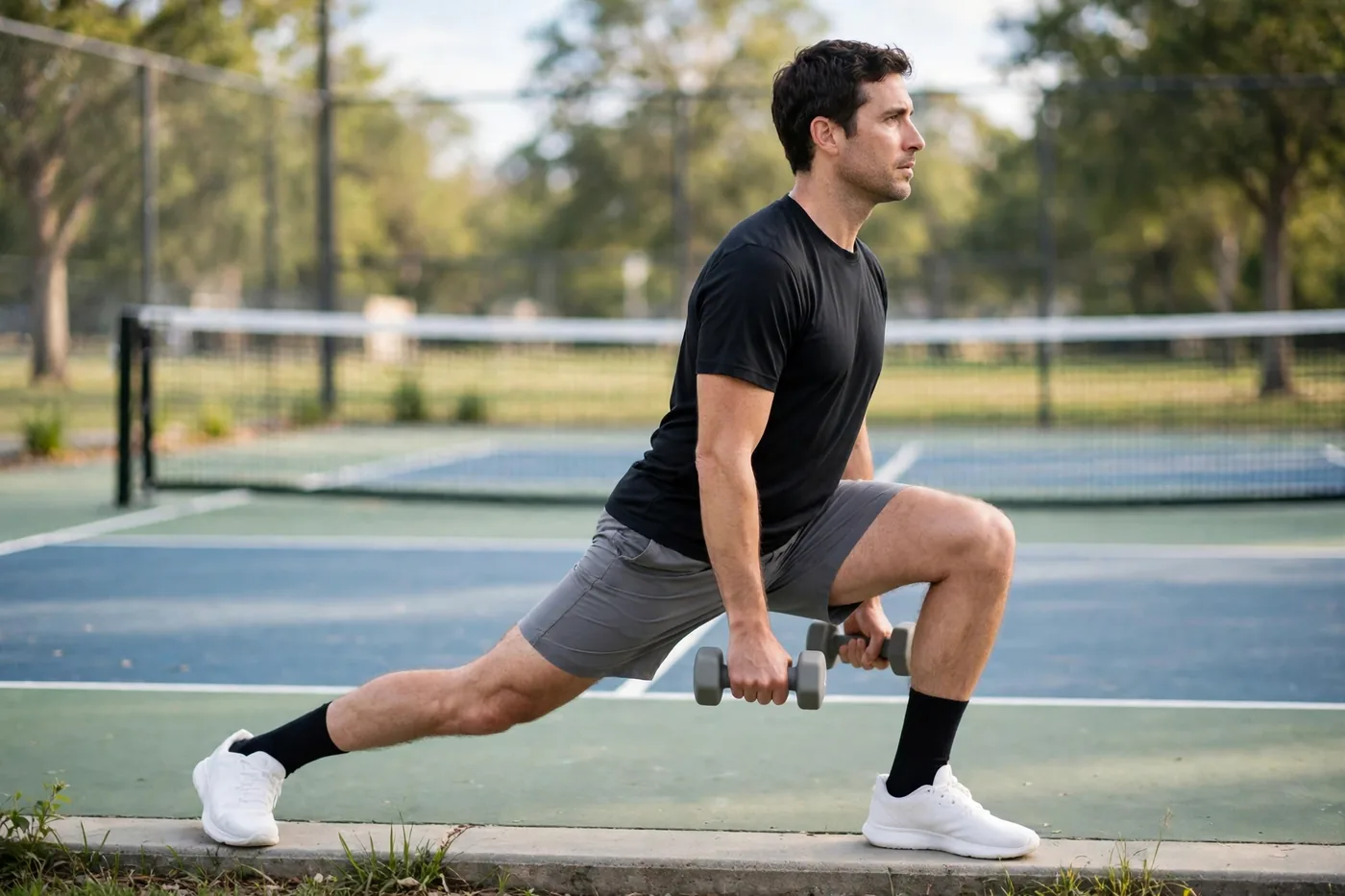
Trains the exact court pattern: step out, brake, and drive back to the start. From shoulder-width feet, step forward landing heel first, bend both knees without letting the back knee touch down, then push off the front heel to stand.
Multi-Directional Lunges
Trains braking and control sideways and backward, the directions court play actually uses. The 2024 research team specifically recommends multi-directional lunging in player conditioning. Use the same mechanics as the forward lunge, stepping sideways or back, keeping steps short and controlled.
Lateral Band Walk
Trains the hip abductors under tension while moving sideways, a direct rehearsal of the defensive shuffle. Loop a band above the knees or around the ankles, soften both knees, and step sideways against the pull, keeping tension on the band throughout.
Form cues from the University of Melbourne physiotherapy library: lead with the heel and avoid twisting your trunk as you step.
Single-Leg Balance Toe Touch
Trains single-leg balance and hip control, the position you occupy mid-lunge and mid-reach. Stand on one leg with a slight knee bend, hinge and reach the opposite hand toward the standing foot, then return slowly. Keep a chair nearby while learning.
Core And Rotation
These four drills come from clinician guidance and a pickleball-specific clinician program: recommended practice for the rotational demands of strokes, presented as conditioning, not studied prescriptions.
Forearm Plank
Trains trunk stiffness for stroke transfer and quick directional changes. Rest on forearms and toes with your body in one straight line, brace your midsection, and breathe steadily. End the set when your hips start to sag.
Plank Row
Trains anti-rotation core control plus back and shoulder pulling strength. Start in a push-up position with feet slightly wide, row one hand toward your ribs, and keep hips and shoulders square to the ground without rocking. Alternate arms.
Medicine-Ball Rotational Twist
Trains rotational trunk control for groundstrokes and serves. Hold a light ball at chest height, rotate your trunk to one side and back through center to the other, moving the ball with your shoulders. Keep hips facing forward and the motion smooth.
Band Diagonal Pattern
Trains the diagonal shoulder-and-trunk pattern used in swings, with a slow, controlled return. Anchor a light band, stand side-on, reach across your body to grasp it with the far hand, then pull diagonally across and down. Switch sides after the set.
Shoulders And Rotator Cuff
Cuff work uses light resistance by design. The AAOS shoulder program starts with a weight light enough to finish the reps without pain, progresses in 2-to-3-pound steps, and keeps working weights light.
Side-Lying External Rotation
Trains the infraspinatus and teres minor, cuff muscles supporting the back of the shoulder. Lie on your side with a rolled towel under the top elbow, elbow bent 90 degrees on your hip, and rotate your forearm up toward the ceiling.
Band External Rotation, Elbow At Your Side
Trains the external rotators with your arm in the low, ready-position posture. Loop a band to a doorknob, stand side-on with elbow pinned to your side and bent 90 degrees, and rotate your forearm outward against the band. Return slowly.
90/90 External Rotation With Band
Trains the cuff in the raised-arm position used for overheads and high volleys. Anchor the band at waist height, hold your elbow at shoulder height bent 90 degrees, and rotate your hand up until it points at the ceiling over your elbow.
Reverse Fly Or Band Pull-Apart
Trains the rear deltoids and shoulder-blade muscles that hold your posture through long sessions. With arms straight just below shoulder height, pull your hands apart while squeezing your shoulder blades together until your arms are level with your shoulders. Return slowly.
One-Arm Dumbbell Push Press (Advanced, Optional)
Trains shoulder power and overhead endurance with leg drive. This is the most advanced move in the plan and is optional: include it only if you already lift with sound technique, and keep the load modest.
Hold a dumbbell at shoulder height, dip your knees, drive up through your legs as you press overhead, and lower under control. Rest generously between sets.
Grip And Forearm
Andrews Sports Medicine clinicians include wrist strengthening in training for paddle control, and the OTRF pickleball program trains the grip and forearm directly.
Wrist Roller
Trains grip plus the wrist flexors and extensors together. Hold a dowel at waist height with a light weight hanging from its cord, roll the cord up by turning your hands, then unroll it slowly.
Supported Wrist Extension
Trains the wrist extensors on top of the forearm, which stabilize the paddle face on contact. Sit with your forearm supported on a table, wrist at the edge, palm down, and lift your hand against a light dumbbell before lowering slowly.
The conservative progression comes from an AAOS program: begin with no weight, then add load in 1-pound steps only when the current stage feels comfortable on consecutive days without increased pain.
Slow Negative Wrist Extension
Trains the forearm extensors under a slow lowering load, the braking action your forearm performs on off-center hits. Rest your hand over a table edge, palm down, lift your wrist back as far as comfortable, then lower it slowly against light resistance.
One boundary matters here: this section is general conditioning, not elbow treatment or rehabilitation. If your elbow already hurts, follow our pickleball elbow guide and get checked rather than training through it.
Mobility
Wall Calf Stretch
Targets calf and ankle range used in split-steps, lunges and push-offs; ankle mobility was among the measures in the recreational-player research above. Face a wall in a split stance, keep both heels down, lean in gently, hold, then switch legs.
Quadruped Thoracic Rotation
Targets mid-back rotation, the segment your strokes rotate through. On hands and knees, place one hand behind your head and rotate your shoulders so that elbow turns toward the opposite side, without rotating your hips. Repeat, then switch sides.
Passive External Rotation Stretch
Targets shoulder external-rotation range for comfortable overheads and reaches. Hold a light stick in one hand, cup the other end with the opposite hand, keep the stretching elbow tucked at your side, and gently push that hand outward with the stick.
Forearm Stretch
Targets wrist and forearm range for relaxed grip changes between shots. Take hold of the back of one hand with the other and draw your fingers gently downward. Hold, then switch hands.
Leg Swings
A dynamic hip-mobility movement rather than a held stretch, used in warm-ups. Stand on one leg holding support if needed, swing the free leg forward and back while gradually increasing height, and bend the knee on the backward swing. A side-to-side version works too.
For more options, our collection of stretches and warm-up exercises for pickleball pairs well with this section.
A Sample Week
The OTRF pickleball program organizes its strengthening work as two alternating days alongside a pre-play warm-up. The example below mirrors that structure using this guide’s exercises.
Day A: bodyweight squat, step-up, plank row, 90/90 external rotation, wrist roller, quadruped thoracic rotation.
Day B: forward lunge with push-off, side-lying hip abduction, lateral band walk, side-lying external rotation, slow negative wrist extension, forearm plank.
Run the two days on non-consecutive days, with a rest day between sessions. Add mobility work to your warm-up and post-play minutes.
This layout is an example assembled from the cited guidelines and clinician programs, not a personal prescription. Adjust it to your equipment, experience and clinician’s advice.
One honest note: the guidelines behind this plan do not settle whether to train on the same days you play. Players schedule it both ways; arrange your week so sessions and court time each get reasonably fresh legs.
Court time still counts toward weekly activity, as our calorie guide shows. Strengthening and balance work are what off-court training adds.
How To Progress Without Guessing
The ACSM stand’s headline advice is progressive effort over time. Training to complete failure is not required: stopping with 2 to 3 repetitions in reserve produced comparable outcomes in the evidence reviewed.
For load increases, the long-standing ACSM progression rule is practical: when you can perform 1 to 2 repetitions above the top of your target range, increase the load by 2 to 10 percent.
Small muscles get smaller steps. AAOS programs progress shoulder work in 2-to-3-pound steps and forearm work in 1-pound steps, advancing only when the current stage is pain-free.
Frequently Asked Questions
How many days a week should a pickleball player strength train?
Two or more days covering all major muscle groups is the shared baseline. The ACSM 2026 position stand sets at least two days weekly, and CDC guidance for older adults calls for strengthening on two or more days.
Can I do this plan at home without a gym membership?
Yes. The ACSM review found strength and muscle benefits from band training, bodyweight training and home-based programs. Every exercise here needs only dumbbells, a band, a chair and floor space.
Do I need heavy weights to get stronger?
Not for this plan’s goals. Effort and steady progression drive the benefit for recreational players, and stopping a couple of reps short of failure works. Loads near 80 percent of maximum are reserved for dedicated strength goals.
I am over 60 and have arthritis. Is strength training appropriate for me?
CDC guidance explicitly includes muscle strengthening for adults 65 and older, plus balance activities. With arthritis or another chronic condition, talk with your doctor first; if you cannot reach the minimum targets, do as much as you can.
What should I do if an exercise hurts?
Stop. The OTRF program’s rule is to discontinue any exercise that causes discomfort or feels beyond your abilities, and AAOS advises choosing loads you can move without pain. Persistent soreness or limited mobility warrants a sports medicine visit.
How long before I notice a difference?
Think in program blocks rather than promises. The AAOS conditioning programs run 4 to 6 weeks, and the ACSM evidence base covers programs of at least six weeks. Expect gradual change over weeks, not overnight results.
Sources
- American College of Sports Medicine, 2026 position stand on resistance training prescription for healthy adults — acsm.org
- ExRx summary of ACSM training guidelines and the progression rule — exrx.net
- Myers and Hanks, hip strength, change of direction and falls in recreational pickleball players, International Journal of Sports Physical Therapy, 2024 — PubMed
- Myers and Hanks, multi-faceted training program study in senior pickleball players, Healthcare, 2025 — doi.org
- OTRF, in-season warm-up and strengthening program for pickleball — otrfund.org
- Andrews Sports Medicine, optimizing pickleball performance — andrewssportsmedicine.com
- AAOS OrthoInfo, rotator cuff and shoulder conditioning program — orthoinfo.aaos.org
- AAOS OrthoInfo, hip conditioning program — orthoinfo.org
- AAOS OrthoInfo, therapeutic exercise program for epicondylitis — orthoinfo.aaos.org
- CDC, physical activity basics for older adults — cdc.gov
- Mayo Clinic, how to warm up and cool down — mayoclinic.org
- University of Melbourne physiotherapy, hip abductor strengthening exercise library — unimelb.edu.au

Shoaib is the publisher of Pickleball Card. He oversees the site’s guides to pickleball rules, ratings, strategy and gear, all researched from primary sources — the USA Pickleball Rulebook, DUPR and manufacturer documentation — and updated as the game changes.