Most pickleball wrist injuries come from one moment: a fall onto an outstretched hand. That is the short answer, and the most useful one, because fall prevention protects your wrist far better than any wrist exercise alone.
The second cause is overuse — repeated gripping, flicking and off-centre hits that irritate the tendons and small structures of the wrist.
What the Evidence Actually Shows
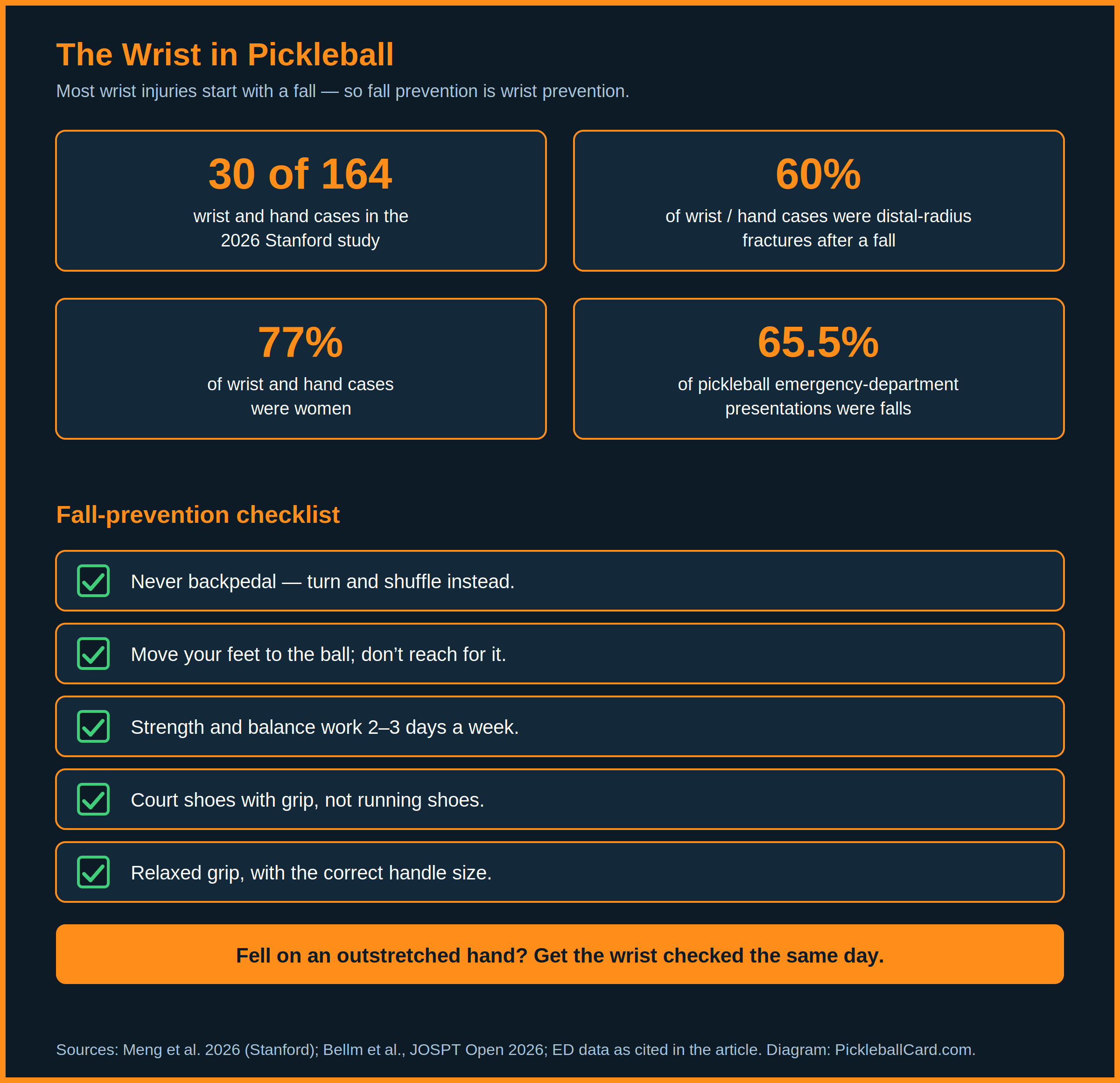
A 2026 Stanford study looked at 164 pickleball injuries seen in outpatient orthopaedic and sports-medicine clinics between 2019 and 2023. The wrist and hand were the second-largest group, with 30 cases — behind the knee (52) and ahead of the shoulder (23).
Inside the wrist and hand group, one injury dominated: distal-radius fractures after a fall accounted for 60% of cases. Remember this was a single specialist centre, so it skews towards more serious injuries.
A nationwide survey of 1,758 players, published in 2025 and 2026 in two analyses, gives the wider picture.
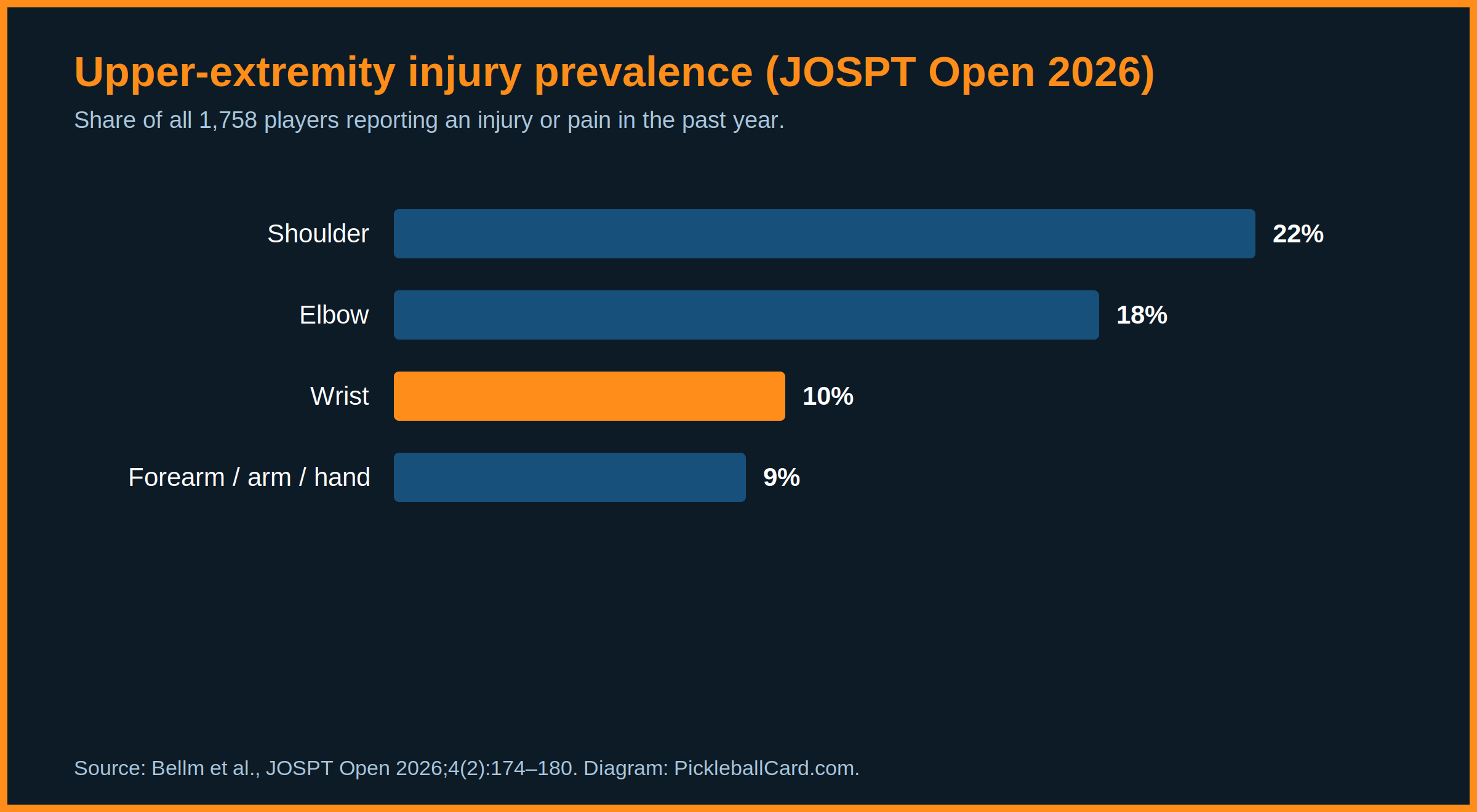
Upper-extremity injuries affected 39% of players in the past year, and the wrist was the third most affected upper-body region, with 10% of all players reporting a wrist injury or pain — behind the shoulder (22%) and the elbow (18%).
Fractures were rare among upper-extremity injuries, at 3.9%, but far more common in women (6.3%) than in men (1.2%).
Falls: The Main Cause of Serious Wrist Injuries
Falls are the most common mechanism of pickleball injury overall. In a study of United States emergency departments covering 2013 to 2022, falls accounted for 65.5% of presentations — an estimated 43,434 of 66,350 injuries.
In the same study, the wrist was the single most fractured site, at 29.2% of fractures, and the most injured site overall at 12.7%.
Orthopaedic surgeon Dr. Steven Ward puts the mechanism plainly: falling backward or sideways onto an outstretched hand is the most common cause of serious pickleball fractures, especially in players over 50 and players with osteoporosis.
That matches the Stanford finding and the survey finding that fractures affect women more often than men.
The movements that lead to falls are familiar: backpedalling for a lob, lunging for a wide ball, and sudden stops and direction changes. The same surgeon’s advice is blunt: never backpedal. Turn and shuffle back for lobs, or let the ball go.
Our footwork and agility drills train the turn-and-shuffle habit, and our guide to pickleball safety and eye protection covers court-surface and fall hazards more widely.
Sprains, TFCC and Tendon Problems
Not every wrist problem is a fracture. In the survey, the most common type of upper-extremity injury was chronic overuse conditions (41.3%), followed by sprains (23.9%) and muscle strains (20.1%).
Repeated gripping, wrist flicks and off-centre hits load the small tendons and ligaments of the wrist again and again.
Two wrist conditions appear in player guides’ injury lists, and they are worth knowing by name — with a clear caveat: the recovery windows they give are typical ranges from guides, not medical advice or a prognosis for any individual.
They list wrist sprains at a typical range of 1 to 8 weeks, and TFCC pain — the triangular fibrocartilage complex, the small cartilage pad on the little-finger side of the wrist — at 6 to 12 or more weeks.
They also list De Quervain’s tenosynovitis, irritation of the tendons on the thumb side, at 4 to 8 or more weeks.
If your wrist pain matches any of these descriptions, that is a reason to see a clinician, not a diagnosis.
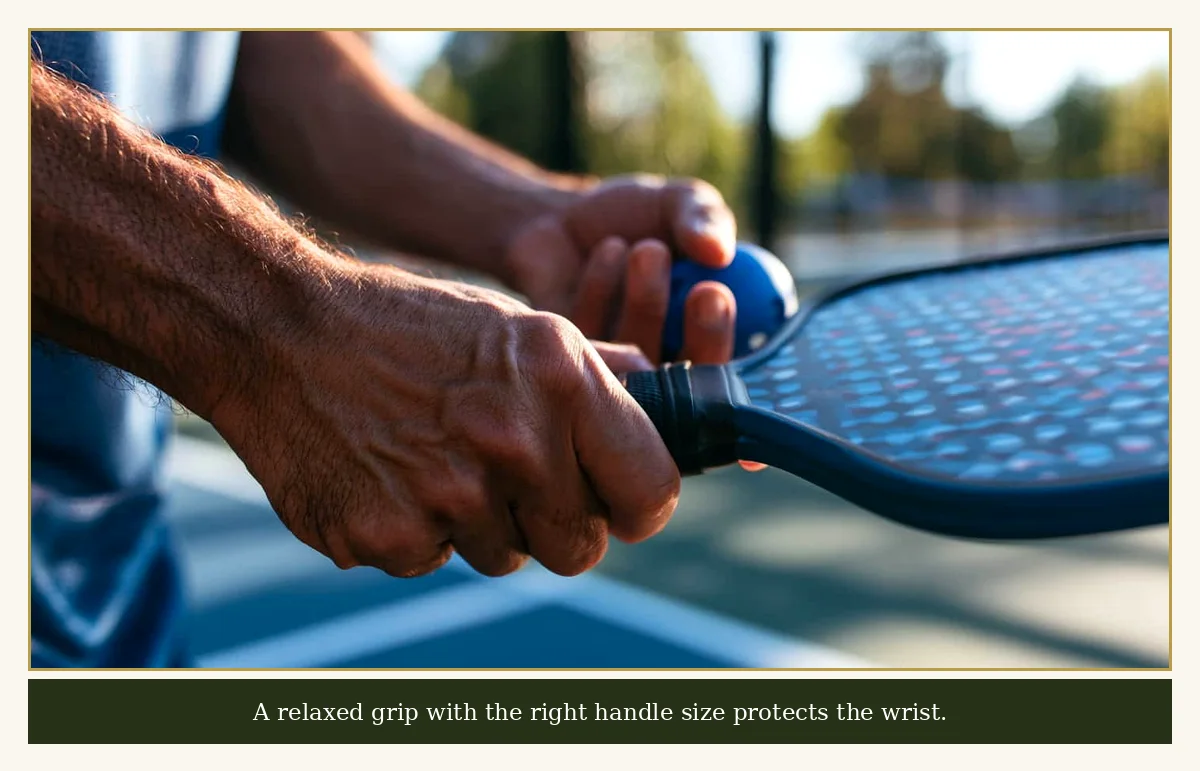
Houston Methodist’s orthopaedic guidance adds a practical point: proper paddle handle size can decrease the risk of wrist and elbow injuries. A handle that is too small encourages over-gripping, and a tight grip loads the forearm tendons that cross the wrist.
Our guides to pickleball grips and how to hold a pickleball paddle cover grip size and a relaxed hold, and our guide to the best pickleball paddles for tennis elbow discusses paddle weight and grip.
The elbow article on this site, pickleball elbow prevention, covers the forearm side of the same problem.
Who Is Most at Risk?
Women are the clearest at-risk group for wrist fractures. They made up 77% of Stanford’s wrist and hand cases, and in the nationwide survey, fractures made up 6.3% of women’s upper-extremity injuries compared with 1.2% of men’s.
Age matters too: the surgeon quoted above singles out players over 50 and players with osteoporosis, and the emergency-department study found a mean age of 64, with players aged 65 to 80 accounting for 61.1% of presentations.
Frequency and experience matter as well. In the 2025 survey analysis, playing three or more times a week was linked to 45% higher odds of reporting an injury or complaint, and having played for less than five years was linked to 50% higher odds.
Players who rated injury prevention as low or moderate in importance had about twice the odds of reporting an injury. The study was cross-sectional, so it cannot prove causation.
Our guide to pickleball tips for seniors covers managing sessions and recovery time for older players.
Prevention: Fall Prevention First, Grip Second
The Stanford authors’ prevention table is short and clear for the wrist: fall prevention. Everything else in this section supports that one priority.
Stop backpedalling. Turn your hips and run diagonally for lobs, or let the ball go. Move your feet to the ball instead of reaching, and plant your foot under your centre of mass.
Train strength and balance. Dr. Ward recommends strength and balance work 2 to 3 days a week.
In a small 10-week study of players aged 55 and over (29 players, not randomised), the training group held hip strength while the control group lost it, and falls were 25% vs 44% at five months.
Our pickleball strength training plan is the place to start on this site.
Warm up dynamically. The American Medical Association’s 2026 guidance recommends a dynamic warm-up before play — walking lunges, high knees and arm circles, until you have broken a light sweat — and static stretching for the cool-down.
Our warm-ups and cool-downs guide sets out the order: dynamic before, static after.
Wear court shoes. Running shoes have soft soles and little side-to-side support; court shoes have firm sides and grip for cutting and pivoting, and a slip or badly planted foot is often what starts a fall.
Check your grip. Use a handle size that lets you hold the paddle firmly without squeezing hard, keep your grip relaxed between shots, and avoid flicking the wrist for power — let the paddle face and your body do the work.
The wrist picture at a glance:
| Wrist problem | What the evidence says | What helps |
|---|---|---|
| Distal-radius fracture | 60% of Stanford wrist/hand cases, after a fall; women 77% of cases | Fall prevention; never backpedal; balance training |
| Wrist sprain | Sprains made up 23.9% of upper-extremity injuries in the survey; typical range 1–8 weeks | Rest the wrist; see a clinician if pain persists |
| TFCC pain | Typical range 6–12+ weeks (guide site); little-finger side of the wrist | Avoid flipping the wrist; let the paddle face do the work |
| De Quervain’s tenosynovitis | Typical range 4–8+ weeks (guide site); thumb side of the wrist | Relax thumb pressure on the handle; see a clinician |
When to Get Your Wrist Checked
This article is general information, not medical advice, and it cannot diagnose your wrist. Seek prompt medical care if your wrist looks deformed after a fall, you cannot move it or bear weight through the hand, it swells quickly, or you heard a crack or pop.
Numbness, tingling or weakness in the hand or fingers also needs prompt care. If the same pain returns every time you play, or it has not improved after a couple of weeks, ask a clinician or physiotherapist to check the wrist.
Do not follow a strengthening programme from an article alone if you have an existing wrist problem; ask a clinician to set the load.
A Note on Medical Information
Everything in this article is general information about pickleball wrist injuries, based on the published studies and hospital guidance listed in the editor’s notes. It is not medical advice, and it cannot diagnose or treat an injury.
Only a clinician who examines you can tell which cause applies to you. If you are new to exercise, have heart or lung problems, or have an existing wrist condition, get medically cleared before starting a new exercise routine.
Frequently Asked Questions
What is the most common pickleball wrist injury?
A distal-radius fracture after a fall. In a 2026 Stanford study, distal-radius fractures accounted for 60% of the 30 wrist and hand cases, and women made up 77% of those cases.
Why does my wrist hurt after pickleball?
The two main causes in the evidence are a fall onto an outstretched hand and overuse — repeated gripping, wrist flicks and off-centre hits. Persistent pain should be checked by a clinician.
What is TFCC pain?
Pain from the triangular fibrocartilage complex, the small cartilage pad on the little-finger side of the wrist. Typical ranges reported in player guides run 6 to 12 or more weeks — a guide’s typical range, not a prognosis. Only a clinician can diagnose it.
Can I play pickleball with a wrist sprain?
Only a clinician who has examined your wrist can answer that. A pickleball guide site gives a typical range of 1 to 8 weeks for a wrist sprain, but that is a guide’s typical range, not medical advice for any individual.
Does grip size affect wrist injuries?
Yes, according to Houston Methodist: proper paddle handle size can decrease the risk of wrist and elbow injuries, because a handle that is too small encourages over-gripping.
See our guides to pickleball grips and how to hold a pickleball paddle.
How can I prevent wrist injuries in pickleball?
Fall prevention first: never backpedal, move your feet to the ball, train strength and balance, warm up dynamically, and wear court shoes. Then check your grip — relaxed, correct size, no wrist flick for power.

Shoaib is the publisher of Pickleball Card. He oversees the site’s guides to pickleball rules, ratings, strategy and gear, all researched from primary sources — the USA Pickleball Rulebook, DUPR and manufacturer documentation — and updated as the game changes.