Most rallies are lost before the paddle swings. You read the shot late, your feet stay planted, and you reach for the ball off balance. These footwork drills fix that: the split step, the lateral shuffle, and the small, low steps that keep you quick at the kitchen.
Why Footwork Matters More Than Paddle Speed
A pickleball court is small — 20 feet wide and 44 feet long — so almost no point is won by sprinting. Points are won by arriving early, in balance, with your paddle up. Your feet decide what your hands can do: arrive late and your choices shrink to one desperate option.
The Dink puts the time pressure in plain terms. Citing data published by USA Pickleball’s coaching resources, it reports that the average recreational rally lasts between 3 and 8 seconds. Rally length varies by level and format, so treat that as a guide to how little time you have. The Dink also reports research in the Journal of Aging and Physical Activity which found sport-specific agility training improved reactive movement speed in recreational players by up to 18% within six weeks. That is The Dink’s reporting of the research, not PickleballCard’s own testing.
Start With the Ready Position
Stand with feet a little wider than shoulder-width apart, knees bent, weight on the balls of your feet. Keep your chest facing the net, paddle up in front of your chest, eyes on your opponent. See our guide to pickleball drills and our beginner drills.
The Split Step: When and How
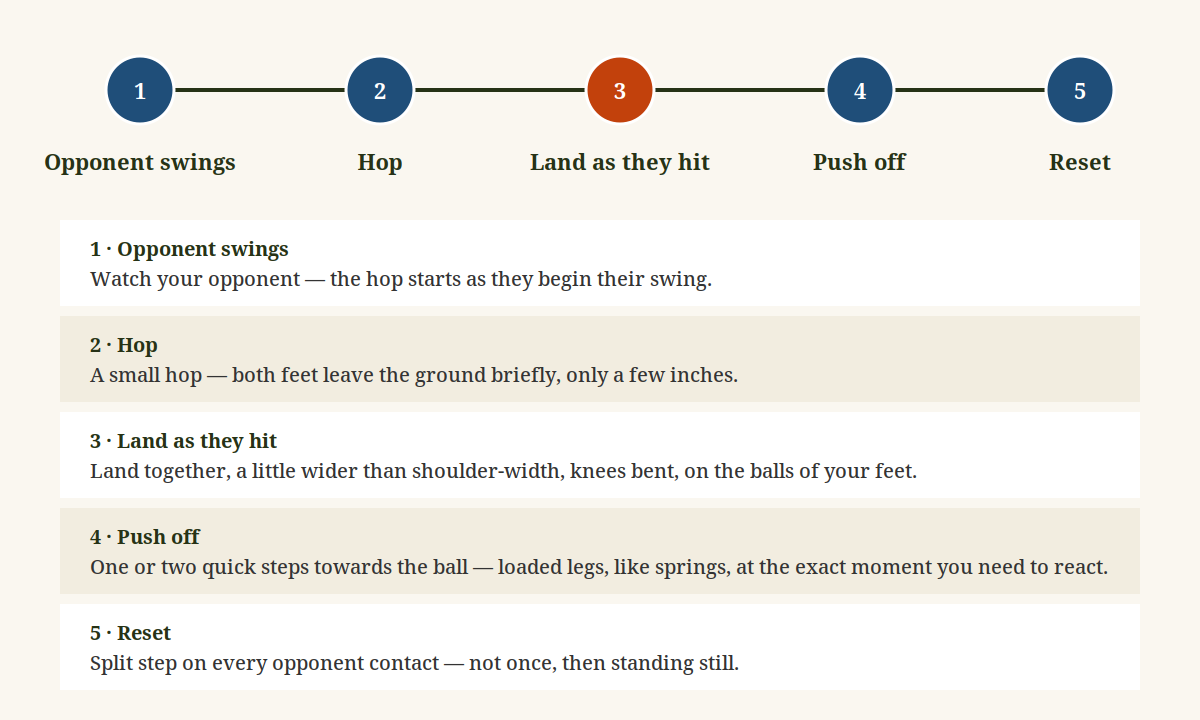
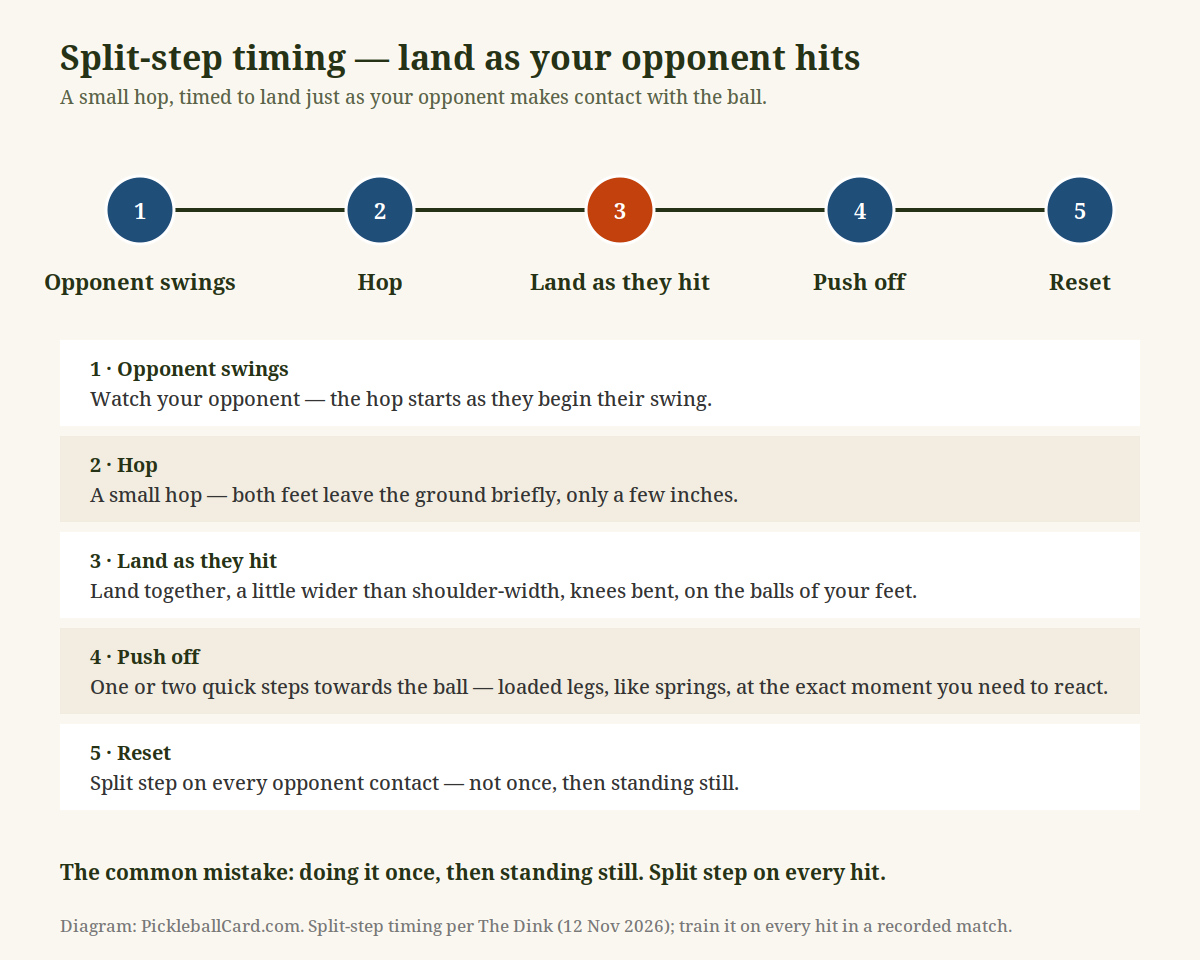
The split step is the most valuable footwork habit in pickleball. It is a small hop — both feet leaving the ground briefly and landing together, a little wider than shoulder-width, knees bent — timed to land just as your opponent makes contact with the ball. Landing as they hit loads your legs like springs at the exact moment you need to react.
Stand at the kitchen line, paddle up. As your partner swings to hit, hop a few inches, land on the balls of your feet, take one or two quick steps towards the ball and reset. Split step on every opponent contact. The common mistake is doing it once and then standing still. Train the timing without a court: split step on every hit in a recorded match. See our guide to the pickleball split step.
The Lateral Shuffle
Most pickleball movement is sideways, especially at the kitchen. The lateral shuffle covers that ground without turning your body from the net or crossing your feet. Push off the foot furthest from where you want to go, step sideways with the near foot, then bring the trailing foot back to shoulder-width. Stay low, knees bent, paddle in front of you. Keep steps short and quick: long lunges leave you stretched out and slow to change direction.
Drill: set two cones about 10 feet apart at the kitchen line. Start in the middle, split step, shuffle to the right cone, touch it, and shuffle back left to the other cone. Do 3 sets of 8 round trips, resting about 45 seconds between sets. Keep your paddle up throughout.
Kitchen Movement: Small Steps, Staying Low
The kitchen is where footwork laziness costs the most. A dink lands two feet to your left, and instead of taking a small shuffle step you keep your feet planted and stretch your arm. The result is usually a ball popped up or dumped into the net. Move your feet to the ball, even when it is only a step away, with small, quick, low shuffle steps.
Three habits help: step, then hit (plant your feet before you swing); shuffle along the kitchen line rather than stepping into the non-volley zone; and pivot and recover after reaching wide, turning your feet back to face the net. Practise with PicklePlayGuide’s kitchen ladder drill: shuffle side to side through cones across the kitchen, never crossing your legs.
The T-Drill
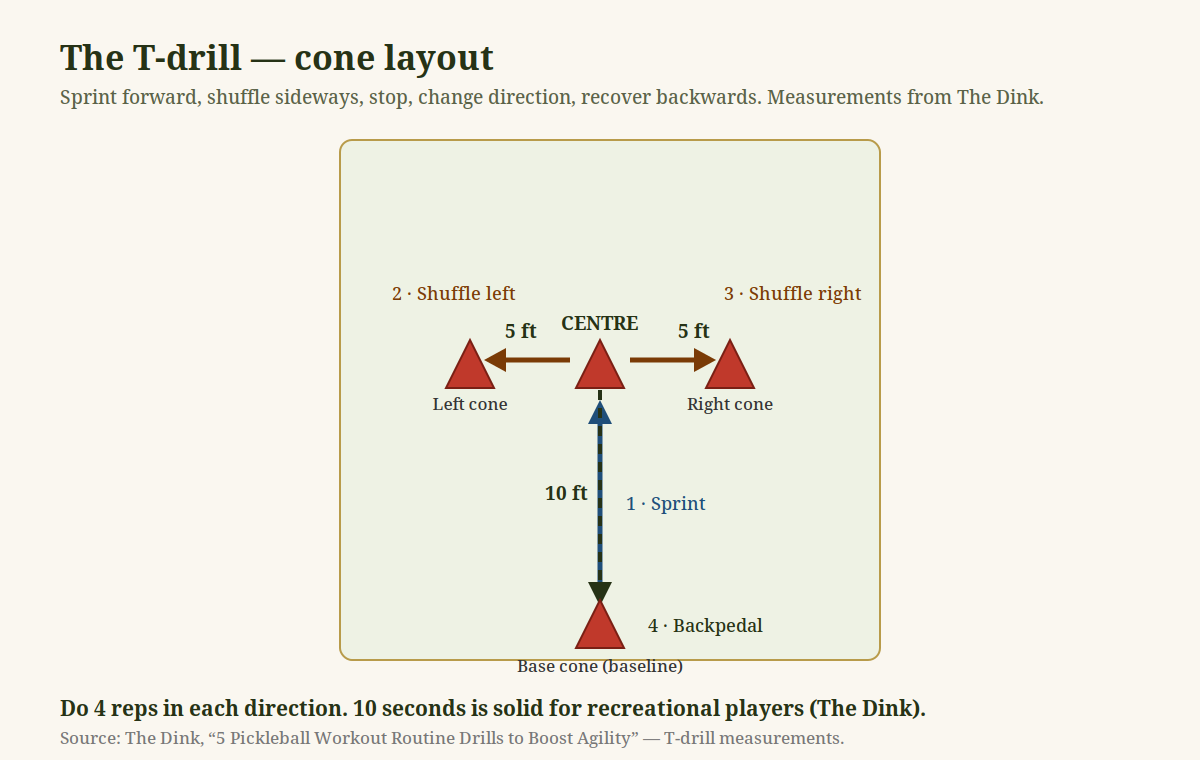
The T-drill trains the sequence a real point demands: sprint forward, shuffle sideways, stop, change direction, recover backwards. Place four cones in a T: one at the baseline, one 10 feet forward in the centre, and one 5 feet to each side of it — the measurements in The Dink’s version. Sprint to the centre, shuffle left, shuffle right, shuffle back to the centre, then backpedal to the base. That is one rep.
The hard part is the stopping: decelerating under control and pushing off in a new direction without stumbling. Do 4 reps in each direction. The Dink suggests 10 seconds is solid for recreational players.
Ladder Drills
An agility ladder works for pickleball with one condition: keep your paddle up and your eyes forward, not down at the rungs. Staring at your feet trains the wrong habit. No ladder? Use chalk or tape lines instead.
- Two-in, two-out. Both feet step into each box, then out laterally. Stay low and quick. The best first pattern, simple enough to do with eyes up.
- Ickey shuffle. One foot in, the other out, as you advance. PicklePlayGuide lists it among its five proven ladder drills.
- Single-leg hops. Hop through each box on one foot, then switch feet next pass.
Run the three patterns, rest 60 seconds, repeat for 3 sets.
Reaction and Shadow Drills
Pre-planned drills build the shapes; reaction drills build the speed of deciding. In a match you rarely know where the ball is going until the last moment, so some training should be unpredictable.
- Shadow split step. A partner tosses balls randomly left or right. Split step as they release, then explode towards the ball. PicklePlayGuide lists this first among its agility drills.
- Reaction ball drop. At the kitchen line, a partner drops a soft ball randomly left, right or centre. Split step and catch it before it bounces twice.
- Shadow footwork circuit. Shuffle right and mime a forehand, shuffle left and mime a backhand, sprint to the kitchen and split step, then backpedal. Good for practising pickleball alone. See our guide to the pickleball practice wall.
The drills at a glance:
| Drill | What it trains | How to do it |
|---|---|---|
| Lateral shuffle | Sideways movement at the kitchen | 3 sets of 8 round trips; 45 seconds rest |
| T-drill | Sprint, shuffle, stop, change direction, recover | 4 reps each direction; 10 seconds solid |
| Ladder drills | Quick feet, paddle up, eyes forward | 3 patterns, 60 seconds rest, 3 sets |
| Reaction ball drop | Reaction speed at the kitchen | Catch a dropped ball before it bounces twice |
| Kitchen ladder | Small shuffle steps along the kitchen line | Shuffle through cones across the kitchen |
A Simple Weekly Routine: Three Short Sessions
PicklePlayGuide suggests three sessions a week — technique, speed and reaction, and a mixed session. The Dink likewise recommends two to three sessions a week, and says you should notice meaningful improvements in 4 to 6 weeks. That is The Dink’s claim, not a guarantee.
Session 1 — Technique (15 minutes). Warm up 5 minutes, then 5 minutes of split-step practice at the kitchen and 5 minutes of slow, clean lateral shuffles. Finish with ladder work.
Session 2 — Speed and reaction (15–20 minutes). Warm up 5 minutes. Then 4 T-drill reps each direction, 3 sets of 8 lateral shuffle round trips, and 5 minutes of a reaction drill.
Session 3 — Mixed, on court (15–20 minutes). Warm up 5 minutes, then a figure-8 cone drill, a transition-zone shadow drill, and a kitchen ladder shuffle with a partner feeding balls.
Do them on non-consecutive days. If you only have one session a week, do Session 1.
Common Footwork Mistakes
- Looking down at your feet. It kills peripheral vision and slows reactions. Keep your eyes up.
- Overstriding. Long steps land on your heels and act as a brake. Use short, quick steps.
- Crossing your feet in a shuffle. It tangles and unbalances you. Shuffle parallel; save crossovers for distance.
- Standing tall between shots. Straight legs mean a slow first step. Stay low.
- Skipping the split step. The Dink calls it the most common footwork error in recreational play. Fix this first.
Safety Notes
Agility work is explosive — quick stops, direction changes, small hops — so warm up 5 to 10 minutes first with dynamic movement: light jogging, leg swings, arm circles, gentle shuffles. Wear court shoes with good lateral support and drill on a clean, dry surface.
Stop if you feel sharp pain; do not push through it. This article is general information, not medical advice, and cannot diagnose or treat an injury. If pain persists, or you have an existing joint, knee, ankle or balance problem, speak to a qualified health professional before starting a new exercise routine. See our guide to common pickleball injuries.
Frequently Asked Questions
How often should I practise pickleball footwork drills?
Two to three short sessions a week, roughly 15 to 20 minutes each, according to The Dink.
How long does it take to see results?
The Dink says meaningful improvements in 4 to 6 weeks. Research it cites, in the Journal of Aging and Physical Activity, found reactive movement speed improved by up to 18% within six weeks of agility training.
What is the split step in pickleball?
A small two-footed hop made just as your opponent hits the ball. You land on the balls of your feet, knees bent, feet a little wider than shoulder-width, ready to push off in any direction.
Can I do agility drills without a partner or a court?
Yes. Ladder patterns with chalk or tape lines, shuffles between two markers, shadow split steps to a recorded match, and a reaction ball dropped from chest height all work alone. A wall adds hitting — see our pickleball practice wall guide.
Should my feet cross when I shuffle sideways?
No. Keep them parallel: push off the far foot, step with the near foot, bring the trailing foot back to shoulder-width. Crossing slows you down and unbalances you.
Why do I keep getting caught flat-footed at the kitchen?
Usually one of three habits: standing tall, skipping the split step, or reaching instead of taking a small shuffle step. Fix the split step first.
Sources
- The Dink Pickleball, “5 Pickleball Workout Routine Drills to Boost Agility”, https://www.thedinkpickleball.com/5-pickleball-workout-routine-drills-to-boost-agility/ — accessed 12 Nov 2026. T-drill and ladder drills (cone measurements, 4 reps each direction, 10 seconds solid), lateral shuffle drill (3 sets of 8 round trips, 45 seconds rest), 2–3 sessions a week, improvements in 4–6 weeks; the 3–8 second rally figure attributed to USA Pickleball coaching resources and the 18% in six weeks finding from the Journal of Aging and Physical Activity.
- PicklePlayGuide, “Best Pickleball Agility Drills (2026 Ultimate Guide)”, https://www.pickleplayguide.com/blog/best-pickleball-agility-drills-2026-ultimate-guide/ — accessed 12 Nov 2026. Shadow split step, reaction drills, ladder progressions, kitchen ladder, three-session weekly structure.
- PicklePlayGuide, “7 Proven Ladder Drills for Pickleball (2026)”, https://www.pickleplayguide.com/blog/7-proven-ladder-drills-for-pickleball-2026/ — accessed 12 Nov 2026. The five ladder drills, including Ickey shuffle and single-leg hop.
- The Dink Pickleball, “How to Improve Pickleball Footwork: 5 Pro Drills”, https://www.thedinkpickleball.com/how-to-improve-pickleball-footwork-5-pro-drills/ — accessed 12 Nov 2026. Split step activation drill, figure-8 shuffle, transition zone sprint-and-stop.
- Balls With Holes, “Pickleball Footwork: The Real Reason You Miss Shots”, https://www.ballswithholes.com/articles/pickleball-footwork — published 3 Sep 2026, accessed 12 Nov 2026. Kitchen-line reaching habit.

Shoaib is the publisher of Pickleball Card. He oversees the site’s guides to pickleball rules, ratings, strategy and gear, all researched from primary sources — the USA Pickleball Rulebook, DUPR and manufacturer documentation — and updated as the game changes.