Doubles pickleball is a team game first and a shot-making game second. If you know the basic rules and can keep a rally going, the fastest way to win more points is not a harder drive — it is standing in the right place, moving with your partner, and agreeing in advance who takes the ball down the middle.
The Simple Default Formation
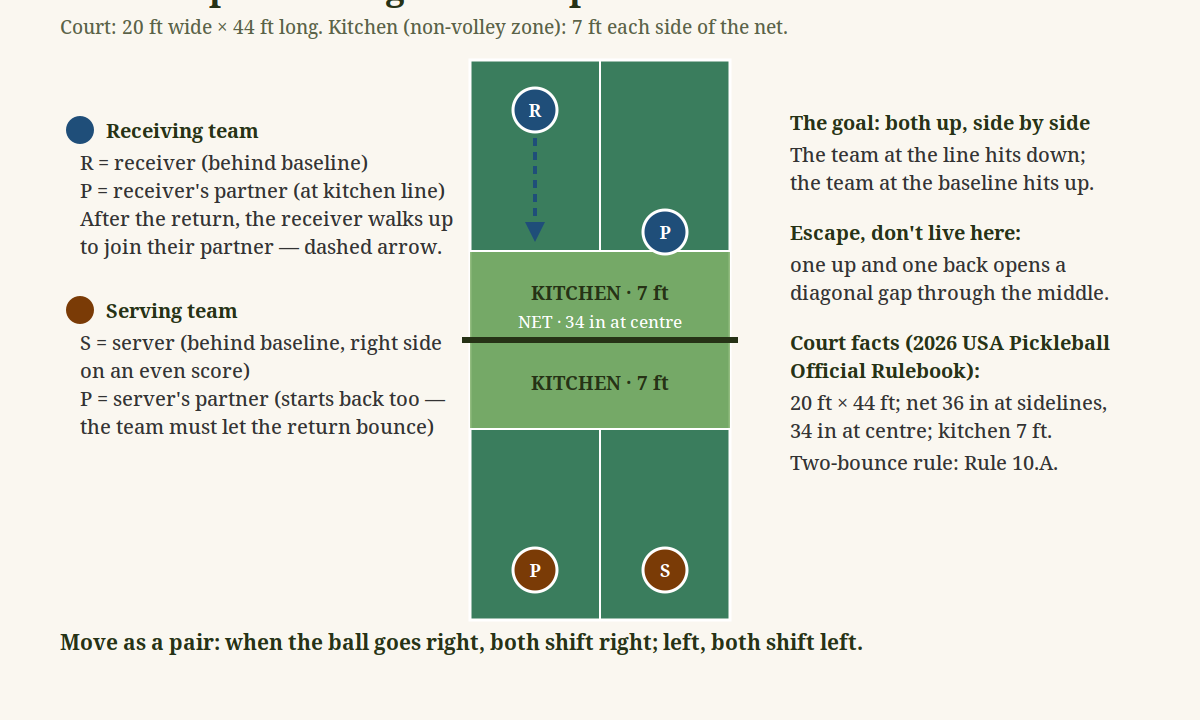
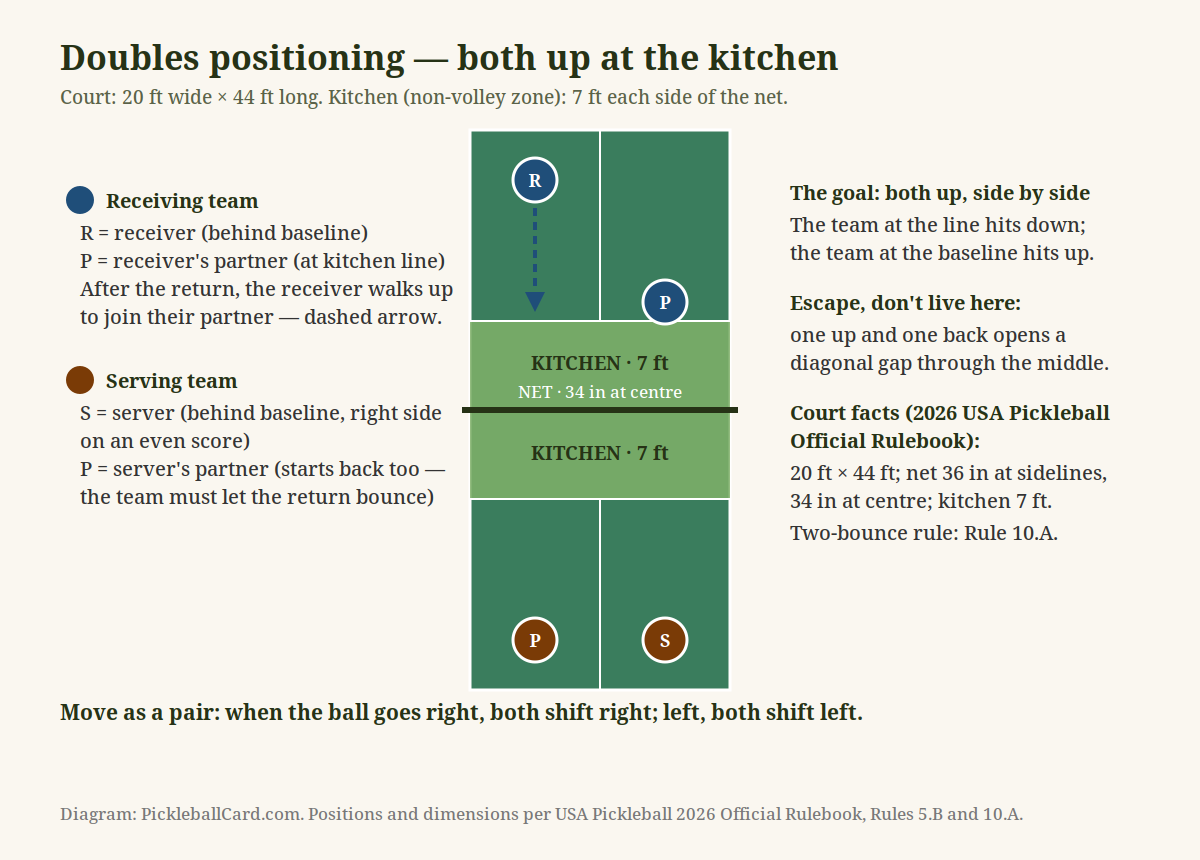
Once a point settles, both teams should be at the kitchen line, side by side, paddles up. From there you can hit down at your opponents’ feet and cover most of the court between you.
The two-bounce rule shapes how each team gets there: the serve must bounce before the return, and the return must bounce before the serving team hits it (Rule 10.A, 2026 USA Pickleball Official Rulebook). Receiving, your partner starts at the kitchen line; you return deep, then walk straight up to join them. Serving, both of you start back, because you must let the return bounce.
Both up is the goal; both back is a safe fallback when a lob pushes you off the line; one up and one back is the position to escape. It opens a diagonal gap through the middle, and the back player must hit everything upward.
Four Core Principles
1. Move as a pair. When the ball goes right, both shift right; left, both shift left. Stay roughly a paddle-and-a-half apart, so no gap opens in the middle.
2. Get to the kitchen together, and stay there. The team at the line hits down; the team at the baseline hits up. Step back together only if a lob forces you off the line.
3. Keep the ball low until someone lifts it. Dink crosscourt as your default — lowest part of the net, most margin for error. Aim at your opponents’ feet and wait; the attackable ball is the high one, not the hard one.
4. Aim at the middle and the weaker side. Balls down the middle confuse two opponents at once or force a weak backhand. A steady ball at the weaker player’s backhand foot beats a flashy winner attempt at the stronger player — a key difference from singles (see the difference between pickleball singles and doubles).
Serve and Return Positioning
Serving team: the server stands behind the baseline in the correct service court for the score, and the partner starts back too, near the baseline — not at the net, where the return could be volleyed before it bounces and cost a fault. Serve deep, ideally toward the receiver’s backhand, and stay back to play the third shot.
Receiving team: the receiver stands behind the baseline; the partner starts at the kitchen line, ready to cover the middle. After the return, the receiver moves up to join them. Unsure who serves from which side? Check the pickleball doubles rules before building habits on a wrong rotation.
| Situation | Where the teams stand |
|---|---|
| At the serve | Serving: server behind the baseline, partner back too. Receiving: receiver behind the baseline, partner at the kitchen line |
| After the return | Serving team stays back for the third shot; receiver walks up to join their partner |
| Point settled | Both teams at the kitchen line, side by side |
| Lob pushes you off the line | Both teams step back together |
The Third Shot as a Team
The third shot decides whether the serving team gets to the net or spends the point defending. If the return is low or deep, hit a third-shot drop — a soft, arcing shot into your opponents’ kitchen that forces them to hit up — and move forward while it is in the air. If the return is short or high, a firm, low drive at the middle or the weaker player’s feet can work instead, and can set up a drop on the fifth shot. Move up only as far as the shot allows: a good drop buys three steps, a weak one buys one step and a reset. The server’s partner must move with the server.
Who Takes the Middle?
Middle balls cause more confusion in beginner doubles than any other shot, and the rulebook does not settle it — there is no official rule assigning middle balls to either partner. Agree on a rule before the game, and use short calls during it.
Default: the forehand in the middle takes it. For two right-handed players, that is usually the player on the left, whose forehand faces the centre line (see who should take the middle in pickleball). Override: the better-positioned player takes it. If the forehand player is stretched wide or off balance, the balanced player — even on a backhand — should take it.
Call it early, then commit. Say “Mine!” or “Yours!” as your opponent makes contact, while the ball is still crossing the net; a late call creates more confusion than silence. Agree one sentence before your first game: “Forehand takes the middle unless one of us is pulled wide — then the player in the centre takes it.”
Stacking, Explained Plainly
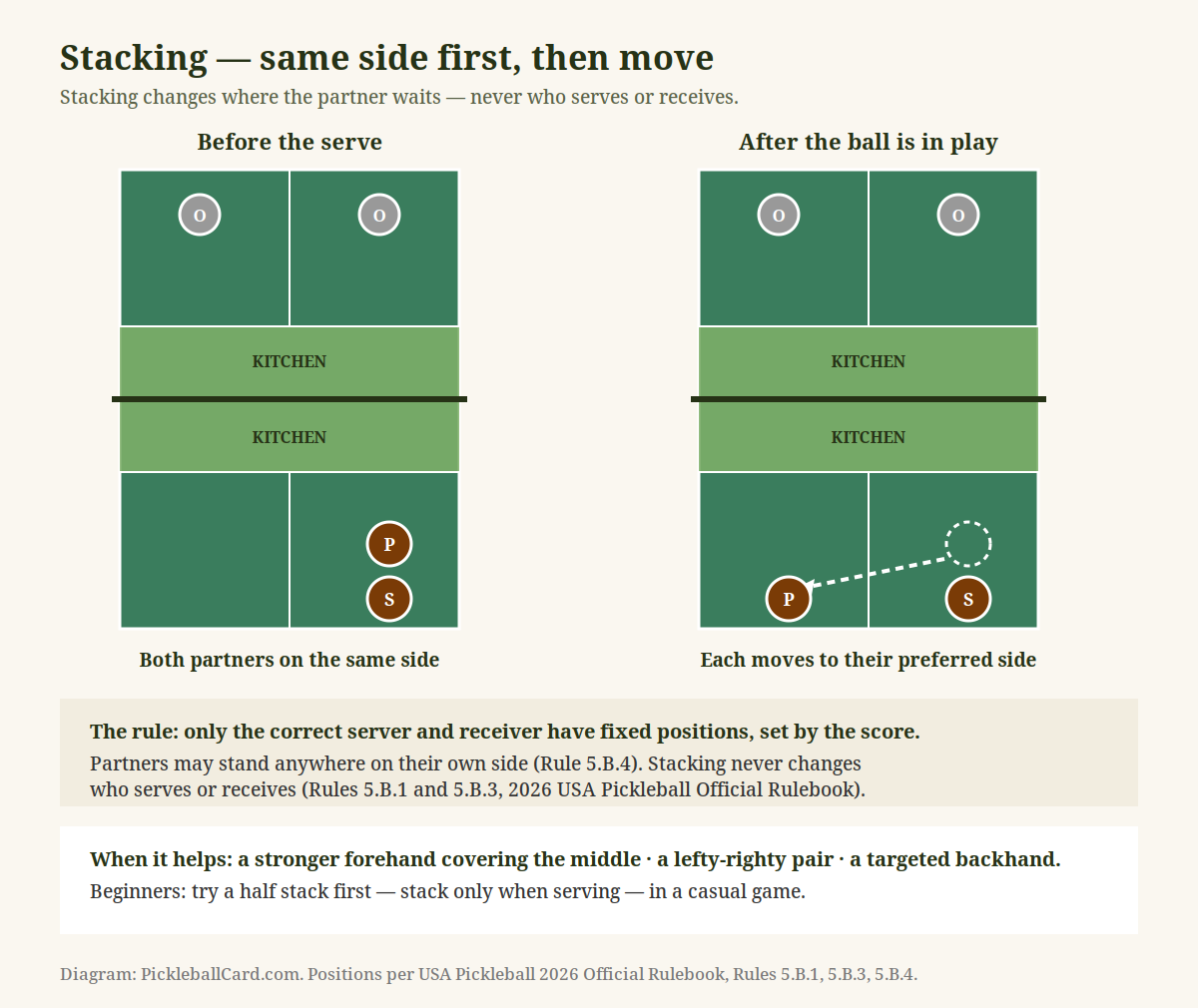
Stacking means both partners line up on the same side before the serve or return, then move to their preferred sides once the ball is in play. It is legal: under the 2026 USA Pickleball Official Rulebook, only the correct server and receiver have fixed positions, set by the score (Rules 5.B.1 and 5.B.3); their partners may stand anywhere on their own side (Rule 5.B.4). Stacking changes where the partner waits — never who serves or receives.
When it helps: a clearly stronger forehand that should always cover the middle; a lefty-righty pair wanting both forehands in the middle; a backhand opponents keep targeting. When beginners should not stack: most of the time, at first — if you still think hard about who serves from which side, stacking adds a second thing to track while you should be watching the ball. Try a half stack — stack only when serving — in a casual game. See what is stacking in pickleball for full and half stacking and hand signals.
Poaching: When to Cross, When to Stay Home
A poach is crossing the centre line to take a ball that would normally be your partner’s. Done well, it ends points; done badly, it leaves your side empty and your partner covering two-thirds of the court alone.
Poach when the ball is high, slow, and near the middle — a floating dink, a popped-up reset, or a soft return. If you can take it above net height and hit down, cross and finish it; the same applies when your partner is stuck deep. Stay home when the ball is low, fast, or wide. Crossing to hit up from below net height is the worst trade in doubles. When you do poach, your partner slides across behind you. Call “Mine!” early, keep poaches rare — a few per game — with a simple pre-serve signal: an open hand behind your back for “I’m going”, a fist for “I’m staying.” See pickleball poaching and pickleball mixed doubles strategy.
Communication and Simple Signals
Keep the language small so it works under pressure. Before the point, one sentence: who takes the middle, whether anyone is poaching, and where the serve is going. During the point, five words: “Mine.” “Yours.” “Out” or “Leave.” “Switch.” “Up” or “Go.” Between points, ten seconds of talk — re-agree the middle rule, check whether your partner slid across after a poach — saves ten confused points.
Common Beginner Mistakes
Most beginner errors are positioning errors in disguise: playing one up and one back all rally; both players chasing the same ball; standing still after the return; speeding up a low dink; poaching balls you have to lift; having no plan for the middle. Each is fixed by a rule above — move forward together, agree the middle rule, dink low, and poach only balls you can hit down.
Three Simple Drills to Practise as a Team
1. Move-as-a-pair dinks. Both teams dink crosscourt at the kitchen line, low at each other’s feet. Every third ball, the hitter calls “right” or “left” and both partners shuffle that way together. Aim for ten in a row with no gap between partners. It uses the dinking drills in our pickleball drills guide.
2. Third-shot walk-up. One team serves, the other returns deep. After every third shot, the serving team must take at least two steps toward the kitchen before the next ball. A point only counts for the serving team if both players reach the line during the rally.
3. Mine-or-yours middle balls. One player feeds balls across the net — middle, left, right. The receiving pair must call “Mine!” or “Yours!” before the ball crosses the net. No call, or a late call, means the feed is replayed. For solo days, the wall drills in our pickleball practice wall guide keep dinks and volleys sharp.
Frequently Asked Questions
What is the best doubles formation for beginners?
Both players at the kitchen line, side by side. Treat one up and one back as a position to escape, not a place to live.
Should beginners learn stacking?
Not first. Learn conventional positioning, the third-shot drop, and a clear middle-ball rule first. Stacking helps with a clear reason — a lefty-righty pair, a much stronger forehand, or a targeted backhand.
Who should take the ball down the middle in doubles?
By default, the player whose forehand covers the middle — for two right-handed players, usually the player on the left. But the balanced player should take it if the forehand player is stretched wide. Agree the rule before the game and call “Mine!” or “Yours!” early.
When should I poach in pickleball doubles?
Poach high, slow balls near the middle that you can hit down, and balls your partner cannot reach because they are stuck deep. Do not poach low balls, balls your partner is set for, or wide balls on their sideline.
Why is one up and one back a bad position in doubles?
It opens a diagonal gap through the middle and leaves the back player hitting everything upward while the front player defends alone. It is correct only briefly — while the serving team plays the third shot.
Sources
- USA Pickleball, 2026 Official Rulebook, Rules 5.B.1, 5.B.3, 5.B.4, 10.A. Accessed 12 Nov 2026. https://usapickleball.org/what-is-pickleball/official-rules/
- Pickleball Paddle HQ, “Pickleball Doubles Strategy,” updated 1 July 2026. https://www.pickleballpaddlehq.com/guides/pickleball-doubles-strategy
- The Dink, “Pickleball Doubles Strategy for Beginners.” https://www.thedinkpickleball.com/pickleball-doubles-strategy-for-beginners-5-simple-tips/
- Pickleball Union, “How to Own the Middle.” https://pickleballunion.com/cover-the-middle-correctly-pickleball-doubles/
- The Lab Pickleball, “Pickleball Stacking.” https://www.thelabpb.com/blog/pickleball-stacking-miami
- Pickleball US, “Pickleball Stacking Strategy,” updated 9 July 2026. https://pickleballus.org/play/strategy/doubles/stacking/
- Pickleland, “How to Poach in Pickleball Doubles,” 25 July 2026. https://pickleland.com/how-to-poach-in-pickleball-doubles/
- The Dink, “How to Poach Effectively in Pickleball.” https://www.thedinkpickleball.com/how-to-poach-effectively-in-pickleball/

Shoaib is the publisher of Pickleball Card. He oversees the site’s guides to pickleball rules, ratings, strategy and gear, all researched from primary sources — the USA Pickleball Rulebook, DUPR and manufacturer documentation — and updated as the game changes.