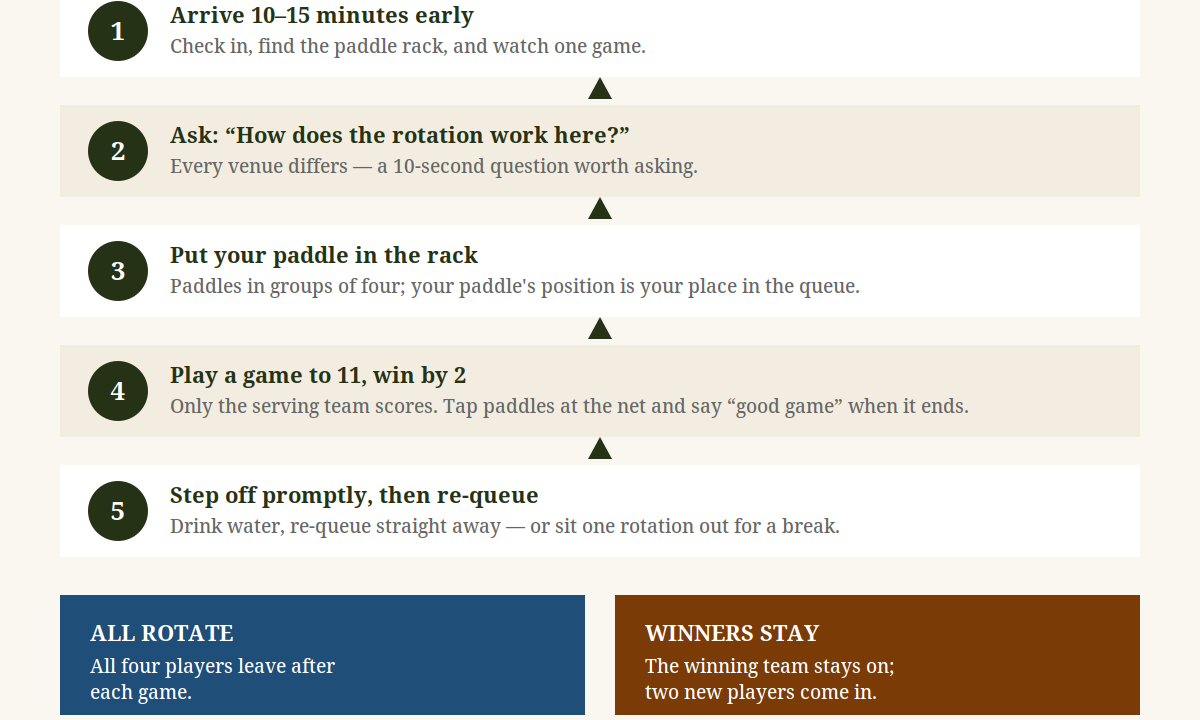
Open play is pickleball’s friendly front door: turn up alone, put your paddle in the queue, and rotate into doubles games with new partners. Bring a paddle, court shoes and water, learn the queue and score call, and you will be rallying within minutes.
Before You Go
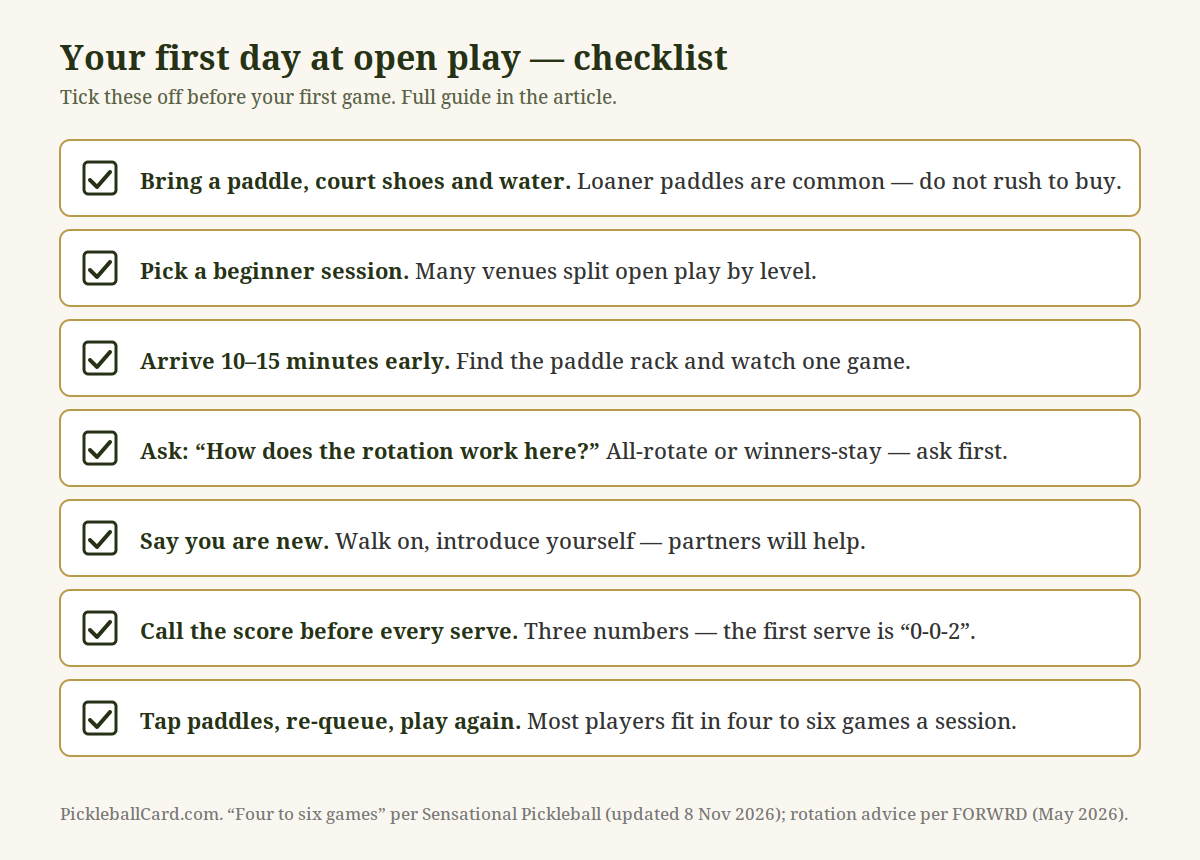
Pick a beginner-friendly session — many rec centres split open play by level, or mark some hours “beginner open play.”
Find a session through our guide to finding pickleball near you. Pickleheads — now USA Pickleball’s official court finder — is a good first stop, per FORWRD (May 2026).
Arrive 10 to 15 minutes early to check in, find the paddle rack, and watch one game. Read our how to play pickleball guide beforehand.
What it costs. Most public park courts are free. Rec centre open play usually runs $3–8 a session, indoor club sessions $10–20 (FORWRD, May 2026).
What to Bring
A paddle. Any beginner-friendly paddle will do. If you do not own one yet, do not rush to buy — many rec centres have loaners. When you are ready, our guide to the best pickleball paddles for beginners explains what to look for.
Court shoes. Pickleball is a sideways game, and court shoes are built for lateral movement, with a non-marking sole where indoor venues require it. As GetRallyPick puts it (July 2026), running shoes “will betray you the first time you shuffle sideways.”
Water, a towel, and a few balls. Bring a full water bottle and sip between games. Venues usually supply balls, but park sessions sometimes do not. Outdoor balls have fewer, larger holes and are heavier, so the wind carries them less; indoor balls are softer, with smaller holes (GetRallyPick, July 2026).
Comfortable clothes. Athletic clothes, a hat and sunscreen outdoors, eye protection if you want it.
Arriving and Joining the Queue
Open play is drop-in: no reservations, no assigned partners, no need to bring three friends. You join the rotation and play doubles with whoever is next in line; partners change each game.
At most venues the queue is physical — paddles in a rack, on a fence, or in a line on a bench, in groups of four — and your paddle’s position is your place in it.
First, find the rack and ask: “How does the rotation work here?” The answer differs from court to court. FORWRD (May 2026) makes the same point: getting the rotation wrong “creates friction immediately — it’s a 10-second question worth asking.” In all rotate, all four players leave after each game; in winners stay, the winning team stays on and two new players come in. Do not jump the queue, and never slide a friend’s paddle in behind yours to hold a place.
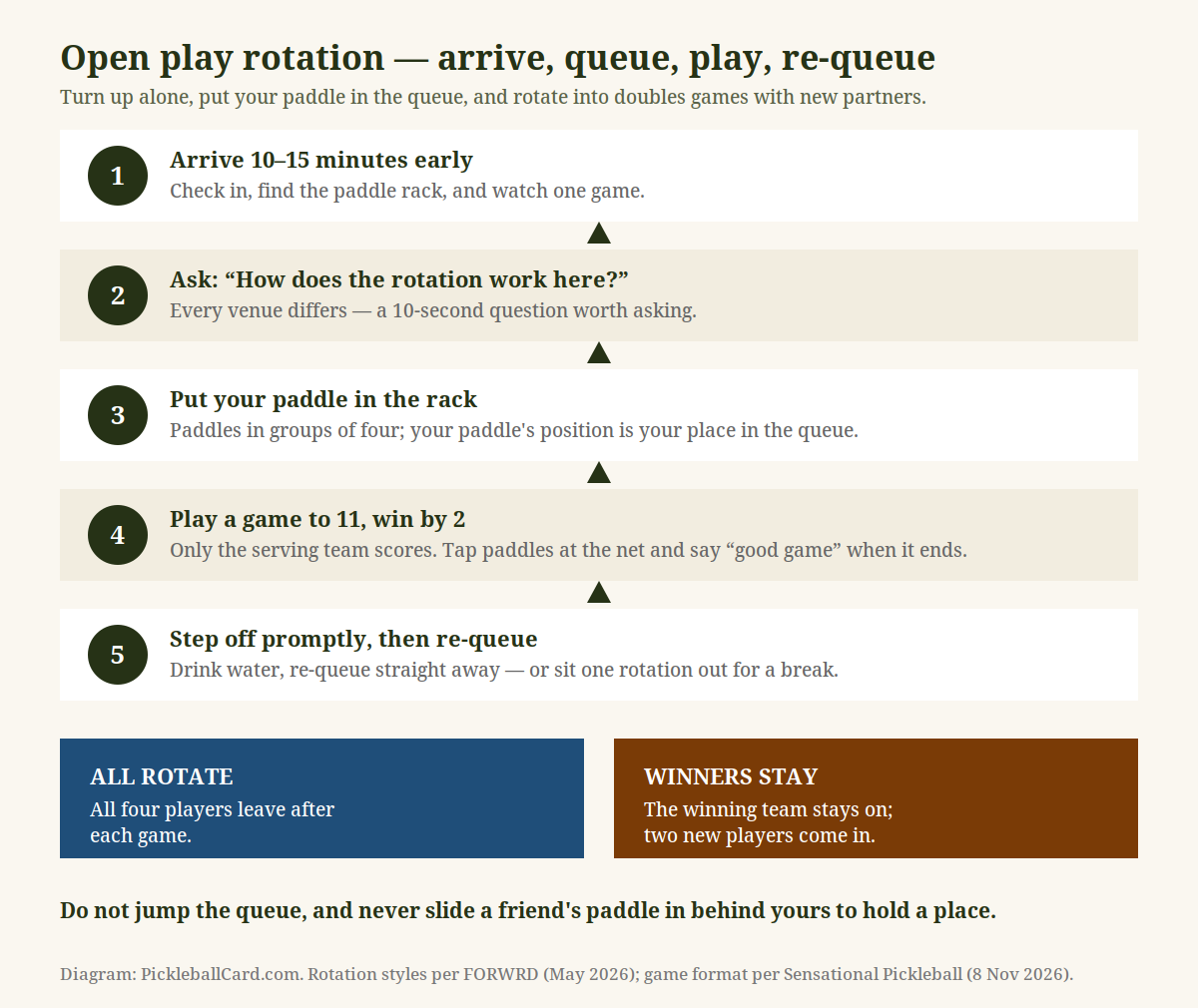
While you wait, watch a game and warm up lightly — games to 11 are short, so your wait is rarely long. When your paddle comes up, walk on, introduce yourself and say you are new. For more, see our guide to how pickleball open play works.
How a Game Starts
The four players decide who serves first — often a quick paddle spin. The server stands behind the baseline and serves underhand, diagonally into the opposite service box, below the waist, in an upward arc, clearing the 7-foot kitchen. A serve on the kitchen line is a fault; on any other line, the ball is in.
Then the two-bounce rule: the receiving team must let the serve bounce, then the serving team must let the return bounce. After that, anyone may volley. Do not power the serve — a deep, safe serve into the middle of the box is best on day one.
Games are usually played to 11, win by 2. Only the serving team can score: if the receiving team wins a rally, they get the serve, not a point. At the end, all four players tap paddles at the net and say “good game.” Then step off, re-queue, and do it again. Most players fit in four to six games a session (Sensational Pickleball, 8 Nov 2026).
Where to Stand
At the start of each point, each player has a home spot. The server stands behind the baseline, diagonally across from the receiver — right on an even score, left on an odd one. The server’s partner also starts behind the baseline — the serving team must let the return bounce. The receiver waits near the baseline; their partner starts at the kitchen line. After the serve and return, you can move anywhere on your side — and should, because the team at the kitchen line controls most rallies. After the return, the receiver moves up to join their partner; the serving team moves up when it can, usually after the third shot. A deep return lets you walk in behind it; a short one leaves you stranded.
Between shots, keep your paddle up in front of your chest, knees bent, and stay with your partner to cover the middle.
Calling the Score
The server calls the score before every serve, loudly enough for all four players to hear. In doubles it is three numbers: your score, their score, then the server number, 1 or 2. With 4 points to their 2, as first server, you call “4-2-1.”
The first serve of the game is always called “0-0-2,” because the first serving team only gets one server. When your team wins a point on your serve, you and your partner swap sides and the same person serves again.
If you forget the score, ask before you serve. As Sensational Pickleball notes (November 2026), “Do not worry if you get it wrong. Someone will help.” For a full walkthrough, see our guide on how to score in pickleball.
What to Do Between Games
Step off promptly when your game ends. Drink water and re-queue straight away if you want another game; if you need a break, sit one rotation out and tell the people behind you.
Use the wait to watch one player whose positioning you like, then ask them for one thing to work on.
Five Mistakes That Cost Beginners Points
| Mistake | Fix |
|---|---|
| Staying at the baseline | Move up after the third shot |
| Hitting everything hard | Serve and return deep |
| Volleying the return | Stay back; say “bounce” |
| Stepping into the kitchen | Let it bounce, then step in |
| Forgetting the score | Call the score every serve |
1. Staying at the Baseline
You serve or return, then stay planted at the baseline while your opponents settle at the kitchen line. The baseline feels safe, but it is where you lose from — the team at the line hits down, and you hit up. Fix: move forward whenever the rules allow: walk in behind your deep return, and move up after the third shot.
2. Hitting Everything Hard
Every ball gets a full swing. Hard shots from the baseline fly long, or come back at your feet. Placement beats power: a soft shot at opponents’ feet does more damage than a drive that sails out. Fix: aim for “in” over “impressive” — serve deep, return deep, keep rallies down the middle.
3. Volleying the Return of Serve
You serve, your opponent returns, and reflex takes over — you volley it out of the air. Fault: the serve and the return must both bounce before anyone volleys. Fix: after you serve, stay behind the baseline and say “bounce” to yourself.
4. Stepping Into the Kitchen to Volley
A high ball floats near the net. You step forward, volley it — and your foot is in the kitchen, or touching its line. Fault. You may stand in the kitchen and hit a ball that has bounced there, but you may not volley from inside it. Fix: if the ball will bounce in the kitchen, let it bounce, then step in; if not, keep your feet behind the line and reach.
5. Forgetting the Score — and Going Quiet About It
You lose track, guess rather than ask, and serve from the wrong side. Fix: call the score loudly before every serve, even if unsure — saying it lets someone correct you first.
Etiquette That Keeps You Invited Back
Call lines honestly. You call balls on your own side. If a ball lands on the line, it is in; if you cannot tell, give it to your opponent.
Wait for the rally to end before crossing behind a court. If a ball rolls onto another court, call “Ball!” loudly and do not chase it. Return stray balls underarm, only when their rally has ended.
Save coaching for people who ask for it. Do not over-apologise — a quick “my bad” is fine. And match the level of play: do not slam the ball at beginners. See our guide to pickleball etiquette and the unwritten rules.
A Simple Plan for Your First Session
Show up early, say you are new, serve and return deep, move to the kitchen line, and call the score before every serve.
Expect the score to confuse you for your first few games, and expect to volley a return by reflex at least once. Most people are rallying within their first ten minutes, as GetRallyPick observes. Once you have played your first game to 11, you are a pickleball player.
Frequently Asked Questions
Do I need a partner to go to open play?
No. Open play is designed for players who turn up alone — you join the paddle queue and are grouped with the next three players.
Do I need my own paddle for my first session?
Not necessarily. Many rec centres lend paddles to first-timers.
How long does a game of open play last?
Most games are played to 11, win by 2, and are short — usually well under half an hour — so you are rarely waiting long.
What if I do not know the score or where to stand?
Say so. Tell your partner you are new and ask for a reminder — asking is normal, far better than guessing.
Can I just watch a game before I join in?
Yes. Arrive early, watch one game, and notice how the queue, the serve and the score call work. Then put your paddle in the queue.
Sources
- Sensational Pickleball — “Your first game, step by step” (published 12 Oct 2026; updated 8 Nov 2026). https://www.sensationalpickleball.com/learn/getting-started/your-first-game/
- FORWRD — “How to Find Pickleball Courts Near Me: 6 Best Tools (2026)” (last updated May 2026). https://forwrd.co/blogs/pickleball/how-to-find-pickleball-courts-near-me
- GetRallyPick — “How to Play Pickleball: A Beginner Guide (US)” (updated July 2026). https://getrallypick.com/learn/how-to-play-pickleball.html

Shoaib is the publisher of Pickleball Card. He oversees the site’s guides to pickleball rules, ratings, strategy and gear, all researched from primary sources — the USA Pickleball Rulebook, DUPR and manufacturer documentation — and updated as the game changes.