You show up with a paddle, no partner and no plan. An hour later you are finishing your third game, paired with people you met at the gate. That is the whole promise of open play.
It is the default way recreational pickleball is organized across the United States. Public courts, rec centers, churches and clubs all run it. Yet the unwritten system — racks, stacks, rotations — baffles first-timers.
This guide explains exactly how pickleball open play works: what it is, how the paddle-rack queue works step by step, every common rotation format, the etiquette regulars expect, and how a beginner joins without the awkwardness.
Key Takeaways
- Open play means show up solo and rotate in. No partner, reservation or team is required. You queue up and get matched with whoever else is waiting.
- The paddle rack is the queue. Paddles sit in arrival order, usually left to right and top to bottom. Your paddle — not your body — holds your place in line.
- Rotation depends on crowd size. Quiet sessions let games run long; busy sessions use 4-on/4-off so everyone cycles through. Always ask what the rotation is.
- You do not need to be good to join. Beginner-friendly courts and skill-level racks exist specifically so new players get games at their level.
- Etiquette matters more than skill. Calling the score loudly, mixing partners, playing down with beginners and keeping pace are what get you invited back.
What Is Open Play in Pickleball?
Open play is a session format where courts are open to whoever shows up, and players rotate through games with changing partners and opponents. Nobody books a court; everyone shares.
The session is usually run by a facility, club or park system. Posted hours say “open play” for a block of time — say, 9 a.m. to noon — and players arrive and leave freely within it.
There are no assigned teams and typically no referees. Games are self-officiated, and the rotation system — not a schedule — decides who plays next. That is what makes it social and what makes it efficient.
It is also the main on-ramp to the sport. Most players learned the game, found their playing partners and earned their level entirely inside open play sessions, not in lessons.
Open Play vs Drop-In vs Reserved Courts
Three terms get mixed up at the front desk. They describe different things, and knowing the difference tells you what you are walking into.
| Term | What it means | What to expect |
|---|---|---|
| Open play | Scheduled session where everyone rotates through shared courts | A queue system runs during set hours; partners and opponents change |
| Drop-in | Often the same as open play, sometimes with a fee | Pay at the desk or show a membership; then join the same rotation |
| Reserved court | You book one court for your group at a set time | Your four stay together; no one rotates in on you |
Some facilities label open play sessions by level: beginner, intermediate or advanced open play. That is not gatekeeping — it is how players get even games instead of blowouts.
Who Open Play Is For
Everyone, genuinely. Sessions exist for brand-new players, for social regulars who play five mornings a week, and for competitive players sharpening their doubles.
Beginners do best at dedicated beginner open play or on courts marked for newer players. The level is matched, the pace is slower, and mistakes are expected rather than punished.
Strong players do best where the session is strong. A 4.0 player who joins beginner open play for easy wins helps nobody and annoys everybody. Match your session to your level.
How the Paddle-Rack Queue Works, Step by Step
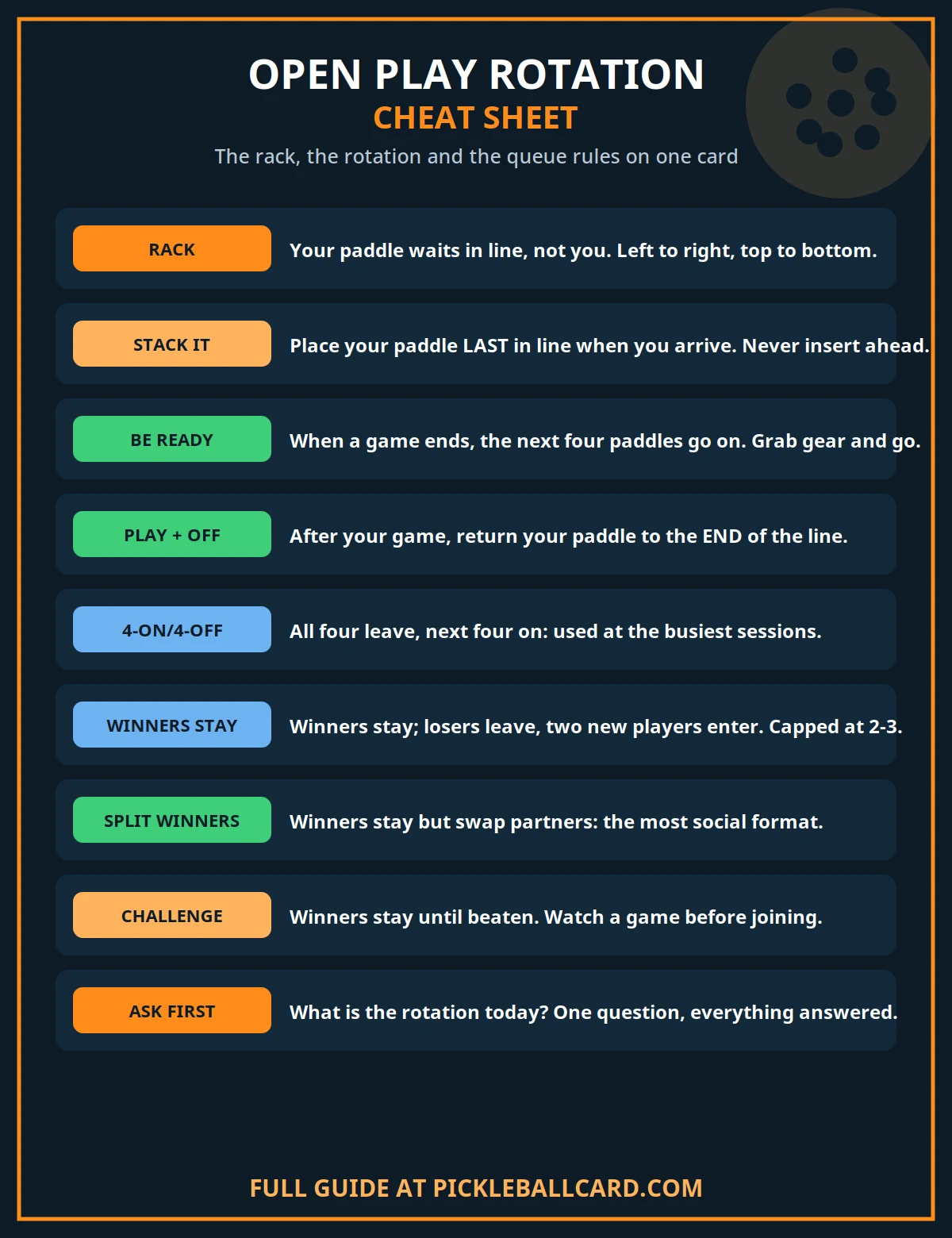
The paddle rack is a row of slots — a plastic bin, a wall rack or just a stretch of fence — where waiting players park their paddles in arrival order. First paddle in line plays next.
The logic is simple: when all courts are full, your paddle waits in line instead of you standing around. As games finish, the next paddles in line go on. Fair, visible and self-running.
- Find the rack when you arrive. It sits near the courts or the gate, sometimes on a bench or table. If you cannot spot one, ask: “Where do paddles go?”
- Read the order direction. Most racks run left to right, top to bottom, but not all. Watch which end new paddles join before you place yours.
- Place your paddle last in line. Add it to the end — the far right or the bottom slot. Never move anyone else’s paddle or insert yours ahead.
- Mark your paddle first. Many paddles look identical. Put your name on yours with tape or a marker so nobody mistakes it for theirs in the line.
- Stay nearby and watch the games. When a game ends, players coming off will call out “open court” or “next four,” and the next paddles in line are up.
- Be ready when your paddles are called. Grab your gear, water and balls and head to the empty court promptly. The line moves on your pace.
- After your game, go to the end of the line. Whether you won or lost, your next game starts at the back of the queue. Nobody keeps a spot.
Some racks use a slider, a marker ball or a clip to show which paddle is up next, which removes all doubt. Others just trust the left-to-right order. Both work if everyone respects them.
What If There Is No Rack?
Informal courts still queue — paddles line up on a bench, a table or the ground in arrival order. The system is identical; only the furniture is different.
When in doubt, announce yourself. “I am new here — how does the rotation work?” Regulars will tell you the house version, because every venue has small local variations.
The Best First Question to Ask
Ask this before your paddle ever touches the rack: “What is the rotation today?” The answer tells you everything — how many come on, whether winners stay, and how long you will wait.
That one question also marks you as someone who respects the system. Regulars notice, and it buys you goodwill that lasts your whole session.
The Main Rotation Formats, Compared
Rotation formats answer one question: when a game ends, who stays and who leaves? The answer changes with crowd size, competitiveness and venue rules. Here is the full landscape.
| Format | How it works | Best for | Watch out for |
|---|---|---|---|
| 4-on / 4-off | All four players leave when the game ends; the next four paddles go on | Very busy sessions with a long wait line | Partners split up unless the venue allows paired paddles |
| Winners stay | The winning team stays; the losing team leaves and two new players enter | Smaller or moderately busy groups | One strong team can hold the court for a long time |
| Winners stay and split | Winners stay but swap partners; two new players join, one per team | Social sessions and mixed levels | Do not refuse to split — it breaks the format |
| 2-on / 2-off | Two players leave and two enter; which two depends on local rules | Small groups where everyone knows each other | The order can get fuzzy without someone managing it |
| Challenge court | Winners stay until beaten; challengers enter in queue order | Competitive sessions and confident players | Beginners can wait a long time — watch a game first |
| Skill-level courts | Separate racks or courts for beginner, intermediate and advanced | Large mixed-skill sessions | Check how the session defines each level before you pick a queue |
4-On / 4-Off: The Busiest-Session Format
When the wait line is long, fairness means speed. Everyone plays one game to 11 and comes off, and the next four go straight on. No team holds a court.
This is the format that gives the most players the most games per hour. If you arrive mid-morning on a Saturday at a packed park, this is almost certainly what you will find.
Partners rarely stay together under 4-on/4-off, because the next four paddles in line decide the teams. Some venues let two paddles stack together as a pair — accepted for a few games, not all session.
Winners Stay (and the Two-or-Three Cap)
In smaller groups the winners stay on and the next two players from the queue take on the losers’ side. It rewards winning and keeps the games continuous.
Most sessions cap how long winners can stay — usually two or three consecutive games — then they step off so others get a turn. The cap is what keeps it friendly rather than territorial.
This format suits moderately busy sessions where the queue is short enough that losing teams are not waiting forty minutes for a rematch.
Winners Stay and Split: The Social Format
The winners remain on court but separate, each taking a new partner from the incoming players. Skill spreads around instead of concentrating on one side.
This is the friendliest competitive format. It breaks up cliques, balances lopsided games and makes mixing partners the default rather than the exception.
If you refuse to split with your partner in a split-winners session, you are not protecting your game — you are breaking the rotation everyone else is following. Find a challenge court or a reserved hour instead.
Challenge Courts: The Competitive Lane
Large facilities often set one or two courts aside as challenge courts. Winners stay until someone beats them, and the challengers queue in order. It is the local leaderboard made physical.
The level here runs higher than the rest of the session. If you are not sure you match the speed, watch one game before stacking your paddle. Nobody judges the watching; everyone judges the unprepared.
Challenge courts absorb the competitive players so the regular open-play courts stay social. Both lanes need each other — the session works because they are separate.
Skill-Level Courts and Racks
Big sessions divide courts — or even separate paddle racks — by level. Beginners get their own rotation, intermediates theirs, advanced theirs. Everyone gets even games.
Level labels vary wildly between venues. One park’s “intermediate” is another’s advanced. Ask how the session defines each tier, or watch a few rallies before choosing your queue.
When you are between levels, start at the lower one for a session or two. Earning your way up is respected; camping down to dominate is not.
Your First-Visit Checklist
- Paddle. Any legal paddle works — nobody inspects your gear at the gate. Loaner paddles are common at beginner sessions, so ask if you do not own one yet.
- Court shoes. Tennis or pickleball shoes with lateral support. Running shoes roll ankles on hard cuts, and some indoor venues require non-marking soles.
- Water. More than you think. Sessions run two to three hours in the sun, and most courts have no fountain nearby.
- A ball or two. Facilities provide most balls, but bringing your own is good form — balls crack constantly and everyone appreciates a fresh one.
- Sun and sweat gear. Hat, sunglasses and a towel for outdoor summer sessions. A change of shirt turns a sweaty stop into a second wind.
- Your name on your paddle. Tape or marker. It is the simplest etiquette on this list and the one beginners most often skip.
- Arrival time with intent. Arrive near the session start, not at peak hour. Early sessions are emptier, calmer and friendlier to new faces.
- Ten minutes of observation. Before your first game, watch the rack, the rotation and the warm-ups. You will learn the local system faster watching than reading.
- An introduction. Say you are new and ask how things run here. Regulars who would never correct a stranger will happily coach a newcomer.
- Warm-up readiness. When your paddles are called, go. Keep your pre-game warm-up to two or three minutes so the queue keeps moving.
Open-Play Etiquette That Gets You Invited Back
Etiquette in open play is not decoration. It is the operating system the whole rotation runs on. Our full guide to pickleball etiquette and the unwritten rules covers the sport broadly; this is the open-play edition.
Call the Score Loudly, Every Point
There are no referees, so the server calls the score before every serve — loud enough that all four players and the sideline hear it. Silent scoring breeds disputes.
Calling the score is also how partners stay synced on which server it is. A loud, clear call prevents the “whose serve is it?” stoppage that slows every game.
When in Doubt, Call It In
Line calls belong to the receiving side, and the honest rule is simple: if you did not clearly see the ball land out, it was in. Generosity is the currency of rec play.
Arguing a line call you barely saw buys nothing and costs everything. The players around you remember how you handled it long after they forget the score.
Mix Partners — Do Not Build Fortresses
Open play’s whole point is playing with different people. Splitting up and mixing partners keeps games balanced, builds the community and improves your own game faster than any private practice.
Arriving as a pair is fine; refusing to ever separate is not. If you only want to play with your partner, that is what reserved courts and private hours are for.
Play Down Gracefully
You will inevitably face someone well below your level. Do not smash at them. Work your soft game — dinks, drops, resets — and keep rallies alive instead of ending them.
The player you crush today remembers it next month. The player you lifted up with a patient, competitive game remembers that too — and tells everyone.
Keep the Pace
Short warm-ups, prompt court changes and quick games are the grease in the system. When people are waiting, five-minute warm-ups and slow resets between points are a quiet theft of everyone’s court time.
Between games, clear the court fast. Retrieve your paddle, your bag and your water in one motion, because the next four are already waiting at the gate.
Safety Calls Come First
Call “ball on court” the instant a stray ball enters another game. Everyone stops, retrieves it and resumes. Chasing a ball across an active court without a call is how ankles and collisions happen.
Never reach onto another court to grab your ball while their rally is live. Wait for their point to end, then ask. Ten seconds of patience beats any injury.
What to Bring to Open Play
The gear list is short: paddle, proper court shoes, water and sun protection. Rec play asks for almost nothing expensive — one of the reasons the sport spread so fast.
What matters more than gear is what you bring socially. Arrive early, introduce yourself to whoever is at the rack, and ask a regular how today’s rotation runs.
Beginners should also bring realistic expectations. Your first games will feel fast and chaotic. Give it three sessions before you judge anything — the fog clears quickly.
If you have never played at all, learn the basic rules before your first session. Our guide to how to play pickleball covers scoring, serving and the kitchen so your first game is not a rules lesson.
Peak Hours: What Changes When Courts Are Packed
Morning and evening sessions are the rush hours. More players than courts means the rotation tightens: 4-on/4-off, shorter games, and warm-ups measured in minutes.
Games themselves may shrink. Some sessions play to 9 or even 7 when the queue is long, instead of the standard 11, win by 2. The facility or the group sets it — check before you start.
Wait times stretch, too. A ten-minute queue at 9 a.m. can be twenty-five by 10:30. If your schedule is flexible, the mid-session lull is the sweetest court time in the building.
Fairness norms get stricter at peak. Lingering on a court after your game, replaying disputed games or skipping the queue will get you corrected fast. At quiet times the same infractions get a shrug.
How a Beginner Joins, Without the Awkwardness
Walk up to the courts during posted open play hours — not mid-game, but between games, at the gate or near the rack. Stand where waiting players stand, not on a playing surface.
Say it plainly: “Hi, I am new — how does the rotation work here?” That sentence does three things at once: introduces you, signals respect for the system, and invites help.
Stack your paddle at the end of the line like everyone else. Then watch one full rotation before your turn. You will see exactly how teams form, how games end and where you go after.
When your turn comes, introduce yourself to your three partners-in-a-game: “First time here, go easy on the explanations.” Players love a beginner who asks for help — they hate a beginner who pretends they do not need it.
Play to learn, not to win. Position, paddle readiness and calling the score matter more than winners in your first sessions. The wins come on their own soon enough.
If you catch the bug and start entering events, our guide to your first pickleball tournament covers what to expect, what to bring and how tournament play differs from open play.
Finding Open Play Sessions Near You
The fastest route is the official one. USA Pickleball maintains a Places to Play court finder with verified locations across the country, including posted open play schedules.
Municipal rec centers are the other backbone. Most publish “drop-in pickleball” hours on their websites, often indoor in winter and outdoor in summer. A phone call confirms the schedule before you drive over.
Local clubs and churches run some of the best beginner sessions anywhere, usually with loaner paddles and patient regulars. Search your town plus “pickleball club” or ask at any sporting goods counter.
Session-finder apps are how regulars coordinate. The popular ones let hosts post sessions (“Intermediate open play, 9 a.m. at Central Park”) and show sign-up counts before you leave home — useful for gauging how busy a session will be.
Check the posted rules wherever you land. Hours, fees, indoor balls versus outdoor balls, and the rotation format are all local decisions, and the regulars enforce them.
Frequently Asked Questions
Do I need a partner for open play?
No — showing up solo is the norm, not the exception. The rotation pairs you with whoever else is waiting. Open play exists precisely so that nobody needs to arrange a game first.
What if I have never played and the courts look advanced?
Do not stack into the fast group. Look for beginner open play hours or a beginner-designated court or rack, and watch a game first. Starting at your level is how every regular started.
How long do I wait between games?
It depends on players versus courts. Quiet sessions mean almost no wait; packed peak sessions can mean fifteen to thirty minutes. Arriving near the session start keeps waits shortest.
Can I bring a friend and always play with them?
For a few games, usually yes — stacking two paddles together is widely accepted. For the whole session, no. Open play expects mixing, so protect the friendship and still rotate in with others.
What happens if my team keeps winning?
Depends on the format. In winners-stay systems there is usually a cap of two or three consecutive games before you step off. In 4-on/4-off everyone leaves after one game, winners included.
Is open play free?
Public parks are usually free. Rec centers charge a drop-in fee or require a membership, and clubs charge dues. The session-finder app, the rec center website or a quick call will tell you before you go.
The Bottom Line
Open play is pickleball’s social engine: show up, stack your paddle, ask the rotation, and play whoever is there. The system looks chaotic from the parking lot and runs like clockwork from the gate.
Everything that confuses beginners has a simple answer. The rack is the queue. The rotation matches the crowd. The etiquette is generosity. And the one question that opens every door is “how does it work here?”
Now the only hard part is the drive there. Everything after the first game takes care of itself.
Sources: USA Pickleball, Places to Play — Find Pickleball Courts Near You (official court finder with open play schedules); USA Pickleball, Official USA Pickleball Rulebook (game format, scoring and self-officiated play).
This guide is original; no competitor content is linked or reproduced.

Shoaib is the publisher of Pickleball Card. He oversees the site’s guides to pickleball rules, ratings, strategy and gear, all researched from primary sources — the USA Pickleball Rulebook, DUPR and manufacturer documentation — and updated as the game changes.