Your first pickleball tournament will feel nothing like open play. There is a check-in desk, a bracket, long waits, sudden matches, and strangers who warm up like professionals.
None of that means you are not ready. It means tournament day runs on its own system, and the system is learnable before you arrive.
This guide walks through the whole experience: choosing an event, entering the right division, every format, the day itself, and what to bring.
Key Takeaways
- Start small and local. A one-day club or local event teaches the system without the cost and pressure of a large national tournament.
- Enter honestly at your level. Your first event is for learning the format. Playing in the right bracket gives you close matches and useful feedback.
- Most first events use round robin or double elimination. Both guarantee more than one match, so one bad game never ends your day.
- Tournament day is mostly waiting. Bring food, water, layers and patience. Matches arrive in clusters, often with little warning.
- Rules are stricter than open play. Approved paddles, called scores, timeout limits and, at some events, referees all apply from game one.
- Judge the day by lessons, not medals. You will learn more about your real level in one tournament than in months of casual games.
The Short Answer: What a First Tournament Feels Like
Expect a full day built around short bursts of play. You check in early, warm up when a court opens, then wait for your bracket to be called.
When your match is called, everything speeds up. Games are scored formally, the next match is already waiting, and there is little time to dwell.
Between matches you go back to waiting: watching, eating, stretching and tracking the bracket. That rhythm, not the standard of play, surprises first-timers most.
Step 1: Choose the Right First Tournament
Pick an event close to home. Sleeping in your own bed and driving thirty minutes removes travel stress from a day that already has enough variables.
Pick a small or mid-sized event. Fields are friendlier, schedules run closer to time, and organisers have more patience for first-timer questions.
Pick one event, not three. Enter a single doubles division first. Adding singles and mixed doubles on debut usually means exhaustion, not extra value.
Read the event page carefully before paying. It states the format, the ball, the scoring, the refund policy and whether matches are refereed or self-officiated.
If anything is unclear, email the tournament director. Asking before you enter is normal, and directors answer first-timer questions every single week.
Step 2: Enter the Right Division — Skill, Age and Event Type
Divisions are split by skill level, often by age as well. You enter the bracket that matches your honest current level, not your best day.
If you have a rating, use it. If you do not, self-rate conservatively using the level descriptions on our pickleball ratings guide.
New tournament players commonly belong in the 2.5 or 3.0 bracket. Winning easily in open play against the same friends does not make you a 3.5.
Playing up sounds brave and usually backfires. You get few rallies, little feedback and a short day. Playing down is unfair to the field and teaches nothing.
Sanctioned events require a USA Pickleball membership and an approved paddle. Local unsanctioned events are often more relaxed, which is another reason to start there.
Choose your partner for communication, not just skill. A calm partner who talks between points is worth more than a stronger partner who goes silent.
The Formats, Explained in Plain Language
| Format | How it works | What it means for you |
|---|---|---|
| Round robin | Every team plays every other team in the group | Most matches, no early exit — the friendliest first format |
| Double elimination | A loss drops you into a second bracket; a second loss ends your day | One bad match is survivable; you can still reach the final |
| Single elimination with consolation | A loss ends your title run; consolation games decide bronze | Shorter day; every early match carries real pressure |
| Pool play into playoffs | Round robin pools seed a single or double elimination playoff | A long day: group games first, knockout games after |
The USA Pickleball rulebook recognises these formats for sanctioned play. The tournament director chooses which one your event uses, so check before you register.
Round Robin: The Best First Format
In a round robin, you play everyone in your group. The winner is decided by matches won, with head-to-head results breaking the first tie.
If teams are still level, point differential decides. That is why every point matters, even in a match you are clearly losing.
Games are often shorter here: one game to 11, or one game to 15, especially in larger groups. Shorter games reward a fast start.
Double Elimination: Two Lives
Lose once and you drop into the consolation, or opportunity, bracket. Lose there and you are finished. Win it and you can still play for gold.
The consolation winner must beat the unbeaten finalist, then win a further tiebreak game to 15. It is a long road back, but it exists.
For a first-timer, the safety net matters psychologically. A nervous opening loss does not end your tournament in the first hour.
Scoring You Will Actually See
Standard tournament scoring options include best two of three games to 11. You will also see one game to 15 or 21 in faster formats.
Every format is win by two, except some team events that finish win by one. Confirm your event’s scoring on the information page.
If scoring itself still feels shaky, revisit how to play pickleball before the event. Tournament day is a bad classroom for basics.
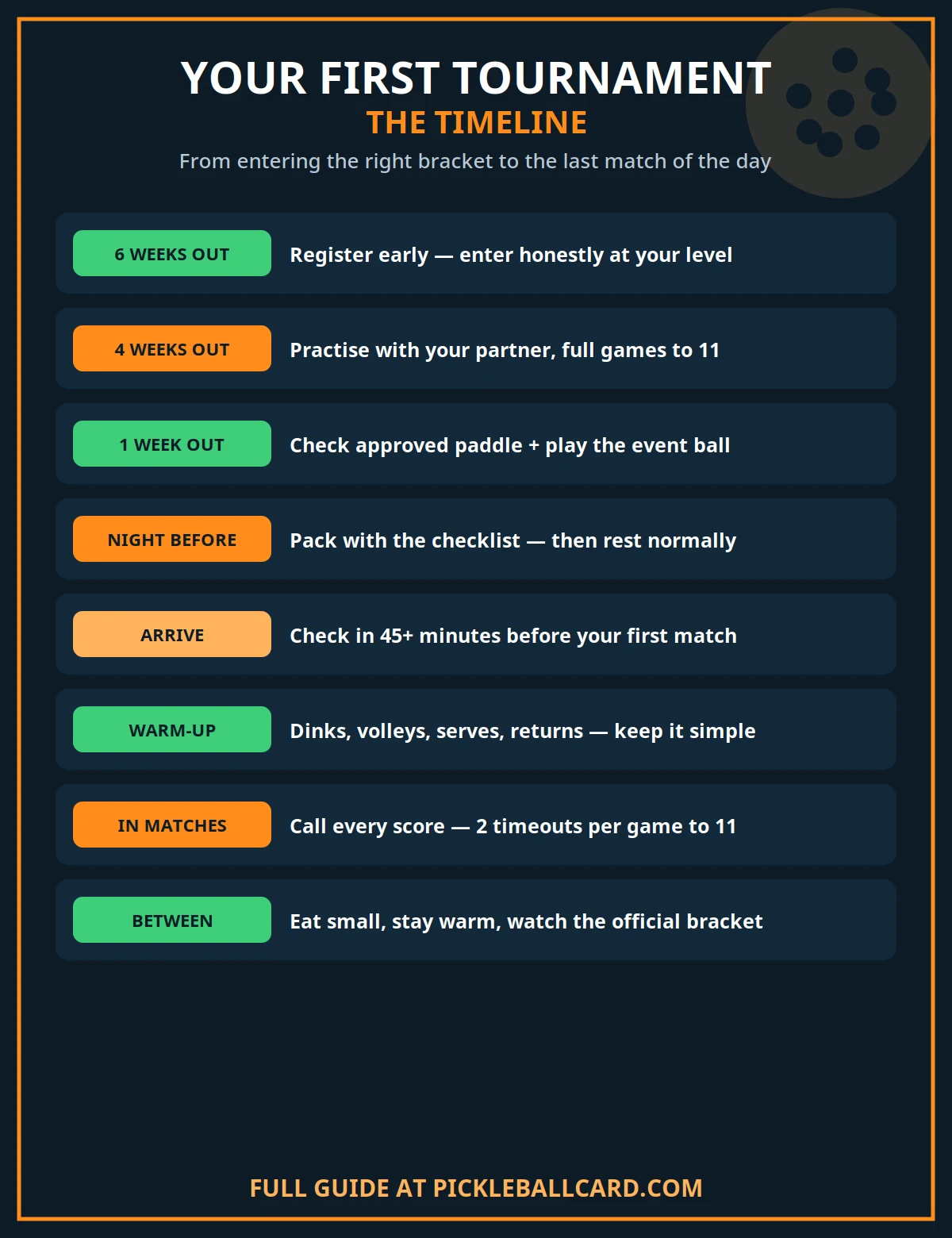
Your Preparation Timeline
Four to Six Weeks Before
Register early. Popular beginner brackets fill first, and late entries often land on a waitlist that only moves when someone withdraws.
Lock in your partner and practise together. Play full games to 11, call the score aloud, and practise starting both serving and receiving.
Play against strangers at least twice. Tournament opponents do not know your habits, and that unfamiliarity is exactly what you need to rehearse.
One to Two Weeks Before
Check your paddle is on the USA Pickleball approved list if your event is sanctioned. Check grips, edge guards and spare gear at the same time.
Play one session using the tournament ball. Balls differ in pace and bounce, and adjusting during the warm-up on the day is too late.
Agree a simple game plan with your partner: who takes middle balls, who calls shots, and what you do when you fall behind early.
The Night Before
Pack using the checklist below, then stop thinking about gear. Lay out clothes, charge your phone and check the drive and parking.
Eat normally and sleep normally. Tournament eve is not the moment for a new diet, new shoes or a radical technique change.
Tournament Day, Hour by Hour
Check-In
Arrive at least forty-five minutes before your first match. Check in at the desk, confirm your bracket and court, and get your player packet.
Listen for how matches will be called: a loudspeaker, a text alert or a desk announcement. Missing a call can mean a forfeit.
Starting servers in doubles may be given a band or marker to wear. Put it on immediately; it settles correct-server questions before they start.
Warm-Up Reality
Warm-up courts are scarce and shared. Expect ten busy minutes, not a private practice session, and share the court generously.
Warm up the shots that matter: dinks, volleys, serves and returns. Skip trick shots. You are preparing your feet and eyes, not entertaining anyone.
On court before a match, the warm-up is brief and formal. Use it to check the ball, the wind and the court surface.
During Matches
Call the score loudly before every serve, every time. In self-officiated matches this habit prevents most disputes before they can begin.
You are responsible for line calls on your side, with the benefit of any doubt going to your opponents. Refereed matches change that job, not the principle.
Our guide to pickleball etiquette and unwritten rules covers the sportsmanship standard. Tournaments test it harder than open play ever does.
Know your timeouts. Each team gets two one-minute timeouts per game to 11 or 15. Use one to reset; never save both for later.
Between games you get up to two minutes. In a deciding game to 11, teams change ends at six points, with up to a minute to switch.
Between Matches: The Long Middle of the Day
Bring a chair, shade and something to do. Waits of an hour or more are normal, especially while other brackets clear the courts.
Eat small and often. A heavy lunch sits badly before an afternoon match; steady snacks and water keep your energy flat and usable.
Stay loosely warm. Walk, stretch gently and hit a few balls when a court frees up, rather than sitting still for ninety minutes.
Watch the bracket, not the rumours. Schedules slip; the official desk and the official bracket are the only sources worth trusting.
What to Bring: The Complete Checklist
| Category | Bring | Why |
|---|---|---|
| Play | Your paddle plus a backup paddle | A cracked frame or dead grip should not end your day |
| Play | Court shoes, spare socks, spare shirt | Long days on hard courts punish feet and soak clothing |
| Fuel | Water bottle plus electrolytes | Venue supplies run out; cramps end more days than opponents do |
| Fuel | Snacks you already know agree with you | Tournament day is no place to experiment with food |
| Comfort | Chair, hat, sunscreen, towel, layers | You will spend most of the day off court, often outdoors |
| Care | Tape, plasters, pain relief you normally use | Small problems stay small only if you can treat them |
| Admin | Phone, charger, ID, membership details if required | Brackets, alerts and check-in all run through your phone |
Nerves: What Everyone Feels and What Helps
Everyone is nervous in a first tournament, including the team that looks ice-cold. Hands shake, serves tighten and simple balls get careful. That is normal physiology.
Shrink the target. Judge yourself on routines, not results: breathe before serving, call the score, move your feet, and communicate after every point.
Play your ordinary game. Tournaments punish invented shots. The player who wins a first event is rarely the flashiest; they are the most consistent.
Expect one bad game. Reset rules help: towel off, agree one simple adjustment with your partner, and play the next game point by point.
Remember why you entered. A first tournament is market research on your own game. The medal, if it comes, is a bonus.
Five Mistakes First-Timers Make
- Entering too high. An honest bracket gives close matches. A vanity bracket gives a short, silent day and almost no useful feedback.
- Arriving at start time. Check-in, parking and warm-up all take longer than expected. Early is calm; on time is already rushed.
- Changing equipment that week. A new paddle, grip or shoe needs practice hours first. Debut familiar gear, not shopping.
- Ignoring the waits. Players eat too little, sit too long and cool down completely. Manage the hours between matches like part of the event.
- Arguing line calls. Benefit of the doubt goes to your opponents. Win the next point instead of re-litigating the last one.
Frequently Asked Questions
Do I need a rating to enter my first pickleball tournament?
No. Most events let first-timers self-rate. Choose the bracket that matches your honest level, using published level descriptions, and expect the rating system to catch up quickly.
Do I need a USA Pickleball membership?
For sanctioned events, yes. Membership is required and your paddle must be approved. Many local and club events are unsanctioned and more flexible, so check the event page.
How many matches will I play?
It depends on the format. Round robin guarantees a game against every team in your group. Double elimination guarantees at least two matches. Single elimination guarantees one.
How long does a tournament day last?
Plan for most of a day. Your bracket may finish in three hours or run past six, depending on field size, courts and schedule delays.
What if I lose my first match?
In double elimination you drop into the second bracket and keep playing. In round robin there is no elimination at all. Only pure single elimination ends your run.
Should I play singles or doubles first?
Doubles, for most people. It is the most common format, shares the workload, and a partner makes the system, the waits and the nerves easier to handle.
The Bottom Line
A first tournament is a system to learn, not a verdict on your talent. Choose a small local event, enter honestly, and prepare for the waiting.
Learn the format before you arrive, pack for the whole day, call every score, and treat every match as information about your real game.
Walk away with a list: what held up, what broke down, and what to practise next. That list, not the result, is the real prize.
Sources: USA Pickleball, Official Rules — tournament formats, standard scoring options and timeout rules in the current rulebook.
This guide is original; no competitor content is linked or reproduced.