Pickleball etiquette is mostly not in the rulebook. It is the social code that keeps open play friendly: announce the score before every serve, give your opponents the benefit of the doubt on close line calls, call faults on yourself, rotate fairly when courts are busy, do not coach a partner who did not ask, and finish every game at the net with a paddle tap. None of that will appear as a fault in an officiated match — but break it often enough at your local courts and you will stop getting invited into good games.
This guide separates what is actually backed by USA Pickleball from what is pure social custom, so you know which norms are close to rules and which are simply how considerate players behave. It covers score calling, line calls, open-play rotation, body shots, coaching, targeting, and how a game should end — with a do and don’t checklist you can use before your next session.
Key Takeaways
- Announce the full score loudly before every serve — server score, receiver score, and server number in doubles. It prevents most mid-game score arguments before they start.
- Close line calls go to your opponents. Only call a ball out when you see it clearly and are certain; if you are unsure, it is in.
- Call faults on yourself and your partner as soon as they happen — foot faults, non-volley zone faults, and a ball that clipped you on its way out included.
- At busy courts, rotate fairly. Use the paddle queue, come off after a game when others are waiting, and never rearrange the queue to move friends up.
- Offer coaching only when it is asked for. Unsolicited advice mid-game is the fastest way to annoy a partner, however good the tip is.
- End every game at the net. A paddle tap and a genuine thank-you, win or lose, is the sport’s handshake.
Written vs Unwritten: What Is Actually Official?
Pickleball has two layers. The first is the Official Rulebook — serves, faults, scoring and line-call procedures that referees can enforce. The second is etiquette: shared expectations that no referee will call, but that every regular player recognises.
USA Pickleball bridges the two with its Sportsmanship Guide. The guide presents pickleball as a fun, competitive and highly social sport built on respect, fair play and graciousness in winning and losing, and it is explicit that the Official Rules take precedence over the guide wherever they overlap. That distinction is the honest way to teach etiquette: some norms below — benefit of the doubt on line calls, calling faults on yourself, rotating fairly in social play, and providing coaching only when requested — are directly backed by that guide. Others — a raised paddle after a lucky net cord, or a brief apology for an unintentional body shot — are widely accepted custom with no official text behind them.
Why does the distinction matter? Because a player who claims an unwritten norm is “a rule” will lose credibility in the first argument that follows. Know which is which, follow both, and correct others gently — if at all.
Before and During the Game
Introduce Yourself and Start Clean
If you do not know the other players, introduce yourself before the first serve. It takes ten seconds, it makes later disagreements far less personal, and it is one of the courtesy basics USA Pickleball lists first. The same spirit covers language and behaviour: no foul language aimed at anyone, no denigrating comments about a partner’s miss or an opponent’s level, and a willingness to accommodate players with adaptive needs where you reasonably can.
Warm Up With Courtesy, Not Winners
A warm-up is for both sides to find their touch, not for practising your hardest drive at a player who is still stretching. Dink cooperatively, feed balls your opponents can actually hit, and keep the warm-up short when courts are busy and a queue is watching. If you arrive mid-session, do not expect a long personal warm-up while three paddles are already waiting.
Announce the Score — Every Serve, Out Loud
Before every serve, call the full score clearly enough for the receiving team to hear: your score, their score, and — in doubles — whether you are server one or server two. Do it before you start your motion, not during it, so an opponent who disagrees can stop you before the rally begins.
This is partly etiquette and partly practical rulebook hygiene. Most score disputes are not cheating; they are two teams honestly remembering different numbers because nobody stated the score out loud for six rallies. A clear call makes the score a shared fact. If you are new to the numbering itself, our guide to how to play pickleball explains the three-number call and the rest of the basics in order.
Line Calls and Faults: Where Etiquette Meets the Rulebook
Give the Benefit of the Doubt — Every Time
The core principle is simple: opponents make the calls on their own end of the court, and any ball you cannot call out with certainty is in. Call your own shot out if you clearly see it out. If you are unsure, play it as in — or, in social play, ask your opponents what they saw and accept their answer graciously if you defer the call to them.
If you question an opponent’s call, do it respectfully and once. Arguing a line call in a recreational game almost never changes the call; it reliably changes the mood. Our dedicated guide to the official rules for line calls in pickleball covers the formal line-calling code, including what happens when partners disagree, in full.
Correct Your Own Partner Promptly
If your partner calls a ball out and you clearly saw it in, say so straight away. That feels awkward the first time — you are overruling the person on your own team — but it is exactly what good sportsmanship requires, and experienced players respect it. In doubles, partner disagreement on a line call resolves in favour of the opponents in any case, so correcting a wrong call costs you nothing you were entitled to keep.
Call Faults on Yourself
Serve with a foot on the baseline, step into the non-volley zone on a volley, or feel a ball clip your shirt on its way long? Call it on yourself as soon as it happens, whether or not anyone else noticed. Watch your partner’s feet for service and kitchen foot faults too, and accept an opponent’s fault call graciously rather than litigating it. Honest self-calling is the single behaviour that most quickly earns a new player a reputation as someone worth playing with. For what counts as a fault in the first place, see our explainer on what is a fault in pickleball.
Replays Are for Genuine Hinders
Claim a replay when something genuinely prevented your team from playing the ball — a ball rolling in from another court is the classic case. Do not treat a replay as a way to erase a rally you simply lost, or to renegotiate a close line call you disliked. In recreational play, replaying a truly disputed point by agreement is common and friendly; in officiated play, the rulebook procedure governs, so do not promise a replay format that a tournament will not allow.
Open-Play Rotation: The Paddle Queue Explained
Open play is where etiquette is tested most, because nobody owns the court. Local systems vary, but the shared principles are consistent — and USA Pickleball’s guide backs them directly for social play: rotate on and off fairly, follow local practice, do not jump ahead of others who are waiting, and be ready when your turn comes.
| Situation | What good etiquette looks like |
|---|---|
| You arrive and courts are full | Put your paddle in the queue / next-up rack in order. Do not place it ahead of paddles already waiting. |
| Your game finishes and others are waiting | Come off. All four players leave and re-queue unless the local system says otherwise. |
| Winners-stay format | Winners may stay for the locally agreed number of games — commonly two — then split or come off, as that venue does it. Follow the local norm, not your preference. |
| You want to play with a friend in the queue | Move yourself back to their position. Never move them — or anyone else — forward past waiting players. |
| Your turn is coming up | Be present, paddle in hand, ready to step on. A queue should never have to hunt for its fourth player. |
| Levels are mixed | Mix in willingly for some games. Splitting courts by level is fine where a venue offers it; refusing ever to play down is not. |
Two queue tricks deserve naming because everyone recognises them: calling a lower score than the real one, and quietly starting a second game, both to avoid leaving a court. Do not do either. If you must cross behind an active court, wait until play has stopped, then cross quickly as a single group so you disrupt that game as little as possible.
Balls on Court, Body Shots and Net Cords
Call “Ball On” — Loudly and Immediately
When your ball rolls onto another court, warn those players at once with a loud “ball” call if anyone could step on it or be hit. Stop play on your own court when a stray ball enters it. When a ball strays onto your court and play has stopped, make eye contact with the right person and roll or toss it back without disrupting neighbouring games. If a loose ball is rolling harmlessly behind another court, wait until their point ends rather than interrupting it to retrieve yours.
Do Not Walk Behind a Live Rally
Never walk behind or across a court while a rally is in progress — to fetch a ball, reach a bench, or take a shortcut. Wait for the point to finish. It is a safety rule as much as a courtesy: a player backpedalling for a lob cannot see you.
Body Shots and Net Cords: The Brief Apology
Pickleball is played close to the net, and balls will hit bodies. An unintentional body shot needs only a quick raised paddle or a short “sorry” — then move on; over-apologising slows the game as much as not apologising at all. The same gesture covers a lucky net-cord winner: a brief acknowledgement that fortune, not skill, won that point. What etiquette does forbid is intent and excess: do not slam the ball directly at a player when an open-court winner was available, and never throw a paddle or strike a ball in anger.
Coaching, Targeting and Playing Down: The Three Fastest Ways to Break the Code
No Unsolicited Coaching
Provide coaching and advice only when it is requested. That applies to opponents and, just as much, to your partner. A partner who has just missed three backhands does not need a technical lecture between rallies; they need a simple “next one” and a partner who stays positive. Avoid criticism and negative non-verbal communication — the sigh, the stare, the paddle dropped in disgust all count, and everyone on court reads them. If you genuinely see something helpful, ask once, between games: “Want a thought on that return?” Accept no for an answer.
Do Not Freeze Out the Weaker Player — or Hunt Them Relentlessly
In social play, be kind as the stronger player: avoid hitting excessively to the weaker player, and do not make a beginner the target of every hard shot just because it produces easy points. Freezing a newer player out of every rally is the mirror-image offence — they paid for court time too, and a game they never touch the ball in teaches them nothing except not to come back.
Be plain about the exception: competitive and tournament play is different. In a rated or tournament match, playing your best strategy — including directing more balls at the opponent you judge weaker — is normal competitive play, and nobody owes an apology for it. Etiquette governs how you treat people, not whether you try to win a match that counts.
Playing Up and Playing Down
Be willing, sometimes, to play with less-skilled players; every regular was carried through early games by someone who did the same. And if you want to join a stronger group, ask nicely rather than demanding a place or inserting your paddle into their rotation uninvited. Both directions of generosity keep a club’s open play alive.
Ending the Game: The Paddle Tap
At the end of every game, meet the other players at the net and acknowledge them positively — in practice, the paddle tap over the net tape, accompanied by a simple “good game” or thanks. In officiated matches, thank the referee as well. Do it after a heavy loss exactly as after a win; graciousness in losing is half of the sportsmanship standard, not an optional extra for good days.
Walk off promptly when others are waiting, take your water bottle and towel with you, and leave the court as you found it. If a genuine disagreement happened during the game, the net is the place for a short, friendly reset — not for reopening the argument point by point.
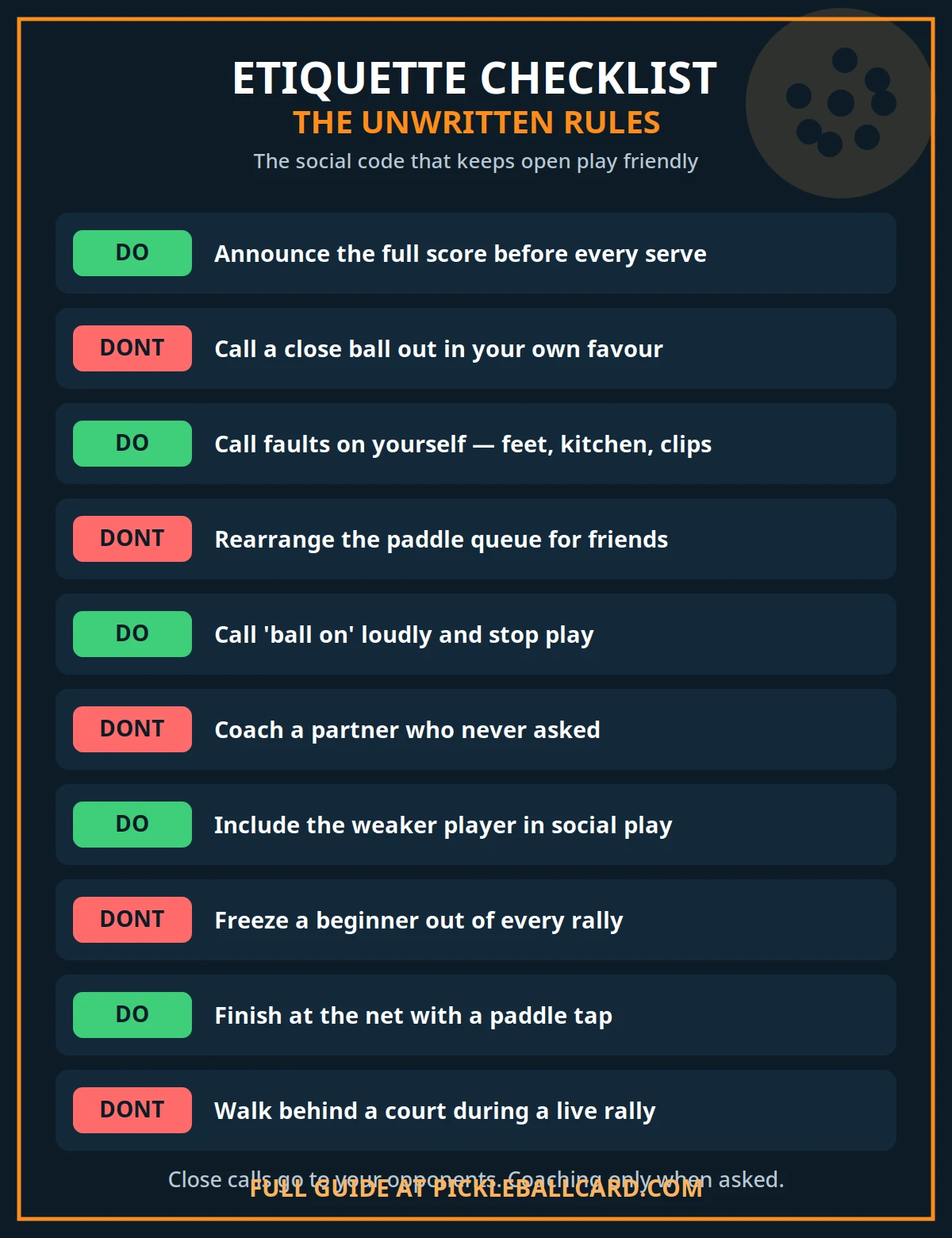
Pickleball Etiquette Checklist: Do and Don’t
| Do | Don’t |
|---|---|
| Introduce yourself to players you do not know | Walk onto a court mid-rally or behind a live game |
| Announce the full score before every serve | Start your serve motion before calling the score |
| Call a ball out only when you see it clearly and are certain | Call a close ball out and resolve doubt in your own favour |
| Correct your partner’s wrong call promptly | Argue an opponent’s call repeatedly |
| Call foot, kitchen and body-clip faults on yourself | Stay silent about a fault only you noticed |
| Queue your paddle in order and come off when others wait | Rearrange the queue, jump ahead, or start a quiet second game |
| Call “ball on” immediately and return stray balls with eye contact | Chase your ball onto another court during their rally |
| Apologise briefly for body shots and lucky net cords | Slam at a player’s body when the open court was available |
| Coach only when asked; encourage your partner | Lecture, sigh at, or criticise a partner mid-game |
| Include the weaker player in social rallies | Freeze a beginner out — or target them on every shot |
| Finish at the net with a paddle tap, win or lose | Leave the court without acknowledging your opponents |
Frequently Asked Questions
Is announcing the score a rule or just etiquette?
Both layers touch it. The scoring rules require the score to be called before the serve in organised play, and etiquette adds the practical standard: call it loudly, completely — including the server number in doubles — and before you begin your motion, so anyone who disagrees can speak before the rally starts.
What should I do if my partner makes a bad line call?
Correct it promptly and plainly: “I saw that in — their point.” USA Pickleball’s sportsmanship guidance expects exactly that, and partner disagreement resolves in the opponents’ favour under the line-call code in any case. Do it without blame; your partner may simply have had a worse angle than you.
Can I ask my opponents to replay a disputed point?
In recreational play, yes — offering to replay a genuinely disputed point is a friendly, widely accepted solution when nobody is certain. In officiated or tournament play, follow the rulebook procedure instead: replays are for genuine hinders and the specific situations the rules define, not a general remedy for disagreement.
Is it rude to hit most shots at the weaker player?
In social and open play, yes — repeatedly targeting the weaker player, or slamming directly at them, breaks the expectation that everyone gets a real game. In competitive, rated or tournament play, directing shots strategically is normal and expected. The setting, not the shot itself, decides which standard applies.
How long can winners stay on court at open play?
There is no universal number — it is set by local practice. Common systems are four-on/four-off when courts are full, or winners staying for a set number of games (often two) before splitting or coming off. Read the venue’s posted system, watch what regulars do, and follow that rather than assuming a right to stay on.
What do I do when a ball rolls onto our court mid-rally?
Stop play and call it — a loose ball on court is a safety issue first and a hinder second. Return the ball to the correct player with eye contact once play has stopped, then replay the interrupted rally. If the ball is yours and it rolls behind another court without endangering anyone, wait for their point to end before retrieving it.
The Bottom Line
Pickleball etiquette comes down to a short list practised consistently: call the score, give close calls away, own your faults, share the courts fairly, keep advice for when it is wanted, include everyone in social games, and shake it out at the net afterwards. Much of that is backed directly by USA Pickleball’s own sportsmanship guidance; the rest is the custom that makes strangers welcome at open play. Master those habits and you will be invited into better games than any single shot could earn you — because in a sport this social, how you play matters almost as much as how well you play.
Sources: USA Pickleball, Essential Sportsmanship Guide for USA Pickleball Players and the Official Rules of Pickleball hub. Where this article describes a norm as social custom rather than official guidance, it is presented as convention, not as a rule.