USA Pickleball rewrote the rulebook for 2026 — and it is a bigger update than most players realise. Of the 114 changes proposed, 42 were approved or approved with amendments, the entire book was reorganised and renumbered, and several rules that change how rallies are actually won and lost took effect on January 1, 2026. If you are still quoting rule numbers from the 2025 book (4.A.7 for the serve, 6.C.7 for line calls), those numbers no longer exist.
This guide covers every 2026 change that affects your game, with the official new rule numbers so you can check each one in the rulebook yourself. Most summaries online skip the rule numbers and miss half the changes — here is the complete picture.
Key Takeaways
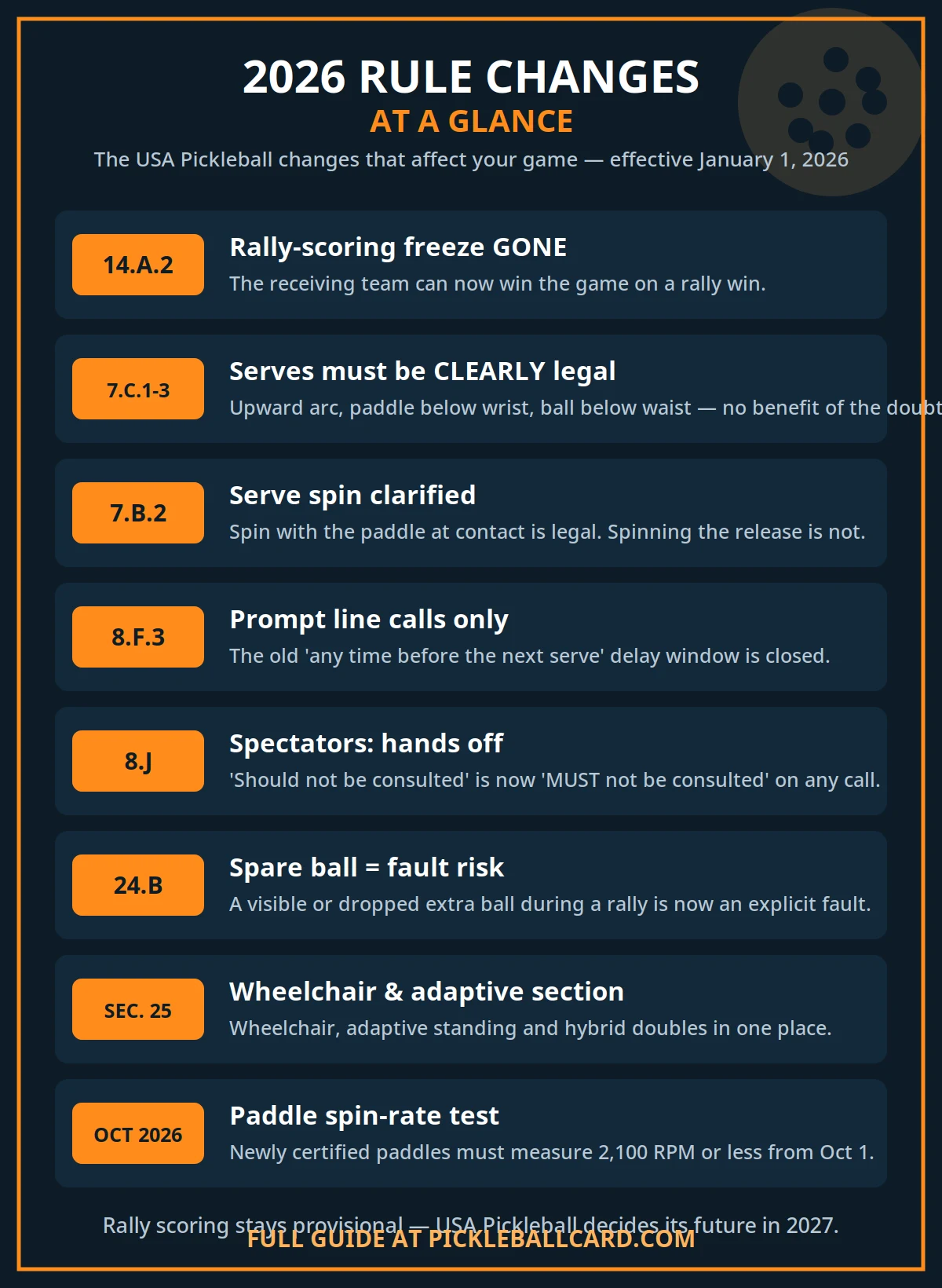
- The rally-scoring “freeze” is gone (Rule 14.A.2) — in rally scoring, the receiving team can now win the game on a rally win.
- Serves must now be clearly legal (Rules 7.C.1–7.C.3) — borderline volley serves no longer get the benefit of the doubt.
- Spin applied with the paddle at contact is expressly legal (Rule 7.B.2) — only spinning the ball on the release is banned.
- Line calls must be prompt (Rule 8.F.3) — the old “any time before the next serve” delay window has been closed.
- Spectators must not be consulted on any call (Rule 8.J) — “should not” became “must not.”
- A new paddle spin-rate test arrives October 1, 2026 — newly certified paddles must measure 2,100 RPM or less.
The 2026 Changes at a Glance
| Change | 2025 Rule | 2026 Rule | What is different |
|---|---|---|---|
| Rally-scoring freeze removed | 4.F.1 | 14.A.2 | Receiving team can win the game on a rally win |
| Game can be won on a technical foul | 12.B.1.c | 4.B | First team to the winning point wins — however the point is scored |
| Serve must be “clearly” legal | 4.A.7 | 7.C.1–7.C.3 | “Clearly” added to all three volley-serve tests |
| Serve spin clarified | 4.A.5 | 7.B.2 | Paddle spin at contact is legal; release spin is not |
| Prompt line calls | 6.C.7 | 8.F / 8.F.3 | No more waiting until the next serve to call “out” |
| Spectators and calls | 13.C.2.a | 8.J | “Should not be consulted” is now “must not be consulted” |
| Partner disagreement on a call | 6.C.8 | 8.H | “Doubt” is now called “conflict” — the call is still “in” |
| Wrong-score challenges | 4.K | 6.F–6.F.4 | Fixed outcomes: replay, fault, or the result stands |
| Time-out signalling | 10.A.3 | 21.A.2 | Time-outs must be called by voice and/or hand signal |
| Penalties before the match | 13.G.3.e | 22.A | Referees can penalise behaviour before the first serve |
| Extra ball during a rally | 7.N | 24.B | A visible or dropped spare ball is now an explicit fault |
| Double and triple hits | 11.A | 10.D | Triple hits in one motion are legal; two-player hits are a fault |
| Net-post winner | 11.K | 10.C.5 | Bounce in, then touch the post — the hitter wins the rally |
| Wheelchair & adaptive play | Scattered | Section 25 | Wheelchair, adaptive standing and hybrid doubles consolidated |
Scoring Changes
The Rally-Scoring “Freeze” Is Gone (Rules 14.A.2 and 15.C.2)
This is the headline change of 2026. Under the old provisional rule, a rally-scoring game could only be won by the serving team — if the receiving team reached game point, the score effectively froze until they won a rally on their own serve. Rule 14.A.2 now states simply that a point is scored by the player or team that wins each rally, with no exception at game point. If the receiving team has game point and wins the rally, the game is over.
Two things have not changed. Rally scoring is still a provisional format under Rule 15.C.2 — traditional side-out scoring remains the standard, rally scoring is a Tournament Director’s option, and it still cannot be used in double-elimination doubles events, 2026 Golden Ticket events or the 2026 National Championships. And the format’s long-term future is undecided: USA Pickleball will decide in 2027 whether to make rally scoring permanent, extend the trial, or drop it. For the full breakdown of how the format works, see our guide to rally scoring in pickleball.
A Game Can Now Be Won on a Technical Foul (Rule 4.B)
The 2025 book said the game-winning point could only be scored by the serving player or team. Rule 4.B replaces that with a simple principle: the first player or team to score the winning point wins the game. USA Pickleball’s own example shows why it matters — if the receiving team sits on game point and the serving team is assessed a technical foul, the point awarded for the foul wins the game for the receiving team, without them serving a single ball.
Serve Rule Changes
Your Volley Serve Must Now Be “Clearly” Legal (Rules 7.C.1–7.C.3)
The three volley-serve tests are the same as before — the paddle moving in an upward arc, the top of the paddle head below the wrist, and contact below the waist. What changed is one word, added to all three tests: clearly. The paddle must move in a clear upward arc (7.C.1), the paddle head must clearly stay below the wrist (7.C.2), and the ball must clearly be struck at or below waist level (7.C.3).
USA Pickleball says the word was added to make the rule “stronger and more enforceable” — and the practical effect in officiated matches is real: a serve that is merely arguable no longer gets the benefit of the doubt, and can be called a fault. If your volley serve lives anywhere near the limits, 2026 is the year to give yourself margin. Our full breakdown of the pickleball serving rules covers both serve types in detail.
Spin on the Serve: What Is Actually Legal Now (Rule 7.B.2)
This is the change players get wrong most often — USA Pickleball calls it one of the most misunderstood rules in the book. The old wording banned imparting spin “with any part of the body or the paddle” on the release, which many players read as banning paddle spin altogether. Rule 7.B.2 now draws the line precisely:
- Illegal: manipulating or spinning the ball with your hand, fingers or paddle before contact — the release itself. The “chainsaw” finger-spin serve stays banned.
- Legal: applying spin with the paddle at the moment of contact. The rule now says so in plain words: “Spin may be applied to the ball upon contact by the paddle.”
So a brushing, cut or topspin motion as you strike the ball is fine. Spinning the ball out of your hand as you let it go is not.
The Drop Serve Is Untouched
None of the three “clearly” tests apply to the drop serve, which is governed by its own release rules (Rule 7.D) and is unchanged for 2026. If your volley serve keeps drawing questions under the stricter standard, the drop serve remains the simplest legal alternative — let the ball bounce, then hit it however you like.
Line Calls and On-Court Conduct
Line Calls Must Be Prompt — the Delay Window Is Closed (Rules 8.F and 8.F.3)
Previously, a player who failed to return a ball could wait — calling “out,” appealing, or asking the opponents — at any point up until the next serve. That window invited gamesmanship and referee complications, and for 2026 it is gone. Under Rule 8.F, an “out” call must be signalled promptly, by voice, hand signal, or both. Rule 8.F.3 sets the timing: if you play the ball, your call must come before your opponent hits it or the ball becomes dead; if you do not play it, a prompt call still counts even if the ball dies first — but a slow call no longer does. USA Pickleball does add a common-sense note: a ball that is clearly and unquestionably out should never be ruled “in” just because nobody made a formal call. See our guide to pickleball line calls for how line-calling etiquette and the rules fit together.
Spectators Must Not Be Consulted (Rule 8.J)
One word changed, and it matters: spectators must not be consulted on any call — the 2025 “should not” was only a recommendation. In an unofficiated match you can now summon the Head Referee or Tournament Director if an opponent keeps asking the crowd; in an officiated match, the referee can back the rule with a verbal warning, a technical warning or a technical foul.
“Doubt” Is Now “Conflict” (Rule 8.H)
When doubles partners disagree on a line call, the outcome is unchanged — the ball is “in.” What changed is the language: partner disagreement is now formally called a conflict rather than “doubt,” a deliberate wording change to reflect that the partners actively disagree.
Wrong-Score Challenges Have Fixed Outcomes (Rules 6.F–6.F.4)
Challenging the score mid-rally used to end in argument. The 2026 rules spell out every case. Stop before the return of serve is hit and the score really is wrong, and the rally is replayed with the correct score (6.F.1). Stop play to challenge a score that was actually correct, and it is a fault (6.F.2). Stop after the return of serve, and it is also a fault (6.F.3). If the rally finishes, its result stands and the score is corrected before the next serve (6.F.4). Knowing the score — and calling it correctly — just became a competitive skill; our how to score in pickleball guide covers the scoring system end to end.
Match Play, Time-Outs and Penalties
Time-Outs Must Be Clearly Signalled (Rule 21.A.2)
Calling “time-out” under your breath as you walk off no longer counts. A time-out must now be called audibly by voice or visibly by hand signal (or both), directed at your opponents and the referee. Call one after the serve has been hit and it is a fault; ask without any audible or visible signal and you risk a verbal or technical warning for delay of game. USA Pickleball’s summary is blunt: players may not leave the playing area without clearly calling a time-out.
Penalties Can Start Before the Match (Rule 22.A)
Referees can now assess warnings and penalties any time players are in the vicinity of the court — including during warm-ups and the pre-match briefing, and for behaviour on the way to the court. The old rule covered conduct “at the court” once play was around the corner; the 2026 version makes the referee’s authority explicit from the moment you arrive.
Stronger Ejection and Forfeit Rules (Rules 22.L and 22.I.1)
The Tournament Director’s power to eject a player or expel them from the venue now expressly covers injurious paddle or ball abuse and physical violence causing injury (22.L.2), and flagrant behaviour including damage to venue property (22.L.5) — before, during or after play, with no need to prove intent. Separately, Rule 22.I.1 makes aggressively striking or throwing a ball or paddle in anger that hits someone or damages property an automatic match forfeit.
Rescinding a Challenge or Medical Time-Out Now Costs You (Rules 20.J.1 and 21.C.4)
Two “free delay” tactics were closed off. Withdraw a request for the Head Referee after it has been acknowledged, and your team is charged a standard time-out — or a technical foul if you have none left (20.J.1). Rescind a medical time-out after officials have been called but before they arrive, and the same pricing applies: a standard time-out is charged, or a technical foul if none remain (21.C.4).
Your Partner Can Play On Alone After a Retirement (Rule 21.C.9)
If a doubles player cannot continue after the 15-minute medical time-out, the match is a retirement for that player — but under the new rule, the partner may choose to play on alone under the normal rules. The retired player must leave the court and cannot return to that match; the remaining players keep their positions and rotation, and serves aimed at the retired player’s court must still land in the correct service box.
Rally Rules You Might Miss
A Spare Ball in Your Pocket Is Now an Explicit Fault Risk (Rule 24.B)
Carrying a second ball is still allowed — but under Rule 24.B it must stay out of your opponent’s sight and in your possession. If a carried ball becomes visible during a live rally, or drops onto the playing surface, Rule 24.B.1 makes it a fault against you. The safest 2026 habit: leave the spare ball at the net post.
Triple Hits Are Legal — Two-Player Hits Are Not (Rule 10.D)
The double-hit rule was widened: a ball can now be hit more than once — a double, triple or even greater multi-hit — provided the stroke is one continuous, single-direction motion by one player (10.D, 10.D.1). The flip side is now written down too: if you and your partner both hit the ball to return it, that is a fault (10.D.2). Carrying the ball remains a fault, as before.
The Net-Post Winner, Clarified (Rule 10.C.5)
If a ball crosses the net, bounces in your opponent’s court, and then — carried by spin or wind — touches the net post, the rally belongs to the player who hit the shot: the receiver failed to return a ball that had already bounced in. Rule 10.C.5 frames it as a fault on the player who did not make the return. A ball that hits a permanent object on the fly, before bouncing in, is still dead against the hitter.
Tournament small print: round robins gained a fifth tiebreaker — most total points scored across all matches (Rule 15.B.4.f) — and line judges’ “blocked” signal now obliges the referee to make or canvass the call immediately (Rule 19.H).
Wheelchair and Adaptive Play Get Their Own Section (Section 25)
One of the most substantial structural changes of 2026 is also the easiest to miss: wheelchair and adaptive rules were pulled out of the scattered corners of the old book and consolidated into a dedicated Section 25. Wheelchair play (25.A) now sits in one place — the wheelchair is part of the player’s body, the large rear wheels are treated like a standing player’s legs for serving and kitchen faults, the two-bounce allowance is spelled out, and power wheelchairs are permitted (player-controlled, maximum 10 mph). Our dedicated guide to wheelchair pickleball covers how wheelchair pickleball works.
New for 2026, Adaptive Standing Play (25.B) formally covers players with a permanent physical disability who play without a wheelchair: prosthetics, braces and crutches are allowed and count as part of the body, and eligible players with significant mobility impairments may use a two-bounce allowance, declared before the match. Hybrid Doubles (25.C) — one wheelchair player and one standing player per team — is now a defined format in its own right.
Equipment Changes for 2026: The Paddle Spin Test
Equipment standards are not part of the rulebook itself — they live in USA Pickleball’s separate Equipment Standards Manual — but 2026 brings the biggest equipment change in years. From October 1, 2026, every paddle submitted for USA Pickleball certification must pass a new Spin Rate Test: a measured spin rate of 2,100 RPM or less, calculated from camera footage using an instrumented test ball. Paddles certified before that date under the existing surface-roughness and friction tests remain approved, but anything new must meet the spin cap.
Two more equipment points for 2026: USA Pickleball has launched on-site paddle field testing at Golden Ticket events (friction, deflection and weight/balance checks, with passing paddles receiving an RFID sticker), and the PBCoR “trampoline effect” limit in force for 2026 is 0.43 (tightened from 0.44 in November 2025) — paddles that exceed it can be removed from the Approved Paddle List, including models that were legal when bought. If you are shopping this year, our guide to how to choose a pickleball paddle explains what to check before you buy.
What These Changes Mean for Your Game
If you play recreationally: the changes you will actually feel are the prompt line call (call it when you see it, not after a chat), the spectator rule (the crowd no longer gets a vote), and the serve-spin clarification — your brushing topspin serve was probably always fine, but spinning the ball out of your hand on the release never was. If you play in a group that uses rally scoring, game point just got simpler: win the rally, win the game.
If you play tournaments: build margin into your volley serve before a referee does it for you, signal your time-outs like you mean them, and know that conduct rules now run from the warm-up to the car park. Tournament players should also note the rescinded-challenge and medical time-out pricing, the new round-robin tiebreaker, and — before buying a new paddle late in 2026 — the October spin-rate deadline.
Frequently Asked Questions
What are the biggest pickleball rule changes for 2026?
The changes most players will notice are the removal of the rally-scoring “freeze” (Rule 14.A.2), the new “clearly legal” standard for volley serves (Rules 7.C.1–7.C.3), prompt-only line calls (Rule 8.F.3), the ban on consulting spectators (Rule 8.J), and the clarification that paddle spin at contact on the serve is legal (Rule 7.B.2).
When did the 2026 pickleball rules take effect?
The 2026 USA Pickleball rules took effect on January 1, 2026. The change document was published on December 17, 2025, so players and officials had the full list of changes before the new rules came into force.
Is rally scoring now the official scoring format?
No. Rally scoring remains a provisional, optional format for 2026 (Rule 15.C.2) that a Tournament Director may choose; traditional side-out scoring is still the standard. USA Pickleball will decide in 2027 whether rally scoring becomes permanent, stays provisional, or is discontinued.
Can you put spin on a pickleball serve in 2026?
Yes — with the paddle. Rule 7.B.2 expressly allows spin applied to the ball upon contact by the paddle. What remains illegal is spinning or manipulating the ball on the release, before contact, including the “chainsaw” finger-spin serve.
Is the drop serve affected by the new serve rules?
No. The three “clearly” tests (Rules 7.C.1–7.C.3) apply only to the volley serve. The drop serve is governed by its own release rules (Rule 7.D) and is unchanged for 2026.
Do the 2026 rule changes apply to casual games?
The rulebook governs sanctioned play, and referees only enforce it in officiated matches — nobody can assess a technical foul in your Saturday game. But most organised recreational play follows the USA Pickleball rulebook by agreement, and the practical changes (prompt line calls, no spectator calls, serve-spin legality) are worth adopting in any game that wants to stay friendly.
The Bottom Line
The 2026 update is less about new ways to play and more about removing grey areas: serves that are clearly legal or a fault, line calls made on the spot, spectators out of the decision, and a scoring format that no longer freezes at game point. Learn the half-dozen changes in the table at the top of this page and you are ahead of most players — and if you run into a rule nobody can settle, the official sources below are the final word. New to the game entirely? Start with our guide on how to play pickleball, then come back to this page before your first tournament.
Sources: USA Pickleball, 2026 Rulebook Change Document and the official rules hub; USA Pickleball equipment news on the Spin Rate Test timeline. Rule numbers cited are the new 2026 numbers.