On 22 May 2026, professional pickleball got its own rulebook. The United Pickleball Association of America (UPA-A) published a 71-page unified rulebook for the PPA Tour and Major League Pickleball (MLP), banning the drop serve at pro level, formalising paddle and video challenges, and introducing a Warning–Blue Card–Orange Card conduct system.
First, who this rulebook actually governs
This is a professional rulebook for PPA and MLP play. It does not rewrite the rules for your Saturday open play. The Professional Rules in Appendix B apply to “all players competing in designated professional brackets sanctioned by UPA-A, including PPA Tour events, MLP events, and affiliated professional competitions.” Non-sanctioned competitions may adopt them only if the organiser chooses to. If you play under USA Pickleball rules, those still govern your game — see our pickleball rules guide and our round-up of the 2026 pickleball rule changes.
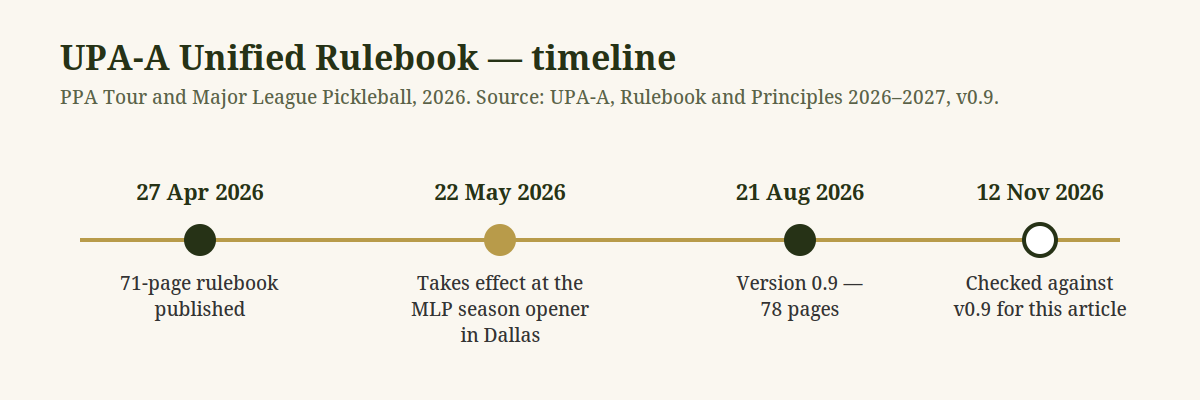
The new standards took effect on 22 May 2026, at the opening event of the MLP 2026 season in Dallas.
Version note: the April 2026 release was 71 pages; the copy now on the UPA-A site is Version 0.9, dated 21 August 2026, at 78 pages — the version checked on 12 November 2026.
What changed at a glance
| Change | New rule at pro level |
|---|---|
| Drop serve | Banned — volley serve only |
| “Close” serve | A serve a referee cannot clearly confirm as legal is a fault |
| Paddle challenge | Paddle stays in play; result stands; fines decide it |
| Lost line or video review | Timeout, then a Mark, then a Mark plus a point |
| Blowing or fanning the ball | Now a fault |
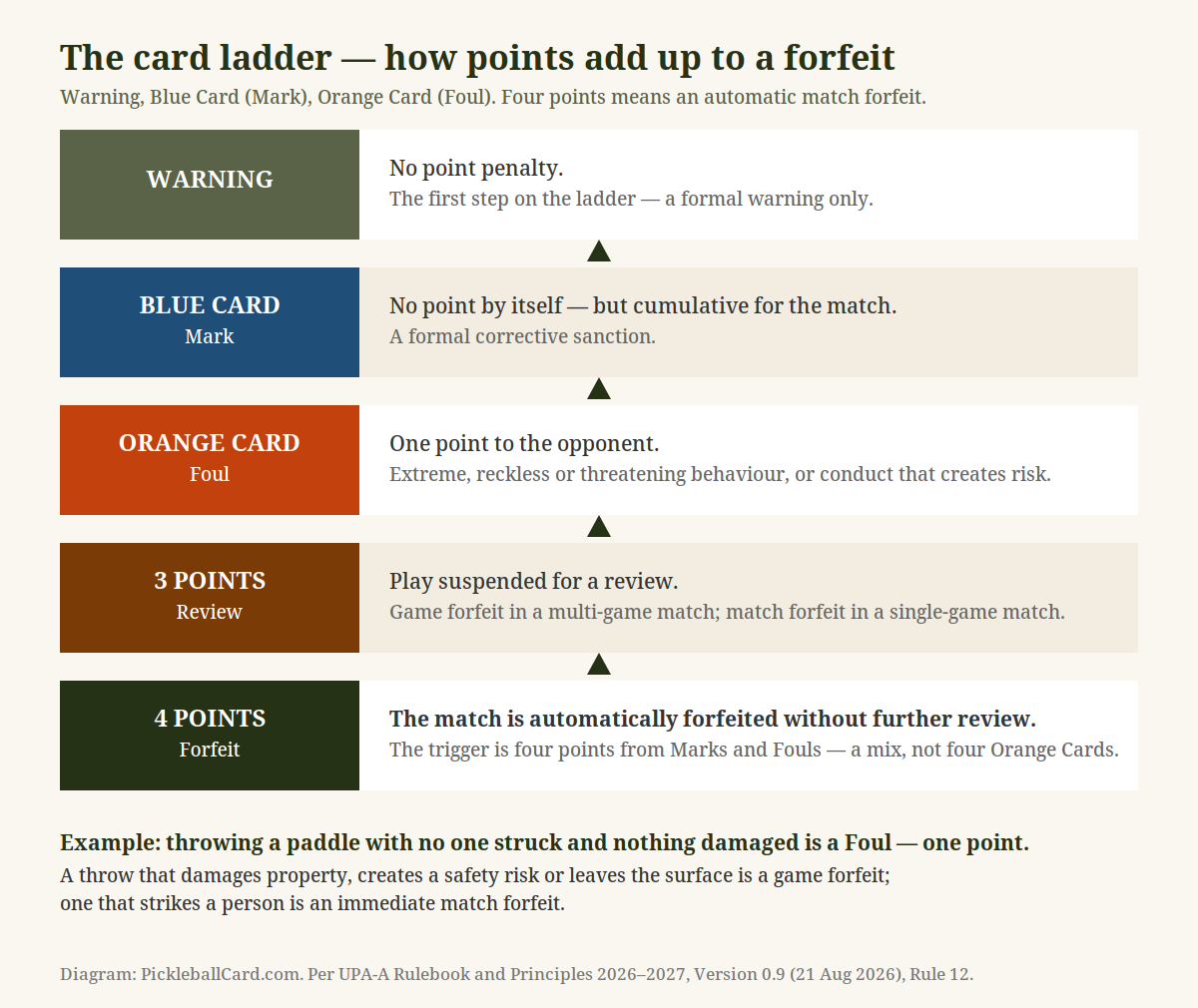
| Card system | Warning → Blue Card (Mark) → Orange Card (Foul, one point); four points = automatic forfeit |
The drop serve is gone — at pro level only
The rulebook states it in one sentence: “Professional competition requires use of the Volley Serve. The Drop Serve is not permitted.” The drop serve — drop the ball, let it bounce, then hit it — had been the easier option, because the volley serve’s upward-arc, below-the-waist and paddle-below-the-wrist requirements do not apply to it. At pro level it is now closed. For recreational players, nothing changes: the drop serve remains legal under USA Pickleball rules — permanent since 2022, after starting as a provisional rule in 2021 — and it is still the serve many coaches teach first. Our guide to the pickleball drop serve explains the release and the bounce — so a serve legal at your local courts on Saturday can be illegal on a PPA broadcast on Sunday.
The volley serve now has a “close means fault” test
The ban is only half the serve story. If a server’s feet placement, ball release, arm swing, point of contact or paddle position was “close” — meaning its legality “cannot be clearly confirmed with certainty by visual observation” — then “the serve is not legal and a fault will be called.” A borderline serve a referee cannot clearly confirm as legal is now a fault.
What “clean” means: one-handed release, clearly below the shoulder, visible to receiver and lead referee, no added spin or manipulation; the ball may rise by no more than one ball diameter. The swing must be underhand and clearly low to high; contact clearly at or below the waist, paddle head no higher than the wrist. Our serving rules in pickleball guide walks through the same mechanics in full.
Paddle challenges are now a formal weapon
A player can challenge an opponent’s paddle during a match — including a gold medal match, if the challenge is declared before the score call for the final rally — by formally asserting the paddle “may exceed permitted performance limits.” Three things surprise most fans. First, the challenged paddle stays in play for the rest of the match; confiscated only afterwards, if it was used after the challenge, and sent for testing. Second, the match result never changes — “Match results stand as played regardless of testing outcome” — and results are released publicly in about a week. Third, the penalty is a fine, not points: a compliant paddle means the challenger is fined; a non-compliant one means the player who used it is fined, with further sanctions possible at UPA-A discretion. The rulebook does not publish fine amounts.
Video challenges and line reviews now come with real risk
Video review existed before. What changed is the price of being wrong. Under the current published rulebook, losing a line review or video challenge costs a timeout if one is available; if none is available and no Mark or Foul has yet been issued, a Mark is issued; if none is available and a Mark or Foul has already been issued, a Mark is assessed and one point is awarded to the opponent.
Line reviews cover line calls only — OUT calls, IN rulings and short serves. Video challenges can cover other challengeable actions during a rally, but only the player or team that lost the rally may request one; serve-related issues generally cannot be challenged, except for an uncalled let serve. When an OUT call is reviewed, the challenger is penalised if the call stands; the incorrect caller, if it is overturned.
Blowing or fanning the ball is now a fault
The rulebook says a player may not attempt to influence, propel or alter the ball’s flight by any means other than a legal paddle strike — “e.g., blowing on or fanning the ball, directing airflow, or using any object, apparel, or body movement to affect its path.” A violation is a fault. The context was an incident at the Sacramento Open, where Eric Oncins blew a ball over the net — not prohibited at the time. From 22 May 2026, it is a fault. For background, see our guide to what is a fault in pickleball.
The card system: Warning, Blue Card, Orange Card
A Warning carries no point penalty. A Mark, shown as a Blue Card, is a formal corrective sanction: no point by itself, but cumulative for the match. A Foul, shown as an Orange Card, awards one point to the opponent, for extreme, reckless or threatening behaviour, or conduct creating risk to people, property or competitive integrity. After one Mark, any later Mark or Foul gives the opponent a point; if a Foul is the first sanction, a point is awarded immediately.
Paddle throwing is the example most fans will recognise: a throw in disregard of surroundings, with no person struck and no property damaged, is a Foul — an Orange Card and a point. A throw that damages property, creates a safety risk or leaves the playing surface is an immediate game forfeit; one that strikes a person is an immediate match forfeit. The forfeit maths: it is not simply “four orange cards and you lose.” At three total points from Marks and Fouls, play is suspended for a review, and the ruling is a game forfeit in a multi-game match, or a match forfeit in a single-game match. At four total points, “the match is automatically forfeited without further review.” The trigger is four points awarded through the accumulation system — a mix of Marks and Fouls, not only four Orange Cards.
What a pro spectator will actually see
You will see no drop serves in pro brackets, and referees faulting serves that look “close”. You will see challenges used sparingly: a lost challenge costs a timeout, then a Mark, then a point — and if the OUT call was right, the challenger pays; if it was wrong, the caller pays. A paddle throw is no longer a frustrated player’s release valve: a harmless throw still costs a point, and a throw endangering anyone can end a game or a match. New to the two pro competitions? Our explainers on what is the PPA Tour and what is Major League Pickleball tell them apart.
What recreational players should ignore — and what to keep
Ignore the drop-serve ban, the paddle challenge procedure, the card system and the challenge ladder — none apply to your open play. Keep three things. First, the volley serve mechanics — upward arc, below the waist, paddle below the wrist — are the same in both rulebooks, so a clean serve travels with you. Second, the self-officiating principle: without a referee, a player has no authority to enforce a fault on an opponent. You can question a suspected fault, but enforcement rests with the player alleged to have committed it — and stopping a live rally to claim a fault you cannot get acknowledged is itself a fault. Third, the spirit behind the cards: do not throw paddles, do not abuse officials or opponents, and do not coach from the sidelines in a way that interferes with play.
Frequently asked questions
Does the UPA-A rulebook apply to recreational pickleball?
No. They apply to designated professional brackets sanctioned by the UPA-A, including PPA Tour and MLP events. Recreational play follows USA Pickleball rules.
Is the drop serve now illegal in pickleball?
Only in professional competition: “Professional competition requires use of the Volley Serve. The Drop Serve is not permitted.” It remains legal under USA Pickleball rules.
What happens if a pro challenges an opponent’s paddle and is wrong?
If the paddle is compliant, the challenging player is fined. The paddle stays in use for the rest of the match, and the match result stands.
How does the orange-card system work?
An Orange Card is a Foul, and a Foul awards one point to the opponent. A Blue Card is a Mark: no point by itself, but after one Mark, any further Mark or Foul gives the opponent a point. Four total points means an automatic forfeit.
Can a pro lose a match just for throwing a paddle?
Yes. A throw with no person struck and no property damaged is a Foul — one point to the opponent. A throw that damages property, creates a safety risk or leaves the playing surface is an immediate game forfeit; one that strikes a person is an immediate match forfeit.
Is blowing on the ball a fault now?
At pro level, yes — a player may not attempt to influence, propel or alter the ball’s flight by any means other than a legal paddle strike, including blowing on or fanning the ball. Recreational play is unchanged.
Sources
- UPA-A, Rulebook and Principles 2026–2027, Version 0.9, dated 21 August 2026 (78 pages) — https://upaa.unitedpickleball.com/wp-content/uploads/2026/08/V0.9-8.24.26-UPA-A-Rulebook-.pdf. Accessed 12 November 2026. Primary source: PR 1.1, PR 2.3, PR 3.1–3.2, PR 6.2–6.5, Rule 6.3, Rule 12 (12.3, 12.5, 12.6, 12.7), Rule 1.1, Rule 15.3 (self-officiated matches).
- The Dink, Alex E. Weaver, “Pro Pickleball Rulebook: Line Calls, Paddle Throws, Ball Blowing,” 27 April 2026, updated 28 April 2026 — https://www.thedinkpickleball.com/pro-pickleball-rulebook-line-calls-paddle-throws-ball-blowing/. Accessed 12 November 2026. Launch coverage: 71 pages, effective 22 May 2026 at the MLP season opener in Dallas.
- pickleball.com, “UPA-A releases rulebook to govern PPA Tour, Major League Pickleball matches” — https://pickleball.com/news/upa-a-releases-rulebook-to-govern-ppa-tour-major-league-pickleball-matches. Accessed 12 November 2026. Corroborates the 71-page document, 22 May date, challenge escalation, Mark/Foul system, Owl AI partnership, and the Sacramento Open incident involving Eric Oncins. (No publication date shown on the page as retrieved; it predates 22 May 2026.)
- The Dink newsletter, “Pro pickleball’s tough new rules,” 27 April 2026 — https://newsletter.thedinkpickleball.com/p/pro-pickleball-s-tough-new-rules. Accessed 12 November 2026.
- Times Now News, “Pickleball’s New Rulebook Arrives: UPA-A Tightens Challenges, Conduct And Officiating,” 5 May 2026 — https://www.timesnownews.com/sports/pickleball/pickleballs-new-rulebook-arrives-upa-a-tightens-challenges-conduct-and-officiating-article-154251904. Accessed 12 November 2026.
- Times Now News, “UPA-A Splits From USA Pickleball, Introduces New Rulebook for PPA Tour, MLP,” 24 May 2026 — https://www.timesnownews.com/sports/pickleball/upa-a-splits-from-usa-pickleball-introduces-new-rulebook-for-ppa-tour-mlp-article-154388486. Accessed 12 November 2026. Source for the “two line reviews and one free video challenge per game” description in May 2026; this figure does not appear in the current rulebook (Version 0.9), so it is reported as launch-period coverage, not current rule text.
- Pickleball Insiders, “Pickleball Serve Rules: What Is Legal in 2026,” updated 26 September 2026 — https://pickleballinsiders.com/ppa-updates-the-serving-rules/. Accessed 12 November 2026. Drop serve legal under USA Pickleball rules (permanent since 2022, provisional in 2021).
- Pickleball Max, “Pickleball Serve Rules: What You Need to Know!” (updated 2026 to the USA Pickleball Official Rulebook 2026) — https://www.pickleballmax.com/pickleball-serve-rules/. Accessed 12 November 2026. Corroborates the drop serve’s 2021 provisional introduction and 2022 removal of provisional status.

Shoaib is the publisher of Pickleball Card. He oversees the site’s guides to pickleball rules, ratings, strategy and gear, all researched from primary sources — the USA Pickleball Rulebook, DUPR and manufacturer documentation — and updated as the game changes.