Major League Pickleball — MLP — is professional pickleball played as a team sport. Cities have teams, teams draft players, and matches are decided by a singles tiebreak with a name of its own.
It looks nothing like a normal tournament bracket. Four doubles games come first, every game counts, and a 2-2 tie triggers the DreamBreaker.
This guide explains the whole format in plain language: the teams, the match structure, the hybrid scoring, the DreamBreaker, the season and the playoffs.
Key Takeaways
- MLP is a coed team league. Hometown teams of men and women compete together, rather than players entering events as individual pairs.
- Every match has four games. Women’s doubles, men’s doubles and two mixed doubles games, each worth a point toward the match.
- A 2-2 tie goes to a DreamBreaker. A singles tiebreak to 21 under rally scoring, with teammates rotating in every four points.
- Scoring is hybrid in 2026. Doubles games use side-out scoring to 11, win by two. Only the DreamBreaker uses rally scoring.
- All four games are always played. Even a 3-0 lead finishes the fourth game, because results feed standings and tiebreakers.
- The season builds to playoffs. Regular-season standings points decide which twelve teams reach the 2026 MLP Playoffs.
The Short Answer
Major League Pickleball is the sport’s team league, launched in 2021. Franchises draft rosters of professional men and women and play coed team matches.
Each match is four doubles games. Win three and you win the match. Split them 2-2 and a DreamBreaker singles tiebreak decides it.
Think of it as pickleball rebuilt for team drama: short games, constant pressure, and a tiebreak format you will not see in any ordinary tournament.
What Exactly Is Major League Pickleball?
MLP launched in 2021 as a deliberate break from pickleball’s usual structure, where pairs enter tournaments together and play only for themselves.
Here, the league’s own description is a coed team league with some of the most influential team owners in professional sports behind its franchises.
The official site counts 20 hometown teams and more than 100 of the top-ranked professional players competing across the season.
Teams carry city or regional identities, so fans support a franchise through a whole season instead of following a pair from event to event.
That team layer is the point. Mixed doubles is not a side event in MLP — it is half the match, and roster balance wins titles.
If you are new to the pro game, our profiles of famous Pickleball players introduce many of the stars who headline MLP rosters.
A Brief History of the League
MLP was founded in 2021, when pickleball’s growth was obvious but its professional side still ran on individual tournament entries.
The founding idea was borrowed from other American sports: franchises, a draft, team owners and a championship — structures fans already knew how to follow.
The format experimented early. Earlier seasons used rally scoring to 21 across the doubles games, a faster but less traditional look.
The league later settled on its hybrid model: familiar side-out doubles games, with rally scoring kept for the DreamBreaker where it creates most drama.
Sponsorship and team values grew with the sport around it, and by 2026 the calendar had settled into a compact May-to-August season.
The history matters for one practical reason: when you read older MLP explainers, check the date. The scoring format has genuinely changed since they were written.
How an MLP Match Works, Step by Step
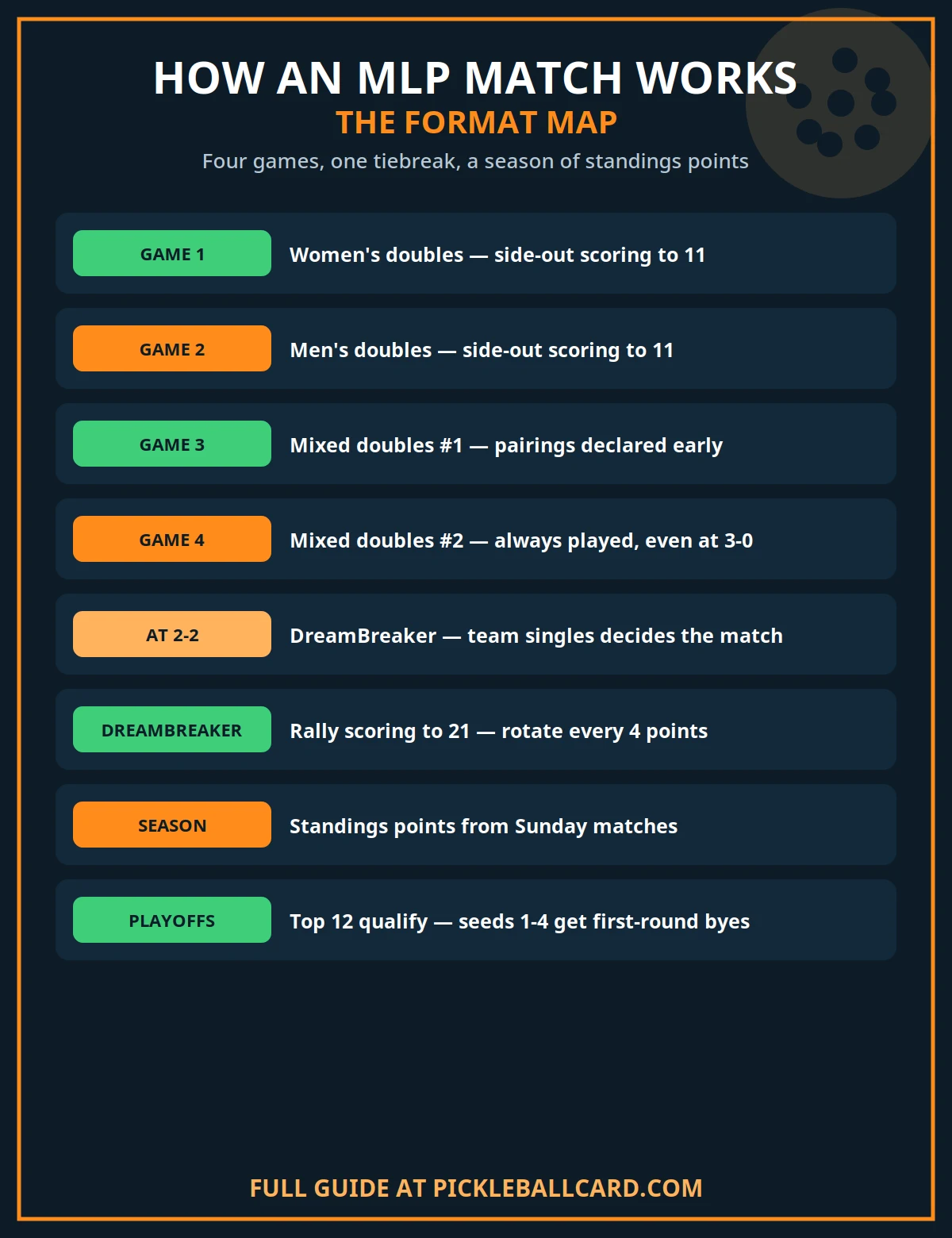
- Women’s doubles. The two women on each roster open the match. One game, one point for the winner.
- Men’s doubles. The men’s pairing follows, again for one match point.
- Mixed doubles, game one. Each team fields a mixed pairing — usually its first-choice combination.
- Mixed doubles, game two. The remaining mixed combination plays the fourth game. New pairings, fresh matchups, same stakes.
- DreamBreaker, if needed. At 2-2, the match goes to the singles tiebreak explained below. At 3-1 or 4-0, the match is already decided.
Notice the design: gender doubles test each squad’s depth, and the two mixed games test its combinations. A team cannot hide a weak pairing anywhere.
All four games are played even when a team leads 3-0. The extra game still matters for game records and the tiebreakers used in group standings.
Lineups matter before a ball is hit. Teams declare their pairings in advance, and choosing which mixed combination plays first is a genuine tactical decision.
The Hybrid Scoring System, Explained
| Game type | Scoring system | Played to | Key detail |
|---|---|---|---|
| Women’s doubles | Side-out scoring | 11, win by 2 | Only the serving team scores, as in traditional pickleball |
| Men’s doubles | Side-out scoring | 11, win by 2 | Same format as the women’s game |
| Mixed doubles (both games) | Side-out scoring | 11, win by 2 | Pairings are declared before the match |
| DreamBreaker singles | Rally scoring | 21, win by 2 | Every rally scores; players rotate every 4 points; the game must be won on serve at the end |
Older guides describe MLP as rally scoring to 21 for everything. That was true in earlier seasons, but it is not the current doubles format.
For 2026, the league confirms side-out scoring for the gender and mixed doubles games, played to 11 with a winning margin of two.
Rally scoring survives where it works best: the DreamBreaker, where every rally scoring keeps the tiebreak fast and constantly tense.
If traditional scoring itself is new to you, our guide to pickleball ratings sits alongside scoring explainers that cover the recreational game.
The DreamBreaker: MLP’s Signature Tiebreak
The DreamBreaker is a team singles game played to 21 under rally scoring. It only appears when a match is tied 2-2 after the four doubles games.
Every player takes part. Teammates rotate through the singles matchup in a set order, switching out every four points, so no one player carries the tiebreak alone.
Because scoring is rally-based, the score moves on every rally. A small lead can vanish in a minute, which is why crowds love it.
Two details raise the pressure further. Teams change ends partway through, and at the end the game must be won while serving — a freeze at game point.
Strategically, the rotation order is a chess move. Coaches try to land their strongest singles players on the most favourable stretches of the rotation.
It is also the only singles most MLP fans watch. Doubles specialists suddenly have to cover a full court alone, with their whole team courtside.
Teams, Drafts and Rosters
MLP rosters are built through a draft. Teams select from a pool of available professionals rather than simply signing any pair they like.
Each roster combines men’s and women’s players, because the format needs both: gender doubles pairs plus two different mixed combinations in every match.
Recent seasons expanded rosters beyond the starting four, giving teams bench options. Starting lineups are declared before each match day, so depth is used, not wasted.
That structure rewards general managers as much as players. Drafting a strong third or fourth option can decide a DreamBreaker months later.
For fans, the draft creates an off-season story normal tournaments never have: rebuilds, steals, and rosters that look completely different each year.
The Season and the Road to the Playoffs
The 2026 calendar features 13 events in total: nine regular-season events, a mid-season tournament and three weekends of playoffs, running from May to August.
At each regular-season event, 11 teams take part. They split into groups and play round robin from Thursday to Saturday.
The top teams in each group advance to Sunday. Sunday’s head-to-head matches are where teams earn the standings points that shape their season.
Across the season, standings points also reward how a match was won, so a DreamBreaker victory and a regulation victory are not quite equal.
The top 12 teams in the final standings qualify for the 2026 MLP Playoffs, seeded one through twelve.
Seeds one to four receive first-round byes and start at the quarterfinals in Newport Beach. Seeds five to twelve open the playoffs in Dallas.
The four quarterfinal winners advance to the semifinals in New York City, and the two semifinal winners meet in the finals, also in New York.
A Worked Example: One Match, Start to Finish
Imagine two teams level on talent. The women’s doubles game goes to Team A, 11-8. Team B answers in the men’s game, 11-9. The match is 1-1.
Team A’s first mixed pairing wins the third game, 11-7. Team B now needs the fourth game simply to survive — and gets it, 12-10. The match is 2-2.
Everything now rests on the DreamBreaker. Six players per side rotate through singles rallies, four points at a time, every rally scoring toward 21.
Team B’s rotation order proves smarter: its strongest singles player lands the closing stretch, and Team B takes the DreamBreaker 21-18 — and the match with it.
Under the standings system, that DreamBreaker win is worth slightly less than a 3-1 regulation win. Winning well matters, not just winning.
A Quick MLP Glossary
| Term | What it means |
|---|---|
| MLPlay | The league’s own name for its team match format and rules |
| DreamBreaker | The rally-scored singles tiebreak to 21 that decides a 2-2 match |
| Regulation win | Winning the match 3-1 or 4-0, without needing a DreamBreaker |
| Side-out scoring | Traditional pickleball scoring: only the serving team can win points |
| Rally scoring | Every rally produces a point, whoever served |
| Standings points | Season points earned from match results, used to seed the playoffs |
| Freeze | At DreamBreaker game point, the leading team must win the final point on its own serve |
MLP vs a Regular Pickleball Tournament
| Feature | Major League Pickleball | Regular pro tournament |
|---|---|---|
| Who competes | City-based teams with drafted rosters | Individual pairs enter together |
| Match structure | Four team games: women’s, men’s, two mixed | Separate draws for each event |
| Mixed doubles | Half of every match, always | One event among several |
| Scoring | Side-out to 11 in doubles; rally-scored DreamBreaker to 21 | Usually side-out to 11, best of three games |
| Tiebreak | DreamBreaker team singles | A deciding third game in the same format |
| Season story | Standings, drafts, playoffs, a champion team | Each event stands alone |
The contrast explains MLP’s appeal. A normal tournament crowns pairs. MLP crowns a team — and gives fans a table to argue about all season.
It also sits inside a bigger story: record crowds and new fans keep arriving, as we cover in why pickleball is so popular.
Why Players and Fans Like the Format
Players get something rare in pickleball: teammates. Bench energy, shared game plans and a season-long identity are normal in other sports and novel here.
Fans get short, legible matches. Four games, one point each, a possible tiebreak — a newcomer understands the stakes within five minutes of watching.
Mixed doubles benefits most. In MLP it is never an afterthought: it decides matches every week, and its best players become genuine stars.
And the DreamBreaker gives the league a highlight format of its own — the clip new fans share first when they discover the league.
How to Watch and Follow MLP
Start with the league’s own site and schedule, which publish each event’s team matchups in advance so you can preview the pairings.
Pick a hometown team early. Following one roster through the standings race makes the group stage and Sunday points far easier to care about.
When you watch a match, track the mixed pairings. Which combination a team saves for the fourth game often reveals its whole strategy.
If a DreamBreaker starts, watch the rotation order instead of the ball for a few points. The matchup chess is the format’s hidden game.
Three Misconceptions to Drop
First, MLP is not the only pro pickleball. Tour events for individual pairs run alongside it, and most MLP players compete in both worlds.
Second, the DreamBreaker is not regular singles. It is a rotating team tiebreak, and a player may only face two or three opponents across it.
Third, a 3-0 lead does not end the match early. The fourth game is always played, because game records feed the standings tiebreakers.
Frequently Asked Questions
What does MLP stand for?
Major League Pickleball. It is a coed professional team league — presented by DoorDash in recent seasons — where city-based franchises compete across a season of events.
What is a DreamBreaker in pickleball?
MLP’s singles tiebreak, played when a team match is tied 2-2. It uses rally scoring to 21, win by two, with teammates rotating in every four points.
How many games are in an MLP match?
Four: women’s doubles, men’s doubles and two mixed doubles games. Each game is worth one point, all four are always played, and 2-2 triggers the DreamBreaker.
Does MLP use rally scoring?
Only in the DreamBreaker. In 2026 the doubles games use traditional side-out scoring to 11, win by two — older all-rally-scoring descriptions are out of date.
How are MLP teams formed?
Through a draft from a pool of professional players. Rosters combine men and women, expanded beyond four players in recent seasons, with starting lineups declared before match days.
How many teams make the MLP playoffs?
Twelve in 2026. They are seeded by regular-season standings points, with the top four seeds receiving byes into the quarterfinals.
The Bottom Line
Major League Pickleball turns an individual sport into a team season: drafted rosters, four-game matches, standings points and a playoff bracket.
Its two inventions are what to remember — mixed doubles as half of every match, and the DreamBreaker singles tiebreak when everything is level.
Watch one full match, ideally one that reaches a DreamBreaker. After that, the format explains itself better than any guide can.
Sources: Major League Pickleball, The ABC’s of MLP (2026 format, season and playoffs); USA Pickleball, Official Rules for traditional side-out scoring.
This explainer is original; no competitor content is linked or reproduced.