• Skip to primary navigation
  • Skip to main content
  • Skip to primary sidebar

Pickleballcard

All About Pickleball Gears

  • About Pickleball
    • How To Play Pickleball
    • Pickleball Rules
    • Pickleball Kitchen Rules
    • Serving Rules
    • Pickleball Ratings
    • Pickleball Tips
    • Pickleball History
  • Pickleball Shoes
    • Best Pickleball Shoes
    • Best Pickleball Shoes For Men
    • Best Pickleball Shoes For Women
  • Pickleball Paddles
    • Best Pickleball Paddles
    • Elongated Pickleball Paddles
    • Graphite Pickleball Paddles
    • Onix Pickleball Paddles
    • Pickleball Paddles for Women
    • Pickleball Paddles For Spin
  • Vs
    • Pickleball Vs Tennis
    • Paddle Tennis Vs Pickleball
    • Indoor Vs Outdoor Pickleball

Your First Pickleball Tournament: What to Expect and What to Bring

October 21, 2026 by shoaib

Your first pickleball tournament will feel nothing like open play. There is a check-in desk, a bracket, long waits, sudden matches, and strangers who warm up like professionals.

None of that means you are not ready. It means tournament day runs on its own system, and the system is learnable before you arrive.

This guide walks through the whole experience: choosing an event, entering the right division, every format, the day itself, and what to bring.

Key Takeaways

  • Start small and local. A one-day club or local event teaches the system without the cost and pressure of a large national tournament.
  • Enter honestly at your level. Your first event is for learning the format. Playing in the right bracket gives you close matches and useful feedback.
  • Most first events use round robin or double elimination. Both guarantee more than one match, so one bad game never ends your day.
  • Tournament day is mostly waiting. Bring food, water, layers and patience. Matches arrive in clusters, often with little warning.
  • Rules are stricter than open play. Approved paddles, called scores, timeout limits and, at some events, referees all apply from game one.
  • Judge the day by lessons, not medals. You will learn more about your real level in one tournament than in months of casual games.

The Short Answer: What a First Tournament Feels Like

Expect a full day built around short bursts of play. You check in early, warm up when a court opens, then wait for your bracket to be called.

When your match is called, everything speeds up. Games are scored formally, the next match is already waiting, and there is little time to dwell.

Between matches you go back to waiting: watching, eating, stretching and tracking the bracket. That rhythm, not the standard of play, surprises first-timers most.

Step 1: Choose the Right First Tournament

Pick an event close to home. Sleeping in your own bed and driving thirty minutes removes travel stress from a day that already has enough variables.

Pick a small or mid-sized event. Fields are friendlier, schedules run closer to time, and organisers have more patience for first-timer questions.

Pick one event, not three. Enter a single doubles division first. Adding singles and mixed doubles on debut usually means exhaustion, not extra value.

Read the event page carefully before paying. It states the format, the ball, the scoring, the refund policy and whether matches are refereed or self-officiated.

If anything is unclear, email the tournament director. Asking before you enter is normal, and directors answer first-timer questions every single week.

Step 2: Enter the Right Division — Skill, Age and Event Type

Divisions are split by skill level, often by age as well. You enter the bracket that matches your honest current level, not your best day.

If you have a rating, use it. If you do not, self-rate conservatively using the level descriptions on our pickleball ratings guide.

New tournament players commonly belong in the 2.5 or 3.0 bracket. Winning easily in open play against the same friends does not make you a 3.5.

Playing up sounds brave and usually backfires. You get few rallies, little feedback and a short day. Playing down is unfair to the field and teaches nothing.

Sanctioned events require a USA Pickleball membership and an approved paddle. Local unsanctioned events are often more relaxed, which is another reason to start there.

Choose your partner for communication, not just skill. A calm partner who talks between points is worth more than a stronger partner who goes silent.

The Formats, Explained in Plain Language

Format How it works What it means for you
Round robin Every team plays every other team in the group Most matches, no early exit — the friendliest first format
Double elimination A loss drops you into a second bracket; a second loss ends your day One bad match is survivable; you can still reach the final
Single elimination with consolation A loss ends your title run; consolation games decide bronze Shorter day; every early match carries real pressure
Pool play into playoffs Round robin pools seed a single or double elimination playoff A long day: group games first, knockout games after

The USA Pickleball rulebook recognises these formats for sanctioned play. The tournament director chooses which one your event uses, so check before you register.

Round Robin: The Best First Format

In a round robin, you play everyone in your group. The winner is decided by matches won, with head-to-head results breaking the first tie.

If teams are still level, point differential decides. That is why every point matters, even in a match you are clearly losing.

Games are often shorter here: one game to 11, or one game to 15, especially in larger groups. Shorter games reward a fast start.

Double Elimination: Two Lives

Lose once and you drop into the consolation, or opportunity, bracket. Lose there and you are finished. Win it and you can still play for gold.

The consolation winner must beat the unbeaten finalist, then win a further tiebreak game to 15. It is a long road back, but it exists.

For a first-timer, the safety net matters psychologically. A nervous opening loss does not end your tournament in the first hour.

Scoring You Will Actually See

Standard tournament scoring options include best two of three games to 11. You will also see one game to 15 or 21 in faster formats.

Every format is win by two, except some team events that finish win by one. Confirm your event’s scoring on the information page.

If scoring itself still feels shaky, revisit how to play pickleball before the event. Tournament day is a bad classroom for basics.
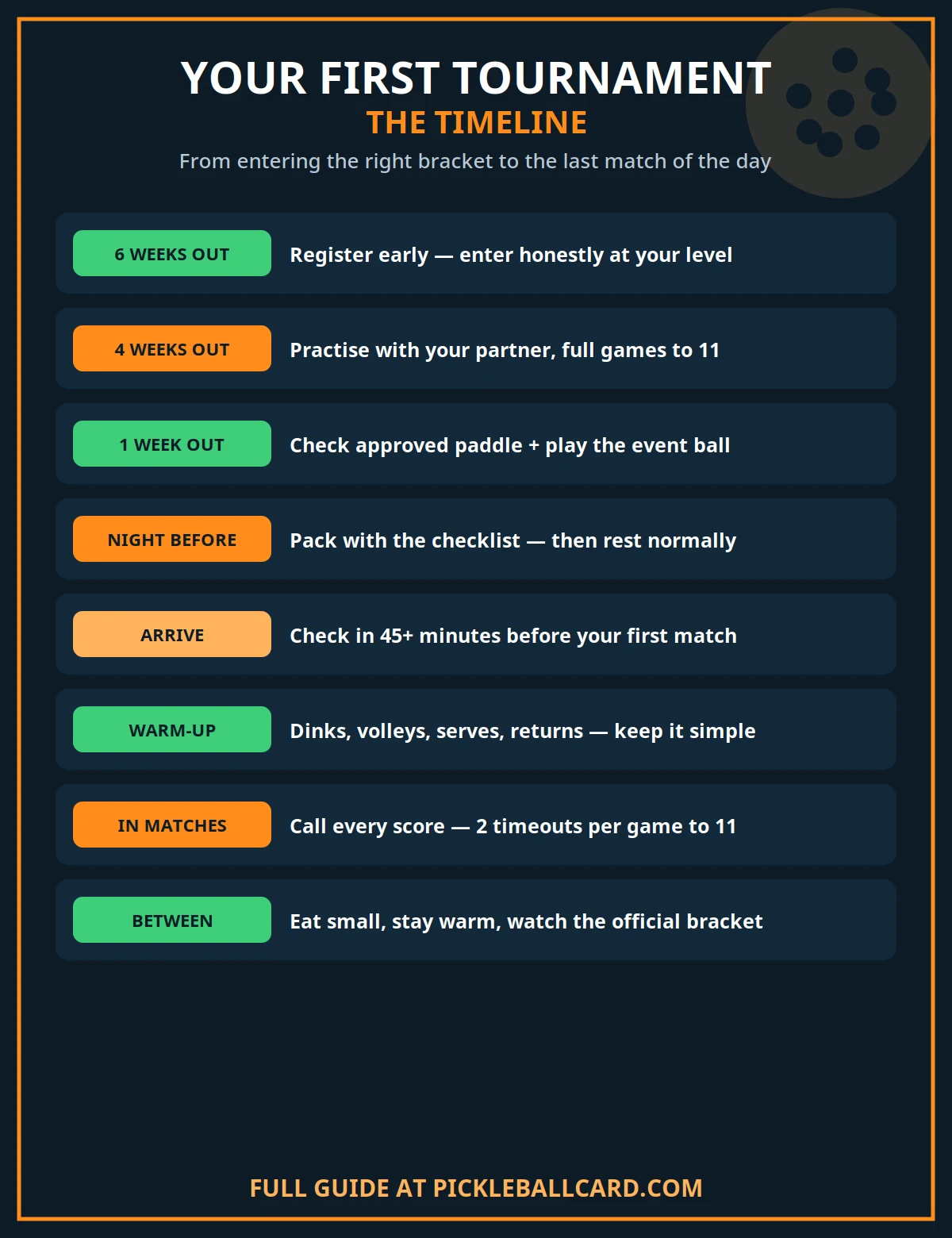
First pickleball tournament timeline — from registration to the last match
Your first tournament timeline — from registration to the last match of the day.

Your Preparation Timeline

Four to Six Weeks Before

Register early. Popular beginner brackets fill first, and late entries often land on a waitlist that only moves when someone withdraws.

Lock in your partner and practise together. Play full games to 11, call the score aloud, and practise starting both serving and receiving.

Play against strangers at least twice. Tournament opponents do not know your habits, and that unfamiliarity is exactly what you need to rehearse.

One to Two Weeks Before

Check your paddle is on the USA Pickleball approved list if your event is sanctioned. Check grips, edge guards and spare gear at the same time.

Play one session using the tournament ball. Balls differ in pace and bounce, and adjusting during the warm-up on the day is too late.

Agree a simple game plan with your partner: who takes middle balls, who calls shots, and what you do when you fall behind early.

The Night Before

Pack using the checklist below, then stop thinking about gear. Lay out clothes, charge your phone and check the drive and parking.

Eat normally and sleep normally. Tournament eve is not the moment for a new diet, new shoes or a radical technique change.

Tournament Day, Hour by Hour

Check-In

Arrive at least forty-five minutes before your first match. Check in at the desk, confirm your bracket and court, and get your player packet.

Listen for how matches will be called: a loudspeaker, a text alert or a desk announcement. Missing a call can mean a forfeit.

Starting servers in doubles may be given a band or marker to wear. Put it on immediately; it settles correct-server questions before they start.

Warm-Up Reality

Warm-up courts are scarce and shared. Expect ten busy minutes, not a private practice session, and share the court generously.

Warm up the shots that matter: dinks, volleys, serves and returns. Skip trick shots. You are preparing your feet and eyes, not entertaining anyone.

On court before a match, the warm-up is brief and formal. Use it to check the ball, the wind and the court surface.

During Matches

Call the score loudly before every serve, every time. In self-officiated matches this habit prevents most disputes before they can begin.

You are responsible for line calls on your side, with the benefit of any doubt going to your opponents. Refereed matches change that job, not the principle.

Our guide to pickleball etiquette and unwritten rules covers the sportsmanship standard. Tournaments test it harder than open play ever does.

Know your timeouts. Each team gets two one-minute timeouts per game to 11 or 15. Use one to reset; never save both for later.

Between games you get up to two minutes. In a deciding game to 11, teams change ends at six points, with up to a minute to switch.

Between Matches: The Long Middle of the Day

Bring a chair, shade and something to do. Waits of an hour or more are normal, especially while other brackets clear the courts.

Eat small and often. A heavy lunch sits badly before an afternoon match; steady snacks and water keep your energy flat and usable.

Stay loosely warm. Walk, stretch gently and hit a few balls when a court frees up, rather than sitting still for ninety minutes.

Watch the bracket, not the rumours. Schedules slip; the official desk and the official bracket are the only sources worth trusting.

What to Bring: The Complete Checklist

Category Bring Why
Play Your paddle plus a backup paddle A cracked frame or dead grip should not end your day
Play Court shoes, spare socks, spare shirt Long days on hard courts punish feet and soak clothing
Fuel Water bottle plus electrolytes Venue supplies run out; cramps end more days than opponents do
Fuel Snacks you already know agree with you Tournament day is no place to experiment with food
Comfort Chair, hat, sunscreen, towel, layers You will spend most of the day off court, often outdoors
Care Tape, plasters, pain relief you normally use Small problems stay small only if you can treat them
Admin Phone, charger, ID, membership details if required Brackets, alerts and check-in all run through your phone

Nerves: What Everyone Feels and What Helps

Everyone is nervous in a first tournament, including the team that looks ice-cold. Hands shake, serves tighten and simple balls get careful. That is normal physiology.

Shrink the target. Judge yourself on routines, not results: breathe before serving, call the score, move your feet, and communicate after every point.

Play your ordinary game. Tournaments punish invented shots. The player who wins a first event is rarely the flashiest; they are the most consistent.

Expect one bad game. Reset rules help: towel off, agree one simple adjustment with your partner, and play the next game point by point.

Remember why you entered. A first tournament is market research on your own game. The medal, if it comes, is a bonus.

Five Mistakes First-Timers Make

  1. Entering too high. An honest bracket gives close matches. A vanity bracket gives a short, silent day and almost no useful feedback.
  2. Arriving at start time. Check-in, parking and warm-up all take longer than expected. Early is calm; on time is already rushed.
  3. Changing equipment that week. A new paddle, grip or shoe needs practice hours first. Debut familiar gear, not shopping.
  4. Ignoring the waits. Players eat too little, sit too long and cool down completely. Manage the hours between matches like part of the event.
  5. Arguing line calls. Benefit of the doubt goes to your opponents. Win the next point instead of re-litigating the last one.

Frequently Asked Questions

Do I need a rating to enter my first pickleball tournament?

No. Most events let first-timers self-rate. Choose the bracket that matches your honest level, using published level descriptions, and expect the rating system to catch up quickly.

Do I need a USA Pickleball membership?

For sanctioned events, yes. Membership is required and your paddle must be approved. Many local and club events are unsanctioned and more flexible, so check the event page.

How many matches will I play?

It depends on the format. Round robin guarantees a game against every team in your group. Double elimination guarantees at least two matches. Single elimination guarantees one.

How long does a tournament day last?

Plan for most of a day. Your bracket may finish in three hours or run past six, depending on field size, courts and schedule delays.

What if I lose my first match?

In double elimination you drop into the second bracket and keep playing. In round robin there is no elimination at all. Only pure single elimination ends your run.

Should I play singles or doubles first?

Doubles, for most people. It is the most common format, shares the workload, and a partner makes the system, the waits and the nerves easier to handle.

The Bottom Line

A first tournament is a system to learn, not a verdict on your talent. Choose a small local event, enter honestly, and prepare for the waiting.

Learn the format before you arrive, pack for the whole day, call every score, and treat every match as information about your real game.

Walk away with a list: what held up, what broke down, and what to practise next. That list, not the result, is the real prize.

Sources: USA Pickleball, Official Rules — tournament formats, standard scoring options and timeout rules in the current rulebook.

This guide is original; no competitor content is linked or reproduced.

shoaib
shoaib

Shoaib is the publisher of Pickleball Card. He oversees the site’s guides to pickleball rules, ratings, strategy and gear, all researched from primary sources — the USA Pickleball Rulebook, DUPR and manufacturer documentation — and updated as the game changes.
pickleballcard.com

Filed Under: Ratings & Competition

What Is Major League Pickleball? MLP Format and DreamBreaker Explained

October 20, 2026 by shoaib

Major League Pickleball — MLP — is professional pickleball played as a team sport. Cities have teams, teams draft players, and matches are decided by a singles tiebreak with a name of its own.

It looks nothing like a normal tournament bracket. Four doubles games come first, every game counts, and a 2-2 tie triggers the DreamBreaker.

This guide explains the whole format in plain language: the teams, the match structure, the hybrid scoring, the DreamBreaker, the season and the playoffs.

Key Takeaways

  • MLP is a coed team league. Hometown teams of men and women compete together, rather than players entering events as individual pairs.
  • Every match has four games. Women’s doubles, men’s doubles and two mixed doubles games, each worth a point toward the match.
  • A 2-2 tie goes to a DreamBreaker. A singles tiebreak to 21 under rally scoring, with teammates rotating in every four points.
  • Scoring is hybrid in 2026. Doubles games use side-out scoring to 11, win by two. Only the DreamBreaker uses rally scoring.
  • All four games are always played. Even a 3-0 lead finishes the fourth game, because results feed standings and tiebreakers.
  • The season builds to playoffs. Regular-season standings points decide which twelve teams reach the 2026 MLP Playoffs.

The Short Answer

Major League Pickleball is the sport’s team league, launched in 2021. Franchises draft rosters of professional men and women and play coed team matches.

Each match is four doubles games. Win three and you win the match. Split them 2-2 and a DreamBreaker singles tiebreak decides it.

Think of it as pickleball rebuilt for team drama: short games, constant pressure, and a tiebreak format you will not see in any ordinary tournament.

What Exactly Is Major League Pickleball?

MLP launched in 2021 as a deliberate break from pickleball’s usual structure, where pairs enter tournaments together and play only for themselves.

Here, the league’s own description is a coed team league with some of the most influential team owners in professional sports behind its franchises.

The official site counts 20 hometown teams and more than 100 of the top-ranked professional players competing across the season.

Teams carry city or regional identities, so fans support a franchise through a whole season instead of following a pair from event to event.

That team layer is the point. Mixed doubles is not a side event in MLP — it is half the match, and roster balance wins titles.

If you are new to the pro game, our profiles of famous Pickleball players introduce many of the stars who headline MLP rosters.

A Brief History of the League

MLP was founded in 2021, when pickleball’s growth was obvious but its professional side still ran on individual tournament entries.

The founding idea was borrowed from other American sports: franchises, a draft, team owners and a championship — structures fans already knew how to follow.

The format experimented early. Earlier seasons used rally scoring to 21 across the doubles games, a faster but less traditional look.

The league later settled on its hybrid model: familiar side-out doubles games, with rally scoring kept for the DreamBreaker where it creates most drama.

Sponsorship and team values grew with the sport around it, and by 2026 the calendar had settled into a compact May-to-August season.

The history matters for one practical reason: when you read older MLP explainers, check the date. The scoring format has genuinely changed since they were written.

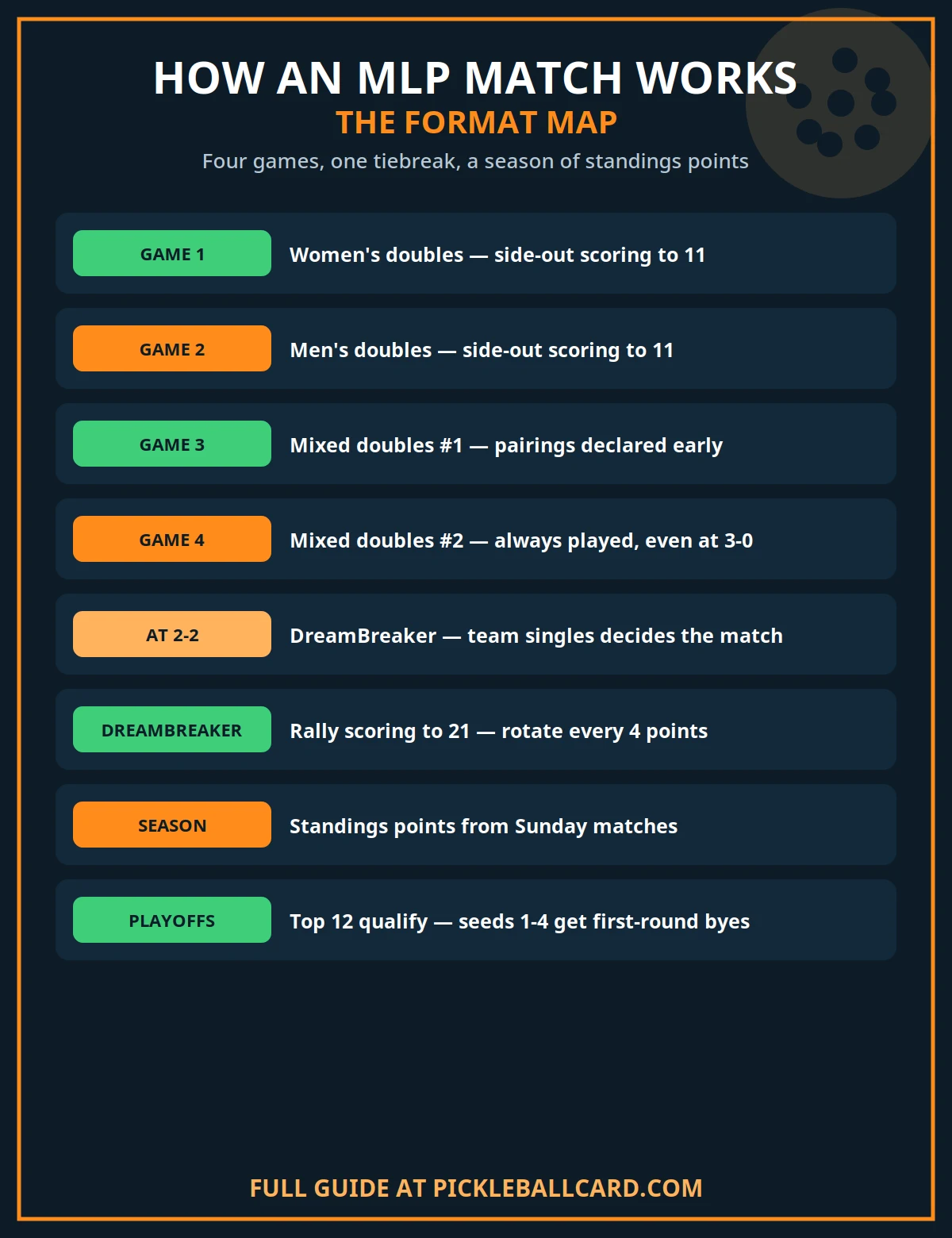
How an MLP Match Works, Step by Step

  1. Women’s doubles. The two women on each roster open the match. One game, one point for the winner.
  2. Men’s doubles. The men’s pairing follows, again for one match point.
  3. Mixed doubles, game one. Each team fields a mixed pairing — usually its first-choice combination.
  4. Mixed doubles, game two. The remaining mixed combination plays the fourth game. New pairings, fresh matchups, same stakes.
  5. DreamBreaker, if needed. At 2-2, the match goes to the singles tiebreak explained below. At 3-1 or 4-0, the match is already decided.

Notice the design: gender doubles test each squad’s depth, and the two mixed games test its combinations. A team cannot hide a weak pairing anywhere.

All four games are played even when a team leads 3-0. The extra game still matters for game records and the tiebreakers used in group standings.

Lineups matter before a ball is hit. Teams declare their pairings in advance, and choosing which mixed combination plays first is a genuine tactical decision.

The Hybrid Scoring System, Explained

Game type Scoring system Played to Key detail
Women’s doubles Side-out scoring 11, win by 2 Only the serving team scores, as in traditional pickleball
Men’s doubles Side-out scoring 11, win by 2 Same format as the women’s game
Mixed doubles (both games) Side-out scoring 11, win by 2 Pairings are declared before the match
DreamBreaker singles Rally scoring 21, win by 2 Every rally scores; players rotate every 4 points; the game must be won on serve at the end

Older guides describe MLP as rally scoring to 21 for everything. That was true in earlier seasons, but it is not the current doubles format.

For 2026, the league confirms side-out scoring for the gender and mixed doubles games, played to 11 with a winning margin of two.

Rally scoring survives where it works best: the DreamBreaker, where every rally scoring keeps the tiebreak fast and constantly tense.

If traditional scoring itself is new to you, our guide to pickleball ratings sits alongside scoring explainers that cover the recreational game.

The DreamBreaker: MLP’s Signature Tiebreak

The DreamBreaker is a team singles game played to 21 under rally scoring. It only appears when a match is tied 2-2 after the four doubles games.

Every player takes part. Teammates rotate through the singles matchup in a set order, switching out every four points, so no one player carries the tiebreak alone.

Because scoring is rally-based, the score moves on every rally. A small lead can vanish in a minute, which is why crowds love it.

Two details raise the pressure further. Teams change ends partway through, and at the end the game must be won while serving — a freeze at game point.

Strategically, the rotation order is a chess move. Coaches try to land their strongest singles players on the most favourable stretches of the rotation.

It is also the only singles most MLP fans watch. Doubles specialists suddenly have to cover a full court alone, with their whole team courtside.

How an MLP match works infographic — four doubles games, the DreamBreaker at 2-2, standings points and playoffs
How an MLP match works: four games, a DreamBreaker at 2-2, and the road to the playoffs.

Teams, Drafts and Rosters

MLP rosters are built through a draft. Teams select from a pool of available professionals rather than simply signing any pair they like.

Each roster combines men’s and women’s players, because the format needs both: gender doubles pairs plus two different mixed combinations in every match.

Recent seasons expanded rosters beyond the starting four, giving teams bench options. Starting lineups are declared before each match day, so depth is used, not wasted.

That structure rewards general managers as much as players. Drafting a strong third or fourth option can decide a DreamBreaker months later.

For fans, the draft creates an off-season story normal tournaments never have: rebuilds, steals, and rosters that look completely different each year.

The Season and the Road to the Playoffs

The 2026 calendar features 13 events in total: nine regular-season events, a mid-season tournament and three weekends of playoffs, running from May to August.

At each regular-season event, 11 teams take part. They split into groups and play round robin from Thursday to Saturday.

The top teams in each group advance to Sunday. Sunday’s head-to-head matches are where teams earn the standings points that shape their season.

Across the season, standings points also reward how a match was won, so a DreamBreaker victory and a regulation victory are not quite equal.

The top 12 teams in the final standings qualify for the 2026 MLP Playoffs, seeded one through twelve.

Seeds one to four receive first-round byes and start at the quarterfinals in Newport Beach. Seeds five to twelve open the playoffs in Dallas.

The four quarterfinal winners advance to the semifinals in New York City, and the two semifinal winners meet in the finals, also in New York.

A Worked Example: One Match, Start to Finish

Imagine two teams level on talent. The women’s doubles game goes to Team A, 11-8. Team B answers in the men’s game, 11-9. The match is 1-1.

Team A’s first mixed pairing wins the third game, 11-7. Team B now needs the fourth game simply to survive — and gets it, 12-10. The match is 2-2.

Everything now rests on the DreamBreaker. Six players per side rotate through singles rallies, four points at a time, every rally scoring toward 21.

Team B’s rotation order proves smarter: its strongest singles player lands the closing stretch, and Team B takes the DreamBreaker 21-18 — and the match with it.

Under the standings system, that DreamBreaker win is worth slightly less than a 3-1 regulation win. Winning well matters, not just winning.

A Quick MLP Glossary

Term What it means
MLPlay The league’s own name for its team match format and rules
DreamBreaker The rally-scored singles tiebreak to 21 that decides a 2-2 match
Regulation win Winning the match 3-1 or 4-0, without needing a DreamBreaker
Side-out scoring Traditional pickleball scoring: only the serving team can win points
Rally scoring Every rally produces a point, whoever served
Standings points Season points earned from match results, used to seed the playoffs
Freeze At DreamBreaker game point, the leading team must win the final point on its own serve

MLP vs a Regular Pickleball Tournament

Feature Major League Pickleball Regular pro tournament
Who competes City-based teams with drafted rosters Individual pairs enter together
Match structure Four team games: women’s, men’s, two mixed Separate draws for each event
Mixed doubles Half of every match, always One event among several
Scoring Side-out to 11 in doubles; rally-scored DreamBreaker to 21 Usually side-out to 11, best of three games
Tiebreak DreamBreaker team singles A deciding third game in the same format
Season story Standings, drafts, playoffs, a champion team Each event stands alone

The contrast explains MLP’s appeal. A normal tournament crowns pairs. MLP crowns a team — and gives fans a table to argue about all season.

It also sits inside a bigger story: record crowds and new fans keep arriving, as we cover in why pickleball is so popular.

Why Players and Fans Like the Format

Players get something rare in pickleball: teammates. Bench energy, shared game plans and a season-long identity are normal in other sports and novel here.

Fans get short, legible matches. Four games, one point each, a possible tiebreak — a newcomer understands the stakes within five minutes of watching.

Mixed doubles benefits most. In MLP it is never an afterthought: it decides matches every week, and its best players become genuine stars.

And the DreamBreaker gives the league a highlight format of its own — the clip new fans share first when they discover the league.

How to Watch and Follow MLP

Start with the league’s own site and schedule, which publish each event’s team matchups in advance so you can preview the pairings.

Pick a hometown team early. Following one roster through the standings race makes the group stage and Sunday points far easier to care about.

When you watch a match, track the mixed pairings. Which combination a team saves for the fourth game often reveals its whole strategy.

If a DreamBreaker starts, watch the rotation order instead of the ball for a few points. The matchup chess is the format’s hidden game.

Three Misconceptions to Drop

First, MLP is not the only pro pickleball. Tour events for individual pairs run alongside it, and most MLP players compete in both worlds.

Second, the DreamBreaker is not regular singles. It is a rotating team tiebreak, and a player may only face two or three opponents across it.

Third, a 3-0 lead does not end the match early. The fourth game is always played, because game records feed the standings tiebreakers.

Frequently Asked Questions

What does MLP stand for?

Major League Pickleball. It is a coed professional team league — presented by DoorDash in recent seasons — where city-based franchises compete across a season of events.

What is a DreamBreaker in pickleball?

MLP’s singles tiebreak, played when a team match is tied 2-2. It uses rally scoring to 21, win by two, with teammates rotating in every four points.

How many games are in an MLP match?

Four: women’s doubles, men’s doubles and two mixed doubles games. Each game is worth one point, all four are always played, and 2-2 triggers the DreamBreaker.

Does MLP use rally scoring?

Only in the DreamBreaker. In 2026 the doubles games use traditional side-out scoring to 11, win by two — older all-rally-scoring descriptions are out of date.

How are MLP teams formed?

Through a draft from a pool of professional players. Rosters combine men and women, expanded beyond four players in recent seasons, with starting lineups declared before match days.

How many teams make the MLP playoffs?

Twelve in 2026. They are seeded by regular-season standings points, with the top four seeds receiving byes into the quarterfinals.

The Bottom Line

Major League Pickleball turns an individual sport into a team season: drafted rosters, four-game matches, standings points and a playoff bracket.

Its two inventions are what to remember — mixed doubles as half of every match, and the DreamBreaker singles tiebreak when everything is level.

Watch one full match, ideally one that reaches a DreamBreaker. After that, the format explains itself better than any guide can.

Sources: Major League Pickleball, The ABC’s of MLP (2026 format, season and playoffs); USA Pickleball, Official Rules for traditional side-out scoring.

This explainer is original; no competitor content is linked or reproduced.

shoaib
shoaib

Shoaib is the publisher of Pickleball Card. He oversees the site’s guides to pickleball rules, ratings, strategy and gear, all researched from primary sources — the USA Pickleball Rulebook, DUPR and manufacturer documentation — and updated as the game changes.

pickleballcard.com

Filed Under: Ratings & Competition

Pickleball Ratings | Pickleball Rating Chart

October 14, 2026 by Sadaf Awan

This page is the home of ratings and competition coverage on Pickleballcard. The chart below is the starting point: find your level, then use the guides under it to understand DUPR, leagues and your first tournament.

Ratings guidance here follows the USA Pickleball skill-level definitions and the published DUPR system, and every level description is checked against those sources. Our About page explains how we research and cite.

Pickleball Ratings

Pickleball is one of the evolving sports that is getting recognition worldwide. Seeking the interest level of people in pickleball in the United States of America, the pickleball authority is making utmost efforts to bring optimistic scenarios regarding it.

Regarding recognition, Pickleball Ratings are very authentic and credible to know. Through a world pickleball ranking, every player tends to improve their action or game. This improvement will help them to gain expertise in pickleball.

The USAPA passes every player on a rating scale to be part of tournaments. This rating scale informs about the expert Level of the player. Now, it must be challenging to provide you with an official and new pickleball rating system.

However, we will still depict the ratio scale to determine the players’ proficiency. The scale would most likely close as per the standards of USAPA. To get the most precise overview, go through the following pickleball rating chart;

Pickleball Rating Chart

Pickleball Rating, Pickleball Skill Rating
Pickleball Skill Levels Chart

USA Pickleball Rankings

If you are interested in playing professional pickleball, you must be aware of your perfectionism pickleball skill levels. Here is the rating scale for judging your playing action to provide this detail.

This USAPA ratings scale is based on the standards issued by the relevant authorities of pickleball. The experts make the scale more renowned by its applicability to usual game standards. You will most likely understand this pickleball rating system even as a beginner.

Pickleball Rating Chart, USA Pickleball Rating

The pickleball ranking system includes the numerals and provides information about your lagging points as a player. All the aspects where you need specific potential or areas of improvement are well explained.

All of these are exceptional scale ranges issued by USAPA standards. You can effectively judge yourself through this pickleball rating quiz where you are standing over your game expertise. Let’s figure it out in detail;

1. Beginner Level (1.0 To 2.0 Skill Rating)

In this Level, the player has just started playing pickleball. They have little knowledge of the rules and terms of pickleball actions. The player has passed through only one trial of the game. At the basic level of understanding, the player might know how to serve the ball.

They did not know how to develop their forehand, so the ball did not return correctly after serving. The lawyer starts initiating the court aspects by learning all these pickleball rules. Players seek the guidance of an expert at this Level to locate the precise angle over the court. Slow and steady, they start creating the double-play experience.

2. Beginning Level (2.5 Skill Rating)

After beginners, one learns to seek “in” serving of the ball. In this 2.5 pickleball rating Level of serving, the player knows to get an idea about ground strokes and all their related aspects. The player in this pickleball rankings level gets familiar with all the soft gaming rules.

Ultimately tries to move on to dinking activities. The court coverage for the beginning level of the player is still not that satisfactory and needs an overall improvement in this section. the player keeps scoring and learning with a betterment pace

3. Novice Or Beginning Level (3.0 Skill Rating)

The novice player is learning to make new credible paths for pickleball. The players are developing to seek new shots over the court. At this 3.0 pickleball rating, the player knows he deserves the all appropriately and returns it in an affine manner.

The players are up to the edge where they know to pay new students, including dinks and lobs. They are skilled enough to participate in the tournament match pickleball. The players can implement all the basic shots of the game in professional competition.

But still, there is a need to improve several other strategic things.

4. Intermediate Level (3.5 Skill Rating)

The intermediate-level player is perfectionist enough to have a hold over the ball on the court. They work over medium-paced shots but learn to work over fast-paced pictures. The 3.5-pickleball player is still at the point of missing the shots over the court.

At a 3.5 pickleball rating, the players professionally start learning the skills for double-game adventures. The general strategies for the double game are fundamental, but you must watch the continuous court ruling.

The players become a perfect server, with a complete hold over the ball and its returning ability. Overall, you would tend to grasp the shots as per the tournament requirement or your playing position on the court.

5. Intermediate To Advanced Level (4.0 Skill Rating)

This might be the beginning of the advanced level of gaming for players. They know a wide range of shots, so they can change their interactivity enough to drive their opponents to commit a fault. The players are perfection-spinning. The spinning action will assist a trough off the ball for players, and this is an extraordinary chance to practice the pickleball drills.

However, the shot served by the player will look smooth. It will go uneven when it lands on the rival’s courtside. Then, the spinning can send it toward another path, making it almost difficult to hit.

At this 4.0 pickleball rating, players know how to pass judgment on a drink and see whether they should pursue it. They can recognize shortcomings and misleading points in their rivals, and know-how utilizing specific abilities can help them.

6. Advanced Level (4.5 Skill Rating)

Services at this Level are generally predictable and controlled. You can recognize the opponents’ shortcomings and change your abilities appropriately as per the need.

As you got over the basics of the double game. You function admirably with your partner at this 4.5 pickleball rating Level. The player knows where they will be and how they will hit. Similarly, you most likely know what’s in store for the opponent. Rather than responding to shots, you’re one stride ahead of seeking expert Level.

7. Expert Level (5.5+ Skill Rating)

The player with this consideration on the scale level will help you to get the reference about the perfection level in pickleball. The player is professionally ready to participate in and win national/international tournaments.

The players with a 5.0 or 5.5 skill rating are worthy enough to convey the exceptional game to the audience or the beginners. This level player is keen enough to bring adventure or excitement to the play. This is the highest pickleball rating.

DUPR Pickleball Ratings

Getting DUPR pickleball ratings will help you judge your playing skills and help you devise a strategy.

The DUPR pickleball ratings are hands down one of the best methods to gauge your brown Pickleball performance. It is an excellent way to give you a clear idea of your standing and how much more practice you need to become the best version of yourself.

It does not involve any complex mathematical calculations, nor does it have anything to do with engaging an expert. It is based on simple observations and judgment of scoring.

What Is A DUPR Rating?

DUPR stands for Dynamic Universal Pickleball Rating, and it is hands down the most accurate global skill rating system for Pickleball. It gives you an exact figure of your competence, hence giving you a clear idea of where you stand in your pickleball game. The best part is that anyone can use this method to get a Pickleball rating regardless of age, gender, and competence. DUPR rating changes from 2.00 to 8.00 for novice to pro pickleball players.

DUPR rating depends upon three factors,

  • How many points have you won against your competitors
  • Did you win or lose the match
  • The match was recreational play, a league or a sanctioned tournament

I know how frustrating it can be not knowing how well you are playing Pickleball as a beginner or even at an advanced level. Knowing where you stand gives you an idea of how well you are playing and how much effort you need further in order to get where you want to be. Hence, the DUPR system was invented for this sole purpose back in 2021 by Steve Kuhn, the founder of Major League Pickleball (MLP).

How Do I Get A DUPR Rating

Getting a DUPR rating is very easy. In fact, all you have to do is play one game and have your score and performance judges to get a rating. Your scoring depends upon three major questions: How many points did you score? Did you end up winning the match or losing it? Was it a sanctioned tournament, an unsanctioned tournament, or a league match?

DUPR Pickleball Ratings Chart, DUPR Rating Chart
DUPR Pickleball Ratings Chart

Each of these questions carries weight. Your scores are built upon these weights, and hence, you get a full scoring of your skills after only a single game. Of course, there are certain doubts about the accuracy of this method, too, since it may vary from one game to the other. However, the variance is only slight, so you can trust this method for now until a better one comes along.

So, it is safe to say that the DUPR pickleball ratings method is super easy and acceptably accurate. All you have to do is play a single game and have your performance scored on a pre-set weightage scale. This will give you a good idea of your standing and how much more practice you need in order to reach the level you desire.

UTPR Pickleball Ratings

UTPR Pickleball ratings are based on a player’s past four years of experience playing this game. All the wins and losses and the kind of pickleball games that you play significantly contribute to this rating. This rating is considered when registering for sanctioned tournaments.

It means that your records will determine whether you ever get to play in a sanctioned pickleball tournament at all. Of course, there are certain other things that you should know about this specific rating as well.

What Is UTPR Rating?

UTPR ratings stand for USA Tournament Player Ratings. It is hands down one of the best and most accurate methods of ranking your own Pickleball performance. It is even better and more reliable than the DUPR rating, which is based on plain observation and a standard scale of markings.

UTPR score ranges from 1.0 to 6.0 and only changes when you play sanctioned and official tournaments. This method is based on the players’ overall wins vs. losses in Pickleball games for over four years. It means that you would have to have at least four years of pickleball playing experience in order to be able to get a rating.

The best thing about the UTPR rating is that it is fully official and is used in the USA for sanctioned tournaments. Plus, this rating gets updated officially with every tournament you play. The scales will dip in your favor with every win you achieve or against you if you lose a major tournament.

How To Get A UTPR Rating?

Getting a UTPR rating is easy, and you won’t have to do anything about it yourself. As I said, it is an official rating, and the Pickleball Association maintains the records. The rating will be either in the form of two digits or four, depending on your skill level and how many tournaments you have won.

The rating is also based on what kind of tournaments you play. These include gender doubles, singles, and mixed doubles. Each of these tournaments endows certain specific ratings to the player and gradually builds up the records.

So, it is safe to say that the UTPR ratings are hands down the only professional-level ratings of Pickleball players. It is acceptable all across the USA and is considered when registering players for sanctioned Pickleball tournaments. A UTPL rating is based on more than four years of experience playing Pickleball.

It means that you will only get your UTPL rating once you cross the time limit of four years of this experience. Before that, all your wins/losses will be recorded by the Pickleball Association. You can only play a sanctioned pickleball tournament based on your UTPL rating.

DUPR Vs UTPR

Aspect DUPR UTPR
Purpose A Universal Rating System For All Players A Specific Rating System For USA-Approved Sanctioned Tournaments
Scale It Ranges From 2.00 To 8.00 It Ranges From 1.0 To 6.0
Scope It Covers League, Tournament, And Recreational Play. It Covers Only Tournament Play
Calculation Calculate Rating Based On An Algorithm Against Other Rated Players Calculate Rating By Performance In Tournaments
Reach Global Reach Focus On The US
Match Types Rates Both Singles And Doubles Rates Singles, Doubles, And Mixed Doubles Separately
Ideal For Players Seeking Universal Rating Players Focusing On Official Tournaments

Pickleball Player Comparison

Here are the differences between beginner, intermediate, and advanced pickleball players based on their skill levels.

Characteristic Beginner Intermediate Advanced
Serving Basic underhand serve Consistent underhand serve Varied and strategic serves
Court Positioning Learning court positioning Understanding court zones Optimal court awareness
Shot Variety Basic forehand and backhand Developing volleys and dinks Mastering all shot types
Strategy Learning basic game strategies Understanding of opponent patterns Adapting strategy during play
Footwork Basic movement on the court Improved lateral and forward/backward movement Efficient and quick footwork
Game Awareness Focus on personal play Awareness of opponent and teammate Anticipating opponents’ moves
Scorekeeping Learning to keep score Confident in keeping score Keen understanding of scoring
Consistency Inconsistent play Consistent performance in rallies High level of shot consistency
Handling Pace Difficulty handling fast shots Comfortable with various shot speeds Exceptional control at any pace
Communication Limited communication with partner Effective communication with partner Seamless communication and coordination
Tournaments Not participating or limited experience Participating in local tournaments Competing at regional/national levels
Skill Rating 1.0 To 3.5 4.0 To 4.5 5.0 To Above

Different Pickleball Ranking Systems

There are a few other pickleball rating systems by different organizations, which include,

  • World Pickleball Rankings
  • Global Pickleball Rankings
  • APP Rankings
  • PPA Rankings

1. World Pickleball Rankings

The World Pickleball Rankings is the most comprehensive ranking scale powered by Pickleball Tournaments for pro players. The system provides insight into players’ performance on professional tours, including PPA, APP, USAPA, and the US Open Pickleball Championship. USAPA, APP Tour, and the US Open Pickleball Championship endorse the World Ranking System.

2. Global Pickleball Rankings

Pickleball Global develops the Global Pickleball Ranking System and provides a unique age and point-based rating to professional players on the 12 best events in the previous 12-month period.

3. APP Rankings

The APP Rankings are developed by the Association of Pickleball Professionals (APP) for professional and beginner players who participate in APP Tours.

4. PPA Rankings

The PPA Rankings system is powered by the Pro Pickleball Association (PPA), which focuses on professional pickleball players’ ratings based on their performance in PPA Tour events. PPA Tour ranking is also called PPA Player Ranking.

People Also Ask

How Are Pickleball Players Rated?

Pickleball players are rated based on their performance for execution, different shots, including forehand, backhand, serve, third shot, and volley, and their ability to understand strategy and pickleball court rules. If you understand match strategy, both serve and return; you will be ranked higher among other pickleball players.

How To Get A Pickleball Rating?

To get a good pickleball rating, you need to fill USA Pickleball questionnaire and complete the USA Pickleball skill assessment form. A certified USAPA member supervises the assessment process. After this, you must get a certification letter from an experienced USA Pickleball player, tournament director, or ambassador.

What Is A 3.0 Pickleball Player?

3.0 is a player who knows pickleball fundamentals and how to position himself on the court. Both 3.0 and 3.5 knows about stacking, forehand, backhand, dink, volley, and different pickleball strategies. He has built some consistency and control over the game.

What Is DUPR Rating For Pickleball?

DUPR is a universal system for rating the pickleball players’ skill level regardless of their age, gender, and location. DUPR ranked all pickleball players between 2.00-8.00, depending upon their match performance. DUPR is calculated by winning points, types of results, and outcomes of the pickleball match. DUPR is also known as the new pickleball rating system.

What Is UTPR In Pickleball?

UTPR stands for USA Pickleball Tournament Player Ratings. It is a pickleball ranking system that USAPA approves. It uses USA Pickleball-approved tournament results and opponent UTPR to settle a player’s UTPR rating. The URPR rates the pickleball players from beginners to professionals.

How To Become A 4.0 Pickleball Player?

Here are some tips to become a 4.0 pickleball player,

  • Makes a solid foundation in basic pickleball strokes like serves, volleys, and forehand and backhand strokes.
  • Improve your pickleball serve, such as underhand and topspin serves.
  • Play pickleball against experienced and pro players so you can learn advanced tactics and strategies.
  • Master advanced pickleball shots like dinks, volleys, and third-shot drops.
  • Improve your positioning by keeping an eye on your opponent’s position and shots and changing your position at the right time.
  • Improve your physical and mental health to build the stamina that is required for longer matches.
  • Learning consistency and practice is the key to success.

How To Rate Yourself In Pickleball?

To rate yourself in pickleball, start by playing matches against players with known ratings and observe how you fare. Reflect on key skills like shot accuracy, strategy, and consistency. Focus on improving your volleys, dinks, forehand, backhand, serves, and drop shots. Regularly participating in local tournaments can also provide a realistic gauge of your level.

Where DUPR Fits In

The skill chart in this guide is a self-assessment system — useful for your first months, but subjective. The rating most organised pickleball now runs on is DUPR (Dynamic Universal Pickleball Rating), an algorithm-based rating adopted by Major League Pickleball and the PPA Tour and used by clubs and tournaments across the country. Instead of judging your strokes, DUPR reads your results: who you played, who won, and by how much, then updates your number — on a scale from 2.000 to 8.000 — as more results are logged. Beating a stronger pair moves you more than beating a weaker one, and a reliability indicator shows how much match data stands behind the rating. The practical takeaway: use the chart here to find your starting level and the right open-play group, then let a results-based rating like DUPR track your real progress once you start competing. If you are still learning the basics, begin with how to play pickleball; curious how the pros rate? See the famous pickleball players list.

The Final Statement

The Pickleball rating quiz is useful for providing the best output in assessing your quality as a player. Above all, we try to make this rating scale understandable and easy to get for you in the sectional discussion provided above.

This content might be helpful if you are a beginner looking for something considerable to get the game interface. You might become a consistent athlete with a better aiming target by seeking the appropriate information.


Estimate Your Rating

Not sure where you sit on the chart? Take the pickleball rating estimator: 14 questions mapped to the same skill chart, and it names the two areas holding your band down.

Ratings & Competition Guides

Go deeper on the systems behind the chart:

  • Why did my DUPR rating drop after a win? — How DUPR weighs expected results, and why a win can still move your rating down.
  • What is Major League Pickleball? — The co-ed team league explained: format, draft, scoring and how it differs from tour play.
  • Your first pickleball tournament — What to expect, what to bring, and how ratings decide your bracket.

Once you know your level, train for the next one with the pickleball strategy hub, which organizes drills and match-play guides by the decisions each level has to learn.

Other Related Posts:
  • Best Shoes For Pickleball
  • Pickleball Vs Paddle Tennis
  • What Is Pickleball?
  • Pickleball Scoring
  • Best Pickleball Tips


Author Profile Picture Of Sadaf Awan
Sadaf Awan

Sadaf Awan writes Pickleball Card’s footwear and gear guides. With a background in biology, she looks at shoes the practical way players feel them — fit, support, cushioning, grip and how a shoe holds up on hard courts. She compares manufacturer specs with how each model is built, and flags when a guide is research-based rather than hands-on.

Filed Under: Ratings & Competition

Why Did My DUPR Rating Drop After a Win?

October 12, 2026 by shoaib

You won. You shook hands, logged the score — and your DUPR rating went down. It feels like a bug, but under DUPR’s current algorithm it is usually the system working exactly as designed. DUPR does not reward wins on their own. Before every match it works out the score it expects from the ratings of everyone on court. If your team scores more than that expectation, your rating rises. If you score less than expected, your rating falls — even if less still turned out to be enough to win the game.

That single idea explains almost every confusing rating move players are seeing now: the narrow win that costs you points, the close loss that gains you points, and the partner whose number moved by a different amount from yours in the very same match. This guide works through each case with concrete scorelines, explains why DUPR changed the system this way, and sets out what actually makes a rating climb.

Key Takeaways

  • DUPR is a measurement, not a reward. A win can earn a medal or a better seed, but the rating only tracks how you performed compared with what your current rating predicted.
  • Margin against expectation is what moves you. Beat a much weaker team 11–8 when the system expected 11–3, and you have underperformed — your rating can dip while theirs rises.
  • You can go up in a loss. Push a stronger opponent far closer than expected and the system reads that as evidence you are better than your number.
  • One match never defines a rating. DUPR builds the number from your full body of results; well-established ratings move less per match than new or inactive ones.
  • Playing down is no longer a climbing strategy. Under the old approach any win lifted you; now routine wins over weaker players can hold you back unless you win by at least the expected margin.

The Short Answer: You Scored Less Than DUPR Expected

Think of every rated match as a prediction test. DUPR lines up the four ratings in a doubles game (or the two in singles), calculates the scoreline those ratings imply, and then compares reality with the forecast. Win 11–3 when 11–3 was expected and you have confirmed your rating — a small rise, or almost no change. Win only 11–9 in the same matchup and the evidence points the other way: either you are slightly weaker than your number suggests, or your opponents are slightly stronger than theirs. The system nudges both ratings toward each other so the next prediction starts closer to the truth.

Nothing in that logic requires you to have played badly. An 11–9 win is still a win, your opponents may have played the game of their month, and a couple of net cords may have gone against you. DUPR is not judging effort or fairness in a single afternoon — it is updating a statistical estimate, and it expects those one-off effects to cancel out across many matches.

How DUPR Actually Decides: Expected Score Explained

Three steps sit behind every rating change:

  1. Pre-match ratings set the expectation. The bigger the rating gap between the teams, the bigger the expected winning margin. A 4.5 pair facing a 3.5 pair is expected to win comfortably; two evenly matched pairs are expected to trade points to a close finish.
  2. The actual score is compared with the expectation. Points scored matter, not just the final W or L. That is why 11–2 and 11–9 against the same opponents can move a rating in opposite directions.
  3. Ratings adjust toward the new evidence. Overperform and you rise; underperform and you fall. DUPR says updates now land almost immediately after a result is entered, and you can see the effect match by match rather than waiting for a weekly recalculation.

If you are still working out where the number itself comes from, our full guide to pickleball ratings and the rating chart covers the skill levels behind DUPR, self-ratings and tournament ratings side by side.

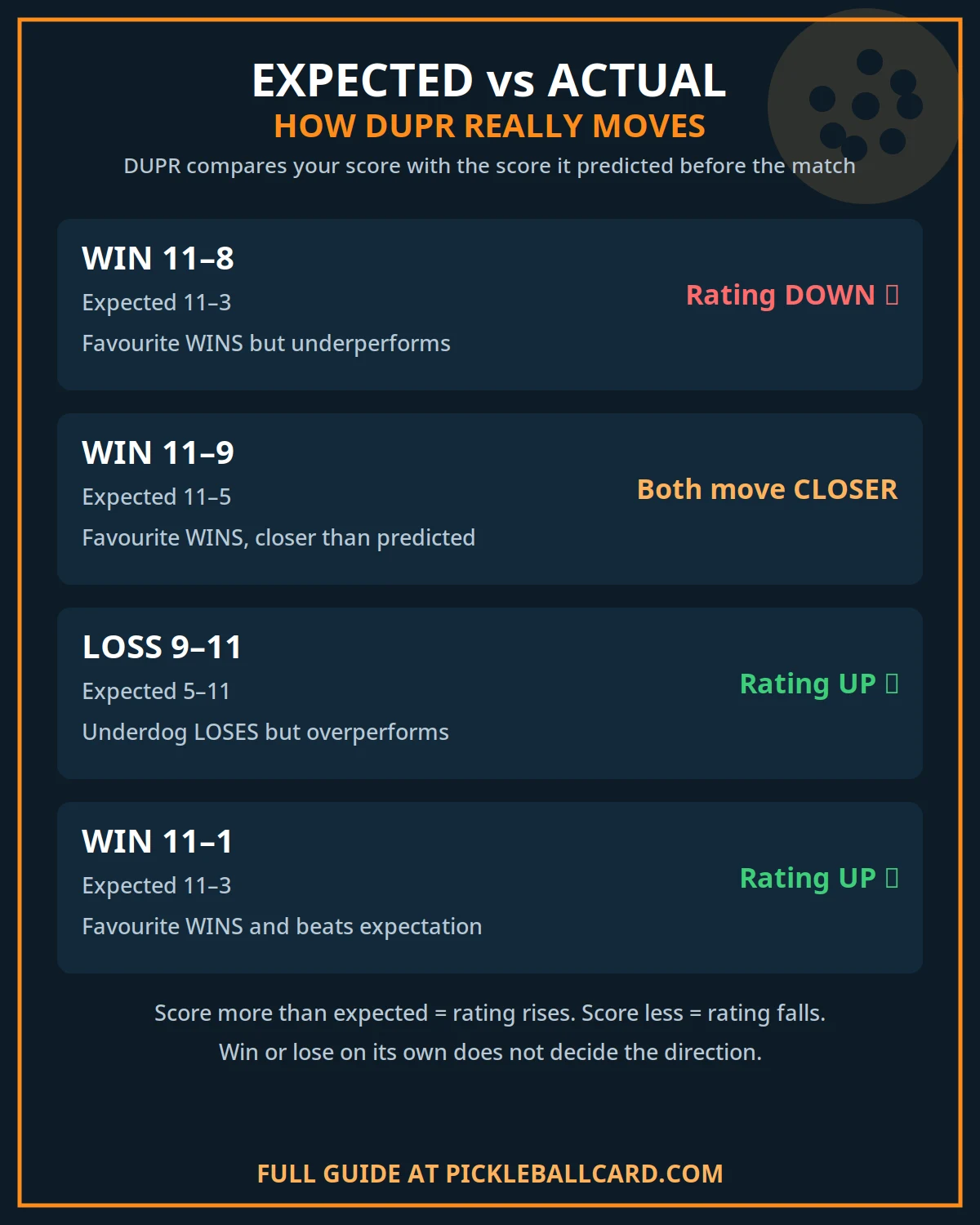
Expected vs Actual: Four Scenarios That Explain Everything

Scenario Expected score Actual score What happens to the favourite’s rating Why
Strong favourite wins narrowly Win 11–3 Win 11–8 Down Won, but scored five fewer points than predicted — underperformance
Favourite wins, but closer than predicted (DUPR’s own example) Win 11–5 Win 11–9 Down slightly Both ratings move closer together so the next forecast is more accurate
Underdog loses narrowly (singles, 3.5 vs 4.0) Lose 5–11 Lose 9–11 Up The underdog scored four more points than expected — overperformance in defeat
Favourite wins as predicted or better Win 11–3 Win 11–3 or 11–1 Up Met or beat the expectation — the rating is confirmed or improved

The first three rows follow worked examples DUPR itself has published to explain the update. The fourth row is the same logic run in reverse, included as an illustration.

DUPR expected vs actual score infographic — how winning by less than the expected margin can lower your rating

Expected vs actual: the margin against DUPR’s prediction — not the win itself — is what moves your rating.

Read the table once and most “strange” rating moves stop being strange. The result column in the app — win or loss — is only half the story. The other half, the margin against expectation, is the half that moves the number.

Why Did My Partner’s Rating Move Differently From Mine?

Partners share a scoreline but not a rating history, so identical matches routinely produce different movements. Four factors drive the difference:

  • Different starting ratings. If you are the higher-rated player on your team, the expectation placed on the team leans more heavily on you — and an underperformance is charged more to the player the system thought would carry the result.
  • Different reliability. Alongside the rating, DUPR tracks a Reliability Score — a measure of how established and current the number is. More matches, more recent matches, and a wider mix of partners and opponents all raise it. High-reliability players see smaller shifts per match; newer or less active players see bigger swings from the same result.
  • Different match volume. A rating built on hundreds of logged games barely moves on one result. A rating built on a handful of games is still calibrating, and every new scoreline carries more weight.
  • Singles and doubles are separate. DUPR keeps singles and doubles ratings apart because the two formats test different skills. A doubles result does nothing to your singles number, however dramatic it felt.

So if your partner dropped 0.03 and you dropped 0.01 from the same win, neither figure is a mistake. You simply brought different histories into the same match.

Why DUPR Designed It This Way

Two problems with the old win-always-rises approach pushed DUPR to change. The first is inflation: if winners can only rise and losers are protected from falling in the “wrong” result, the whole rating pool drifts upward over time and a 4.0 stops meaning the same thing from one season or one region to the next. Moving one side up and the other down in each match keeps the overall distribution stable.

The second is playing down. When any win lifted a rating, the safest way to climb was to beat weaker players repeatedly — while players who tested themselves against stronger competition were punished for narrow losses that actually proved their level. Rating performance against expectation reverses both incentives: routine wins over weaker opponents stop paying, and competitive losses against stronger opponents start counting in your favour. DUPR’s stated aim throughout is accuracy — a number that predicts future results as closely as possible, for seeding, bracketing and level-based play.

When a Drop After a Win Is Normal — and When to Check the Entry

Almost certainly normal if:

  • You were clear favourites and won by less than a comfortable margin.
  • Your Reliability Score is low, or you have few logged matches — early ratings swing more.
  • Your opponents were rated well below you, even if they played above their usual level on the day.
  • The drop is small. Established ratings typically move in hundredths, not tenths, on a single match.

Worth checking if:

  • The score in the app does not match the score you actually played — a transposed 11–6 entered as 6–11 flips the entire calculation.
  • A match was validated that you did not play, was a friendly hit-around rather than a competitive game, or was entered under the wrong format (singles vs doubles).
  • Your rating moved by an unusually large amount despite a long, active match history.

DUPR offers a rating-review request route for results you believe are wrong, so a genuine data error is fixable — start by confirming the entered score with everyone who played before querying the movement itself. And keep the basics straight when you log games yourself: our guide to how to score in pickleball runs through the scoring calls that feed those entries.

How to Make Your Rating Actually Go Up

There is no loophole, and DUPR is blunt about that — but the new system does reward specific habits:

  1. Play at or above your level. Matches against players near or above your rating are where overperformance is possible in both wins and losses. Matches far below your level demand near-perfection just to stand still.
  2. Compete for every point. Because margin matters, easing off at 9–2 or going through the motions in a losing cause now has a rating cost. The last three points of a lost game can be the difference between a drop and a rise.
  3. Build reliability. Log matches regularly, across varied partners and opponents, in leagues, clubs and tournaments that record results. A higher Reliability Score steadies the number and makes each result count as it should.
  4. Log enough matches. A thin match history is the most common reason players feel mis-rated. More recorded games give the system the evidence it needs to place you correctly.
  5. Get better — it is still the main route. The algorithm is trying to predict your typical performance, not your best day. Consistent improvement, repeated across matches, is what moves the needle permanently.

Three Myths the Update Retired

“A win always raises your rating.” That was the old behaviour, and older club guides and PDFs still state it as an absolute rule. Under the current algorithm it is simply false — performance against expectation decides the direction.

“Playing down is an easy way to climb.” It was, once. Now a favourite who wins narrowly can slide, and DUPR expects some previously inflated ratings to settle downward as players keep logging matches under the new model. That settling is a correction, not a penalty.

“One match wrecked my rating.” DUPR’s position is that a single result never defines a rating. Conditions cut both ways over a season — the wind, the net cords and the off day that hurt you on Saturday help you on another. If your number truly reflects your level, a dip after one underperformance is followed by rises when you perform to it again. New to rated play entirely? Start with how to play pickleball, then get some logged matches in before judging the number.

Frequently Asked Questions

Can my DUPR rating go up after a loss?

Yes. If you score more points than the system expected — for example losing 9–11 to a player it predicted would beat you 11–5 — you overperformed, and your rating can rise despite the loss.

Does the winning margin really matter in DUPR?

Yes — it is the core of the current model. DUPR compares the actual score with the expected score derived from pre-match ratings, so an 11–2 win and an 11–9 win over the same opponents can move your rating in opposite directions.

Why did my rating drop more than my partner’s in the same match?

Because you brought different histories into it. Starting rating, Reliability Score and total logged matches all shape how much one result moves a player, so partners routinely see different changes from an identical scoreline.

Do singles and doubles results affect each other?

No. DUPR maintains separate singles and doubles ratings because the formats test different skills. Only doubles results move your doubles rating, and vice versa.

How long does it take for a DUPR rating to stabilise?

There is no fixed official match count, and you should be wary of any site that quotes one as a DUPR rule. In practice, ratings settle as match volume, recency and variety of opponents build your Reliability Score — the more representative games you log, the smaller the swing from any single result.

What can I do if a result was entered incorrectly?

First confirm the entered score, format and players with everyone involved — a wrong scoreline is the most common cause of a “wrong” rating move. If the entry itself is incorrect, DUPR provides a rating-review request process for exactly that situation.

The Bottom Line

A drop after a win is not DUPR punishing success. It is the system saying: “You won that match by less than a player of your rating should have — so your rating needs a small correction, and your opponents deserve a small one upward.” Win by the margin your rating predicts (or better), compete for every point when you are losing, play opponents who test you, and log enough matches for your reliability to grow — and the number will follow your game instead of confusing you after it.

Know your band first: the pickleball rating estimator gives you a chart-based self-rating in about two minutes, so you can judge whether a DUPR move matches your actual level.

shoaib
shoaib

Shoaib is the publisher of Pickleball Card. He oversees the site’s guides to pickleball rules, ratings, strategy and gear, all researched from primary sources — the USA Pickleball Rulebook, DUPR and manufacturer documentation — and updated as the game changes.

pickleballcard.com

Filed Under: Ratings & Competition

Latest Posts

  • Skinny Singles Pickleball: Rules, Court Setup & Strategy
  • Quiet Pickleball Paddles & Noise Rules
  • Tournament Balls: Franklin X-40 Vs Onix Dura Fast 40
  • Games Like Pickleball: Badminton, Racquetball, Tennis, Padel And More
  • Drills for Beginners in Pickleball: Dinks, Serves, Volleys and Drops
  • Timeout Rules in Pickleball: Standard, Medical and Between-Game Timeouts
  • Pickleball Safety And Eye Protection
  • What To Wear To Play Pickleball: Shoes, Clothes, And Court Essentials
  • Pickleball Statistics: Participation, Growth, And The Numbers That Matter
  • Paddle Generations Explained: From Thermoformed To Foam (Gen 2, Gen 3, Gen 4)
  • About
  • Privacy Policy
  • Terms And Conditions
  • Affiliate Disclosure

COPYRIGHT © 2026 · Pickleballcard.COM, ALL RIGHTS RESERVED.

PICKLEBALLCARD.COM IS A PARTICIPANT IN THE AMAZON SERVICES LLC ASSOCIATES PROGRAM, AN AFFILIATE ADVERTISING PROGRAM DESIGNED TO PROVIDE A MEANS FOR SITES TO EARN ADVERTISING FEES BY ADVERTISING AND LINKING TO AMAZON.COM. AMAZON, THE AMAZON LOGO, AMAZONSUPPLY, AND THE AMAZONSUPPLY LOGO ARE TRADEMARKS OF AMAZON.COM, INC. OR ITS AFFILIATES. AS AN AMAZON ASSOCIATE WE EARN AFFILIATE COMMISSIONS FROM QUALIFYING PURCHASES.