If you love pickleball, you already know what makes a racket sport fun. Quick rallies, clever placement, and games that welcome new players all matter. The good news is that pickleball is far from the only sport with that mix.
Several related games share its friendly pace, its social doubles format, or its love of soft shots and sharp angles. Some are played on similar courts, while others feel completely different at first. Each one rewards a slightly different strength.
This guide compares the games most similar to pickleball, starting with badminton and racquetball in depth. It also covers tennis, padel, squash, and table tennis, so you can pick your next game with confidence.
Key Takeaways
- Badminton is the closest cousin to pickleball in court size, since a doubles badminton court measures 20 feet wide by 44 feet long.
- Racquetball shares pickleball’s compact court and fast reactions, but it is played indoors against walls, with no net at all.
- Tennis and padel use larger courts and tennis-style scoring, yet both reward the same placement and patience pickleball players already practise.
- Squash and table tennis are faster and more intense, but they sharpen the reflexes, footwork, and touch that transfer straight back to pickleball.
- The best next game depends on what you enjoy most: gentle rallies, hard-hitting speed, strategy, or a social doubles match.
Why Pickleball Players Look for Similar Games
Pickleball hooks players for a few clear reasons. Rallies start quickly, points often turn on placement rather than power, and doubles keeps the game social. A new game feels inviting when it keeps at least some of that balance.
Some players want a second sport for days when courts are full. Others want a winter option indoors, a faster workout, or a new challenge that still uses familiar skills. A similar game can fill any of those gaps.
It also helps to know what will feel strange. A bigger court demands more running, a walled court changes every bounce, and a lighter shuttle or smaller ball changes timing. Knowing those differences in advance makes the first session far more enjoyable.
Badminton vs Pickleball
Badminton is the natural first stop for a pickleball player. The two sports share a court footprint, a net game, and a style of play built on quick reactions. Yet the shuttle changes everything about timing, movement, and shot choice.
The Court and Equipment
A badminton court is 13.40 metres long, which is 44 feet, and 6.10 metres wide for doubles, which is 20 feet. Those are exactly the dimensions of a pickleball court. Singles badminton narrows the width to 5.18 metres, or 17 feet.
The net is higher than a pickleball net. It stands 1.55 metres at the posts and 1.524 metres at the centre, roughly five feet high. That height rewards flatter, faster shots and makes steep smashes harder to defend.
Badminton rackets are light, long, and strung, while pickleball paddles are short, solid, and stiff. A shuttlecock weighs only 4.74 to 5.50 grams and slows sharply in flight. That drag creates long, floating rallies and dramatic changes of pace.
How Play Feels
Badminton rallies feel faster in the air but lighter on the body than many players expect. The shuttle travels quickly off the strings, then decelerates, so players must judge speed early. Footwork matters enormously, with lunges, split steps, and rapid changes of direction.
There is no kitchen line holding players back from the net. Instead, the front court is a battleground of tight net shots, lifts, and kills. Pickleball players will recognise the soft game immediately, though the reach and timing feel different.
Doubles badminton adds rotation and shared court coverage that will feel familiar. Partners defend side by side, attack in formation, and cover each other’s weaknesses. Communication matters just as much as it does in pickleball doubles.
Scoring and Rules
Badminton uses rally scoring, so every rally wins a point for one side. Games go to 21 points, and a side must lead by two to win. If the score reaches 29-all, the next point wins the game at 30-29.
Matches are the best of three games. The serve is underarm and diagonal, with the whole shuttle below 1.15 metres when struck. Serves alternate between right and left service courts depending on whether the server’s score is even or odd.
For the full official wording, see the Laws of Badminton published by the Badminton World Federation. Local clubs sometimes simplify rules for social play, so check before your first match.
Who Will Enjoy Badminton Most
Badminton suits pickleball players who love the soft game and quick hands. If your favourite pickleball moments are dinks, drops, and angled winners, badminton will feel like home. It also suits players who want a strong workout without heavy impact on the joints.
It may frustrate players who rely on power alone. A hard smash means little without placement, and a mistimed swing sends the shuttle long. Patience, footwork, and touch win far more points than arm strength.
Starting is easy and cheap. Most sports halls already have badminton courts marked, rackets are affordable, and shuttles cost little. That low barrier makes it one of the simplest second sports to try.
Racquetball vs Pickleball
Racquetball is the indoor, high-speed cousin of pickleball. It keeps the compact court and fast reactions, but removes the net and adds four walls. Every shot can rebound, so rallies rarely end the way you expect.
The Court and Equipment
A racquetball court is an enclosed box 20 feet wide, 40 feet long, and 20 feet high. The front, side, and back walls are all in play, and so is the ceiling. That makes the playing space feel much larger than its floor area suggests.
Players use a short, strung racquet no longer than 22 inches, plus a small, lively rubber ball. The ball bounces high and fast, which keeps rallies moving at a demanding pace. Protective eyewear and a wrist cord are required in sanctioned play.
There is no net to clear and no kitchen to respect. Instead, the front wall is the target on every shot. A legal shot must reach the front wall before touching the floor, and the ball may bounce only once before it is returned.
How Play Feels
Racquetball feels like pickleball played at double speed inside a box. Shots come back off side walls, the back wall, and sometimes the ceiling. Players must track the ball in three dimensions and react to angles that do not exist outdoors.
Positioning is constant work. Good players move to the centre of the court after each shot, watch their opponent’s body shape, and cut off angles early. Fitness matters more here than in a casual pickleball game, especially in singles.
Doubles racquetball is crowded by nature, since four players share one enclosed court. Partners must avoid blocking each other and stay alert to balls rebounding behind them. Many beginners start with singles or cut-throat, a three-player format.
Scoring and Rules
Traditional racquetball uses side-out scoring, so only the serving side can win a point. Winning a rally as the receiver earns the serve, not a point. That makes comebacks possible but can also stretch close games.
A match is the best of three games. The first two games go to 15 points, with no win-by-two requirement. If each side wins one game, a tiebreaker game to 11 points decides the match.
Serves start in the service zone, a five-foot strip marked by the service line and the short line. The server drops the ball, lets it bounce once, and hits it to the front wall so it lands beyond the short line. Two serves are allowed.
Because players share a small space, hinders are part of the game. A rally is replayed when one player blocks the other’s swing or view without fault. Learning these calls takes a few sessions, but regulars are usually happy to explain them.
Who Will Enjoy Racquetball Most
Racquetball suits pickleball players who crave speed and intensity. If you love fast hands at the net and quick reactions, the walled court will thrill you. It is also an excellent indoor option when weather or darkness rules out outdoor pickleball.
It may not suit players who prefer gentle rallies or struggle with very fast balls. The pace is relentless, and the ball can arrive from unexpected directions. Players with knee or shoulder concerns should ease in gradually.
Access is the main hurdle. Racquetball needs a dedicated enclosed court, usually found at gyms, universities, or sports clubs. Once you find one, though, games are easy to organise and equipment is inexpensive.
Tennis vs Pickleball
Tennis is pickleball’s most famous relative, and the family resemblance is obvious. Both are net sports played with similar tactics: serve, return, rally, and finish at the net. The main difference is scale, since tennis asks players to cover far more ground.
A tennis court is 78 feet long, 27 feet wide for singles and 36 feet for doubles. The net is three feet high at the centre and 3.5 feet at the posts. Serves are overarm, and scoring runs through points, games, and sets.
Tennis scoring follows the familiar 15, 30, 40, and game sequence, with sets usually won at six games. Matches are generally the best of three or five sets. The full official rules are published by the International Tennis Federation.
Pickleball players bring real advantages to tennis. Net instincts, volley technique, and doubles positioning all transfer well. The adjustment is fitness and footwork, since groundstrokes travel farther and rallies demand longer sprints.
If you want the full side-by-side breakdown, read our detailed pickleball vs tennis comparison. It covers court size, scoring, equipment, and which skills transfer in each direction.
Padel vs Pickleball
Padel is a doubles racket sport played on an enclosed court with glass walls and mesh fencing. It blends tennis scoring with squash-style rebounds, and it has become one of the most social racket sports around. For pickleball players, it feels both familiar and fresh.
A padel court measures 20 metres long by 10 metres wide, roughly twice the length of a pickleball court. The net is 0.88 metres high at the centre. Players use short, solid rackets with perforated faces and a depressurised ball similar to a tennis ball.
Scoring follows tennis: points run 15, 30, 40, and game, sets go to six games, and matches are usually the best of three sets. The serve is underhand, struck below waist height after one bounce, and must land diagonally in the opposite service box.
The walls change everything. After the ball bounces on the floor, it may rebound off the glass and stay in play. That rewards patience, lobs, and clever angles over outright power, much like the soft game in pickleball.
Padel is almost always played as doubles, which keeps it social and accessible. If you enjoy pickleball doubles strategy, padel will feel natural once you learn to use the walls. Read our full padel vs pickleball comparison for the detailed breakdown.
Squash and Table Tennis
Squash and table tennis sit at the faster end of the racket-sport family. Both demand sharp reflexes and reward precision, but they ask for very different kinds of fitness. They are excellent cross-training for pickleball players who want a bigger challenge.
Squash
Squash is played inside a four-walled court, usually in singles, with both players sharing the same space. A singles court measures 9.75 metres long and 6.4 metres wide. Every shot must strike the front wall above the tin, a strip 0.48 metres high.
The ball is small, hollow, and rubber, and it barely bounces until it warms up. Players alternate shots, and the ball may touch the floor only once before it is returned. Games use rally scoring to 11 points, with a two-point lead required to win.
Squash is one of the most physically demanding racket sports. Rallies are continuous, lunges are deep, and there is no partner to cover half the court. Pickleball players will gain fitness, footwork, and anticipation, but should expect a steep first few sessions.
Table Tennis
Table tennis, often called ping pong, shrinks the whole contest onto a table. The table is 2.74 metres long and 1.525 metres wide, standing 76 centimetres high. A net 15.25 centimetres high divides the two halves.
Players use small, lightweight paddles with rubber faces and a 40-millimetre ball weighing just 2.7 grams. Spin is the great weapon here: topspin, backspin, and sidespin bend rallies in ways pickleball players rarely encounter. Games go to 11 points, with a two-point lead required.
Table tennis is cheap, widely available, and easy on the joints. It sharpens hand speed, spin reading, and short-game touch, all of which help at the pickleball net. It also fits into small spaces, from community halls to garages.
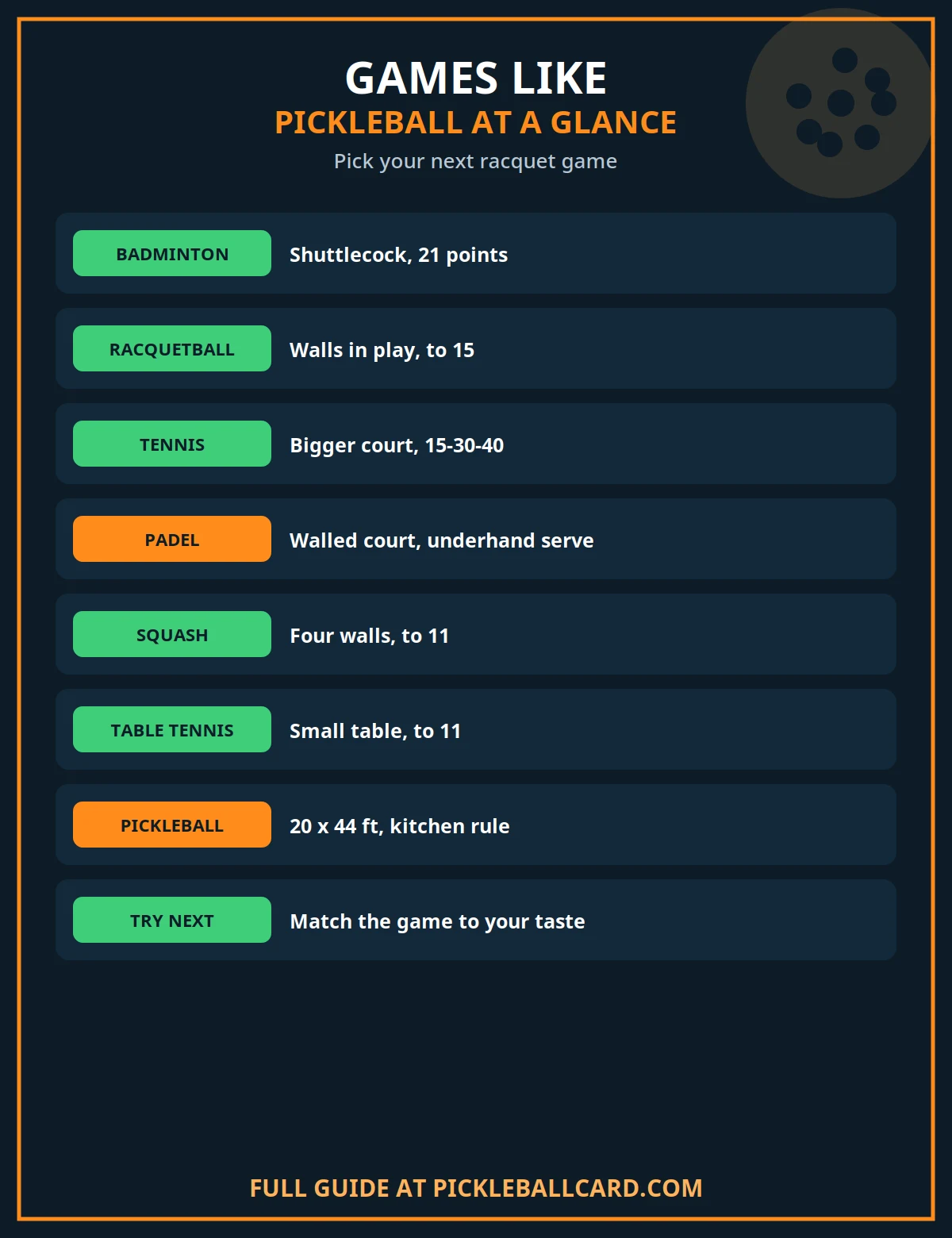
Games Like Pickleball at a Glance
The table below compares each sport on the features that matter most to a pickleball player. Court sizes are for standard adult play, and scoring reflects the common recreational format for each game.
| Game | Court | Equipment | Scoring | Pace | Learning Curve |
|---|---|---|---|---|---|
| Pickleball | 20 x 44 ft, open court | Solid paddle, plastic ball | Usually to 11, win by 2 | Moderate, with fast net exchanges | Gentle |
| Badminton | 20 x 44 ft doubles, net 5 ft | Strung racket, shuttlecock | Rally to 21, win by 2 | Fast in the air, light on the body | Gentle to moderate |
| Racquetball | 20 x 40 ft enclosed, walls live | Strung racquet, rubber ball | Side-out to 15, tiebreak to 11 | Very fast and intense | Moderate to steep |
| Tennis | 27/36 ft wide x 78 ft long | Strung racket, felt ball | 15-30-40, sets to 6 | Moderate to fast, lots of running | Moderate to steep |
| Padel | 10 x 20 m enclosed, glass walls | Solid racket, low-pressure ball | Tennis scoring, sets to 6 | Moderate, wall rallies extend points | Gentle to moderate |
| Squash | 6.4 x 9.75 m enclosed, front wall | Strung racket, rubber ball | Rally to 11, win by 2 | Very fast and demanding | Steep |
| Table tennis | Table 2.74 x 1.525 m | Rubber-faced paddle, light ball | To 11, win by 2 | Extremely fast hands, low running | Gentle to moderate |
Which Game Should You Try Next?
Start with what you love most about pickleball, and let that point the way. The right second sport should feel like a reward, not a chore, so match the game to your favourite part of play.
If you love gentle rallies and the social side of doubles, try badminton or padel first. Both welcome beginners, keep rallies going, and reward placement over power. Badminton is easier to find in most sports halls, while padel shines where courts are available.
If you love speed and intensity, racquetball or squash will raise your pulse. Racquetball keeps the compact court feel of pickleball, while squash delivers the hardest workout of any game here. Both demand good eyewear and a gradual build-up.
If you love strategy and longer matches, tennis offers the deepest tactical game. Court coverage is the challenge, but net skills and doubles instincts transfer directly. Table tennis, meanwhile, is perfect for sharpening reflexes and spin in a small space.
Another close cousin worth knowing is paddle tennis, a smaller-court net game with its own following. Our paddle tennis vs pickleball comparison explains how it differs from pickleball and who tends to enjoy it.
Whatever you choose, give it at least three sessions before judging it. The first session is mostly learning the court and the bounce. By the third, your pickleball instincts start to show, and the game begins to feel like fun.
Frequently Asked Questions
What game is most like pickleball?
Badminton is the closest match in court size, since a doubles badminton court shares pickleball’s 20-by-44-foot footprint. It also rewards soft shots, quick hands, and doubles teamwork. Padel is another strong match for players who love social doubles and placement.
Is badminton easier than pickleball?
Badminton is easy to start but hard to master. Beginners can rally quickly, and the light shuttle is forgiving. Advanced play, however, demands serious footwork and timing. Most pickleball players find the learning curve gentle but the ceiling high.
Is racquetball harder than pickleball?
Racquetball is generally harder on fitness and reactions than pickleball. The enclosed court keeps the ball in play longer, and shots rebound from every wall. Beginners should expect a workout and a few confusing bounces before rallies start to click.
Can pickleball skills transfer to tennis or padel?
Yes, many skills transfer well. Net play, volleys, dinking touch, and doubles positioning all carry over to tennis and padel. The main adjustments are court coverage, longer swings, and, in padel, learning to play the ball off the glass walls.
Which similar game is best for beginners?
Badminton and table tennis are the most beginner-friendly options here. Both are cheap to start, widely available, and easy on the body. Padel is also welcoming, though finding a court can be harder depending on where you live.
Which game like pickleball gives the best workout?
Squash gives the most intense workout, followed closely by racquetball. Both keep players moving continuously in an enclosed space. Badminton and tennis offer strong all-round exercise, while table tennis is lighter on running but excellent for reflexes.
Whichever game you try next, you will return to pickleball a better player. New angles, quicker feet, and a fresh sense of timing all travel back across the net. The best second sport is simply the one you enjoy enough to keep playing.

Shoaib is the publisher of Pickleball Card. He oversees the site’s guides to pickleball rules, ratings, strategy and gear, all researched from primary sources — the USA Pickleball Rulebook, DUPR and manufacturer documentation — and updated as the game changes.