Walk into any paddle shop today and you will hear the same shorthand. A paddle is Gen 2, Gen 3, or Gen 4, and the number is supposed to tell you how it plays. That shorthand is useful, but only up to a point.
The labels describe how a paddle is built, not how good it is. This guide explains each generation in plain language, covering what changed inside the paddle and how those changes affect power, control, spin, and durability.
Key Takeaways
- Generation labels describe construction, not quality. A well-built Gen 2 paddle can beat a poorly built Gen 4 paddle for your game.
- Gen 1 means cold-pressed honeycomb cores with bonded face layers. Gen 2 adds thermoforming, which fuses the paddle into a stronger, unified body.
- Gen 3 adds foam to the core, usually at the edges or through the honeycomb, enlarging the sweet spot.
- Gen 4 replaces the honeycomb core with a full foam core, aiming for consistent feel across the face and resistance to core breakdown.
- There is no single official standard for these labels. Details vary by brand, so check the actual construction.
- Your playing style matters more than the generation number. Different players will prefer different builds.
What Paddle Generation Labels Actually Mean
The generation labels grew out of real changes in paddle manufacturing. Each step solved a problem players had with the previous design, and each step created new trade-offs that still matter today.
Think of the labels as a timeline, not a ranking. Newer does not automatically mean better for every player. It means the construction changed, shifting the balance between power, control, feel, and durability.
One warning comes first. No governing body publishes an official definition of Gen 1, Gen 2, Gen 3, or Gen 4. Treat the labels as a starting point for questions, never as a complete specification.
Gen 1: Cold-Pressed Honeycomb Paddles
Gen 1 paddles are the simplest modern design. A polymer honeycomb core sits between two face layers, bonded together under pressure without high heat. This is often called cold pressing.
The honeycomb core is light and strong for its weight. Its open cell structure absorbs some vibration and gives the paddle a familiar, predictable feel. Early composite and fiberglass paddles were built this way.
The weakness of Gen 1 construction is at the edges. Because the face layers are glued to the core rather than fused into one body, the perimeter can flex inconsistently. Off-center hits often feel dead, and the sweet spot stays small.
Gen 1 paddles also tend to be softer and quieter than later designs. That softness suits beginners and control players, and it keeps prices down. Many good budget paddles still use this basic approach.
Gen 2: The Thermoformed Revolution
Gen 2 changed how paddles are put together. Thermoforming uses heat and pressure to mold the paddle into a single, unified body. The face layers, core, and edge wrap around the paddle as one continuous structure.
Think of the difference like a sandwich versus a shell. A Gen 1 paddle is layers held together by glue. A thermoformed paddle is closer to a single molded shell, with the core sealed inside it.
That change matters for three reasons. First, the edges become stiffer and more consistent, enlarging the usable hitting area. Second, the paddle transfers energy more efficiently, adding power. Third, the sealed edge resists moisture and peeling better than a glued edge.
Thermoforming also opened the door to raw carbon fiber faces. A textured carbon surface grips the ball longer at contact, increasing spin. This combination of a stiff unibody and a gritty face is why thermoformed paddles took over competitive play.
Read our guide to what a thermoformed pickleball paddle is for more on the molding process.
How Thermoforming Works, Step by Step
Thermoforming starts with the paddle’s raw materials laid up in a mold. The core, face sheets, and edge material are positioned exactly where they need to be, before anything is bonded together.
Heat softens the materials while pressure forces them into the mold’s shape. The heat activates bonding agents in the layup, fusing the layers into a single body. The edge that remains is part of the paddle itself, not an added strip.
What Gen 2 Changed on Court
On court, Gen 2 paddles feel more powerful and more consistent than Gen 1 paddles. Drives carry deeper with the same swing, and the sweet spot stretches further toward the edges. Blocks and volleys feel firmer and more predictable.
Spin also improves, mainly because of the raw carbon faces that thermoforming made practical. A textured face grips the ball and adds rotation on serves, topspin drives, and slice dinks alike.
The trade-off is touch. A stiffer, more powerful paddle can feel less forgiving on soft shots. Dinks and drops need a lighter hand, and mishits can fly long if you swing too hard.
Gen 3: Foam Enters the Core
Gen 3 keeps the thermoformed unibody but changes what sits inside it. Foam is added to the core, most commonly around the perimeter, through the honeycomb, or as layers within the core structure.
The foam does several jobs at once. It supports the honeycomb walls so they flex less under impact. It fills gaps that would otherwise feel hollow or dead. It also changes how vibration travels through the paddle, altering the sound and feel of contact.
Players often describe Gen 3 paddles as having a larger, more forgiving sweet spot. That description is broadly fair. The foam perimeter supports the face near the edges, so off-center hits keep more pace and direction.
Some Gen 3 designs go further and partly suspend the core inside foam, an approach sometimes called a floating core. The idea is to let the core move slightly at impact, adding dwell time and a softer, more controlled feel.
Foam-injected Gen 3 paddles are now the standard choice for advanced and competitive players. They combine the power of thermoforming with a more forgiving, consistent hitting area than Gen 2 alone offered.
Foam Edge, Foam-Injected, and Floating Cores
Not all Gen 3 paddles use foam the same way, and the differences affect how they play. A foam edge wall is a ring of foam around the core perimeter. It stiffens the edges and widens the sweet spot.
Foam injection pushes foam into the honeycomb itself, filling cells or channels through the core. This version tends to feel denser and more solid, with a distinctive firm sound at contact. It also adds weight.
Floating-core designs place foam layers around a suspended honeycomb center. The core can flex more freely, softening the feel and improving control on touch shots. The cost is sometimes a slightly less crisp response on hard drives.
When you compare Gen 3 paddles, ask which of these three approaches the manufacturer used. Two paddles can both be labeled Gen 3 and still feel very different, because the foam placement is doing different work.
What Gen 3 Changed on Court
Gen 3 paddles generally offer more power than Gen 2, with a bigger sweet spot and a more consistent response across the face. Off-center hits lose less pace, which matters in fast hands battles at the net.
Control is where opinions split. Some players find the foam’s trampoline effect makes the ball jump off the face too quickly, hurting soft shots. Others find the enlarged sweet spot makes their whole game more consistent.
Durability is Gen 3’s weak spot. Under hard, repeated impact, honeycomb cells can deform permanently, a problem known as core crush. A crushed core feels dead in the middle and sounds dull, losing power unevenly.
Gen 4: The Full Foam Core
Gen 4 removes the honeycomb core entirely and replaces it with foam from face to face. The paddle is still thermoformed into a unibody, but the inside is now a single foam structure rather than honeycomb with foam added.
This is a bigger change than it sounds. A honeycomb core is mostly air, held together by thin plastic walls. A foam core is a continuous material, which behaves far more evenly when the ball strikes anywhere on the face.
Manufacturers of full-foam paddles point to two main benefits. The first is consistent feel, since the core is uniform. The second is durability, since foam that springs back to shape resists the permanent crushing that affects honeycomb cores.
Some full-foam designs add shaped cutouts, or voids, inside the foam to manage weight and tune the sweet spot. Others use perimeter weighting to keep the paddle stable on off-center hits. The foam itself is doing structural work, not just filling space.
Selkirk describes its own foam-core approach in its announcement of the LABS Project Boomstik, which uses a PureFoam core surrounded by an EVA power ring and is presented as a step beyond Gen 3 construction.
What Gen 4 Changed on Court
Gen 4 paddles tend to feel softer and more uniform than Gen 3 paddles. Vibration is damped across the whole face rather than mainly at the edges, so contact feels muted and comfortable. Players with arm sensitivity often notice this quickly.
Power is less predictable from the label alone. Some full-foam paddles are built for explosive power, while others are deliberately soft and control-oriented. Foam density, face layup, and weight distribution matter more than the generation label.
Control can improve, because a uniform core gives a more predictable response. But softness is not the same as forgiveness. A very soft paddle can still twist on off-center hits if it lacks stability.
Spin depends mostly on the face material, just as in earlier generations. A raw carbon face on a Gen 4 paddle can generate heavy spin, while a smooth face will not, whatever the core inside. Always check the face separately from the core.
Durability is Gen 4’s strongest selling point, at least in theory. A foam core that returns to its original shape should outlast a honeycomb core that crushes. Real-world evidence is still accumulating, because full-foam paddles are newer.
Is Gen 4 Better Than Gen 3?
The honest answer is that it depends on what you value. Gen 4 offers a more uniform feel and a promising durability story. Gen 3 offers a wider choice of models, proven tournament results, and generally lower prices.
Most advanced and competitive players still use Gen 3 paddles, because that category is mature and well tested. Gen 4 is a smaller, newer slice of the market, and its models tend to cost more.
Neither generation is automatically better for your game. A Gen 3 paddle that matches your swing and style will beat a Gen 4 paddle that does not. Test both if you can, and judge by feel and results.
Paddle Generations Compared
The table below sums up the four generations side by side. Treat the ratings as general tendencies, not guarantees, because individual models vary widely within each generation.
| Feature | Gen 1: Cold-Pressed | Gen 2: Thermoformed | Gen 3: Foam-Enhanced | Gen 4: Full Foam Core |
|---|---|---|---|---|
| Core construction | Polymer honeycomb, bonded faces | Honeycomb in a thermoformed unibody | Honeycomb plus foam edge, injection, or floating core | 100% foam core, no honeycomb |
| Power | Low to moderate | Moderate to high | High | Varies by model, often high |
| Control and touch | Soft, forgiving, good touch | Firmer, needs a lighter hand on soft shots | Good, but foam pop can affect touch | Uniform feel, often soft and comfortable |
| Spin potential | Moderate, depends on face | High with raw carbon faces | High with raw carbon faces | High with raw carbon faces |
| Sweet spot | Smallest, center-focused | Larger, edges more usable | Large, forgiving across the face | Large and uniform, by design |
| Durability risk | Edge peeling, face wear | Honeycomb core crush over time | Core crush remains the main risk | Designed to resist core crush |
| Typical price level | Lowest | Mid-range | Mid to premium | Premium, fewer models |
| Best for | Beginners, soft-game players | All-round players wanting power and spin | Advanced players wanting power plus forgiveness | Players wanting uniform feel and durability |
Power, Control, Spin, and Sweet Spot in Detail
Power comes mainly from stiffness and energy return. A stiff unibody returns more energy to the ball, so thermoformed paddles hit harder than cold-pressed ones. Foam adds to this by supporting the face.
Spin comes mainly from the face, not the core. Raw carbon fiber’s textured surface grips the ball and adds rotation. If spin is your priority, compare face materials first and core generations second.
See our guide to raw carbon fiber paddles for more on face texture and spin.
Choosing the Right Generation for Your Game
Start with your playing style, not the newest label. A power player who drives from the baseline will value different traits than a soft-game player who wins points at the net.
Beginners and casual players often do best with Gen 1 or an affordable Gen 2 paddle. The softer feel builds touch, the price stays reasonable, and the power is plenty for learning the game.
Intermediate players who want more pace and spin usually land on Gen 2 or Gen 3. Gen 2 offers strong value and proven performance, while Gen 3 adds forgiveness for players who are starting to swing harder.
Advanced and tournament players most often choose Gen 3 today, because the category is deep and proven. Gen 4 is worth testing if you value a uniform feel, play with arm discomfort, or have worn out honeycomb cores before.
Whatever generation you choose, check that the paddle is approved for the play you plan. USA Pickleball maintains an approved paddle list with more than 2,500 paddles, and sanctioned play requires a listed model.
For the full buying process, from grip size to weight and shape, our guide on how to choose a pickleball paddle walks through every decision in order.
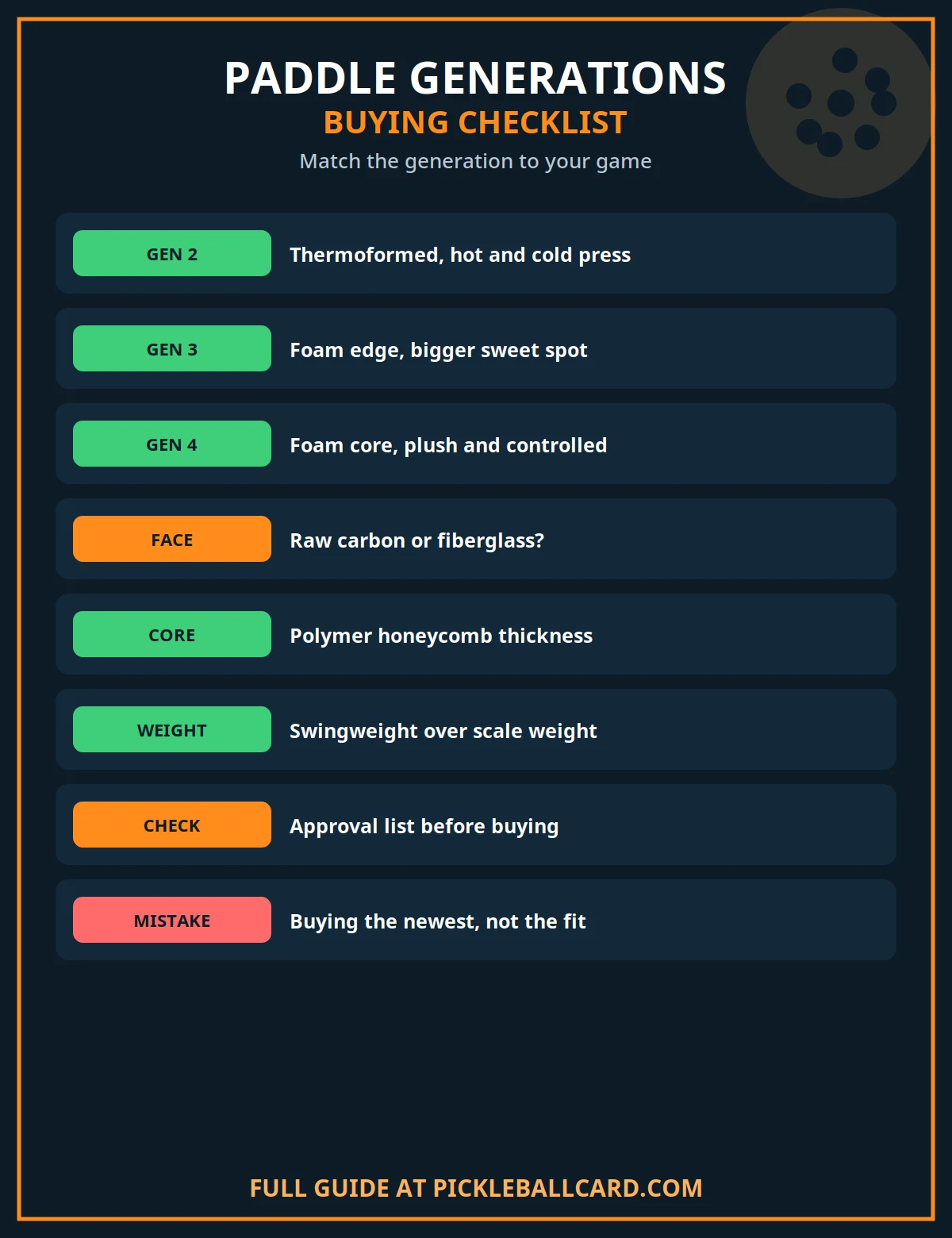
Generations Checklist: Before You Buy
Use this checklist to compare paddles across generations without getting lost in marketing terms. Work through it for every model on your shortlist.
- Confirm the actual construction, as stated by the manufacturer: cold-pressed, thermoformed, foam-enhanced, or full foam core.
- Ask where the foam sits: edge wall, injected core, floating layers, or complete foam core.
- Check the face material separately: raw carbon, fiberglass, or a blend, and whether the surface is textured.
- Note the core thickness: thicker cores usually soften power and improve touch, while thinner cores add pop.
- Compare swing weight and balance, not just static weight, because they decide how the paddle moves in your hand.
- Check the USA Pickleball approved list if you plan sanctioned or rated play.
- Test the sweet spot yourself: hit balls toward the edges and notice how much pace and direction you lose.
- Ask about the warranty and core-crush coverage, especially for honeycomb-core paddles you will hit hard.
- Ignore the generation number as a quality score: judge by feel, results, and construction.
Common Myths About Paddle Generations
Myth one is that a higher generation always means a better paddle. It does not. Generation describes construction, and a well-made paddle from any generation can outperform a poorly made one from a newer generation.
Myth two is that thermoforming alone guarantees power. Thermoforming is a process, not a performance rating. A thermoformed paddle can be soft, stiff, light, or heavy depending on its core, face, and layup.
Myth three is that foam automatically adds control. Foam changes feel and support, but it can also add pop that hurts touch. Whether foam helps your control depends on the foam type, placement, and density.
Myth four is that Gen 4 has already replaced Gen 3. It has not. Gen 3 remains the dominant choice among advanced players, and Gen 4 is still a newer, narrower category with fewer models and higher prices.
Frequently Asked Questions
What Is the Difference Between Gen 2 and Gen 3 Pickleball Paddles?
Gen 2 paddles use a thermoformed honeycomb core, while Gen 3 paddles add foam to that core. The foam enlarges the sweet spot and changes the feel, and Gen 3 paddles usually offer more forgiveness across the face.
What Is a Gen 4 Pickleball Paddle?
A Gen 4 paddle uses a full foam core instead of a honeycomb core. The foam runs from face to face inside a thermoformed unibody, giving a more uniform feel and aiming to resist the core crushing that affects honeycomb paddles.
Is Thermoforming Better Than Cold Pressing?
Thermoforming generally produces a stronger, more consistent paddle with a larger sweet spot and more power. Cold pressing is simpler and cheaper, and it can still produce a soft, comfortable paddle for beginners.
Does Foam in a Paddle Core Make It More Powerful?
Foam can add power by supporting the face and returning energy more efficiently, especially near the edges. But foam type, placement, and density all matter, and some foam designs are built for softness rather than power.
Do Gen 4 Paddles Last Longer Than Gen 3 Paddles?
Full-foam cores are designed to resist core crush, the main durability weakness of honeycomb cores. Early manufacturer testing supports that claim, but Gen 4 paddles are newer, so long-term evidence from years of heavy play is still limited.
Which Paddle Generation Should a Beginner Choose?
Most beginners do best with a Gen 1 paddle or an affordable Gen 2 model. Both offer good touch, reasonable prices, and enough power for learning. Move to Gen 3 or Gen 4 once your playing style is clear.
The Bottom Line on Paddle Generations
Paddle generations tell a genuine story about how paddles changed. Cold pressing gave way to thermoforming, foam joined the core, and now foam is replacing the core entirely. Each step widened the sweet spot and changed the feel of the game.
But the number on the box is only the beginning of the story. The core details, the face material, the weight, and the balance decide how a paddle actually plays. A thoughtful buyer reads past the label and tests the paddle itself.
Start with your game, shortlist across generations, and let your hands decide. The best paddle for you is the one that matches your swing, your style, and your budget, whatever generation it belongs to.

Shoaib is the publisher of Pickleball Card. He oversees the site’s guides to pickleball rules, ratings, strategy and gear, all researched from primary sources — the USA Pickleball Rulebook, DUPR and manufacturer documentation — and updated as the game changes.