Thermoformed is the word printed on half the new paddles in the shop. It sounds like marketing, but it names a real change in how a paddle is built.
A thermoformed paddle is moulded under heat and pressure as one unified piece. That single decision changes its power, its sweet spot, and how it fails.
This guide explains what thermoforming actually is, how it differs from a traditional cold-pressed paddle, and who should — and should not — buy one.
Key Takeaways
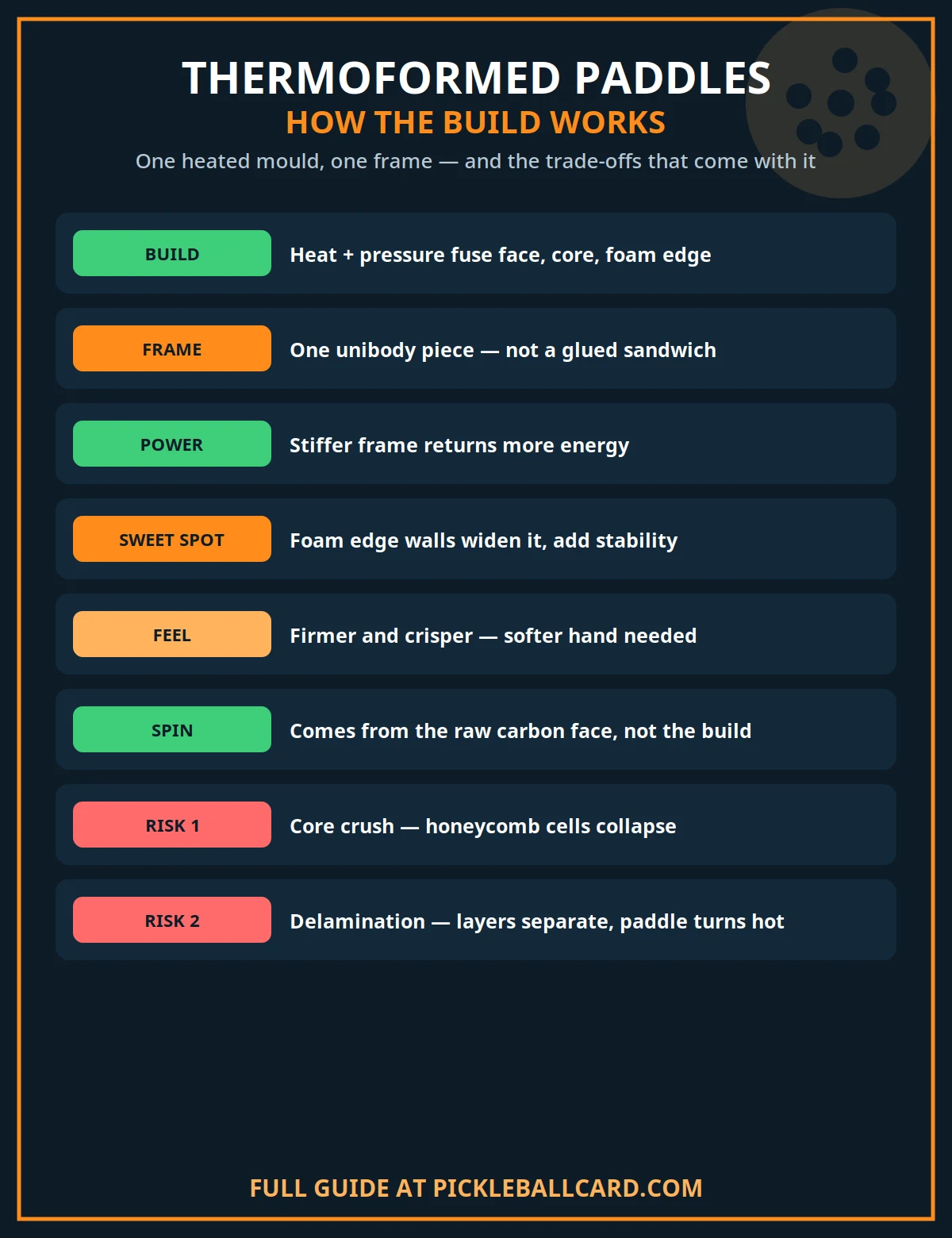
- Thermoforming means heat plus pressure. The face, core and edge are fused in a heated mould into a unibody structure, not glued together cold.
- The payoff is power and stability. A stiffer, unified frame returns more energy, enlarges the sweet spot, and resists twisting on off-centre hits.
- Foam edge walls are part of the design. Most thermoformed paddles inject foam around the perimeter to add stability and soften vibration.
- The trade-off is feel and risk. Thermoformed paddles can feel firmer and less plush, and early models earned a reputation for core crush and delamination.
- It is Generation 2 in USA Pickleball’s history. Thermoforming sits between the classic honeycomb composites and the newer foam-enriched and full-foam designs.
What Does Thermoformed Actually Mean?
Thermoforming is a manufacturing process, not a material. Heat and pressure are applied in a mould so the paddle’s layers fuse into one structure.
Think of it as cooking the paddle into shape. In a traditional build, the parts are assembled and bonded. In thermoforming, they are formed together.
USA Pickleball describes Generation 2 paddles exactly this way: a process using heat and pressure to create a more unified paddle structure.
The same basic technique was already common in other sports. Tennis, golf and baseball equipment used heat-moulded construction long before pickleball adopted it.
That is why two paddles can share a carbon face and a honeycomb core, yet play completely differently. The build method matters as much as the materials.
How a Thermoformed Paddle Is Built, Step by Step
- The core is cut. Most thermoformed paddles still start with a polypropylene honeycomb core, usually 13 to 16 millimetres thick.
- Foam is added around the edge. A foam perimeter is placed around the core to form the edge wall inside the finished paddle.
- The face wraps the whole layup. Carbon fibre, often raw carbon, is laid so it wraps around the core and the foam edge in one piece.
- Heat and pressure fuse it. The layup goes into a heated mould. Under pressure, the layers bond into a single unibody frame.
- The handle and edge finish it. The moulded body is trimmed, the handle is formed or fitted, and the grip and butt cap are added.
The wrap is the key detail. Because the face material continues around the edge, the paddle behaves like one frame instead of a sandwich.
A sandwich can separate at its layers. A unibody frame spreads impact forces around the whole paddle, which is where the extra stability comes from.
Thermoformed vs Cold-Pressed: The Real Difference
Traditional paddles are often called cold-pressed or Gen 1. Their face sheets and core are bonded with adhesive at lower temperatures, then fitted with an edge guard.
Neither method is automatically better. They produce different playing characters, and the table below is the honest version of that difference.
| Feature | Thermoformed (Gen 2) | Cold-pressed (Gen 1) |
|---|---|---|
| Construction | Heat and pressure fuse face, core and foam edge into one unibody piece | Face sheets bonded to the core, separate edge guard fitted after |
| Power | Higher — stiffer frame returns more energy on drives and counters | Lower to moderate — softer, more absorbed energy at contact |
| Sweet spot | Larger, helped by foam edge walls and frame stiffness | Smaller, centred — off-centre hits lose more pace |
| Stability | High twist resistance on off-centre hits | More twisting on wide contact, especially on light models |
| Touch and control | Firmer, crisper feel — drops need a softer hand | Plusher, dwell-heavy feel many control players prefer |
| Spin | Often paired with raw carbon faces, so spin is usually strong | Depends entirely on the face material fitted |
| Known failure modes | Core crush and delamination reported on early models | Edge guard separation and gradual core fatigue |
| Typical price position | Mid-range to premium | Budget to premium — the widest range |
Our guide to the best material for a pickleball paddle covers faces and cores in full. This post adds the missing layer: how those materials are assembled.
Why Thermoformed Paddles Feel More Powerful
Power in a paddle is mostly about energy return. A frame that flexes and twists at contact absorbs energy. A stiff, unified frame gives more of it back.
The unibody build also raises stability without simply adding weight. The paddle resists rotating in your hand when you catch the ball near the edge.
That stability is why counters and blocks feel so solid on thermoformed models. The paddle stays square, so a compact swing still produces depth.
The foam edge wall helps twice. It widens the effective sweet spot, and it dampens some of the harsh vibration a stiff frame would otherwise transmit.
What About Spin?
Thermoforming itself does not create spin. Spin comes mainly from the face surface, and most thermoformed paddles pair the build with a gritty raw carbon face.
The frame helps indirectly. A stable paddle keeps the face angle you intended, so the topspin you swing for is the topspin you actually get.
Do not buy the word thermoformed expecting spin alone. Check the face material and texture first, then treat the construction as the supporting act.
Where Thermoforming Sits: Gen 1 to Gen 4
USA Pickleball’s paddle history gives thermoforming a clear address. It is Generation 2, the era between classic composites and the foam generations that followed.
- Generation 1: honeycomb core between two face layers — polypropylene, aluminium or Nomex cores, fiberglass then graphite faces. Lighter than wood, larger sweet spots.
- Generation 2 — thermoformed: heat and pressure create the unified structure, with more power, durability and manufacturing consistency.
- Generation 3 — foam-enriched: a honeycomb core surrounded by an EVA foam perimeter, changing energy transfer for still more power and spin.
- Generation 4 — full foam: foam becomes the core itself, often in several densities, tuned for consistency and durability.
The generations overlap in shops today. Gen numbers are not an official rating or approval class — they are a useful shorthand for construction eras.
That matters when you shop. A well-made Gen 1 control paddle can suit you better than a Gen 2 power paddle, whatever the generation number suggests.
The Downsides Nobody Should Skip
Core Crush
Core crush is the collapse of the honeycomb cells inside the paddle. Repeated hard impacts, or heat and pressure damage, weaken the core’s structure.
A crushed core changes how the paddle plays. Shots can feel inconsistent, and in some thermoformed models the paddle became noticeably hotter over time.
Manufacturers have improved moulds, foams and quality control since the first wave. Core crush is a known risk to check for, not a certainty.
Delamination
Delamination is separation between layers — the face lifting from the core or the bonds inside the frame letting go. It is a different failure from core crush.
Warning signs include a changed, hollow sound, bubbling on the face, or a sudden trampoline-like jump in power. Any of those means stop and contact the maker.
A paddle that has become hotter through internal failure is not a bonus. In sanctioned play, equipment must perform as approved, not as damaged.
Firmer Feel
The same stiffness that adds power can subtract touch. Drops and resets on a thermoformed paddle often need a deliberately softer hand to stay low.
Some players adapt in a week. Others, especially soft-game players, simply prefer the plush dwell of a traditional build. Both reactions are legitimate.
Our diagnostic guide to when to replace a pickleball paddle shows how to test any paddle — thermoformed or not — for dead spots, core crush and delamination.
Who Should Buy a Thermoformed Paddle?
- Counter-punchers and drivers who want pace without a full swing. The frame does part of the power work for you.
- Singles players who pass and drive from the baseline. Stability and power matter more there than in the doubles soft game.
- Players missing by inches on off-centre contact. The larger sweet spot forgives the contact points that a Gen 1 paddle punishes.
- Stronger players moving up who keep overpowering soft paddles into the net. A crisper frame clarifies that feedback.
Who Should Probably Skip It?
- Pure soft-game players whose whole game is drops, resets and dinks. A plush cold-pressed control paddle may simply feel better.
- Players with a sensitive elbow should be careful. A firmer paddle can transmit more vibration, though foam edges and grip choices change that picture a lot.
- Complete beginners on a budget. Thermoforming is a refinement, not a requirement. Your first paddle should fit your grip, weight and budget first.
Whichever build you choose, fit comes before construction. Our guide on how to choose a pickleball paddle walks through weight, grip size, shape and core thickness in order.
How to Check a Thermoformed Paddle Before You Buy
- Confirm it is approved. If you play tournaments, check the model on USA Pickleball’s approved paddle list under its exact name and version.
- Ask what the edge wall is. Foam-injected edges are standard on true thermoformed builds. Vague answers about construction are a warning sign.
- Read the warranty for failure terms. Look specifically for core crush and delamination coverage, and how long that coverage lasts.
- Tap and bounce it in the shop. Tap across the face and bounce a ball in different zones. Sound and rebound should be even.
- Demo it on your soft shots. Anyone can enjoy the power in five minutes. Your drops and resets decide whether you will enjoy it in month three.
Care Tips That Protect a Thermoformed Frame
A unibody frame is strong, but its bonds still dislike heat. The fastest way to shorten a thermoformed paddle’s life is to store it somewhere hot.
Keep it out of a hot car and away from direct sun between games. Heat softens adhesives and stresses the same bonds that thermoforming created.
Use edge protection tape if you scrape the ground on low balls. The wrapped edge is structural on these paddles, so protecting it protects the frame itself.
Clean the face with a damp cloth and mild care only. Harsh solvents and abrasive pads damage the raw carbon texture that produces your spin.
Finally, run a monthly tap check across the face. A thermoformed paddle that changes its sound is telling you something early — listen while warranty help is simple.
Thermoformed vs Foam-Core: What Comes Next?
Players comparing top-end paddles now meet a second construction question: thermoformed honeycomb, or the newer full-foam cores of Generation 4.
Foam cores remove the honeycomb entirely. That design answers core crush directly, because there are no honeycomb cells left to collapse.
It does not make thermoformed paddles obsolete. Many players prefer the crisper, more direct feedback of a honeycomb thermoformed frame over a foam feel.
Treat Gen 4 as a different feel, not an automatic upgrade. Demo both builds on your drops and counters before you decide which family suits you.
Frequently Asked Questions
Is a thermoformed paddle better than a regular paddle?
It is different, not automatically better. Thermoformed paddles offer more power, stability and sweet-spot size. Traditional paddles often offer a softer touch. Your game decides.
Do all thermoformed paddles have raw carbon faces?
No. Raw carbon is the most common pairing because the two trends arrived together. Thermoforming describes the build process; the face can be carbon, fiberglass or a hybrid.
Are thermoformed paddles legal in tournaments?
Yes, if the specific model is USA Pickleball approved. Approval belongs to the exact model, not to the construction method, so check the approved list before an event.
Do thermoformed paddles last longer?
The unibody frame is durable, and USA Pickleball lists increased durability among its benefits. But early models also showed core crush and delamination, so care and warranty matter.
What is the difference between thermoformed and Gen 3?
Thermoformed is the Gen 2 build: a honeycomb core fused into a unibody frame. Gen 3 adds a full EVA foam perimeter around the core for still more power.
Can I tell if a paddle is thermoformed just by looking?
Not reliably. Some models show a wrapped edge or no separate edge guard, but many look ordinary. The maker’s construction description is the trustworthy source.
The Bottom Line
A thermoformed paddle is a paddle built as one piece under heat and pressure. That unibody build is why it feels powerful, stable and crisp.
It is also why it can feel firm, and why its early failure modes — core crush and delamination — became famous. Modern versions have improved on both counts.
Buy the construction for the right reason: you want frame power and forgiveness on off-centre hits. Demo the soft game first, check the warranty, then commit.
Sources: USA Pickleball, The Evolution of Pickleball Paddle Technology (Generation 2 thermoforming, Generation 3 foam-enriched and Generation 4 foam-core construction).
This guide is original; no competitor content is linked or reproduced.

Shoaib is the publisher of Pickleball Card. He oversees the site’s guides to pickleball rules, ratings, strategy and gear, all researched from primary sources — the USA Pickleball Rulebook, DUPR and manufacturer documentation — and updated as the game changes.