Your paddle has not snapped in half. It just does not play like the paddle you bought — and that quiet decline is exactly how most paddles end.
Paddles rarely die in one moment. The core fatigues, the face smooths out, and your usual shots start needing unusual swings to land.
This guide separates the three failures players confuse — dead spots, core crush and delamination — and gives you simple home tests before you spend anything.
Key Takeaways
- Condition beats age. There is no expiry date on a paddle. Replace on evidence — changed sound, feel, rebound or face texture — not on the calendar alone.
- A dead spot is a symptom, not a diagnosis. It describes an area that returns the ball weakly or unpredictably. Core crush or delamination may be the cause underneath.
- Core crush loses power; delamination can add it. A crushed core feels dull and dead. A delaminated paddle can turn trampoline-hot — and that also means replace it.
- Test before you buy. The tap test, bounce test and thumb-press test take two minutes and confirm whether the change is real and repeatable.
- Some wear is not a death sentence. A worn grip is replaced, a dirty face is cleaned, and a loose edge guard tape is maintenance — not a new paddle.
How Long Does a Pickleball Paddle Actually Last?
There is no single lifespan, because hours and intensity wear a paddle, not birthdays. The same model ages very differently in different players’ bags.
As a broad guide, heavy competitive players often replace paddles within months of hard use. Regular club players commonly get a year or more from one paddle.
Casual weekly players can get several seasons from a quality paddle, especially one stored indoors and kept out of heat and damp.
Treat those ranges as context only. A paddle that passes every test below is not worn out, whatever its age. A failing six-month-old paddle is.
Our companion explainer on how long pickleball paddles last covers lifespan by player type in depth. This post is about the decision: keep, maintain, warranty or replace.
The Three Failures Players Confuse
Dead Spots — the Symptom
A dead spot is an area of the face that returns the ball differently — weaker, lower or less predictably than the areas around it.
The term describes what you feel, not what failed inside. A dead spot can come from core damage, a face separation, or simple localised wear.
One mishit proves nothing. A dead spot counts when the same zone misbehaves on the bounce test and again on court, session after session.
Core Crush — the Core Collapses
Core crush, or core crushing, is the collapse or breakdown of the core inside the paddle. The honeycomb structure no longer holds its rigidity under impact.
Manufacturer Selkirk describes it plainly: the paddle compresses too far when you hit the ball, so drives lose pop and volleys feel dull.
It happens two ways. Some cores are weakened during manufacturing, under high heat and pressure. Others degrade gradually through repeated hard play.
Core crush is subtle compared with delamination. There is no meter for it — players diagnose it with the tap, bounce and press tests below.
Delamination — the Layers Separate
Delamination is separation between bonded layers: the face lifting away from the core, or bonds inside a thermoformed frame letting go.
Its signature is often the opposite of core crush. A separated face can act like a trampoline, adding power the paddle never had when new.
That extra power is a failure, not a gift. The paddle no longer performs as approved, and it should come out of sanctioned play immediately.
Visible clues include bubbling or raised areas on the face, a peeling edge guard, and a hollow change in sound at one contact point.
| Problem | What it is | How it feels | Action |
|---|---|---|---|
| Dead spot | A symptom — one zone responds weakly or unevenly | Clean contact produces a weak, unpredictable ball | Test it — then diagnose the cause below |
| Core crush | Honeycomb core cells collapse or break down | Dull sound, lost pop, mushy or uneven sweet spot | Replace — check warranty first |
| Delamination | Face or internal layers separate from the core | Hollow sound, bubbling, sudden trampoline power | Replace now — do not use in sanctioned play |
| Worn face texture | Grit and texture smooth out with play | Less spin — drives and serves dip less | Replace when lost spin changes your results |
| Worn grip | Grip tape smooths, loosens or gets slippery | Paddle twists; you grip harder to control it | Regrip — maintenance, not replacement |
Seven Signs It Is Time to Replace Your Paddle
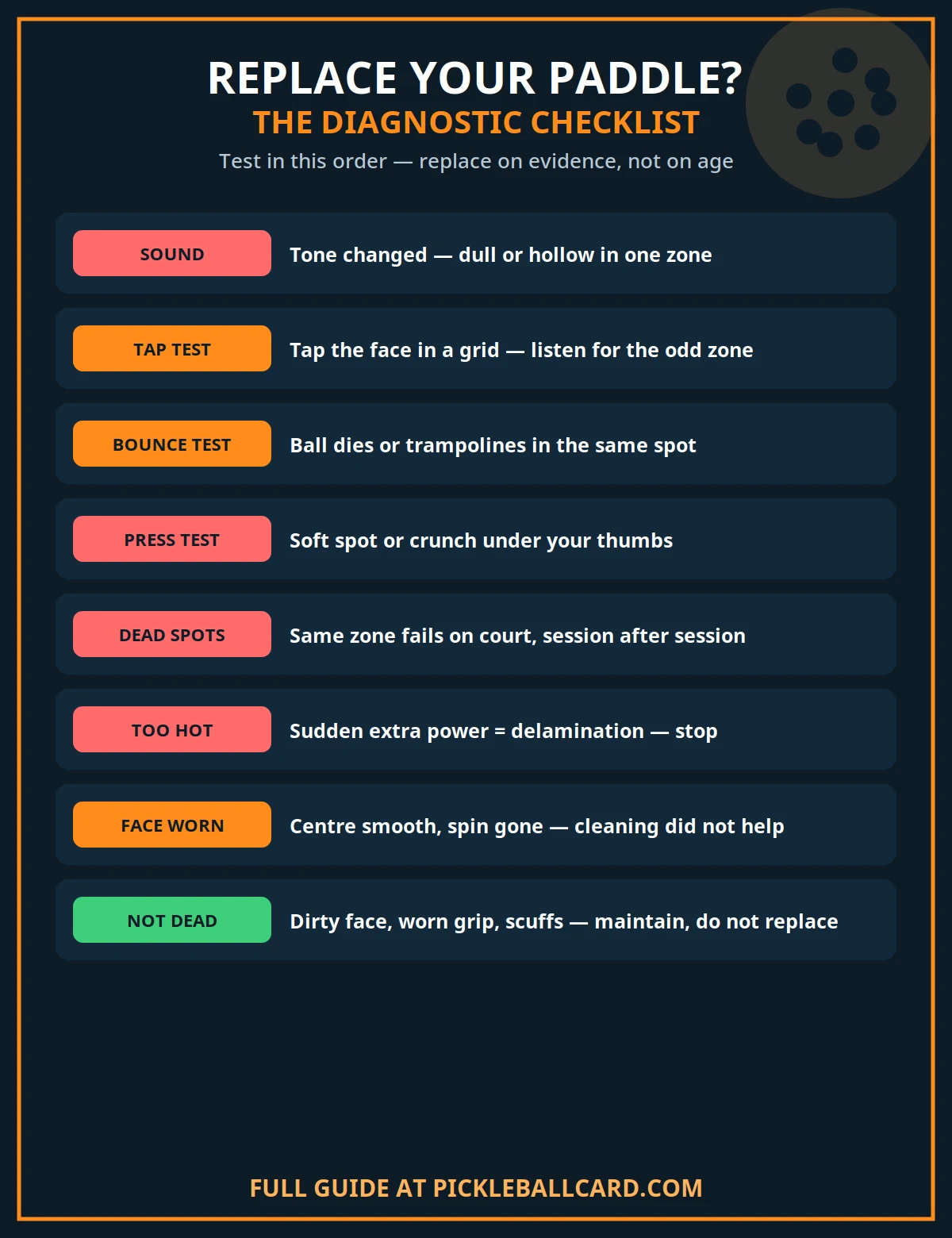
- The sound changed. A firm, even note became dull, hollow or different in one zone. Sound is usually the first honest evidence of internal change.
- Dead spots repeat. The same area fails the bounce test and then fails you on court. Repeatability is what separates damage from a bad day.
- Your normal shots fall short. Drives and serves need visibly bigger swings for their old depth. Over-swinging to compensate is the classic core-fatigue pattern.
- Or your shots suddenly fly long. New, unexplained power with a trampoline feel points to delamination. Treat hotter as broken, not as broken in.
- The face lost its bite. The centre feels smooth and shiny compared with the edges, and your topspin no longer dips the ball as it did.
- You can see structural damage. Cracks, bubbling, a soft spot under your thumb, a separating edge guard, or a loose handle are all stop-and-replace evidence.
- You are changing your game around it. Gripping tighter, avoiding your backhand side, or skipping shots you trust — the paddle is now coaching you, badly.
Three Home Tests That Take Two Minutes
1. The Tap Test
Tap a pen or your knuckle across the whole face in a grid, centre and edges. A healthy paddle answers with a firm, consistent tone throughout.
Listen for a zone that sounds dull, hollow or muted compared with the rest. Mark it mentally — the next two tests check the same spot.
2. The Bounce Test
Hold the paddle still and drop a ball onto different zones of the face from the same height. Rebound height and sound should be broadly even.
A zone where the ball dies, or one where it trampolines noticeably higher, has changed internally. Repeat it twice before you trust the result.
3. The Press and Crunch Test
Press both thumbs firmly into the centre of the face and work outward. The face should feel evenly backed by the core everywhere you press.
A soft, springy patch, a crunching sound, or a spot that gives more than its neighbours signals core collapse or a face that has separated.
Finish with a court test: hit controlled drives, blocks and dinks with this paddle, then with a borrowed fresh one. A clear difference settles the question.
What Does Not Mean Your Paddle Is Dead
- A dirty face. Ball residue and court dust kill grip temporarily. Clean it properly first — our guide to how to clean your pickleball paddle shows the safe method — then retest.
- A worn grip. A smooth or loose grip is replaced in ten minutes with a new grip or overgrip. It is the cheapest fix in the sport.
- Cosmetic scratches and edge scuffs. Scraped edge guards and marked faces look rough but often play perfectly. Judge by the tests, not by appearance.
- One bad session. Wind, a different ball, cold weather and tired legs all change how a paddle seems to play. Evidence must repeat across sessions.
- Wanting a different paddle. A healthy paddle that no longer fits your improving game is an upgrade decision, not a replacement need. Be honest about which one it is.
Check the Warranty Before You Buy Anything
Core crush and delamination are often treated as defects, not wear, especially early in a paddle’s life. Many brands cover them — check before you pay twice.
Find your proof of purchase and the brand’s warranty terms. Note when the sound or feel changed, and photograph any bubbling, cracks or separation.
Contact the manufacturer with that evidence and your test results. A clear tap-test description and a photo are worth more than a long complaint.
If the paddle is approved for tournament play, do not keep using a delaminated one while you wait. Borrow or use a backup for sanctioned matches.
Make the Next Paddle Last Longer
- Keep it out of heat. A hot car boot weakens adhesives and materials. Store the paddle indoors, dry, at normal room temperature.
- Protect the edge. Edge guard tape absorbs the scrapes that would otherwise chip the guard and open the way to moisture and separation.
- Do not tap it on the court. Paddle taps against posts, fences and the ground are small impacts that add up inside the core.
- Rotate if you play daily. Two paddles used in rotation each take half the impacts. Heavy users extend both playing lives this way.
- Retest monthly. One tap test a month catches change early, while a warranty claim is still simple and your game has not adapted around it.
When replacement day does come, choose the successor by fit, not fashion. Our guide on how to choose a pickleball paddle covers weight, grip, shape and construction — including the thermoformed builds explained in our companion post.
Bring your old paddle to the demo if you can. Hitting the failing paddle and a fresh candidate back to back is the clearest comparison you will ever get.
Pay attention to your stock shots, not your highlight shots. Blocks, resets and third-shot drops reveal a paddle’s honesty far faster than one big drive does.
Replacement vs Upgrade: Making the Call Honestly
Replacement restores the performance you lost. An upgrade changes the performance you have. Confusing the two is how players spend money without solving the problem.
If your tests show internal failure, replace first — ideally like for like, or close to it. You already know that paddle’s weight, shape and feel.
Change models only when the old fit was also wrong. A new shape, weight or construction at the same time hides whether the fix actually worked.
If your paddle passes every test but bores you, that is an upgrade. Own that decision, demo properly, and keep the healthy paddle as your backup.
A sound backup matters. When a main paddle fails mid-season, a trusted spare keeps you playing while a warranty claim or delivery takes its time.
What to Do With the Old Paddle
A delaminated or core-crushed paddle should not be sold or passed on as a playing paddle. Its failure is internal, and the next player inherits it blind.
A merely worn paddle — faded spin, honest cosmetic wear, sound structure — can serve as a loaner for friends who want to try the game.
Label it honestly either way. Loaner, practice-wall paddle, or retirement are all fine endings. A silent hand-off of a failing paddle is not.
Keep your proof of purchase for the new paddle from day one. The next warranty conversation, whenever it comes, starts with that receipt.
Frequently Asked Questions
How often should I replace my pickleball paddle?
When the tests say so, not on a schedule. Heavy competitors may see decline within months; casual weekly players can play the same paddle for years.
What is the difference between a dead spot and core crush?
A dead spot is the symptom you feel — one zone returning the ball weakly. Core crush is one possible cause: the honeycomb core inside that zone has collapsed.
Is a hotter paddle a sign of delamination?
It can be. A separated face can trampoline and add power the paddle never had. Sudden extra power plus a hollow sound means stop and contact the manufacturer.
Can I keep playing with a delaminated paddle in rec play?
You should not. It no longer performs as designed or approved, it will keep separating, and a failing face is unpredictable for everyone on the court.
Does a worn-out paddle cause arm pain?
It can contribute. Players compensate for a dead paddle by swinging harder and gripping tighter, and manufacturer guidance notes that overcompensating can change mechanics over time.
Is a smooth paddle face enough reason to replace it?
Only if the lost texture changes your shots. If your spin has genuinely faded and cleaning does not restore it, the face has worn out its useful life.
The Bottom Line
Replace your paddle on evidence: a changed sound, a repeating dead spot, lost or suddenly gained power, a smoothed-out face, or visible structural damage.
Run the tap, bounce and press tests, clean and regrip first, and check the warranty before you buy. That order saves money and settles arguments.
A fresh paddle should feel like your old one did when it was new — predictable. Predictability, not novelty, is what you are actually buying.
Sources: Selkirk, What is core crushing in pickleball? (core-crush definition, tap / bounce / crunch tests, replacement ranges); USA Pickleball, The Evolution of Pickleball Paddle Technology.
This guide is original; no competitor content is linked or reproduced.

Shoaib is the publisher of Pickleball Card. He oversees the site’s guides to pickleball rules, ratings, strategy and gear, all researched from primary sources — the USA Pickleball Rulebook, DUPR and manufacturer documentation — and updated as the game changes.