Pickleball moves fast, and momentum can swing on a single rally. A timeout is the game’s built-in pause button, giving a player or team a short break to regroup.
Used well, a timeout can stop a run of lost points, settle nerves, and let partners agree a new plan. Used badly, it can waste a valuable break or cause confusion at the worst moment.
The rules around timeouts are short, but they are strict. How many you get, how long each one lasts, and when you may call one all depend on the match format.
Medical timeouts follow separate rules. They exist for genuine injury or illness, not for rest, and they carry their own time limit and consequences.
This guide explains pickleball timeout rules in plain language, based on USA Pickleball’s official rules. It covers standard timeouts, breaks between games, and medical timeouts in full.
Key Takeaways
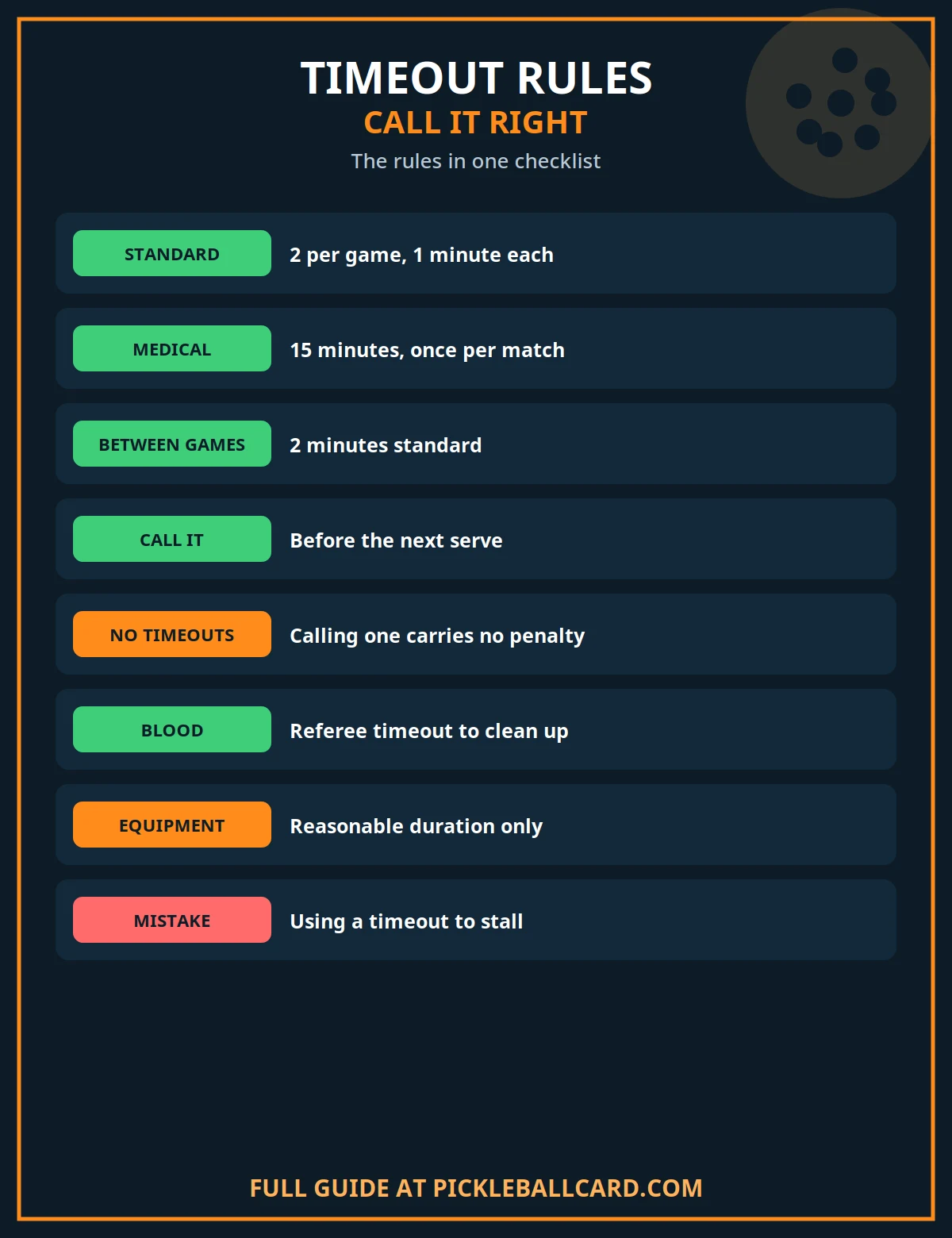
- You get two standard timeouts per game in 11- or 15-point games, and three in a 21-point game.
- Each standard timeout lasts up to one minute, and play may resume early if everyone is ready.
- Any player on a team with timeouts left may call one before the next serve occurs.
- The standard break between games is two minutes, and the standard break between matches is ten minutes.
- A medical timeout lasts up to 15 minutes, and each player may be granted only one per match.
- If a player cannot resume after a medical timeout, the match is declared a retirement, unless standard timeouts remain.
- Blood on a player, clothing, or the court must be controlled and cleaned up before play resumes.
- Calling a timeout when you have none left carries no penalty, but the timeout is not granted.
What Is a Timeout in Pickleball?
A timeout is a formal break in play, called by a player or team, during which the game clock effectively stops. Players leave the court area, talk, drink, and reset before the next rally.
Timeouts exist for a simple reason. Pickleball rallies are short and intense, and a team that is rattled rarely fixes its problems while the points keep coming.
A short pause breaks the rhythm of the match. It gives the trailing team time to breathe, and it gives the leading team a moment to guard against complacency.
Timeouts are also practical. They provide a moment to hydrate, towel off, adjust a grip, or simply slow down a match that has become frantic.
Importantly, a timeout is not an open-ended rest. The rulebook limits both the number and the length of timeouts, so each one is a resource to manage.
Standard Timeouts: How Many, How Long, and Who Can Call One
Standard timeouts are the ordinary timeouts every player and team receives in each game. They are separate from medical, equipment, and referee timeouts.
They reset with each new game. Unused timeouts from one game do not carry over into the next, so there is no reward for hoarding them.
How Many Standard Timeouts Do You Get?
For games played to 11 or 15 points, each player or team is entitled to two timeouts per game. This applies in both singles and doubles.
For games played to 21 points, each player or team is entitled to three timeouts per game. The longer game earns the extra timeout.
In doubles, the allowance belongs to the team, not to each partner. Two partners share the same two or three timeouts, so they should agree before spending one.
In singles, the allowance belongs to the individual player. The same numbers apply: two for 11- or 15-point games, and three for 21-point games.
How Long Does a Standard Timeout Last?
Each standard timeout period may last up to one minute. That minute is the maximum, not a requirement, and play may resume early if all players are ready.
In an officiated match, the referee manages the clock. The referee announces when 15 seconds remain in the timeout, giving players a clear warning to return.
At the end of the timeout, the referee calls “time in” and then calls the score when all players are, or should be, ready to play. At that point, the break is over.
Who May Call a Timeout, and When?
If a team has any remaining timeouts, any player on that team may call a timeout before the next serve occurs. Either partner in doubles may make the call.
The timing matters. A timeout must be called before the next serve occurs, which means during a dead-ball moment between rallies, not during live play.
You cannot call a timeout in the middle of a rally to stop a point that is going badly. The ball must be dead, and the next serve must not yet have occurred.
In an officiated match, direct the call clearly to the referee so there is no doubt. A vague gesture or a quiet word to a partner may not register as a timeout.
What Happens If You Call a Timeout You Do Not Have?
If a team calls a timeout before the serve occurs while having no timeouts remaining, no penalty shall be called under the official rules. The request is simply not granted.
This is a forgiving rule, but it should not be treated as a free pause. Play continues, and the team that made the mistaken call must be ready for the next serve.
The practical lesson is to track your timeouts. Count them out loud with your partner after each one, so nobody calls for a third timeout in an 11-point game.
Timeouts Between Games
The standard time between games in a match is two minutes. This break is automatic, and it does not count against either side’s standard timeouts.
Players may also use timeouts from the upcoming game during the break between games. In other words, you may spend one or both of the next game’s timeouts before that game starts.
If you do, you must inform the referee, or your opponents if there is no referee. The normal two minutes between games is used first, before any of those timeouts begin.
There is one protection built into this rule. If a team returns to play before a requested timeout has started, that team retains the timeout for the upcoming game.
This means you are not charged for a timeout that never began. Once the timeout period has started, however, it counts, even if you return early.
The standard time between matches is ten minutes. If all players are ready sooner, the match may start early, so do not wander far after your previous match ends.
Medical Timeouts in Full
A medical timeout is a longer break granted when a player needs medical attention during a match. It is not a third or fourth standard timeout, and it follows its own rules.
This section explains the medical timeout step by step. It describes the rules only; it is not medical advice, and any serious injury should be assessed by qualified medical personnel.
How Do You Request a Medical Timeout?
A player needing medical attention during a match should request a medical timeout from the referee. In an officiated match, make the request as soon as the problem arises.
The referee shall immediately summon on-site medical personnel, or the tournament director if no medical personnel are present. Their job is to assess the situation and render appropriate first aid.
The 15-minute medical timeout clock does not start at the moment of injury. It starts when the medical personnel or tournament director arrive, as directed by the referee.
Between games, a player may also request a medical timeout, when one is available, before the start of the next game. A medical timeout cannot be called before a match starts.
How Long Does a Medical Timeout Last?
If medical personnel or the tournament director determine that a valid medical condition exists, the player will be allowed no more than 15 minutes for the medical timeout.
The timeout must be continuous and shall not exceed 15 minutes. It cannot be split into several shorter breaks spread across the match.
If treatment is given off court at another location at the venue, the time taken to transport the player to and from that location is excluded from the 15 minutes.
If the player uses fewer than 15 minutes, the remaining time is lost. No additional medical time will be available to that player during the match.
Each player may be granted only one player-requested medical timeout per match. Once it is used, even partly, there is no second medical timeout to fall back on.
What If No Valid Medical Condition Exists?
Not every request results in a medical timeout. Medical personnel or the tournament director must determine that a valid medical condition exists.
If they determine that no valid medical condition exists, the player or team will be charged a standard timeout, if one is available, and issued a technical warning.
If no standard timeout is available, a technical foul will be issued instead. The medical timeout is then no longer available to that player for that match.
What Happens If a Player Cannot Resume?
If a player cannot resume play after the 15-minute medical timeout period, the match will be declared a retirement. The player who cannot continue loses the match by retirement.
There is, however, one way to buy a little more time. The player may use their available standard timeouts after the medical timeout has expired, before the match must be retired.
Each standard timeout used in this way lasts up to one minute, just like any other standard timeout. It is a short extension, not a second medical timeout.
Players should understand this sequence before they need it. The medical timeout, then any remaining standard timeouts, then retirement if play still cannot resume.
The Blood Rule: Bleeding and Blood Cleanup
If blood is present on a player or on the playing surface, play may not resume until the bleeding has been controlled and blood on clothing and the playing surface has been removed.
This is a safety rule first and a timeout rule second. Nobody should be asked to play on a court, or against an opponent, where blood has not been dealt with.
Issues relating solely to blood cleanup or control will be considered a referee timeout. In other words, blood cleanup alone does not consume the player’s medical timeout.
If the same player also needs medical treatment beyond cleanup, the medical timeout rules apply to that treatment. Cleanup and treatment are handled as separate matters.
When the Referee Steps In Without a Request
Sometimes a player cannot or will not ask for help. The rules give the referee a way to act in the interest of safety in that situation.
If the referee determines that a potential medical situation exists, for example heat exhaustion or heat stroke, and the player is unable to or refuses to call a medical timeout, the referee is authorised to call a referee timeout.
The referee then summons medical personnel or the tournament director. Crucially, referee-requested timeouts of this kind will not be charged against the player.
Equipment Timeouts and Referee Timeouts
Equipment problems have their own category. Players are expected to keep apparel and equipment in good playable condition, and to use regular timeouts and breaks between games for adjustments.
Quick adjustments between rallies are allowed, such as tying shoelaces, cleaning glasses, or adjusting a hat. These do not require a timeout at all.
If the referee determines that an equipment change or adjustment is necessary for fair and safe continuation of the match, the referee may award an equipment timeout of reasonable duration.
In non-officiated matches, players work out a reasonable accommodation among themselves for equipment malfunctions. A broken paddle or a snapped shoelace is handled by agreement, not by a stopwatch.
Tournament Play Versus Recreational Play
The timeout numbers above come from the official rulebook, which governs both standard play and tournament play. In practice, how timeouts feel depends on whether a referee is present.
In an officiated tournament match, the referee controls the clock, announces the 15-second warning, calls “time in,” and decides medical and equipment timeouts. Players simply follow the referee’s calls.
In recreational play, there is usually no referee and no formal clock. Players agree timeouts among themselves, keep their own count, and restart when everyone is ready.
That flexibility is fine for social play, but it can cause confusion if one group treats breaks strictly and another treats them casually. Agree the approach before the first serve.
Medical situations deserve the same seriousness in recreational play as in tournaments. Stop play, get help, and do not pressure an injured player to continue before they are ready.
Common Scenarios and Mistakes
Most timeout arguments come from a handful of repeatable situations. Knowing them in advance keeps a match friendly and avoids disputes that sour an otherwise good game.
Calling a Timeout During a Rally
A player who is losing a rally sometimes shouts for a timeout mid-point. Under the rules, that call is not valid, because a timeout must be called before the next serve occurs.
Play continues, and the rally stands. If you need a timeout, wait for the rally to end, then call it clearly before the next serve begins.
Running Out of Timeouts at the End of a Game
The most common regret is spending both timeouts early, then facing a tight finish with nothing left. A 9-9 game with no timeout feels very different from one with a pause available.
Save at least one timeout for the closing points of a close game, unless an early timeout is clearly needed to stop a collapse. A timeout spent at 0-6 may be the reason you reach 9-9 at all.
Using a Medical Timeout as a Rest Break
A player who is tired, but not injured or ill, should use a standard timeout, not a medical timeout. Medical timeouts require a valid medical condition, assessed by medical personnel or the tournament director.
A request that is judged to have no valid medical condition costs a standard timeout and a technical warning, or a technical foul if no standard timeout remains. It also removes the medical timeout for that match.
Fatigue, frustration, and lost momentum are real problems, but they are what standard timeouts are for. Keep the medical timeout for genuine medical needs.
Stalling Instead of Calling a Timeout
Some players try to slow a match without spending a timeout: lingering at the back of the court, retying shoes repeatedly, or taking long drinks between rallies.
The rules expect continuous play. Players may quickly take a drink or towel off between rallies, as long as the flow of the game is not adversely affected, in the referee’s judgment.
In an officiated match, the referee calls the score when play should resume, and repeated delay can draw a warning. In recreational play, opponents will rightly see stalling as poor sportsmanship.
If you need a break, call a timeout honestly and use the minute well. Everyone respects a legitimate timeout more than a slow, unofficial delay.
Forgetting That Timeouts Reset Each Game
Players sometimes believe they have two timeouts for the whole match. In fact, the allowance is per game, and each new game brings a fresh set.
Reset the count at the start of every game, and confirm it with your partner. A ten-second check avoids a mid-game argument about a timeout that was never spent.
Taking a Timeout Before the Match Starts
Neither medical nor regular timeouts may be taken before a match starts. A match cannot begin until all players are present and the starting score is called.
Timeouts may, however, be used before the start of the second and subsequent games in a multiple-game match, as described in the between-games section above.
Timeout Rules at a Glance
The table below summarises every timeout type covered in this guide. Keep it in mind during your next match, and check the official rulebook if a situation falls outside it.
| Timeout type | How many | How long | Charged to |
|---|---|---|---|
| Standard (11- or 15-point game) | 2 per game | Up to 1 minute | Player or team |
| Standard (21-point game) | 3 per game | Up to 1 minute | Player or team |
| Between games | Automatic | 2 minutes | Nobody |
| Between matches | Automatic | 10 minutes | Nobody |
| Medical | 1 per match | Up to 15 minutes | Player requesting it |
| Equipment | As needed | Reasonable duration | Nobody, if referee awards it |
| Referee (blood cleanup, safety, extenuating circumstances) | As needed | As needed | Nobody |
Two points in the table deserve emphasis. First, standard timeouts reset every game, while the medical timeout is limited to one per match. Second, blood cleanup alone is a referee timeout, not a medical timeout.
Frequently Asked Questions
How many timeouts do you get in pickleball?
You get two standard timeouts per game in 11- or 15-point games, and three per game in 21-point games. Each timeout lasts up to one minute.
The allowance belongs to the player in singles and to the team in doubles, and it resets at the start of every game.
Can you call a timeout during a rally?
No. A timeout must be called before the next serve occurs, which means between rallies when the ball is dead. A call made during a rally does not stop the point.
Wait for the rally to end, then call the timeout clearly before the next serve begins.
What happens if you call a timeout when you have none left?
No penalty is called. The timeout is simply not granted, and play continues with the next serve.
Track your timeouts with your partner so the mistake does not happen at a crucial moment in a close game.
How long is a medical timeout in pickleball?
A medical timeout lasts up to 15 minutes, timed from when medical personnel or the tournament director arrive. It must be continuous, and any unused time is lost.
Each player may be granted only one player-requested medical timeout per match.
What happens if a player cannot play after a medical timeout?
If the player cannot resume after the 15-minute medical timeout, the match is declared a retirement. The player may first use any available standard timeouts to gain a little more time.
Each standard timeout adds up to one minute. If play still cannot resume, retirement follows.
Do timeouts carry over to the next game?
No. Standard timeouts reset with each new game, so unused timeouts from one game do not carry into the next. The two-minute break between games is separate and automatic.
You may, however, spend one or both of the next game’s timeouts during the between-games break, after the standard two minutes.
Timeouts Are a Tactic, Not Just a Break
A timeout is one of the few tools that lets you change a match without hitting a ball. Used at the right moment, it can calm a team, disrupt an opponent’s run, and create space for a better plan.
For the full official wording, see USA Pickleball’s official rules (Section 10, time-out rules, 2025 edition). The pickleball rules guide on this site puts timeouts in the wider context of the game.
Doubles players should also read the doubles rules guide, since timeouts are shared between partners, and the tournament formats guide for how multi-game matches are structured.
Next time you play, agree your timeout plan with your partner before the first serve. That one conversation can save a match when the pressure rises.

Shoaib is the publisher of Pickleball Card. He oversees the site’s guides to pickleball rules, ratings, strategy and gear, all researched from primary sources — the USA Pickleball Rulebook, DUPR and manufacturer documentation — and updated as the game changes.