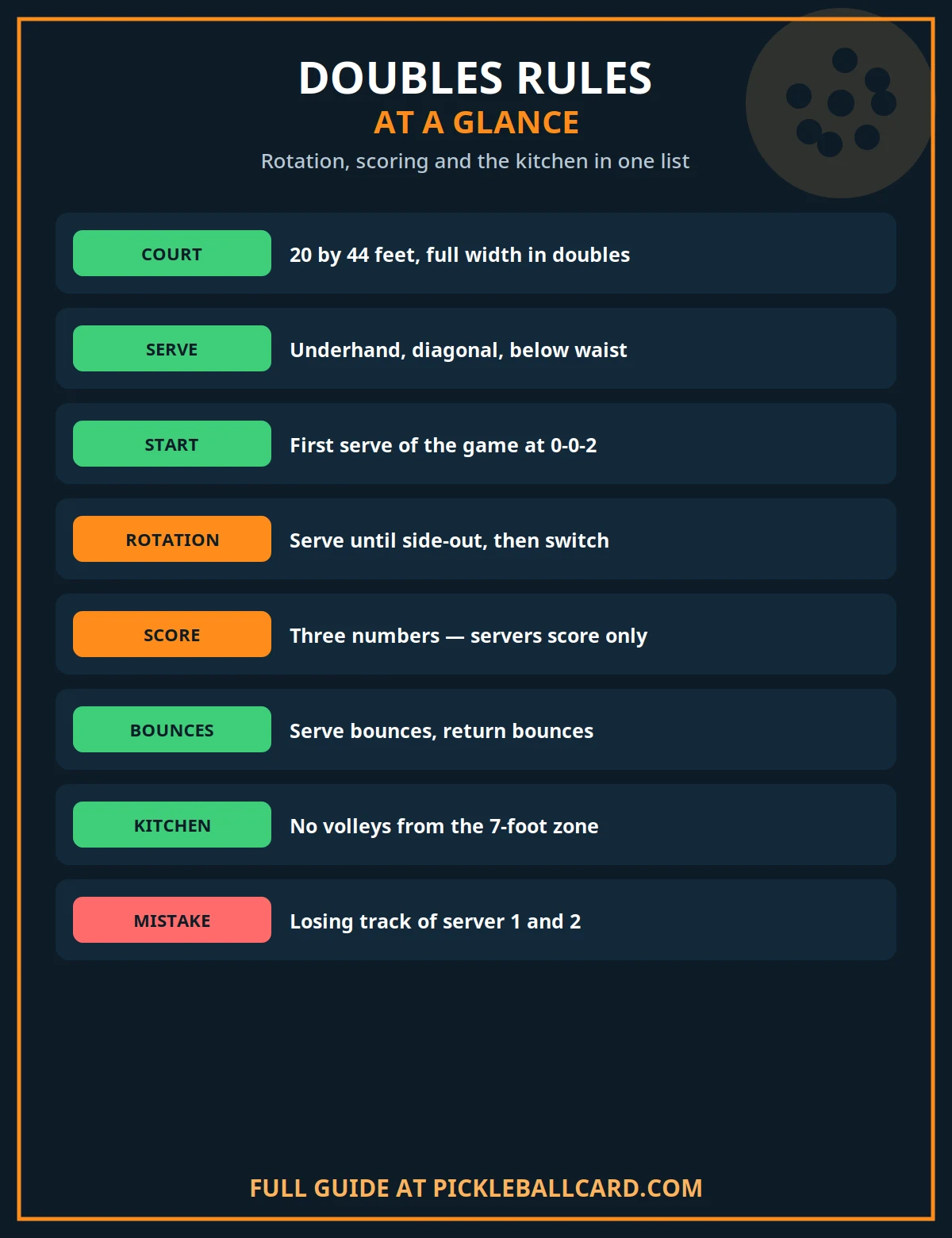
Pickleball doubles is the version most players meet first. Two players cover each side of the court, share the serve, and share the decisions. That shared format changes only a few rules, but those few rules cause most of the confusion for new players.
This guide explains pickleball doubles rules in plain language, using the current USA Pickleball Official Rulebook as the source. Where doubles differs from singles, it says so directly. Where the rules are identical, it says that too.
Key Takeaways
- Doubles uses the same court, ball, net, and basic faults as singles.
- Only the serving team can score in standard side-out scoring.
- Doubles scores are called as three numbers, not two.
- Every game starts at 0-0-2, because the first serving team gets only one server.
- After that start, each team gets two servers before a side-out.
- The two-bounce rule and the non-volley zone apply in doubles exactly as in singles.
- A server switches service courts after every point the serving team wins.
- Either partner may make calls, especially line calls, in doubles.
Court and Positions in Doubles
Doubles is played on a court 20 feet wide and 44 feet long. That is the same court used for singles. The net divides the court, and each side has a non-volley zone.
The non-volley zone extends 7 feet from the net on each side. It is often called the kitchen. The service courts sit behind that zone, split by a centerline.
Each team has two players, one on each side of the centerline at the start of a rally. Positions are not frozen for the whole rally, though. Players move freely once the ball is in play.
At the moment of the serve, only the server and the receiver have fixed roles. The server stands behind the baseline. The receiver stands in the correct diagonal service court.
The non-serving partner and the non-receiving partner may stand anywhere on their own side. In practice, most partners stand near the baseline or near the kitchen line, ready for the next shot.
Who Serves First and Who Receives
The team that wins the opening choice serves first, subject to the format being used. The first server of the game starts from the right-hand service court.
The receiver is the opponent standing diagonally opposite the server. That player must return the serve after it bounces. The other receiver waits for the next shot.
Serving Rules and Serving Rotation
The serve starts every rally in doubles. It must be hit underhand, from behind the baseline, diagonally into the opposite service court. A serve that lands short, in the kitchen, or outside the correct court is a fault.
For a volley serve, the paddle contacts the ball below the waist. The arm moves in an upward arc, and the paddle head stays below the highest part of the wrist. These three points keep the serve underhand.
At contact, at least one foot must be on the playing surface behind the baseline. Neither foot may touch the baseline, the court, or the area outside the imaginary sideline and centerline extensions.
The full score must be called before the server hits the serve. The server must then serve within 10 seconds after the score call is complete. Serving early or late can be a fault.
Only one serve attempt is allowed per server in a rally. There is no second serve in pickleball, unlike tennis. A faulted serve ends that server’s turn.
For a fuller overview of the shared rules, see the pickleball rules guide. It covers the court, equipment, and faults that apply to both formats.
The 0-0-2 Start Exception
Every doubles game starts with the score called as 0-0-2. That third number is the server number. It tells everyone that the first serving team is already on its second server.
In effect, the first serving team gets only one server at the start of the game. If that server faults, the serve passes to the other team at once. There is no Server 1 turn for the opening team.
This exception exists to balance the game. Without it, the team serving first would get a longer opening turn than the team receiving first. The 0-0-2 start removes that advantage.
New players often call the opening score 0-0-1 by mistake. That mistake matters, because it changes who serves next. Always start a doubles game at 0-0-2.
How the Rotation Works After the Start
After the opening sequence, each team gets two servers before a side-out. Server 1 serves until that player faults. The serve then passes to the partner, who becomes Server 2.
Server 2 serves until that player faults. At that point, the side-out is complete, and the serve passes to the other team. The other team then starts with its own Server 1.
The first serve of every side-out comes from the right-hand service court. That rule holds no matter which player is serving. The serving team’s starting side is always the right side after a side-out.
When the serving team wins a point, the server switches service courts. The same server keeps serving, but from the other side. This switch continues after every point the serving team wins.
When the serving team loses a rally, no point is scored. The serve moves to the partner, or to the other team if Server 2 has faulted. The score itself does not change on a lost rally.
A Worked Rotation Example
Imagine Team A serves first at 0-0-2. Team A wins the rally, so the score becomes 1-0-2. The same server switches to the left court and serves again.
Team A then loses a rally. The serve passes to Team B, because Team A has already used its only opening server. Team B now serves at 0-1-1, from the right court.
Team B’s Server 2 serves at 2-1-2. If Server 2 faults, the side-out is complete. Team A takes the serve back, starting at 1-2-1 from the right court.
Scoring in Doubles
Standard doubles uses side-out scoring. Only the serving team can score a point, and only by winning a rally while serving. A receiving team that wins a rally gains the serve, not a point.
Most games are played to 11 points, and the winning team must lead by at least 2 points. If the score reaches 10-10, play continues until one team leads by two. Longer game targets may be used in some formats.
The doubles score is called as three numbers before each serve. The first number is the serving team’s score. The second number is the receiving team’s score. The third number is the server number, 1 or 2.
For example, a call of 5-3-1 means the serving team has 5 points, the receiving team has 3 points, and the server is Server 1. A call of 5-3-2 means the same scores, but Server 2 is serving.
The score must not be called until the server and receiver are in position, or should be in position. All players should be ready, or should be ready, before the call begins.
For a step-by-step scoring walkthrough, see how to score in pickleball. It explains the three-number call with further examples.
Scoring Examples
| Score Called | What It Means | What Happens Next |
|---|---|---|
| 0-0-2 | Game start, first team serving | Opening server serves once only |
| 4-2-1 | Serving team leads, Server 1 | Server 1 keeps serving after a point |
| 4-2-2 | Same scores, Server 2 | Side-out follows a Server 2 fault |
| 10-9-1 | Serving team one point from winning | Game ends only with a two-point lead |
The Two-Bounce Rule in Doubles
The two-bounce rule applies in doubles exactly as it applies in singles. After the serve, the receiving team must let the ball bounce before returning it. That is the first required bounce.
The serving team must then let the return bounce before hitting its next shot. That is the second required bounce. Only after both bounces may either team volley.
This rule stops the serving team from rushing the net and volleying the return. It also stops the receiving team from volleying the serve. Both teams must play one groundstroke first.
A common error is volleying the return of serve as the serving team. That is a fault, even if the shot would have won the rally. Wait for the bounce, then play the ball.
After the two bounces are complete, either team may volley or play the ball after a bounce. The choice depends on the ball’s height, speed, and position on the court.
The Non-Volley Zone and Kitchen in Doubles
The non-volley zone, or kitchen, extends 7 feet from the net on each side. A player may not volley while touching the zone or its lines. That rule is the same in doubles and singles.
A volley means hitting the ball before it bounces. If any part of the player, or anything the player is wearing or carrying, touches the kitchen during a volley, it is a fault.
Momentum matters too. If a player volleys and then falls, steps, or is carried into the kitchen, it is still a fault. This holds even if the ball is already dead before the player touches the zone.
A ball that bounces in the kitchen may be played from inside the kitchen. That is how dinking works. Players step in, play a soft shot after the bounce, and step back out.
In doubles, both partners must watch the kitchen line. A partner who steps in during a volley creates a fault for the team, even if the other partner hit the ball cleanly. Communication helps here.
The kitchen line itself counts as part of the kitchen. On a serve, a ball landing on the kitchen line is short and a fault. During a rally, other shots landing on that line are treated as in.
Faults and Line Calls
A fault ends the rally at once. In doubles, a fault by the serving team loses the serve or completes a side-out. A fault by the receiving team gives a point to the serving team.
Volleying from the kitchen, volleying before the two-bounce rule is satisfied, and serving before the score call is complete are all faults. So is striking the ball twice, or catching the ball.
Line calls decide whether a ball is in or out. A ball that touches any court line is in, with one clear exception. A serve that touches the non-volley zone line is a fault.
For all other shots, a ball touching a line is in, even if only part of the ball touches the line. A ball is out only when it lands completely outside the court lines.
Players call lines on their own side of the court. In doubles, either partner may make a call, especially a line call. Partners should agree quickly and clearly.
If one partner calls a ball out and the other calls it in, doubt exists. In doubles, that doubt means the team’s call is in. Partners should not argue the point after the call is made.
Calls should be made promptly. A late call can look like a second chance, and it invites dispute. Call out clearly, or let play continue as if the ball is in.
Switching Sides and Partner Positioning Basics
In doubles, the server switches service courts after every point the serving team wins. That is the most frequent side switch in a game. It keeps the server’s position tied to the team’s score.
The starting server for each team sets a pattern for the game. When that team’s score is even, the starting server is on the right side. When the score is odd, the starting server is on the left side.
This pattern helps players check their positions. If the score and the starting server’s side do not match, someone is standing in the wrong place. Stop, check the score, and reset before serving.
Partners do not need to stay on fixed sides between rallies. After a rally ends, partners may return to the sides that match the score. That reset prevents confusion on the next serve.
Teams also switch ends of the court between games in a match, following the format in use. Recreational games may skip a formal end change, but tournament formats usually include one. Check the format before the match starts.
At the baseline, the non-serving partner should stay back until the two-bounce rule is complete. Rushing forward early leaves that player exposed to a deep return at the feet.
Common Doubles-Rules Mistakes
- Starting the game at 0-0-1 instead of 0-0-2.
- Calling a side-out after Server 1 faults, instead of passing to Server 2.
- Scoring a point as the receiving team, rather than only gaining the serve.
- Volleying the serve, or volleying the return before it bounces.
- Volleying while standing on the kitchen line, or falling into the kitchen after a volley.
- Serving from the wrong service court after a point, instead of switching sides.
- Serving before the full score is called, or waiting too long after the call.
- Calling a ball out when it touched the line, except for a serve on the kitchen line.
- Letting one partner overrule the other on a shared line call.
- Forgetting that the first serve after a side-out always comes from the right court.
A simple fix is to say the full three-number score before every serve. That habit alone catches wrong-server errors, wrong-side errors, and score errors before the rally starts.
How Doubles Rules Differ From Singles
Most pickleball rules are identical in doubles and singles. The court, the ball, the kitchen, the two-bounce rule, and the fault rules do not change. The differences sit in serving, scoring calls, and calls.
Singles has one player per side, so there is no partner rotation. Doubles has two servers per team, except at the start. That single difference drives most of the extra rules.
For a direct comparison of the singles format, see the pickleball singles rules guide. It explains the two-number score call and the even-and-odd serving sides.
| Feature | Doubles | Singles |
|---|---|---|
| Players per side | Two | One |
| Score call | Three numbers | Two numbers |
| Game start call | 0-0-2 | 0-0 |
| Servers per side-out | Two, except at game start | One |
| Side-out trigger | Two faults by serving team | One fault by server |
| Who can score | Serving team only | Server only |
| Two-bounce rule | Applies | Applies |
| Kitchen rule | Applies | Applies |
| Line calls | Either partner may call | Server or receiver calls own side |
Before You Serve Checklist
- Check that the server is in the correct service court for the score.
- Check that the receiver is ready in the diagonal court.
- Call the full three-number score, including the server number.
- Wait for the call to finish, then serve within 10 seconds.
- Serve underhand, from behind the baseline, into the diagonal court.
- Let the return bounce before playing the third shot.
- Stay out of the kitchen when volleying, including on momentum.
- Switch service courts after each point the serving team wins.
- Pass the serve to your partner after Server 1 faults, not to the other team.
- Call a side-out only after Server 2 faults, except at game start.
Frequently Asked Questions
What is the score at the start of a doubles game?
The score is called as 0-0-2. The first two numbers are the teams’ scores, both zero. The third number shows that the opening team is already on Server 2.
How many serves does each team get in doubles?
Each team normally gets two serves before a side-out. Server 1 serves until faulting, then Server 2 serves until faulting. The opening team is the exception, with one server only.
Can only the serving team score in doubles?
Yes, in standard side-out scoring, only the serving team can score. The receiving team wins the serve by winning a rally, but it does not win a point.
Does the two-bounce rule apply in doubles?
Yes, the two-bounce rule applies in doubles. The receiver must let the serve bounce, and the server’s team must let the return bounce. After those two bounces, volleys are allowed.
Can you stand in the kitchen in doubles?
Yes, you may stand in the kitchen when you are not volleying. The rule only bans volleying while touching the kitchen or its lines. A bounced ball may be played from inside the kitchen.
Who makes line calls in doubles?
Either partner may make calls, especially line calls. Each team calls lines on its own side of the court. Prompt, clear calls keep rallies fair and disputes rare.
Final Thoughts
Pickleball doubles rules reward one habit above all others: call the full score, every time. That habit tracks the server number, the side, and the rotation without extra effort.
When a rule is unclear during a game, check the official source. The USA Pickleball Official Rulebook is the definitive guide, and the 2026 USA Pickleball Official Rulebook PDF gives the full text for players, referees, and organizers.

Shoaib is the publisher of Pickleball Card. He oversees the site’s guides to pickleball rules, ratings, strategy and gear, all researched from primary sources — the USA Pickleball Rulebook, DUPR and manufacturer documentation — and updated as the game changes.