Every pickleball tournament follows a format, and that format shapes your whole day. It decides how many matches you play, how long you wait between them, and what happens after a loss.
Some formats guarantee several matches no matter what. Others end your event with a single defeat. Knowing the difference helps you pick events you will enjoy and prepare for the day ahead.
Key Takeaways
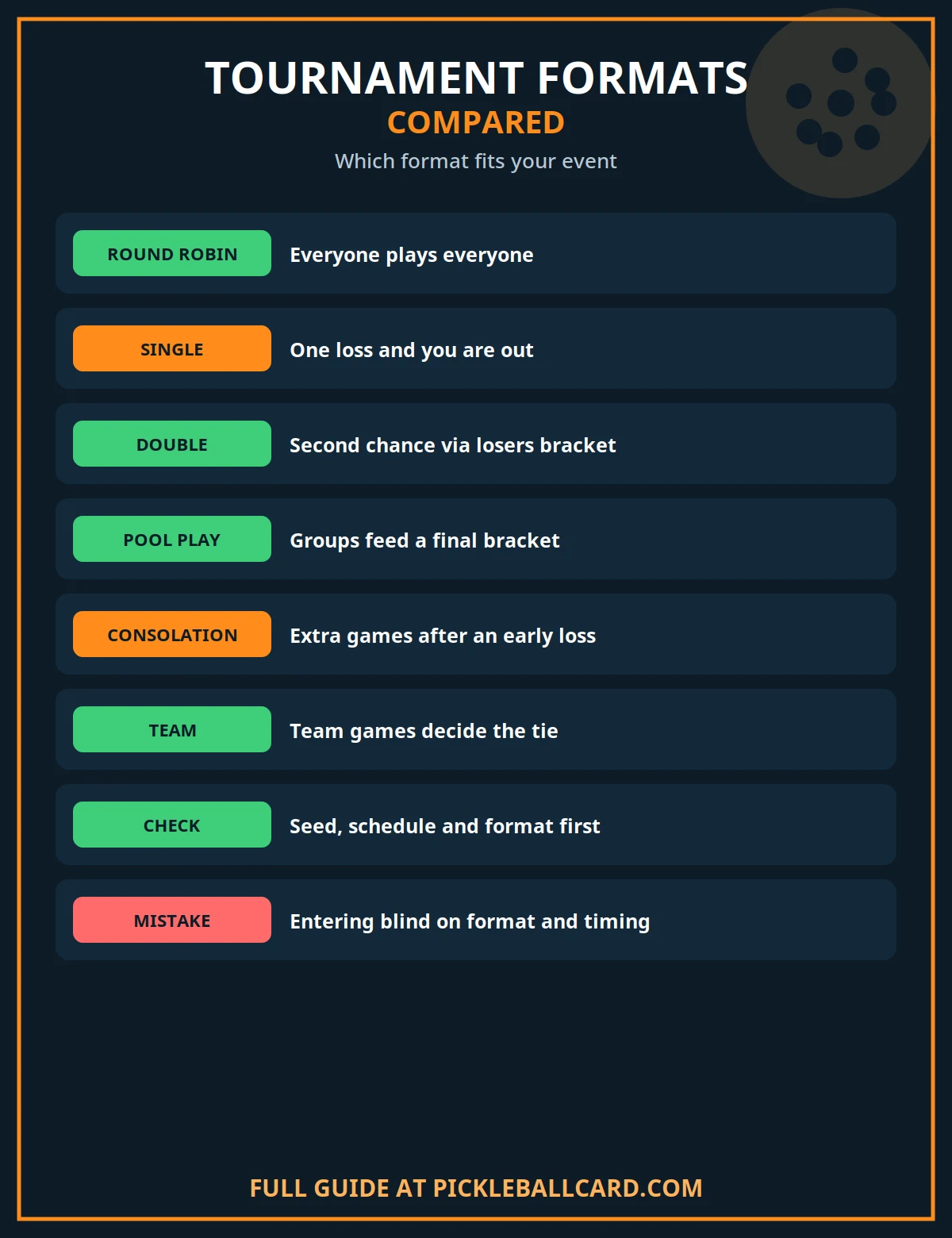
- Round robin gives every entrant a set number of matches against the other players or teams in their group.
- Single elimination ends your event after one loss, which keeps brackets fast but unforgiving.
- Double elimination gives you a second life through a losers bracket after your first defeat.
- Pool play combines a round robin stage with a knockout bracket for the top finishers.
- Consolation brackets give early losers extra matches and a shot at third place.
- The right format depends on your skill level, the time available, and the size of the field.
- Always read the draw, seeding, match scoring, and schedule before you enter an event.
Why Tournament Formats Matter
A format is simply the structure that decides who plays whom and how a winner is found. Two events with the same players can feel completely different because their formats differ.
A round robin event feels social and steady, with matches spread across the day. A single elimination event feels tense and fast, because every match could be your last.
Format also affects fairness. A format with more matches gives a truer picture of who played best on the day. A format with fewer matches rewards hot streaks and punishes slow starts.
Organizers choose formats for practical reasons too. Court availability, daylight, entry numbers, and volunteer staffing all shape what a tournament can realistically run.
How To Read A Tournament Draw
A draw is the published bracket or schedule for your division. It shows your opponents, your match times, and the path to the final.
Start by finding your division, which is usually set by skill level and age group. Then check whether you are in a bracket, a pool, or a round robin group.
Seeding places the strongest entrants apart in the draw so they do not meet too early. Seeding is commonly based on ratings, past results, or the judgment of the tournament director.
If you are unsure how ratings feed into seeding, our guide to pickleball ratings explains the systems organizers commonly use.
Also note the match format printed beside each round. Early rounds may be one game to 15, while medal matches may be best two games out of three to 11.
Finally, check whether losers move into a consolation bracket. That single detail changes how much play you are guaranteed.
Round Robin
Round robin is one of the most player-friendly pickleball tournament formats. Every player or team in a group plays every other player or team in that same group.
How Round Robin Works
In a group of five teams, each team plays four matches, one against each rival. Results are recorded as wins and losses across the whole group.
The standings decide the outcome. The team with the most match wins finishes first, and the rest of the table follows in order.
Some round robins stand alone, with the group winner taking the event. Others feed into playoffs, where the top finishers advance to semifinals or a final.
Pros And Cons Of Round Robin
The biggest advantage is guaranteed play. You know roughly how many matches you will get before you even arrive.
Round robin also handles uneven skill levels gracefully. A weaker team still gets full value from the day instead of going home after one match.
The main drawback is time. A large group needs many matches, which demands more courts and a longer schedule.
Round robin can also produce dead matches late in the day, when neither side can change the final standings.
When To Use Round Robin
Round robin suits small fields, social events, and club tournaments where everyone wants plenty of court time. It also works well for beginners, who benefit from several matches rather than one pressure-filled contest.
Organizers often cap group sizes at four to six teams. Beyond that, the number of matches grows quickly and the day becomes hard to schedule.
Round Robin Tiebreakers In General Terms
Ties are common in round robin play, so every event needs a published tiebreaker order. The usual first step is the number of matches won.
If teams remain tied, head-to-head results are often used next. The winner of the match between the tied teams ranks higher.
Point differential is another common tiebreaker. It compares total points scored against total points conceded across the group.
Some events use head-to-head point differential instead, looking only at the games between the tied teams. Exact tiebreaker orders vary by event, so always check the published rules for your division.
Single Elimination
Single elimination is the simplest bracket format. Win and you advance. Lose once and your event is over.
A 16-team single elimination bracket needs four rounds to crown a champion. The field halves after every round until only the finalists remain.
The format is fast and easy to run. It needs fewer matches than any other bracket, which makes it ideal for large fields and tight schedules.
The downside is obvious. One bad match, one tough draw, or one slow start can end your tournament before it really begins.
Single elimination suits experienced players who value high stakes and a clear path to the title. It is less kind to beginners, who may travel a long way for a single match.
Some single elimination events add a consolation bracket, covered below, to soften this harshness and guarantee extra play.
Double Elimination
Double elimination gives every entrant a second chance. You are out only after your second loss, not your first.
The Winners And Losers Bracket Idea
Every team starts in the winners bracket. Win and you stay there. Lose once and you drop into the losers bracket, sometimes called the back draw.
Teams in the losers bracket keep playing each other. A second loss there ends their event, while survivors keep fighting toward the final.
The winners bracket champion and the losers bracket champion meet in the final. This structure rewards consistency while forgiving a single off day.
The Final And The Tiebreaker Match
Under USA Pickleball sanctioned rules for double elimination, the losers bracket winner plays the winners bracket winner for the championship.
If the losers bracket winner beats the winners bracket winner, a tiebreaker match to 15 points is played to decide gold and silver.
The loser of the losers bracket final receives the bronze medal. This keeps third place meaningful rather than decided by default.
Pros And Cons Of Double Elimination
The clear benefit is fairness. A champion usually has to be beaten twice, which reduces the damage of one unlucky draw.
The cost is time and complexity. Double elimination brackets need nearly twice as many matches as single elimination, plus careful scheduling.
It is a strong choice for medium-sized fields and serious events, where players expect a full test and organizers have the courts to run it.
Pool Play Into A Bracket
Pool play is a hybrid format. The field is split into groups, called pools, and each pool plays a round robin first.
The top finishers from each pool then advance into a knockout bracket. A common setup sends the top two teams from each pool into single elimination playoffs.
This format gives everyone guaranteed matches in the pool stage, then raises the stakes for the playoffs. It blends the social value of round robin with the drama of a bracket.
Pool play also handles large fields well. Pools run in parallel across courts, which keeps the schedule moving even with many entrants.
The main risk is a team that dominates its pool but loses one playoff match and goes home early. That is the trade-off for a format that rewards both consistency and clutch play.
Major professional events have used pool play for season finales, with small pools of four and the top two advancing to semifinals.
Consolation Brackets
A consolation bracket is a second competition for teams that lose early in the main draw. It runs alongside the main bracket rather than replacing it.
Under USA Pickleball sanctioned rules for single elimination with consolation, losers from all rounds enter the consolation bracket.
Those teams play for the bronze medal, and they are eliminated after a second loss. The main bracket finalists still play for gold and silver.
Consolation brackets are a kindness to players and a smart move for organizers. They keep courts busy, keep players at the venue, and make entry fees feel like better value.
When you compare events, check whether consolation play exists. An event with a consolation bracket can easily double your guaranteed matches.
Team Formats
Most pickleball events are built around singles or doubles pairs. Team formats change the unit of competition from a pair to a squad.
In a team event, clubs or drafted squads face each other across several matches. The team that wins the most matches in the tie wins the overall contest.
Team formats reward depth and strategy. A captain must decide lineups, manage player energy, and match strengths against the opposing team.
The best-known team concept is the coed format used by Major League Pickleball. A team match there is built from gender doubles and mixed doubles games, with a singles tiebreaker if the teams are tied.
Amateur team events often borrow this idea in simpler form. A club night might pit two four-player squads against each other across doubles and mixed matches.
Team formats suit social leagues and club rivalries. They turn individual results into a shared result, which many players find more fun than playing alone.
Scoring Variations Commonly Used In Tournaments
Tournament scoring varies by event, and the event listing should always state the scoring in advance. The variations below are common practice, not universal rules.
Games to 11 points are the most common single-game format. They are quick, familiar, and easy to fit into a busy schedule.
Games to 15 points appear often in pool play and consolation rounds. They give players a little more time to settle into a match.
Games to 21 points are used for longer feature matches or finals. They test fitness and patience as well as shot-making.
Almost all tournament games require a win by 2 points. A game tied at 10-10 continues until one side leads by two.
Best two games out of three to 11 is a common format for medal matches. It reduces the chance that one lucky game decides a title.
Some events use timed games or rally scoring to keep a schedule on track. If your event uses either, read the event notes carefully before your first match.
How To Choose The Right Format
Choosing a format means matching the structure to your goals. There is no single best format, only the best fit for a given field.
Match The Format To Your Skill Level
Beginners should look for round robin or pool play events. Guaranteed matches build experience faster than a single high-pressure bracket match.
Intermediate players can enjoy any format, but double elimination offers a good balance of stakes and second chances. It punishes nobody for one slow start.
Advanced players often prefer single or double elimination brackets. They want a clear champion and a format that rewards peak performance under pressure.
Match The Format To Your Time Available
If you have only a morning, single elimination or a small round robin fits best. Both keep the schedule tight and predictable.
If you have a full day, double elimination and pool play become realistic. They need more rounds, more courts, and longer gaps between matches.
Always check the published schedule before entering. A format that looks fun on paper can still mean long waits if courts are scarce.
Match The Format To The Number Of Players
Small fields of four to eight teams suit round robin perfectly. Everyone plays everyone, and the day stays manageable.
Medium fields of eight to sixteen teams suit pool play or double elimination. Pools split the field neatly, and double elimination keeps everyone alive longer.
Large fields of thirty or more teams usually need single elimination or a pool stage. Without a knockout stage, the match count becomes unworkable.
Formats At A Glance
| Format | Games Guaranteed | Time Needed | Second Chances |
|---|---|---|---|
| Round robin | All group opponents | High for large groups | Not applicable |
| Single elimination | One match minimum | Low | None |
| Double elimination | At least two matches | High | Yes, one extra loss |
| Pool play into bracket | All pool opponents | Medium to high | Pool stage only |
| Single elimination with consolation | Main draw plus consolation | Medium | Consolation bracket |
| Team format | Depends on tie size | Medium to high | Team dependent |
What To Check Before You Enter
A few minutes of checking before you register can save a wasted trip. Tournament listings usually answer every question below, but you have to look.
- Format: confirm whether the event is round robin, elimination, pool play, or a hybrid.
- Bracket and seeding: check how seeds are set and whether your division could be combined with another.
- Match scoring: note games to 11, 15, or 21, win by 2, and whether medal matches differ.
- Consolation play: find out whether early losers get extra matches or go home.
- Schedule: check start times, expected finish times, and how weather delays are handled.
- Entry rules: confirm age and skill divisions, partner requirements, and refund or withdrawal terms.
- Courts and balls: note surface type, indoor or outdoor play, and the official ball if listed.
If this will be your first event, read our guide to your first pickleball tournament before you register. It covers packing, warm-ups, and first-match nerves in more detail.
Many players discover tournaments through casual sessions. If you have not tried one yet, see how pickleball open play works for a low-pressure way to meet players and practice match play.
For the official sanctioned format definitions, see the USA Pickleball tournament policies and the Major League Pickleball FAQ on team play.
Frequently Asked Questions
What Is The Best Pickleball Tournament Format For Beginners?
Round robin is usually best for beginners. It guarantees several matches, keeps the atmosphere social, and lets new players learn from different opponents without the fear of instant elimination.
How Many Matches Do You Get In A Round Robin?
You play every other team in your group once. In a group of five teams, that means four matches. Larger groups mean more matches, which is why organizers often cap group sizes.
What Is The Difference Between Single And Double Elimination?
Single elimination ends your event after one loss. Double elimination moves you to a losers bracket after one loss, and only a second loss ends your event.
How Does Pool Play Work In Pickleball?
The field is split into pools, each pool plays a round robin, and the top finishers advance into a knockout bracket. It combines guaranteed matches with a high-stakes finish.
What Happens If You Lose Early In A Tournament?
It depends on the format. In plain single elimination, you are out. In events with a consolation bracket, you move into a second competition for third place.
Do All Tournaments Use The Same Scoring?
No. Common formats include games to 11, 15, or 21 points, usually win by 2, and best two out of three for medal matches. Always check the event listing for the exact scoring.

Shoaib is the publisher of Pickleball Card. He oversees the site’s guides to pickleball rules, ratings, strategy and gear, all researched from primary sources — the USA Pickleball Rulebook, DUPR and manufacturer documentation — and updated as the game changes.