Padel and pickleball look like cousins. Both use a solid paddle, both are played on a small court, and both are growing fast.
They are not the same sport. One is played inside glass walls. The other has a no-volley zone called the kitchen. Almost everything else follows from those two facts.
This guide compares them properly: courts, rackets, balls, serves, scoring, rally style, learning curve, cost and availability — so you can pick the right one first.
Key Takeaways
- The walls are the headline. Padel is enclosed, and the ball stays live off the glass. Pickleball is open, and a ball out is out.
- Padel courts are bigger. Padel is 20 by 10 metres. Pickleball is 44 by 20 feet — about 13.41 by 6.10 metres.
- Scoring is completely different. Padel copies tennis: 15, 30, 40, games and sets. Pickleball plays to 11, win by two.
- Padel is doubles only. Official padel is always pairs. Pickleball is played as singles and doubles, with doubles most common.
- Pickleball is easier to start. Most beginners rally in minutes. Padel’s wall play takes longer to read and trust.
- Neither replaces the other. Plenty of players enjoy both. They simply reward different skills, as this comparison shows.
The Short Answer
Choose padel if you want an enclosed, doubles-only game where rebounds off glass keep rallies alive and positioning matters as much as power.
Choose pickleball if you want the quickest route into a racket sport: a smaller open court, a slower plastic ball, and games you can learn in one session.
If you can, try both. One session of each tells you more than any comparison table — but the table below is a good place to start.
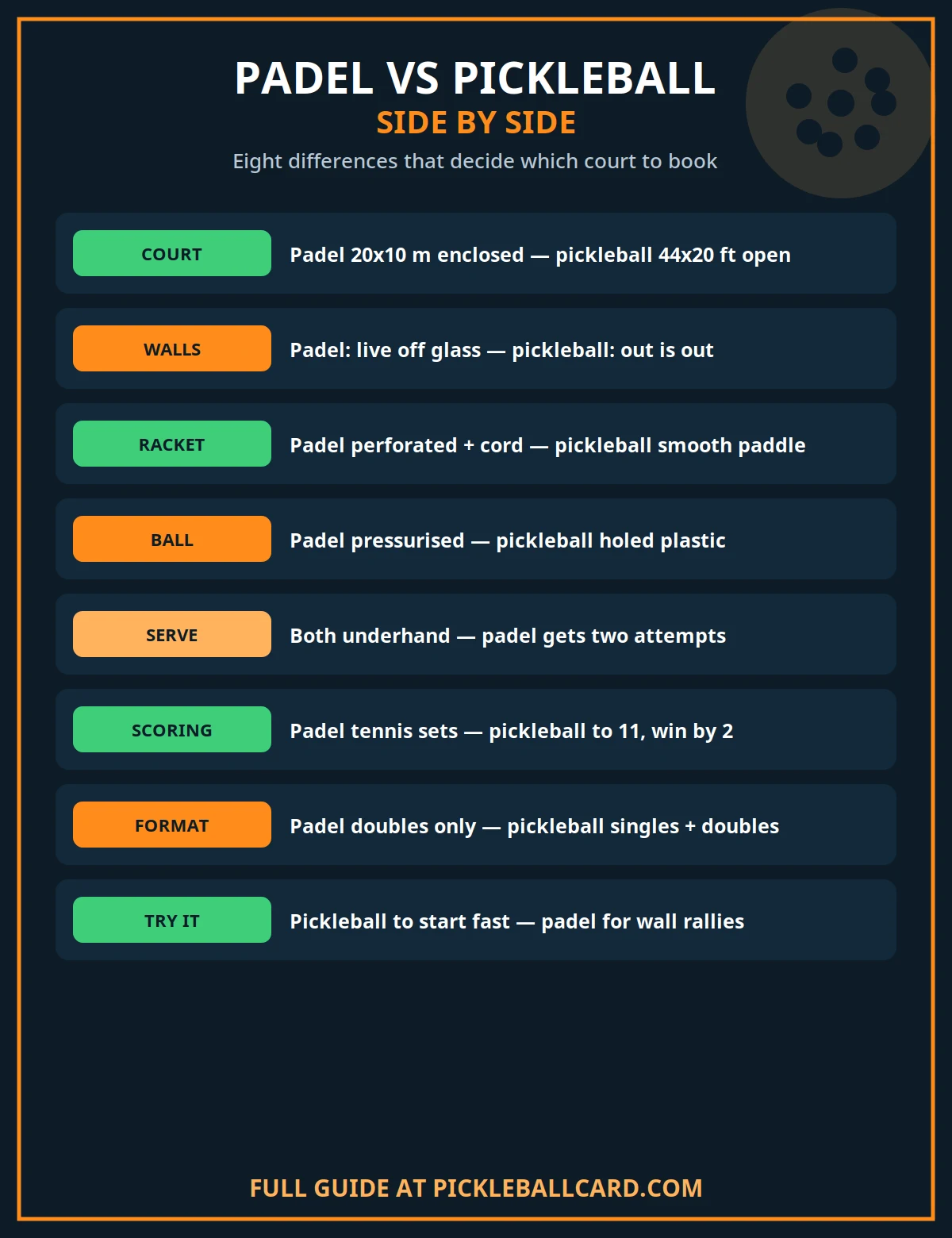
Padel vs Pickleball at a Glance
| Feature | Padel | Pickleball |
|---|---|---|
| Invented | 1969, Acapulco, Mexico | 1965, Bainbridge Island, Washington, USA |
| Court size | 20 m x 10 m, enclosed | 44 ft x 20 ft (13.41 m x 6.10 m), open |
| Walls | Glass and mesh, in play after a bounce | None — the ball is dead once it leaves the court |
| Net height | 0.88 m at centre, 0.92 m at sides | 34 in at centre, 36 in at sidelines |
| Racket / paddle | Solid, perforated, up to 45.5 cm long, wrist cord required | Solid, smooth-faced paddle, larger and usually lighter |
| Ball | Pressurised rubber, similar to a low-pressure tennis ball | Hollow plastic ball with holes |
| Format | Doubles only in official play | Singles and doubles |
| Serve | Underhand, after a bounce, at or below waist, two attempts | Underhand, diagonal, one attempt; volley or drop serve |
| Signature rule | Play the ball off your own glass after it bounces | No volleys inside the 7 ft kitchen (non-volley zone) |
| Scoring | Tennis scoring: points, games, sets, tiebreak at 6-6 | To 11, win by 2; only the serving side scores in traditional scoring |
| Typical rally | Longer, with rebounds and resets off the glass | Shorter court, soft dink exchanges at the kitchen line |
Every figure in this table comes from the two governing bodies: the International Padel Federation (FIP) for padel and USA Pickleball for pickleball.
Two Sports, Two Births — Only Four Years Apart
Pickleball came first, in 1965 on Bainbridge Island near Seattle. Families improvised a game with table-tennis paddles, a perforated plastic ball and a badminton court.
Padel followed in 1969 in Acapulco, Mexico. Enrique Corcuera built an enclosed court on his property, adding walls so the ball stayed in play longer.
From there they travelled differently. Padel spread through Spain, then Europe and Latin America. Pickleball spread through American schools, parks and retirement communities, then everywhere.
That history explains today’s map. Padel courts are easy to find in much of Europe. Pickleball courts are easy to find across the United States.
The Court: Enclosed Glass Box vs Open Court
A padel court measures 20 metres long and 10 metres wide, fully enclosed. Back walls rise to 4 metres in total — glass topped with mesh.
The glass is not decoration. After the ball bounces on your side, it may hit your glass and you can still play it. That one rule rebuilds the whole sport.
A pickleball court measures 44 feet long and 20 feet wide, with no enclosure. If a shot misses the lines, the rally simply ends.
Pickleball’s defining feature sits at the net instead: the kitchen, a 7-foot non-volley zone on each side where you may not hit the ball in the air.
Why the Court Size Matters
Padel’s court is roughly twice pickleball’s playing area, shared by four players in doubles. There is more ground to cover and more angles to defend.
Pickleball’s smaller court is why beginners succeed so quickly. Less distance means shorter swings, slower decisions and rallies that start almost immediately.
It also explains court supply. Several pickleball courts fit inside one tennis court, and lines can be taped onto existing surfaces in minutes.
The Racket and the Ball
A padel racket is solid but perforated, with holes drilled through the face. It has no strings, a short handle and a mandatory wrist cord.
FIP rules cap it at 45.5 cm long, 26 cm wide and 38 mm thick. Most weigh noticeably more than a pickleball paddle.
A pickleball paddle is also solid, but its face is smooth rather than perforated. It is wider than a padel racket and usually lighter in the hand.
The balls differ even more. A padel ball is a pressurised rubber ball, much like a slightly softer tennis ball, 6.35 to 6.77 cm across.
A pickleball is hollow plastic with holes. It flies slower, bounces lower and loses pace quickly, which is exactly why the game stays controllable for beginners.
The Serve: Similar Shape, Different Details
Both serves are underhand and diagonal, which surprises tennis players expecting an overhead weapon. Neither sport lets you win cheap points with the serve alone.
In padel, you bounce the ball behind the service line and strike it at or below waist height. You get two attempts, as in tennis.
The serve must land in the service box and bounce before touching any wall. Hitting the mesh fence on a serve is a fault.
In pickleball, the server strikes the ball in the air or uses a drop serve, contacting it below the waist. There is only one serve attempt.
Pickleball then adds its famous two-bounce rule: the serve and the return must both bounce before anyone may volley. Our guide to how to play pickleball walks through the full sequence.
Scoring and Match Format
If you know tennis scoring, you already know padel scoring. Points run 15, 30, 40 and game, with deuce and advantage, and sets go to six games.
A tiebreak decides a set at 6-6. Matches are normally best of three sets, so a close padel match can run well past an hour.
Pickleball scoring is its own language. Games go to 11 points, win by two, and in traditional scoring only the serving side can score.
Doubles adds the three-number call — server’s score, receiver’s score, server number — which sounds confusing for one game and then becomes automatic.
Games are short. A typical recreational pickleball game lasts ten to twenty minutes, so groups rotate courts and mix partners far more often than in padel.
How a Rally Actually Feels
Padel: Patience, Walls and Angles
Beginners panic when a shot passes them in padel. Experienced players let it go, turn, and play the rebound off the back glass instead.
That single habit transforms defence. Shots that would be clean winners elsewhere come back, so points are built patiently until a real opening appears.
Net position still matters — the attacking pair wants the net — but the walls give the defending pair time and options no open court offers.
Pickleball: The Soft Game at the Kitchen
Pickleball rallies funnel toward the kitchen line. Because volleys are banned inside the zone, players trade soft dinks just over the net, waiting for a ball to attack.
Power matters, but placement and patience matter more at most levels. A hard shot from a bad position usually comes back harder.
The result is a game of small margins played close together, which is why pickleball feels social even when it gets fiercely competitive.
Learning Curve and Physical Demand
Pickleball has the gentler on-ramp. The court is small, the ball is slow, and the underhand serve is easy to land from the first try.
Most new players hold a real rally in their first session. Reaching a decent club level still takes work, but the first fun arrives immediately.
Padel asks more at the start. The basics are friendly, but reading rebounds, using the glass and coordinating with a partner add a second learning curve.
Physically, padel usually demands more running and longer rallies on a bigger court. Pickleball’s doubles game, played mostly near the kitchen, is kinder on the legs.
Neither sport is contact or high-impact by design. As with any new activity, build up gradually and stop if something hurts rather than playing through it.
Cost and Availability
Pickleball’s entry cost is low: an inexpensive paddle, a few balls and a public court, which is often free. Indoor centres charge modest court or session fees.
Padel needs a purpose-built enclosed court, so play usually means booking a club court by the hour and splitting the cost four ways.
Padel rackets also tend to cost more than starter pickleball paddles, and balls lose pressure and need replacing regularly, like tennis balls.
Availability may decide for you. In much of the US, pickleball is the easy find. In Spain and much of Europe, padel courts are the easy find.
Which Should You Try? A Simple Guide
| If this sounds like you… | Try first | Why |
|---|---|---|
| You want fun in your very first session | Pickleball | Small court, slow ball, rallies from minute one |
| You love tennis or squash and want a new twist | Padel | Familiar scoring, plus walls that reward squash-style thinking |
| You mostly play with family across ages | Pickleball | Gentle doubles game grandparents and grandchildren share well |
| You want a workout with long, tactical rallies | Padel | Bigger court, rebounds and longer points ask more of your legs |
| You want singles as well as doubles | Pickleball | Singles is a normal format; official padel is doubles only |
| Your local club is full of glass courts | Padel | Play what your area actually offers, with a ready community |
Already Play One? Switching Is Easier Than Starting Fresh
Pickleball players moving to padel keep their net game and soft hands. The work is learning to let the ball pass and trust the glass behind you.
Padel players moving to pickleball keep their patience and angles. The work is unlearning the walls — and respecting the kitchen, where volleys are simply illegal.
Both groups share one trap: treating the new sport as a smaller version of the old one. Give the different scoring and signature rule a few sessions.
Do not confuse padel with paddle tennis, either. They are separate sports again — our comparison of paddle tennis vs pickleball untangles that older American game.
And if tennis is your reference point, our guide to pickleball vs tennis covers the other comparison most new players ask about.
What the Two Sports Share
For all their differences, padel and pickleball were built on the same idea: make a racket game that ordinary people can enjoy quickly.
Both use a solid-faced implement with no strings. Both serve underhand and diagonally. Both are normally played as doubles, at the net, by mixed-age groups.
Both also reward the same virtues: positioning over raw power, patience in defence, and a partner you communicate with on every single point.
That shared DNA is why so many players cross over happily, and why clubs increasingly offer both sports side by side.
Your First Session in Each Sport: What to Expect
A first pickleball session usually starts with five minutes of explanation: the kitchen, the two-bounce rule and the three-number score call.
Then you play. Expect short rallies, lots of laughter at missed dinks, and a real game — with real points — inside half an hour.
A first padel session starts with the serve mechanics and one safety habit: always wear the wrist cord, and never turn your back carelessly near the glass.
Then you play, more slowly. Your first rebounds off the glass will feel accidental. By the second session, you will start using them on purpose.
Bring court shoes to either sport. Running shoes grip poorly on sideways moves, which both games use constantly, and court shoes protect your ankles.
Frequently Asked Questions
Is padel harder than pickleball?
For most beginners, yes at the start. Pickleball’s smaller court and slower ball produce rallies immediately, while padel adds wall rebounds that take sessions to read confidently.
Can you play padel as singles?
Not in official competition. FIP padel is a doubles sport, played two against two. Narrower singles courts exist for practice, but the real game is always pairs.
Why does padel have walls?
The enclosed court was there from the sport’s invention in 1969. The glass keeps the ball in play after a bounce, extending rallies and adding angles open courts cannot offer.
Is a padel racket the same as a pickleball paddle?
No. A padel racket is perforated, thicker and usually heavier, with a wrist cord and strict size limits. A pickleball paddle has a smooth face and a larger, lighter shape.
Which sport is better exercise?
Both are solid workouts. Padel doubles usually covers more ground with longer rallies, while pickleball singles is surprisingly demanding. Pickleball doubles is the gentlest option of the three.
Which is more popular?
It depends where you stand. Pickleball dominates in the United States, while padel is the bigger game across Spain, much of Europe and Latin America. Both are still growing quickly.
The Bottom Line
Padel is the enclosed, doubles-only, tennis-scored game where the glass is part of the rally. Pickleball is the open, kitchen-centred game scored to 11.
Pickleball wins on accessibility, cost and singles play. Padel wins on rally length, angles and that unique second chance off the back wall.
The best answer is the court near you with people you like. Book one session of each if you can — then you will know.
Sources: International Padel Federation, FIP Rules of Padel; USA Pickleball, Official Rules and Rules hub.
This comparison is original; no competitor content is linked or reproduced.