Walk into almost any outdoor tournament and you will see one of two balls in play. One is the Franklin X-40, a steady, widely used outdoor ball. The other is the Onix Dura Fast 40, a harder, faster ball with a long competition history.
Both balls carry 40 holes, both are built for outdoor courts, and both meet the size and weight limits for sanctioned play. Yet they do not feel the same, sound the same, or reward the same style of game.
That difference matters most when the score matters. A ball that suits a fast, attacking player can frustrate a player who relies on touch, resets, and long rallies. The wrong ball will not ruin your game, but it can change its rhythm.
This guide compares the two balls on verified specifications, feel, speed, durability, and consistency. It also explains how heat, cold, wind, and court surface should change your choice, so you can pick with confidence.
Key Takeaways
- Both balls are outdoor tournament balls with 40 holes, seamless one-piece construction, and USA Pickleball approval for tournament play.
- The Franklin X-40 weighs 26 grams and measures 74 mm across, giving it a balanced mix of pace, control, and forgiveness.
- The Onix Dura Fast 40 uses a patented two-size hole pattern and a harder compound, producing a faster, crisper, livelier game.
- Choose the X-40 for steadier rallies, mixed-level events, and a more forgiving feel on most outdoor courts.
- Choose the Dura Fast 40 for high-level competition, fast courts, and players who strike the ball cleanly and want maximum pace.
- In cold weather, inspect hard outdoor balls often and rotate in fresh balls sooner, since hard plastic is more likely to crack.
- Always check which ball your event names in advance, because the listed ball, not your favourite ball, is the one you must practise with.
What Makes a Tournament Ball?
A tournament ball is not simply a durable ball. It must meet a published set of limits for size, weight, bounce, hardness, and hole count, and it must appear on the approved-ball list.
USA Pickleball sets the governing standard for sanctioned play. A legal ball measures between 2.87 and 2.97 inches in diameter and weighs between 0.78 and 0.935 ounces.
When dropped from 78 inches onto a hard granite plate, it must bounce between 30 and 34 inches. It must also carry between 26 and 40 circular holes.
Those limits create a level field, but they still leave room for real differences. Two balls can both pass the tests while playing very differently on court.
Hardness is one reason why. A harder ball leaves the paddle faster and bounces more sharply. A slightly softer ball absorbs more pace and gives players a fraction more time.
Hole pattern is another reason. Smaller outdoor holes reduce wind drag, while the size, spacing, and arrangement of holes shape flight, spin response, and stability.
Construction matters too. A seamless, one-piece ball holds its round shape better than a ball joined from two halves. Roundness protects bounce consistency over a long match.
Finally, a tournament ball must stay predictable. Players accept speed or softness, but they need the same bounce and flight from the first game to the last.
Why Outdoor Balls Have 40 Small Holes
Outdoor balls face wind, sun, and rough court surfaces. Forty small holes cut drag and help the ball hold its line in a breeze, compared with the larger holes of an indoor ball.
The trade-off is speed. Less drag means a quicker ball, so outdoor rallies tend to move faster and reward clean contact and early preparation.
That is why the difference between indoor and outdoor pickleball balls matters so much. An indoor ball outdoors will drift, slow down, and behave unlike the ball used in competition.
How to Read This Comparison
Every specification below comes from the manufacturer or from USA Pickleball standards. Where a figure comes from a manufacturer product description rather than a numbered test sheet, this guide says so plainly.
Feel, speed, and durability descriptions reflect the manufacturers’ own characterisations and the well-established playing traits of each ball. No laboratory test results are claimed here, because none were verified for this guide.
Use the comparison table for a quick verdict, then read the conditions section before buying. Climate and surface often decide a close contest between these two balls.
Franklin X-40 Profile
The Franklin X-40 is an outdoor ball built around balance. Franklin describes it as a premium, tournament-grade ball made for both professional and amateur players.
Its headline numbers are simple. The X-40 weighs 26 grams, measures 74 mm in diameter, and carries 40 precisely machine-drilled holes.
Both figures sit comfortably inside USA Pickleball limits. The weight gives the ball enough heft to hold its line outdoors without turning every rally into a speed contest.
Franklin Sports builds the X-40 from durable polyethylene in a seamless, one-piece design. Rotational moulding forms the shell without a joint that could split under hard play.
That construction suits concrete, asphalt, and other hard outdoor surfaces. Franklin states that the no-seam design resists dents and cracking during aggressive outdoor play.
The hole pattern is the X-40’s quiet strength. Forty evenly drilled holes produce a balanced flight path and tight, reliable spin from ball to ball.
In practical terms, the X-40 feels controlled rather than explosive. Drives stay manageable, drops sit down more easily, and resets feel less punishing on slight mishits.
That forgiveness explains its broad appeal. Club players, league organisers, and mixed-level events can all use one ball without favouring only the hardest hitters.
Franklin lists the X-40 as USA Pickleball approved for outdoor tournament play. It also names the ball as the official ball of the US Open Pickleball Championships and USA Pickleball.
Franklin additionally lists the X-40 as the official ball of the APP Tour on its product pages. Tournament ball choices can change between seasons, so always confirm the current event listing before you travel.
For a broader look at choosing equipment for competition, see our guide to the best pickleball balls, which places the X-40 among the wider outdoor options.
Who the X-40 Suits Best
The X-40 suits players who value consistency over raw pace. If your game is built on placement, patience, and well-timed speed-ups, this ball supports that style.
It also suits developing competitors. A slightly more forgiving bounce gives newer tournament players time to learn match pace without being overwhelmed by speed.
Event organisers like the X-40 for a similar reason. One ball can serve beginners through advanced players in a single draw without creating complaints about fairness.
Onix Dura Fast 40 Profile
The Onix Dura Fast 40, often shortened to the Dura, is the faster, sharper half of this comparison. Onix describes it as the fastest ball on the market.
That claim rests on two design choices. The Dura uses a harder compound than most outdoor balls, and it pairs that compound with a patented hole pattern.
The pattern is the Dura’s signature feature. Instead of 40 identical holes, it mixes large and small holes across the shell to shape airflow and flight.
Onix states that this two-size pattern produces true flight outdoors, even in wind. The ball is designed to fly straight and fast rather than float or wander.
Like the X-40, the Dura is a seamless, one-piece ball. Onix rotationally moulds the shell, then machines the 40-hole pattern into the finished ball.
That process matters for consistency. A single moulded shell keeps the ball rounder for longer, which protects bounce and flight as a match wears on.
Manufacturer product descriptions list the Dura at 0.92 ounces, or about 26 grams, with a diameter of 2.9375 inches and an average bounce height of 32 inches.
Those figures sit inside USA Pickleball limits, close to the X-40 on weight and slightly larger on diameter. The playing difference comes from hardness and hole design, not from size alone.
On court, the Dura feels crisp and immediate. The ball jumps off the paddle, skids through the court, and punishes late preparation more than a softer ball would.
That character rewards clean strikers. Players with compact swings, fast hands, and confident volleys often find the Dura suits their attacking game.
Onix currently names the Dura Fast 40 as the official ball of the Senior Pro Tour. Onix also states that it was previously used in all PPA Tour events.
Onix further describes the Dura as the official ball of Pickleball Canada in its tournament-ball collection. As with any tour ball, check the current event announcement for the season you enter.
The Dura is available in high-visibility colours, including neon and yellow, with pink also listed on the Onix product page. Bright colours help tracking during fast rallies.
Who the Dura Fast 40 Suits Best
The Dura suits advanced and professional-level players who want the quickest honest test of skill. Speed exposes weak contact and rewards precise timing.
It also suits fast-court events and strong attacking teams. When both sides drive, volley, and speed up often, the Dura keeps rallies sharp and decisive.
Less experienced players may find it less forgiving. Mishits lose pace quickly, and the lively bounce can turn a defensive scramble into a short rally.
Head-to-Head Comparison
The table below puts the two balls side by side on the specifications and playing traits that matter most in a tournament setting.
| Feature | Franklin X-40 | Onix Dura Fast 40 |
|---|---|---|
| Intended play | Outdoor tournament and recreational play | Outdoor tournament and high-level play |
| Construction | Seamless one-piece polyethylene, rotationally moulded | Seamless one-piece, rotationally moulded |
| Hole count | 40 machine-drilled holes | 40 holes in two sizes, patented pattern |
| Weight | 26 grams | 0.92 ounces, about 26 grams |
| Diameter | 74 mm | 2.9375 inches, about 74.6 mm |
| Feel | Balanced, controlled, more forgiving | Hard, crisp, immediate off the paddle |
| Speed | Moderate to fast | Fast, the quicker of the two |
| Durability | Strong on hard outdoor surfaces | Strong in warm play, more crack-prone in cold |
| Consistency | Steady flight and spin, ball to ball | True, straight flight when struck cleanly |
| Best for | Mixed levels, clubs, steady rallies | Advanced play, fast courts, attacking games |
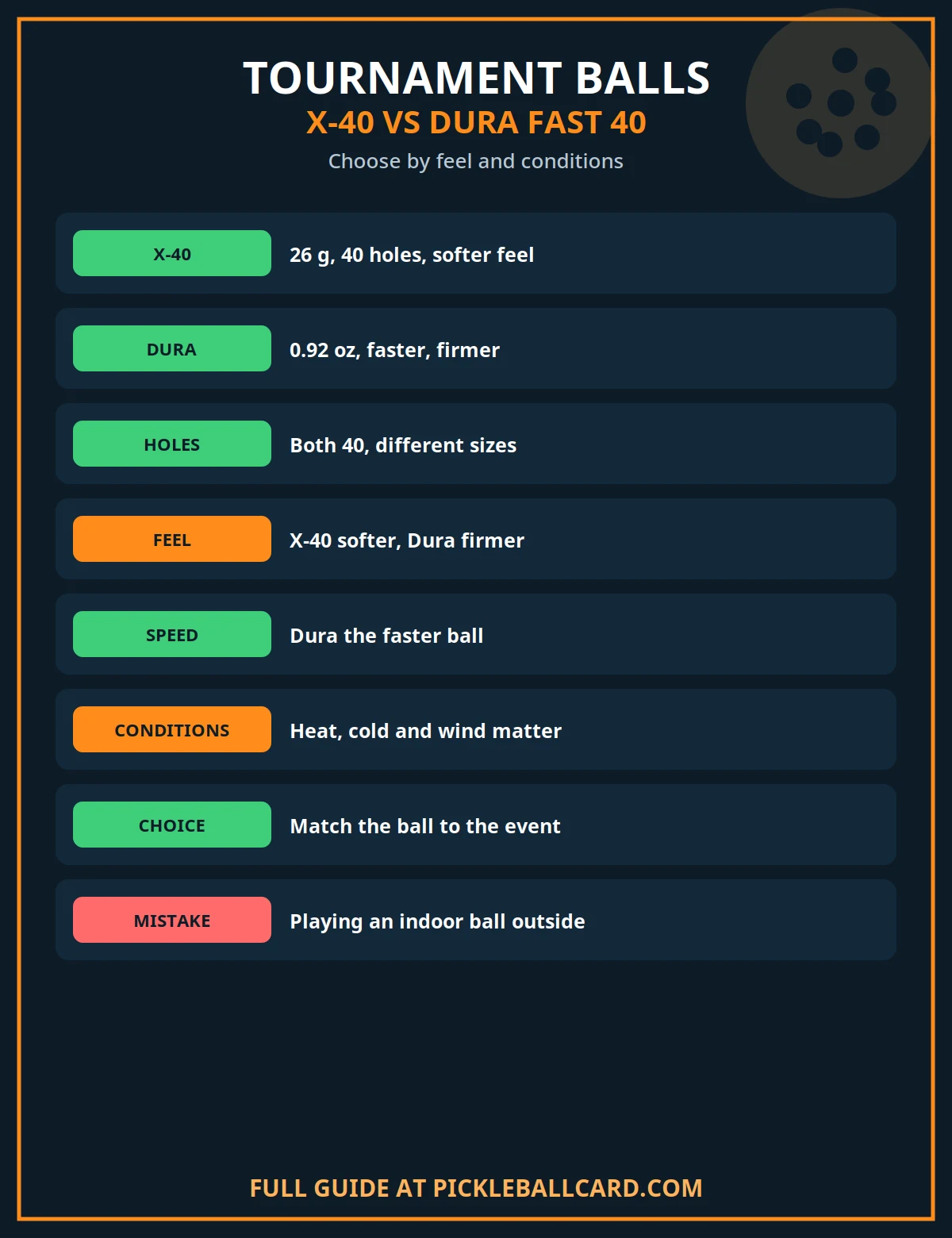
The closest numbers hide the biggest difference. Weight and diameter are nearly identical, yet the balls play differently because hardness and hole design shape speed, spin, and bounce.
Neither definition is better in isolation. The right ball depends on court speed, weather, and the level of play in the draw.
How Conditions Change the Choice
Outdoor tournaments are not played in a laboratory. Heat softens plastic, cold hardens it, wind tests hole design, and court texture changes bounce and wear.
Both balls respond to these forces, but not equally. The harder Dura shows its character most in extremes, while the X-40 stays steadier across a wider range.
Heat
Warm weather softens both balls slightly, which can slow the game a touch and raise bounce. The Dura keeps more of its pace in heat because its harder compound starts firmer.
The X-40 also plays well in warmth, with its balanced flight holding up on hot, still days. Players often report longer, steadier rallies in summer conditions.
In extreme heat, check balls more often. Softened plastic dents more easily, and a dented ball should leave play at once.
Cold
Cold is the condition that separates the two balls most clearly. Hard plastic becomes more brittle as temperatures fall, and the harder Dura is more vulnerable to cracking.
Players in cold-weather events often switch to the X-40 or carry extra Duras. A cracked ball can fail mid-rally, so inspect each ball before a match.
Store balls at room temperature when possible and warm them in a pocket or bag between matches. A cold ball straight from a car boot is more likely to crack on first impact.
When temperatures drop near freezing, rotate fresh balls in sooner. The small cost of an extra ball is cheaper than a disputed point.
Wind
Wind tests hole design directly. The Dura’s two-size pattern is designed to hold a truer line in a breeze, which is one reason advanced players trust it outdoors.
The X-40 also handles wind well for a ball of its pace. Its even 40-hole pattern keeps flight steady in light to moderate wind.
In strong, gusty wind, neither ball can fully defeat the weather. Shorter, lower shots and a steadier ball choice help more than any hole pattern.
Court Surface
Hard outdoor surfaces such as concrete and asphalt wear balls faster than smooth indoor courts. Both balls are built for this, but wear shows differently.
The X-40’s balanced compound copes well with rough textures, holding its shape through long club sessions and multi-day events.
The Dura’s harder shell resists scuffing in warm play, yet on very rough courts it can show stress marks sooner. Check seams and holes after each match.
On smoother outdoor courts, speed differences stand out more. The Dura feels quickest on a clean, fast surface, while the X-40 rewards placement over pace.
Which Ball Suits Which Player or Event?
Start with your level. Beginners and developing competitors usually benefit from the X-40’s steadier flight and more forgiving bounce.
Intermediate players who drive and volley with confidence can play either ball well. Try both in practice and notice which one keeps your rallies longest.
Advanced players chasing maximum pace and the sharpest test will prefer the Dura, especially on fast courts in warm weather.
Club organisers face a different question. One ball must serve many levels, often across several courts and a full day of play.
For mixed-level club events, the X-40 is the safer default. Its forgiveness keeps games enjoyable for weaker players without boring stronger ones.
For elite draws, the Dura is the expected choice. Top players train with it, and its speed matches the standard of high-level competition.
That is one reason tournament directors check format as well as ball. A round-robin social event and a single-elimination championship place different demands on equipment, and our guide to pickleball tournament formats explains how each structure shapes match length and scheduling.
Weather should break any tie. In cold conditions, lean toward the X-40 or carry plenty of spares. In warm, still conditions, the Dura’s speed advantage grows.
Above all, match the ball to the event you actually entered. Practising with one ball and competing with another is the easiest avoidable handicap in tournament play.
Care and Replacement
Outdoor balls wear out, and a worn ball changes a match. Inspect each ball before play by rolling it on a flat surface and checking for wobble, dents, or cracks.
Replace any ball that wobbles, has a visible crack, or has lost its round shape. A damaged ball bounces unevenly and can fail during a rally.
Store balls out of direct sunlight and away from extreme heat or cold. A bag kept indoors lasts longer than a box left in a car boot through summer or winter.
Carry spares to every event. Two or three extra balls cover cracks, losses, and the fresh-ball rotation that cold or rough courts demand.
For club play, rotate balls regularly rather than using one ball until it fails. A fresher ball keeps games fair and reduces arguments about bounce.
For tournaments, buy the exact ball named in the event announcement and practise with it in advance. Familiarity with its speed and bounce is worth more than any last-minute equipment change.
Frequently Asked Questions
Are the Franklin X-40 and Onix Dura Fast 40 both approved for tournament play?
Yes. Both balls are USA Pickleball approved for outdoor tournament play, and both appear on the approved ball list for sanctioned events.
Approval alone does not decide which ball an event uses. Always check the tournament announcement, because organisers name one ball for the whole draw.
Which ball is faster, the X-40 or the Dura Fast 40?
The Dura Fast 40 is the faster ball. Its harder compound and two-size hole pattern produce a crisper, livelier flight off the paddle.
The X-40 is moderate to fast rather than slow. It still moves well outdoors, but it trades a little pace for control and forgiveness.
Why do both balls have 40 holes?
Forty small holes is the standard outdoor pattern. Small holes reduce wind drag and help the ball hold its line outdoors, compared with the larger holes of an indoor ball.
The two balls differ in hole design rather than count. The X-40 uses 40 evenly drilled holes, while the Dura mixes large and small holes in a patented pattern.
Which ball lasts longer outdoors?
On hard outdoor surfaces in warm conditions, both balls last well, with the X-40 showing steady durability across mixed-level play.
In cold conditions, the Dura is more crack-prone because its harder plastic becomes more brittle. Carry spares and inspect hard balls often in winter events.
Can beginners use the Dura Fast 40?
Beginners can use the Dura, but it is less forgiving than the X-40. Mishits lose pace quickly, and the lively bounce can shorten rallies for newer players.
Most beginners progress faster with the X-40 first. Once timing and contact improve, the Dura becomes a fair test rather than a punishment.
Should I practise with the ball my tournament will use?
Yes. Speed, bounce, and feel differ enough between the two balls to change timing, especially on drives, volleys, and third-shot drops.
Book several practice sessions with the event ball. If you cannot find it locally, order early and use it for at least your final week of preparation.

Shoaib is the publisher of Pickleball Card. He oversees the site’s guides to pickleball rules, ratings, strategy and gear, all researched from primary sources — the USA Pickleball Rulebook, DUPR and manufacturer documentation — and updated as the game changes.