What to Wear to Play Pickleball: Shoes, Clothes, and Court Essentials
Pickleball looks casual from the sidelines, but the right outfit changes how you move and how long you last. Short rallies turn into long sessions quickly, and the wrong shoes or heavy clothing can slow you down before the first game ends.
Whether you play indoors on a gym floor or outdoors under a hot sun, the principles stay the same. Choose stable footwear, breathable layers you can adjust, and gear that stays out of your way while you swing, shuffle, and sprint.
Key Takeaways
- Court shoes are the most important item, because pickleball demands fast sideways stops that running shoes are not built to support.
- Wear light, moisture-wicking tops and bottoms that let you lunge, bend, and reach without pulling or riding up.
- Choose non-marking soles, and avoid clothing in the same colour as the ball so opponents can track it clearly.
- Add a hat, sunglasses, and sunscreen outdoors, and layer up with a zip jacket for cold or early-morning sessions.
- Pack a spare shirt, dry socks, water, and a towel, because even a short session can leave you soaked.
Start With Your Shoes
Footwear deserves your attention before anything else in your bag. Pickleball involves constant split steps, sideways shuffles, sudden stops, and quick pivots near the kitchen line. Your shoes must support all of that without letting your foot slide or roll.
Court Shoes Versus Running Shoes
Running shoes are designed mainly for forward motion in a straight line. They cushion each stride and use soft, flexible uppers that bend easily. That design works well on a road, but it offers little support when you cut sideways.
Court shoes take a different approach to stability. They use a wider, flatter base, a lower profile, and reinforced sidewalls that hold your foot inside the shoe during lateral moves. This helps prevent the foot rolling over the edge during a hard stop.
Outsoles matter just as much as the upper. Court shoes use rubber outsoles with tread made for grip on hard courts and gym floors. Many also use a rounded edge that helps you pivot smoothly instead of catching on the surface.
Running shoes also tend to sit higher off the ground than court shoes. A higher platform feels comfortable while walking, but it can feel unstable during a fast sideways lunge. A lower court shoe keeps you closer to the surface.
None of this means you must buy the most expensive court shoe available. It means you should choose a shoe built for court movement rather than forward running. Tennis shoes for hard courts can also work well, because they share the same lateral-support design.
How Court Shoes Should Fit
Fit matters as much as the shoe category you choose. A court shoe should feel snug around the midfoot, with your heel locked in place and toes free to spread slightly. Your foot should not slide forward when you stop suddenly.
Leave about a thumb-width between your longest toe and the front of the shoe. Too little room causes bruised toes during hard stops, while too much room lets your foot slide. Try shoes on with the socks you plan to wear.
Lace your shoes firmly but not so tightly that they cut off circulation. If the laces loosen during play, stop and retie them between points or games. Loose laces increase the risk of tripping and reduce the support the shoe is designed to provide.
Players with wider feet should look for wide-width options rather than sizing up in length. A longer shoe that is too narrow still squeezes the midfoot, while a wide fit gives support without forcing your toes into a cramped space.
Indoor Shoes, Outdoor Shoes, And When To Replace Them
Indoor and outdoor courts place different demands on your shoes, so it helps to match the outsole to the surface. Indoor gym floors need clean, non-marking soles that grip without scuffing. Outdoor concrete and asphalt wear rubber down faster and reward tougher outsoles.
Some players keep two pairs: one clean indoor pair that never goes outside, and one outdoor pair for hard courts. This approach protects gym floors, keeps indoor grip predictable, and extends the life of both pairs. It is a practical choice, not a requirement.
If you play mostly outdoors, check the outsole regularly for smooth, worn patches, especially under the forefoot. Once the tread flattens, grip drops sharply, and quick stops can turn into slides. Replace the shoes before a worn sole affects your movement.
For regular players, court shoes often last several months, but the exact lifespan depends on frequency, surface, body weight, and playing style. Outdoor play shortens life more than indoor play, and aggressive movers wear shoes out faster than steady players.
For a deeper look at models, cushioning, and fit, see our guide to the best pickleball shoes before you buy your next pair.
What The Rules Say About Apparel And Footwear
Pickleball has only a short set of apparel rules, but they are worth knowing before you step on court. They focus on safety, fairness, and respect for the playing surface, rather than on fashion or brand choices.
Under USA Pickleball rules, a player may be asked to change apparel that is inappropriate, including clothing that approximates the colour of the ball. This rule helps opponents see the ball clearly during fast exchanges at the net.
The same rules require graphics, insignias, pictures, and writing on apparel to be in good taste. Tournament directors can enforce apparel changes, and refusing to comply can lead to a forfeit, so tournament players should choose neutral, respectful clothing.
Footwear has one clear rule: shoes must have soles that do not mark or damage the court surface. This protects gym floors and outdoor courts alike, and it is why non-marking soles matter even in casual open play.
You can read the full wording in the USA Pickleball Official Rulebook, Section 2.
Tops: Breathable, Light, And Easy To Move In
Your top should move with you, not against you, during every swing and reach. Look for lightweight, moisture-wicking fabric that pulls sweat away from your skin and dries quickly between games. Cotton feels comfortable at first, but it holds sweat and grows heavy.
Short-sleeve athletic shirts suit most players in warm conditions, while sleeveless tops work well for players who overheat quickly. Choose a fit that stays in place when you raise your arms to serve or smash, without riding up or restricting your shoulders.
Some players prefer a collared polo for a tidier look, especially at clubs with a dress code. A polo works well as long as the fabric breathes and the collar does not flop into your line of sight.
Avoid tops with loose sleeves, dangling drawstrings, or bulky pockets near the waist. Loose fabric can catch a paddle handle, distract you during a swing, or brush the ball during a close net exchange.
Bottoms: Shorts, Skorts, And Leggings That Stay Put
Bottoms matter because pickleball asks your legs to bend, lunge, split, and shuffle constantly. Shorts should offer enough stretch to let you drop low for a dink without pulling tight across the hips or thighs.
Athletic shorts with a comfortable waistband and a 5- to 7-inch inseam suit most players. Shorter shorts give more freedom, while longer shorts give more coverage, so choose the length that lets you move without thinking about it.
Skorts combine a skirt look with the coverage of shorts underneath, and they remain popular for good reason. They move freely, stay in place, and offer the same practical benefits as shorts during fast lateral movement.
Avoid jeans, cargo shorts, heavy work trousers, and any bottom with metal buttons, rivets, or stiff fabric. These items restrict movement, trap heat, and can damage court surfaces or scratch other players during close play.
Socks: Small Item, Big Difference
Socks rarely get attention until they cause a problem, but the right pair prevents blisters and keeps feet comfortable. Choose cushioned athletic socks that wick moisture, fit snugly, and do not bunch inside your shoe during play.
Crew-length socks protect the ankle from shoe rub, while quarter-length socks suit players who prefer less coverage. Either length works, provided the sock stays in place and does not slide down into the shoe.
Avoid thin dress socks, which offer no cushioning, and thick hiking socks, which can make a well-fitted shoe feel tight. Moisture-wicking blends with a reinforced heel and toe last longer and handle repeated washing better.
Hats, Visors, And Sunglasses
Outdoor pickleball adds sun, glare, and wind to the challenge, and headwear helps with all three. A cap or visor shades your eyes, keeps sweat out of your face, and improves your ability to track high balls against a bright sky.
Caps offer more coverage for the scalp and ears, while visors allow more airflow and suit players who overheat easily. Choose whichever feels stable during movement, and avoid hats with a loose fit that might fly off during a sprint.
Sunglasses protect your eyes from glare and from stray balls, especially during fast net exchanges. Choose sport sunglasses with a secure, wraparound fit that stays in place when you move, bend, and look up quickly.
Lenses that block UVA and UVB rays are the standard to look for, and a tint that suits bright conditions helps you read the ball better. Polarised lenses reduce glare from light-coloured courts, but make sure they do not distort depth perception for you.
The CDC recommends a wide-brimmed hat, sunglasses that block UVA and UVB rays, and broad-spectrum sunscreen for outdoor activity, with reapplication after sweating. You can review its guidance in the CDC sun safety advice before planning an outdoor session.
Gloves, Sweatbands, And Grip Extras
Gloves divide opinion among pickleball players, but they solve real problems for some hands. A thin racquet or pickleball glove can improve grip when sweat makes the handle slippery, and it can reduce blisters during long sessions.
Choose a glove that fits snugly without bunching at the palm or fingers. A loose glove reduces feel for the paddle and can slip during a swing, while a tight glove restricts blood flow and becomes uncomfortable quickly.
Many players skip gloves entirely and use a wristband instead. A terry wristband absorbs sweat before it reaches your hand, keeps your grip drier, and costs very little. Carry two if you sweat heavily during summer play.
A headband serves a similar purpose for players who sweat from the forehead. It keeps sweat out of your eyes, works under a cap, and suits players who find visors uncomfortable. Choose a soft, stretchy band that stays in place.
Keep accessories simple and secure, and test them in practice before a match. Anything that needs constant adjustment during rallies will distract you and break your rhythm at the worst moment.
Hot-Weather Outfits
Hot weather calls for the lightest outfit you can wear comfortably. Choose light colours, which reflect heat better than dark colours, and favour mesh panels or vented fabrics that let air flow across your back and sides.
A light performance shirt, breathable shorts, and a visor form a strong hot-weather base. Add sunscreen to exposed skin before you start, and reapply during breaks, because sweat and towelling remove sunscreen faster than most players expect.
Avoid heavy cotton, dark colours, and extra layers on hot days. Each adds heat without improving your game, and overheating affects focus, footwork, and reaction time long before it feels dangerous.
Cold-Weather Layers
Cold weather requires layers you can add and remove as your body warms up. Start with a moisture-wicking base layer, add a light long-sleeve top, and finish with a zip jacket you can remove after the warm-up.
A zip jacket works better than a pullover, because you can open it gradually or take it off quickly between games. Choose a jacket with stretchy fabric and a fit that does not restrict your arm swing or shoulder rotation.
For legs, leggings under shorts or warm-up pants over shorts both work well. Warm-up pants should taper at the ankle so they do not catch on your shoes, and they should come off easily when you warm up.
Gloves for warmth need a different design from grip gloves, so choose thin, flexible gloves that still let you feel the paddle. Bulky winter gloves reduce control and make it harder to adjust your grip during play.
A light beanie or ear band helps on cold, windy mornings, but make sure it stays secure and does not slip over your eyes. Once you warm up, you can remove it and store it in your bag.
Indoor Versus Outdoor: What Changes
The core outfit stays the same indoors and outdoors, but a few details change with the venue. Indoor play removes sun and wind, while outdoor play adds weather, glare, and surface variation that your clothing must handle.
| Setting | Footwear | Clothing | Extras |
|---|---|---|---|
| Indoor Gym | Clean, non-marking court shoes | Light shirt and shorts | Water bottle and towel |
| Outdoor, Hot And Sunny | Durable outdoor court shoes | Light colours and vented fabric | Cap, sunglasses, sunscreen |
| Outdoor, Cool Or Windy | Outdoor court shoes | Base layer plus zip jacket | Warm-up pants, ear band |
| Outdoor, Humid | Breathable court shoes | Moisture-wicking shirt and shorts | Spare shirt, spare socks, towel |
| Tournament Play | Broken-in court shoes | Rule-compliant, neutral colours | Spare outfit and grip tape |
What To Avoid On Court
Some clothing choices look fine off court but cause problems during play. Running shoes top the list, because they lack lateral support and raise the risk of ankle rolls during sideways movement.
Open-toe shoes, sandals, and flat fashion sneakers should never be worn for pickleball. They offer no support, no grip, and no protection if a ball or another player steps on your foot.
Heavy denim, stiff fabrics, and clothing with metal hardware restrict movement and can damage courts. They also trap heat, which makes long sessions uncomfortable and tiring.
Clothing in the same colour as the ball can confuse opponents and may breach official apparel rules. Avoid bright yellow or neon green outfits when playing with a matching ball, especially in tournaments.
Loose jewellery, dangling bracelets, and long necklaces create a safety risk during play. They can catch on clothing, scratch other players, or fly off during a swing, so leave them in your bag.
Your Pickleball Packing Checklist
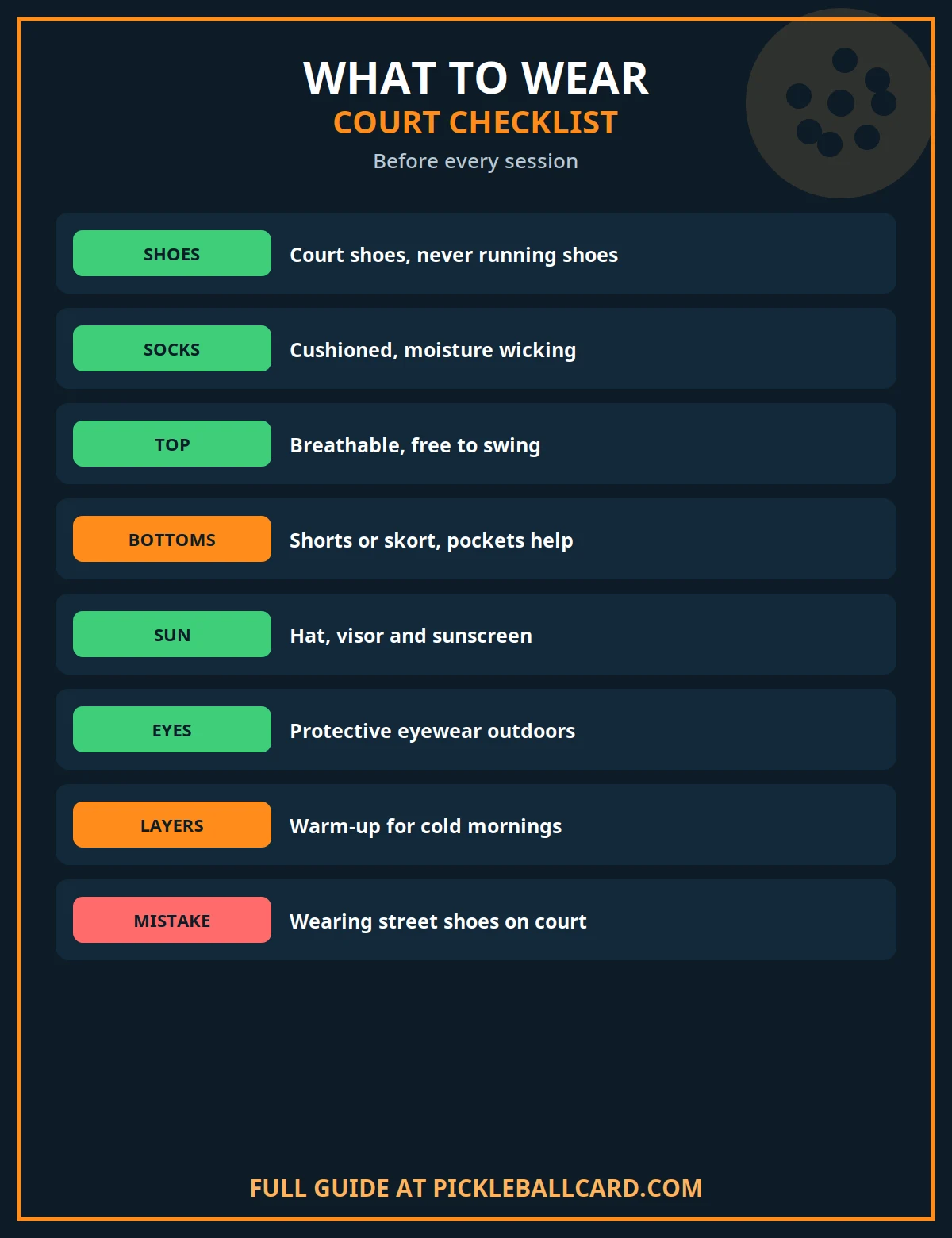
Use this checklist the night before a session, so you never arrive missing a key item. Tick off each piece as you pack it, and keep spares ready for hot or tournament days.
- Court shoes with non-marking soles, broken in and clean
- Moisture-wicking shirt, plus a spare shirt for long sessions
- Athletic shorts, skort, or leggings that allow full movement
- Cushioned athletic socks, plus a spare pair
- Cap or visor for outdoor play
- Sport sunglasses or protective eyewear
- Sunscreen and a water bottle for outdoor sessions
- Wristband or headband if you sweat heavily
- Towel, spare overgrip, and a zip jacket for cool weather
- Paddle, balls, and a bag that keeps shoes separate
If you are new to the game, our beginner guide explains the basic rules and scoring alongside your outfit choices. Read how to play pickleball before your first organised session, so you arrive confident on and off court.
Court manners matter as much as clothing, especially in open play where you rotate partners often. Learn the shared expectations in our guide to pickleball etiquette and unwritten rules to fit in quickly at any venue.
Frequently Asked Questions
Can You Play Pickleball In Running Shoes?
You can play a casual game in running shoes, but it is not a good long-term choice. Running shoes favour forward motion and lack the lateral support pickleball demands, which increases the risk of ankle rolls during sideways stops.
Do You Need Special Pickleball Shoes?
Pickleball-specific shoes are ideal, but any hard-court tennis shoe with lateral support and a non-marking sole works well. The key features are stability, grip, and a low profile, not the label on the box.
What Should Beginners Wear For Their First Game?
Beginners should wear comfortable athletic clothes, cushioned socks, and court shoes if they own them. If court shoes are not available yet, wear the most stable athletic shoes you own and upgrade after a few sessions.
Can You Wear Jeans Or Regular Shorts To Play?
Jeans restrict movement and trap heat, so they are a poor choice for pickleball. Regular athletic shorts work fine, provided they stretch, stay in place, and do not have bulky pockets or stiff fabric.
What Should You Wear For Outdoor Pickleball In Summer?
Wear light colours, moisture-wicking fabric, a cap or visor, and sunglasses, and apply broad-spectrum sunscreen before play. Bring water, a towel, and a spare shirt, and reapply sunscreen during breaks.
Are Hats And Sunglasses Allowed In Tournaments?
Hats and sunglasses are generally allowed, provided they comply with apparel rules on colour and good taste. Avoid headwear or clothing that matches the ball colour or distracts opponents during play.
Final Thoughts
The best pickleball outfit is the one you forget about once play starts. Stable court shoes, breathable clothing, and a few well-chosen accessories let you focus on the ball, your partner, and the next shot.

Shoaib is the publisher of Pickleball Card. He oversees the site’s guides to pickleball rules, ratings, strategy and gear, all researched from primary sources — the USA Pickleball Rulebook, DUPR and manufacturer documentation — and updated as the game changes.