Pickleball is a loud game. The sharp pop of a hard plastic ball on a stiff paddle can carry across a park, a driveway, and a quiet street.
That sound is part of the fun on a busy court. It becomes a problem when courts sit close to homes, offices, or shared community spaces.
Key Takeaways
- A quieter paddle usually combines a thicker core, a softer face, and damping material around the edge.
- Core thickness alone does not guarantee quiet play. Material, construction, and ball choice matter too.
- USA Pickleball runs a Quiet Category for recreational equipment. It is separate from tournament approval.
- Certified quiet paddles are not silent. They change a sharp pop into a softer, lower thump.
- Balls, court surfaces, barriers, and playing hours can matter as much as the paddle itself.
- Always check the rules for your own court or community before you buy new equipment.
- Test a paddle in real play when possible. A short demo tells you more than a product label.
Why Pickleball Sounds So Loud
A pickleball is hard and hollow. When it hits a stiff paddle face, the impact is short, sharp, and high pitched.
That high pitch is the core problem. High sounds travel well and feel intrusive, even when the total volume is not extreme.
Outdoor courts make the issue worse. Hard surfaces reflect sound, fences bounce it back, and open air carries it toward nearby homes.
Indoor courts have a different problem. Walls and hard floors can trap sound, so a game can feel loud even in a large hall.
Four courts playing at once multiply the effect. Players hear a constant stream of pops, calls, and laughter rather than one isolated hit.
What Makes A Paddle Quieter
No single feature makes a paddle quiet. Sound comes from the whole system: core, face, edge, handle, ball, and swing.
Manufacturers reduce sound by slowing the impact slightly, spreading the force, and damping vibration before it reaches the air.
Core Thickness
Thicker cores are a common starting point for quiet paddles. Many quiet designs use cores of 16 millimetres or more.
A thicker core gives the ball a fraction more time in contact with the paddle. That longer contact tends to soften the impact sound.
Thin cores are often faster and crisper. That crisp feel is popular with power players, but it usually produces a sharper sound.
Thickness is not a magic number, though. Two 16 millimetre paddles can sound very different if their cores use different materials.
Core Material
Polymer honeycomb is the most common core in modern paddles. It is lighter and softer sounding than older Nomex cores.
Nomex cores are known for power and a loud, high pitched pop. They are a poor choice for a noise sensitive court.
Some quiet paddles add foam inside or around the core. Foam absorbs energy and reduces the sharp vibration that creates sound.
Hybrid cores combine honeycomb with foam or other damping layers. The goal is control and touch without a harsh impact tone.
Face Material
The face is the skin of the paddle. It meets the ball first, so it shapes the sound as well as spin and control.
Stiff, thin faces tend to sound sharper. Softer or more cushioned faces tend to sound rounder and less piercing.
Carbon fibre faces are common on high performance paddles. Their sound depends heavily on the core and construction underneath them.
Fibreglass faces can feel more flexible and forgiving. That flexibility can soften sound, but it does not guarantee a quiet paddle.
For a closer look at how face materials change feel and performance, see our guide to raw carbon fiber paddles.
Foam And Perimeter Damping
Foam is one of the clearest quiet design ideas. It sits where vibration would otherwise travel freely through the paddle.
Diadem describes its Hush paddle as using an eTPU foam face and a two piece moulded design to reduce impact noise. The company says USA Pickleball testing found a 40 percent reduction in noise compared with the industry standard paddle.
That figure comes from Diadem, not from an independent test you can repeat at home. Treat it as a manufacturer claim tied to a specific test.
Perimeter damping works in a similar way. Foam, rubber, or composite material around the edge can absorb vibration near the rim.
A well sealed edge also helps. Loose edge guards can rattle, and a rattling paddle sounds louder than its core alone would suggest.
Learn more from the manufacturer description of the Diadem Hush paddle and its foam construction.
Edge Guard And Handle
A thick, well fitted edge guard can dampen edge hits. It also protects the paddle when it clips the ground or a fence post.
Handle construction matters less than core and face, but it still plays a role. A cushioned grip can reduce vibration felt in the hand.
Gel inserts and foam wraps are sometimes used for comfort. They may slightly soften sound, but they will not turn a loud paddle quiet.
Check for loose parts before blaming the paddle design. A worn grip, cracked edge guard, or loose butt cap can add unwanted noise.
Quiet Versus Standard Paddles At A Glance
The table below summarises typical differences. Individual models vary, so use it as a guide rather than a guarantee.
| Feature | Quiet Design | Standard Design |
|---|---|---|
| Core thickness | Often 16 millimetres or more | Often 13 to 16 millimetres |
| Core material | Polymer honeycomb, foam, or hybrid | Polymer, Nomex, or aluminium |
| Face | Softer or cushioned surface | Stiff carbon or fibreglass |
| Impact sound | Softer, lower thump | Sharper, higher pop |
| Edge treatment | Foam or damped perimeter | Standard edge guard |
| Playing feel | More control, softer touch | More power, crisper feel |
| Best use | Noise sensitive courts | General and competitive play |
How Much Quieter Is Realistic
A quiet paddle will not make pickleball silent. It changes the character of the sound, and often lowers its volume as well.
That change matters to neighbours. A lower, softer thump is usually less annoying than a sharp, high pitched crack.
Outside certified testing, there is no single standard test for everyday paddle noise. Marketing percentages are therefore hard to compare directly.
One maker may test against its own standard paddle. Another may use a different ball, swing speed, or measuring distance.
Always ask what a percentage is compared with. If the comparison is unclear, treat the number as a rough guide only.
Your own court will also change the result. The same paddle can sound different indoors, outdoors, near a wall, or in open space.
A realistic expectation is a noticeable reduction in sharpness, not silence. If a claim promises total silence, be sceptical.
What Is The USA Pickleball Quiet Category
USA Pickleball created a Quiet Category for recreational pickleball equipment. It recognises products designed to reduce sound during play.
The category covers more than paddles. It can also include balls, covers, and court noise mitigation products.
USA Pickleball announced its first certified Quiet Category product, the OWL paddle by OWL Sport, as a recreational paddle. The announcement states that the paddle was proven to reduce noise by 50 percent and met the Quiet Category criteria.
The same announcement describes the OWL as delivering sound below 80 decibels and below 600 hertz. For comparison, it places industry standard paddles at 1,100 to 1,200 hertz and 85 decibels or more.
Those thresholds are useful because they cover both volume and pitch. A lower pitch is often less intrusive, even at a similar volume.
Quiet Category certification is not the same as tournament approval. A paddle can be quiet certified without being approved for sanctioned tournament play.
Check both lists separately if you play tournaments. Look for the exact model, thickness, and colour where the list gives that detail.
Read the original announcement from USA Pickleball about its first certified Quiet Category product.
How To Choose A Quiet Paddle
Start with your court, not the catalogue. A paddle for a backyard court near neighbours has different priorities from a tournament paddle.
Next, check whether your club or community already has an approved list. Some venues only allow certain paddles or balls.
Then shortlist paddles with thicker cores and damping features. Look for foam, perimeter damping, or Quiet Category certification.
Balance weight with quiet design. A paddle that feels heavy or slow will hurt your game, even if it sounds better.
Our guide to how to choose a pickleball paddle can help you compare weight, core and face options before you narrow your shortlist.
Try the paddle with your usual ball if possible. A paddle tested with a soft indoor ball may sound different with a hard outdoor ball.
Listen from the sideline too. Stand where neighbours or other players would stand, and ask a partner to hit a few rallies.
Finally, check the return policy. Quiet is partly personal, so a short trial period is more valuable than a long product description.
Quiet Paddle Buying Checklist
Use this checklist before you spend money on a quiet paddle.
- Confirm your court, club, or community allows the model you plan to buy.
- Check Quiet Category status separately from tournament approval.
- Choose a thicker core, ideally 16 millimetres or more, when quiet play is the priority.
- Look for foam, hybrid, or perimeter damping in the core or edge.
- Avoid Nomex cores when noise is a known problem.
- Match the paddle to your usual ball type, indoor or outdoor.
- Test weight, grip size, and balance, not just sound.
- Listen from off court, not only from behind the paddle.
- Check edge guard fit and grip condition before your first game.
- Keep the receipt and return details until you have played a full session.
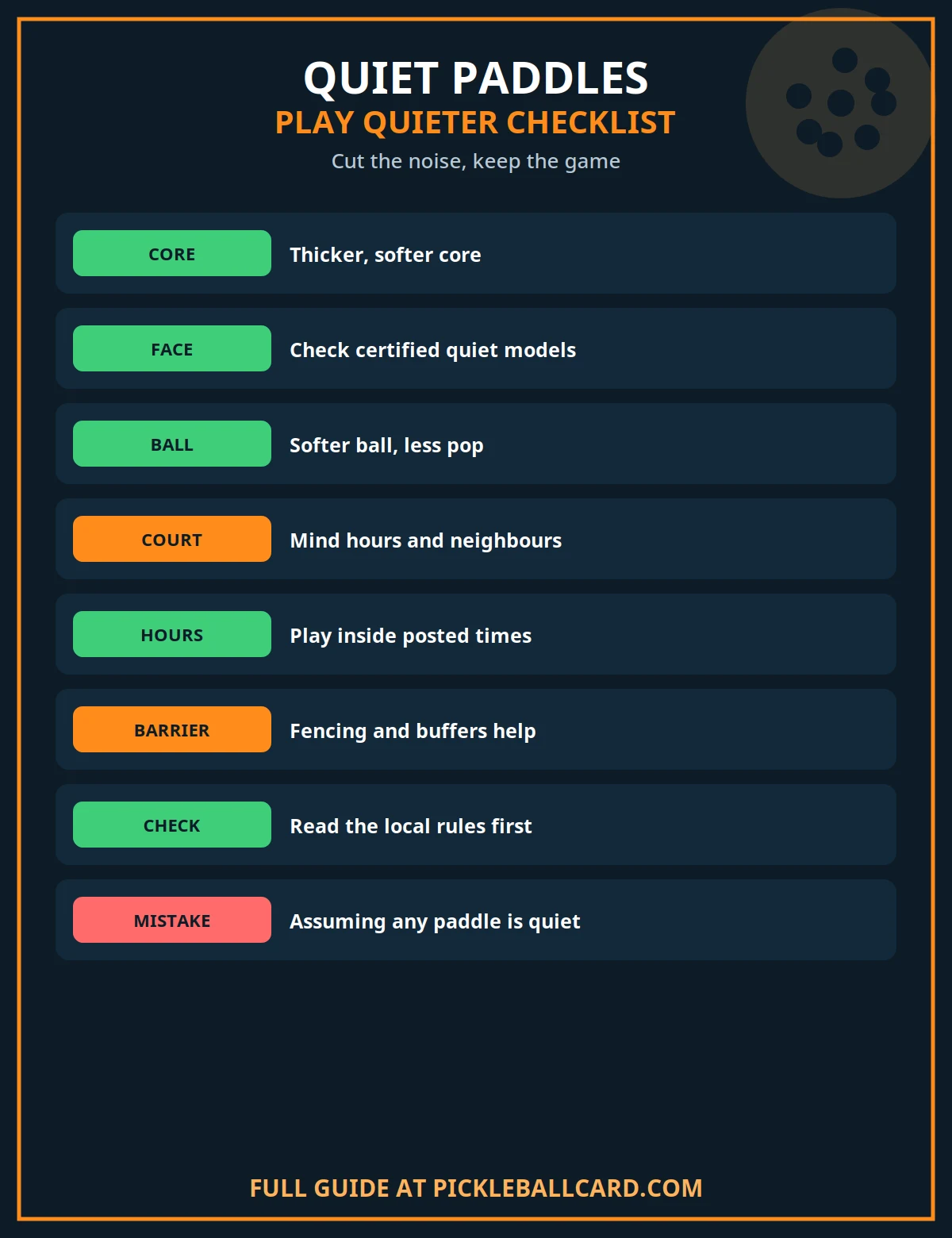
The Ball Matters Too
The ball is half the sound equation. A hard outdoor ball with large holes can sound louder than a softer indoor ball.
Foam balls are much quieter, but they play very differently. They are best for practice, coaching, or very noise sensitive settings.
Do not mix ball types without agreement. Players expect a consistent bounce, and a sudden switch can spoil a game.
If your group agrees to try a quieter ball, test it for a full session. Check bounce, speed, wind behaviour, and durability before adopting it.
Ball wear also affects sound. Cracked or dented balls can sound odd and play unevenly, so replace them promptly.
Noise Reduction Beyond The Paddle
A quiet paddle helps, but it is only one lever. Courts, scheduling, and behaviour can reduce noise further.
Court Placement And Surfaces
Distance is the simplest noise control. Courts placed farther from homes and bedrooms will cause fewer complaints.
Orientation can help as well. Avoid pointing the loudest side of play directly at nearby windows where possible.
Hard concrete reflects sound. Softer court coatings and surrounding grass or planting can absorb some of it.
For home courts, planning matters before construction. See our guide to building a backyard pickleball court for layout and surface basics.
Sound Barriers And Screens
Fences, walls, and acoustic screens can block or absorb sound. Their effect depends on height, material, and gaps.
A low fence with large gaps will do little. A taller, solid barrier close to the court is usually more effective.
Planting alone is a weak barrier. Dense hedges can help slightly, but they are not a substitute for a solid screen.
Ask a local supplier or acoustic adviser for options suited to your site. A barrier that blocks wind or light may create new problems.
Scheduling And Court Hours
Playing hours are often the easiest compromise. Early morning and late evening games cause the most friction with neighbours.
Agree clear start and finish times with your club or community. Publish them where players and neighbours can both see them.
Limit the number of courts in use during sensitive hours. Fewer simultaneous games mean less overlapping sound.
Rotate noisy sessions away from quiet hours when possible. Social play can often move more easily than league matches.
Player Behaviour And Etiquette
Hard smashes and loud paddle taps add unnecessary sound. Save full power for matches where it matters, not warm ups.
Avoid banging paddles together or on fences to celebrate. It sounds louder off court than it feels on court.
Keep shouting and music to a reasonable level. Voices carry, especially in the early morning or evening.
Introduce yourself to neighbours before complaints arise. A friendly conversation often prevents a formal dispute later.
Community And HOA Noise Rules
Community rules vary widely. Some courts have written paddle and ball lists, while others rely on general quiet hours.
Homeowners associations may set court hours, approved equipment, or conditions for new courts. Always read the current rules for your community.
Local councils may also have noise rules. These often depend on time of day, location, and whether the noise is recurring.
Do not assume a national decibel limit applies to your court. This guide does not state a specific law or limit, because rules differ by place.
If you receive a complaint, ask for the exact rule in writing. A clear rule is easier to follow than a general request to be quieter.
Keep a simple record of what you changed. Note the paddle, ball, hours, and any barriers you added, plus the date.
If a dispute continues, use the community process first. Mediation or a club committee decision is usually faster than a legal route.
Trade Offs Of Quiet Paddles
Quiet paddles often favour control over power. Softer faces and thicker cores can reduce the crisp pop some players love.
Some quiet models are heavier or have a different balance. That can affect swing speed, especially on fast volleys.
Foam faces may wear differently from standard faces. Check care instructions and expected lifespan before buying.
Price can also be higher. Special materials and certification add cost, so compare quiet models with your current paddle fairly.
None of these trade offs makes a quiet paddle a bad choice. They simply mean you should test feel as well as sound.
Common Mistakes To Avoid
Do not buy a paddle only because it uses the word quiet. Check its core, face, certification, and real world reviews.
Do not assume a quiet paddle solves a court problem alone. Balls, barriers, and hours may still need attention.
Do not ignore tournament rules. A recreational quiet paddle may not be legal for your next sanctioned event.
Do not add homemade damping that changes the paddle face. Alterations can break equipment rules and affect play.
Do not wait for a complaint to act. Small changes early are easier than major changes after trust has broken down.
Testing A Quiet Paddle Before You Buy
Borrow a paddle from a club member when possible. A short loan is the cheapest and most honest test available.
Play a normal rally, not just a few soft taps. Sound changes with swing speed, ball type, and shot selection.
Ask someone off court to listen. They will hear the game the way neighbours hear it, without the distraction of playing.
Compare two paddles back to back with the same ball. Change only one variable at a time for a fair test.
Note how the paddle feels on dinks, volleys, and serves. A quiet paddle should still let you play your normal game.
Frequently Asked Questions
Are quiet pickleball paddles really quieter?
Yes, in most cases, but the difference is a softer sound rather than silence. Certified quiet paddles aim to lower volume and pitch.
Uncertified paddles vary more. Their sound depends on core, face, ball, and court, so results are harder to predict.
What is the quietest type of pickleball paddle?
There is no single quietest type for every player. Thicker polymer or foam hybrid cores with cushioned faces are usually quieter.
Quiet Category certified paddles are a safer starting point than a paddle that only claims to be quiet.
Can I use a quiet paddle in a tournament?
It depends on the paddle and the event. Quiet Category certification and tournament approval are separate checks.
Verify the exact model on the approved paddle list before entering a sanctioned tournament.
Does a quieter ball help more than a quiet paddle?
Sometimes, yes, especially in practice or social play. A softer ball can reduce sound more than a paddle change alone.
For normal matches, most players prefer to keep standard balls and change the paddle, barriers, or hours instead.
Will a sound barrier fix pickleball noise on its own?
A good barrier helps, but it rarely solves noise alone. Height, material, gaps, and distance all affect the result.
Combine barriers with quieter equipment and sensible hours for the best overall reduction.
What should I do if neighbours complain about pickleball noise?
Listen first, then ask which rule or time is the problem. A specific complaint is easier to solve than a general one.
Try a quieter paddle or ball, agree clear hours, and keep neighbours updated on what you have changed.
Final Thoughts
Quiet pickleball is a shared project. Equipment, courts, schedules, and behaviour all work together to keep play enjoyable.
Start with a paddle that suits your game and your court. Then check the rules, test honestly, and adjust the rest.
When players and neighbours both feel heard, courts stay open longer. That outcome is worth more than any single paddle.

Shoaib is the publisher of Pickleball Card. He oversees the site’s guides to pickleball rules, ratings, strategy and gear, all researched from primary sources — the USA Pickleball Rulebook, DUPR and manufacturer documentation — and updated as the game changes.