Pickleball statistics get quoted everywhere, from news reports to court funding proposals. Yet not every number means the same thing, and some figures travel far from their original source.
This page gathers the most important pickleball numbers in one place. Every figure below carries its source and year, so you can check it, quote it, and trust it.
Where a number comes from a survey estimate, we say so plainly. Where it counts something narrower, such as registered courts in one database, we say that too.
The headline story is simple: participation has grown at a pace rarely seen in American recreational sport. The details, however, are more interesting than the headline alone.
Key Takeaways
- 24.3 million Americans played pickleball in 2025, according to the Sports and Fitness Industry Association (SFIA).
- That total is up 22.8 percent on 2024 and up 171.8 percent over three years, per SFIA.
- Casual players outnumber core players by more than two to one, but core players grew 20.4 percent in 2025.
- Women now account for 42.9 percent of players, up from 38.6 percent in 2020, according to SFIA.
- USA Pickleball listed 68,458 known courts at 15,910 locations in its 2024 Annual Growth Report.
- Always check the year, the definition, and the source before quoting any pickleball statistic.
The Headline Number: 24.3 Million Players
According to SFIA, 24.3 million Americans played pickleball in 2025. That figure comes from SFIA’s 2026 Topline Participation Report, which tracks more than 100 sports and fitness activities.
The total makes pickleball one of the most widely played sports in the United States. SFIA places it among the top 25 most-played sports and activities in the country.
Growth has not been a single-year spike. SFIA describes pickleball as the fastest-growing sport in the United States over the past three years, a title it has now held for five consecutive years.
About 4.5 million new players picked up the sport in 2025 alone, according to SFIA. That single-year intake is larger than the entire player base recorded just a few years earlier.
For context, roughly 4.2 million Americans played pickleball in 2020, per SFIA. The five-year increase from 2020 to 2025 stands at 479 percent.
These are survey estimates, not a headcount of every player. SFIA builds them from an annual survey of 18,000 respondents aged six and older, conducted with the Physical Activity Council.
That method matters for honest quoting. A survey estimate describes the national population, with the usual uncertainty that comes from sampling, rather than counting registered members.
How Participation Grew Year By Year
The year-by-year series shows why the growth story captured so much attention. Each step builds on a larger base, yet the percentage gains stayed unusually high.
Between 2020 and 2022, participation roughly doubled. Then it jumped again in 2023 and 2024, before adding another 4.5 million players in 2025.
Growth rates have cooled from their peak, which is normal for a maturing sport. A smaller percentage on a much larger base still means millions of additional players each year.
| Year | U.S. Players | Change From Prior Year | Source |
|---|---|---|---|
| 2019 | 3.46 million | Not stated here | SFIA participation series |
| 2020 | 4.2 million | About 21 percent | SFIA |
| 2021 | 4.82 million | About 15 percent | SFIA |
| 2022 | 8.95 million | About 86 percent | SFIA |
| 2023 | 13.58 million | About 52 percent | SFIA |
| 2024 | 19.81 million | 45.8 percent | SFIA, 2025 Topline Participation Report |
| 2025 | 24.3 million | 22.8 percent | SFIA, 2026 Topline Participation Report |
The three-year figures deserve special care when quoting them. SFIA reports 171.8 percent growth from 2022 to 2025, and 311 percent growth over the three years ending in 2024.
Those two figures cover different windows, so they are not contradictory. Always name the window alongside the percentage, or the number will mislead readers.
Mid-year snapshots need even more care. SFIA’s 2025 mid-year report estimated 22.7 million players, up 14.7 percent in the first half of 2025.
That mid-year figure was an early snapshot, not a final annual total. The full-year 2025 result later came in at 24.3 million, which shows why interim estimates should never be quoted as final.
Casual Players Versus Core Players
SFIA splits players into two groups, and the split tells a richer story than the headline total. Casual players play one to seven times per year, while core players play eight or more times per year.
In 2025, casual participation reached 16.8 million people, up 23.9 percent from 2024, according to SFIA. Core players numbered 7.48 million, up 20.4 percent from 2024.
Casual players therefore account for roughly seven in ten participants. They include first-timers, holiday players, and people who tried the sport through a friend or a community event.
Core players are the smaller group, but they drive much of the sport’s everyday life. They fill leagues, book courts regularly, enter tournaments, and buy equipment more often.
The fact that both groups grew by more than 20 percent in 2025 matters. It means the sport added newcomers and converted more of them into regular players at the same time.
A sport that only adds first-timers can fade quickly. A sport that also grows its core base builds the leagues, clubs, and court demand that keep it going.
When you read a participation figure, ask which group it covers. A total that mixes casual and core players answers a different question than a core-only figure.
Who Is Playing Pickleball Now
The player base no longer matches the retirement-sport stereotype that shaped early coverage. Participation now spans ages, regions, and experience levels across the country.
That broadening matters for facilities, coaches, and program organizers. A sport played by teenagers, working adults, and retirees needs different schedules, formats, and court capacity.
Age: Younger Players Lead Participation Rates
According to SFIA’s 2026 Pickleball Single Sport Report, ages 13 to 24 now post the highest participation rate of any age segment. The rate measures the share within an age group who play, not the raw headcount.
Young adults also form a large share of all players. SFIA reports that adults aged 25 to 34 make up 16.7 percent of players, the largest single age segment in its breakdown.
Older players remain a major part of the sport. SFIA notes particularly strong engagement among players aged 65 and older, alongside adults aged 25 to 44.
The average player age has fallen as younger players joined. SFIA puts the average player age at 34.8 years in its recent reporting, down from 38.1 years in 2021.
That shift does not mean older players left the sport. It means younger players joined faster, which pulled the average down while the total grew for every group.
Gender: Women Are A Growing Share
Women accounted for 42.9 percent of all pickleball players in 2025, up from 38.6 percent in 2020, according to SFIA. Men accounted for the remaining 57.1 percent.
SFIA’s summary page rounds the split to 57 percent male and 43 percent female. Both versions describe the same data, with the 42.9 percent figure offering greater precision.
The trend is steadier than a single year’s figure suggests. A gain of more than four percentage points over five years reflects sustained recruitment, not a one-off survey swing.
For clubs and leagues, the practical point is clear. Programming that welcomes mixed groups, women’s leagues, and family play now matches where the player base is heading.
If you want the wider story behind these shifts, read our guide to why pickleball became so popular and what keeps new players coming back.
Courts, Locations, And Infrastructure
Participation growth only works if people have somewhere to play. USA Pickleball’s court database tracks that side of the story, and its totals have climbed sharply.
USA Pickleball’s 2024 Annual Growth Report lists 68,458 known courts in its database. During 2024 alone, 18,455 new courts were added to that count.
The same report lists 15,910 locations, after 4,000 new locations were added in 2024. Locations include parks, clubs, schools, and other venues in the database.
USA Pickleball’s 2025 Annual Growth Report raises those totals further, to 82,613 known courts across 18,258 locations. That is an increase of 14,155 courts in one year.
Read those court totals with one important caveat. They count courts known to the database, not every playable court in the United States.
Some growth in the database reflects better discovery and registration of existing courts. Some reflects genuinely new construction and converted tennis courts.
The distinction matters for funding arguments. A database total proves tracked capacity is rising fast, but it cannot prove the exact number of courts nationwide.
New to the game itself? Our beginner guide explains what pickleball is, how it is played, and what you need to start.
| Measure | Figure | Year | Source |
|---|---|---|---|
| Known courts in database | 68,458 | 2024 | USA Pickleball Annual Growth Report |
| New courts added to database | 18,455 | 2024 | USA Pickleball Annual Growth Report |
| Locations in database | 15,910 | 2024 | USA Pickleball Annual Growth Report |
| New locations added to database | 4,000 | 2024 | USA Pickleball Annual Growth Report |
| Known courts in database | 82,613 | 2025 | USA Pickleball Annual Growth Report |
| Locations in database | 18,258 | 2025 | USA Pickleball Annual Growth Report |
The Organized Sport Behind The Numbers
Participation surveys measure everyone who plays, including people who never join anything. USA Pickleball’s own figures measure the organized side of the sport.
USA Pickleball reported a membership base of 62,260 in its 2024 Annual Growth Report. Membership is far smaller than total participation, because most players never register with a governing body.
The same report counts 2,051 USA Pickleball ambassadors promoting the sport across the country in 2024. Ambassadors run local programs, welcome newcomers, and help communities start play.
USA Pickleball sanctioned 142 tournaments in 2024, according to its 2024 Annual Growth Report. That total included the national championships and 13 Golden Ticket events.
Equipment approvals show how fast the industry grew alongside participation. In 2024, USA Pickleball approved 1,225 paddles and 81 balls, from 1,713 new submissions tested.
A total of 476 new manufacturers and brands registered in 2024, per the same report. That breadth of supply helps explain the wide choice of paddles now available to beginners.
Community investment appears in the same report. USA Pickleball awarded 45,350 dollars in grants in 2024, supporting 33 community programs, 4 collegiate initiatives, and 102 youth projects.
The professional game sits on top of this recreational base. If you want to understand the team format, read our explainer on what Major League Pickleball is and how its events work.
Why People Play: Exercise, Fun, And Community
Numbers explain how many people play, but motivations explain why they stay. SFIA’s Pickleball Market Playbook surveyed avid players about what draws them to the sport.
Nearly 94 percent of avid players surveyed cited physical exercise as a motivation, according to SFIA. Fun and enjoyment, competition, and social interaction also ranked among the top motivations.
That combination is unusual among adult sports. Few activities score highly on fitness, competition, and social connection at the same time.
The social format helps explain the appeal. Doubles is the common format, games are short, and the smaller court keeps all four players involved in every rally.
Low barriers also matter. A paddle and a ball cost far less than most sports equipment, and many public courts are free or inexpensive to use.
Those factors do not show up in a participation table. They do, however, explain why a sport can grow quickly and still keep the players it gains.
What The Numbers Do Not Prove
Big numbers invite big claims, so it is worth stating what these statistics cannot prove. A participation estimate does not prove that pickleball is the most popular sport overall.
SFIA ranks pickleball among the top 25 most-played sports and activities in the United States. That is a strong position, but it is not the same as ranking first.
A growth percentage does not prove that growth will continue at the same rate. Early growth from a small base is always easier, in percentage terms, than later growth.
Court database totals do not prove how many courts were newly built in a year. They prove how many courts the database knows about, which is a related but different fact.
Membership figures do not measure total participation. Most players never join a governing body, so membership will always look far smaller than survey participation.
Finally, national figures hide local variation. A county with long court waitlists and a county with empty courts can both sit inside the same national average.
How To Read And Quote Pickleball Stats Honestly
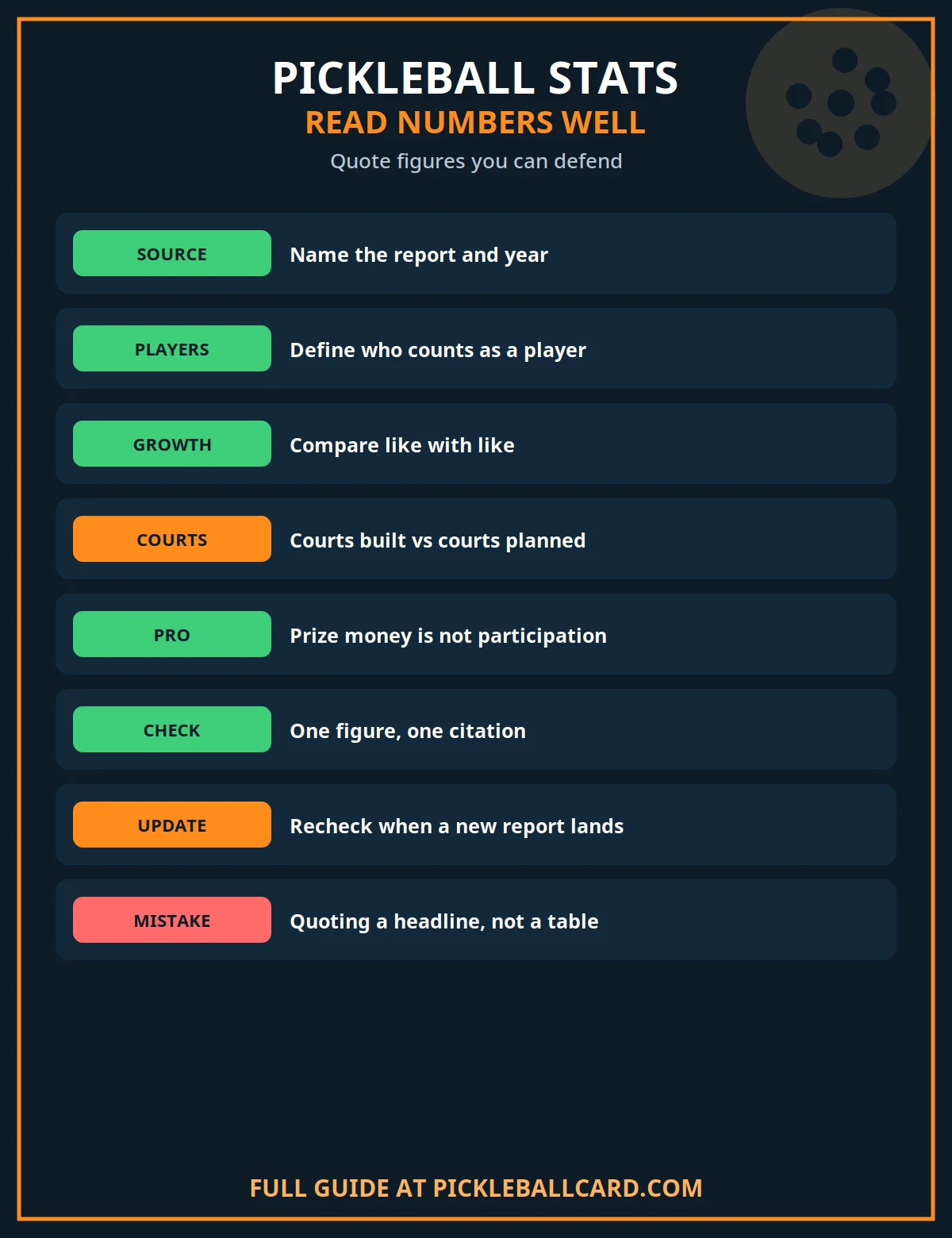
Use this checklist before you share a pickleball statistic in an article, a funding bid, or a social media post. Each step takes seconds, and each one prevents a common error.
- Check the year the figure describes, not just the year the report was published.
- Name the source every time, such as SFIA or USA Pickleball, rather than writing “studies show.”
- State whether the number is a survey estimate, a database count, or a membership total.
- Give the definition: casual, core, or all players, and the age range covered.
- Give the window for any percentage: one year, three years, or five years.
- Do not mix a mid-year snapshot with a full-year total in the same sentence.
- Do not present a database court total as a complete national census of courts.
- Update older figures when a newer annual report is available, and note the change.
- Link to the original source where possible, so readers can verify the number themselves.
- When in doubt, quote the range or the rounded figure and say that it is an estimate.
Frequently Asked Questions
How Many People Play Pickleball In The United States?
According to SFIA, 24.3 million Americans played pickleball in 2025. That figure comes from SFIA’s 2026 Topline Participation Report and covers players aged six and older.
Is Pickleball Really The Fastest-Growing Sport In America?
Yes, on SFIA’s measure. Pickleball grew 171.8 percent from 2022 to 2025, making it the fastest-growing sport in the United States over that three-year period.
SFIA has now described pickleball as the fastest-growing sport for five consecutive years. That streak covers growth relative to other tracked sports, not total participation.
What Is The Difference Between Casual And Core Players?
SFIA defines casual players as people who play one to seven times per year. Core players play eight or more times per year, and they form the regular playing base.
In 2025, there were 16.8 million casual players and 7.48 million core players, according to SFIA. Both groups grew by more than 20 percent that year.
How Many Pickleball Courts Are There In The United States?
USA Pickleball’s database listed 82,613 known courts across 18,258 locations in its 2025 Annual Growth Report. The 2024 report listed 68,458 courts at 15,910 locations.
These are database totals, not a complete census. They show tracked capacity rising fast, but unregistered courts will not appear in the count.
Who Plays Pickleball, By Age And Gender?
Players span all ages, but ages 13 to 24 post the highest participation rate, per SFIA’s 2026 Single Sport Report. Adults aged 25 to 34 form the largest single age segment.
Women account for 42.9 percent of players in 2025, up from 38.6 percent in 2020, according to SFIA. The average player age is 34.8 years in SFIA’s recent reporting.
Where Can I Verify These Pickleball Statistics?
Start with the two primary sources used on this page. SFIA publishes its participation findings on its U.S. pickleball participation page, and USA Pickleball publishes its Annual Growth Report on its own site.
Both sources are linked in the sources table below. Checking the original page beats trusting any second-hand summary, including this one.
Sources
| Figure Used | Source | Year Described |
|---|---|---|
| 24.3 million players; 22.8 percent annual growth; 171.8 percent three-year growth; 479 percent five-year growth | SFIA, U.S. Pickleball Participation Statistics | 2025 |
| 16.8 million casual players; 7.48 million core players; about 4.5 million new players; women 42.9 percent | SFIA, 2026 Topline Participation Report, as summarized on the SFIA participation page | 2025 |
| 68,458 known courts; 15,910 locations; 62,260 members; 142 sanctioned tournaments | USA Pickleball, Annual Growth Report | 2024 |
| 82,613 known courts; 18,258 locations | USA Pickleball, Annual Growth Report | 2025 |
Figures on this page describe the United States only, unless stated otherwise. International participation is growing, but no single global total is quoted here because no comparable primary source was verified for this article.

Shoaib is the publisher of Pickleball Card. He oversees the site’s guides to pickleball rules, ratings, strategy and gear, all researched from primary sources — the USA Pickleball Rulebook, DUPR and manufacturer documentation — and updated as the game changes.