Common Pickleball Injuries and How to Prevent Them
Pickleball looks gentle from the sideline. The court is small, the paddle is light, and the rallies often look relaxed and social.
Under that friendly surface, however, the game asks a lot of your body. You stop suddenly, change direction, lunge wide, reach overhead, and repeat the same swing many times in a single session.
Important: This article gives general information only. It is not medical advice. If you have pain, an injury, or a medical concern, see a qualified health professional promptly. Do not use this guide to diagnose yourself or to decide treatment.
Key Takeaways
- Most common pickleball injuries come from sudden movement, repeated swings, falls, or doing too much too soon.
- Ankles, knees, elbows, shoulders, and wrists take the most strain during normal play.
- A short dynamic warm-up before every session is one of the simplest injury prevention habits.
- Court shoes with lateral support protect your feet far better than running shoes on a pickleball court.
- Building playing time gradually matters more than any single stretch, brace, or piece of equipment.
- Falls are a serious risk, especially when players backpedal, chase lobs, or play on a wet surface.
- Sharp pain, swelling, instability, numbness, or pain that keeps returning are signals to stop and seek care.
- Strength, balance, rest, and good technique work together as a prevention system, not as separate quick fixes.
Why Pickleball Injuries Happen
Injuries rarely have a single cause. Usually, several small factors combine: a cold start, tired legs, a slippery patch, a long rally, and one awkward step.
Understanding those patterns helps you change them. Prevention starts with recognising what the game actually demands, rather than assuming a small court means a small physical load.
Short Bursts and Sudden Direction Changes
Pickleball is a stop-start game. You stand ready, explode a few steps sideways, stop hard, and then move again in the opposite direction.
Those bursts load your ankles, knees, Achilles tendons, and calf muscles in quick succession. The joints must absorb force, stabilise, and then produce force again almost immediately.
Players who arrive cold or fatigued are less able to control those movements. A foot can land slightly off balance, a knee can drift inward, or an ankle can roll before the muscles react.
The Court Surface and Your Footwear
Hard courts give little cushioning. Every step, landing, and lateral push sends force back through your feet, ankles, knees, and hips.
Wet leaves, dust, cracks, and worn patches change grip without warning. A shoe that sticks suddenly can twist an ankle, while a shoe that slides can send a player to the ground.
Running shoes are built mainly for forward motion. They often lack the side support and wide, stable base that lateral court movement requires.
Overuse and Doing Too Much Too Soon
Overuse injuries build slowly. The same tendons and muscles are loaded again and again, with too little recovery between sessions.
New players are especially vulnerable. Enthusiasm can lead to several long sessions in a first week, before tendons, joints, and fitness have adapted to the load.
Returning players face a similar trap. After a break, the skills may still feel familiar, but the tissues may no longer be ready for the same volume or intensity.
Falls and Collisions
Falls often happen during ordinary play, not dramatic dives. A player backpedals for a lob, turns to chase a ball, or steps sideways and loses balance.
When a fall happens, hands instinctively reach out to break it. That reflex can protect the head, but it also puts wrists, elbows, and shoulders at risk.
In doubles, partners can also collide or cross paths. Clear communication about who takes the middle ball reduces that risk considerably.
Pickleball Elbow: The Classic Overuse Problem
Pickleball elbow is a common name for pain on the outer side of the elbow, linked to repeated wrist and forearm movement. It is closely related to the condition often called tennis elbow.
The pain often builds gradually rather than appearing after one shot. Gripping, lifting, shaking hands, or turning a door handle can become uncomfortable as the irritation develops.
Technique and equipment both matter. A grip that is too tight, a paddle that feels heavy or poorly balanced, and a swing that relies on the wrist can all add strain.
For a full guide to causes, warning signs, and prevention habits, read our dedicated article on pickleball elbow prevention. That guide goes deeper than this overview, so this section stays deliberately brief.
Medical authorities describe lateral epicondylitis as an overuse problem of the forearm muscles and tendons, often linked to repeated wrist and arm motion. The Mayo Clinic overview of tennis elbow explains how the pain develops and when to seek care.
Ankle Sprains and Achilles Issues
Ankle sprains are among the most familiar court injuries. They usually follow a sudden sideways step, a landing on an uneven foot, or a twist during a quick change of direction.
Ankle pain after such a moment should not be played through casually. Resting the joint and seeking professional advice are sensible first steps when pain, swelling, or instability appears.
Achilles problems are different. They often develop gradually around the back of the ankle and lower calf, especially when playing volume rises quickly.
Morning stiffness, tenderness along the tendon, or discomfort at the start of play are common early patterns. Those signs are a reason to reduce load and seek advice, not to push harder.
Prevention here is practical. Court shoes with lateral support, a gradual build-up of playing time, calf and ankle strength work, and attention to court conditions all reduce strain.
Balance practice also helps. Single-leg balance and controlled lateral steps train the small stabilising muscles that protect the ankle when a step goes slightly wrong.
Knee Pain and Meniscus-Type Problems
Knees absorb force every time you lunge, squat low for a dink, or stop suddenly. They also twist when the foot stays planted while the body turns.
General knee soreness after a hard session is not the same as a specific injury. Still, persistent pain, swelling, locking, catching, or a feeling that the knee gives way deserves professional assessment.
Meniscus-type problems are often discussed in general terms among players. The meniscus is cartilage inside the knee that helps cushion and stabilise the joint.
Damage to that cartilage can occur through twisting, deep squatting under load, or gradual wear. This article does not diagnose such problems, and players should not try to self-diagnose them.
Strong hips, thighs, and core muscles help the knee track better during movement. Controlled lunges, step-ups, and squats performed with good form support that stability.
Technique matters too. Keeping the knee aligned over the foot during a lunge, avoiding deep twisting under load, and shortening your steps on wide balls can all reduce knee stress.
Shoulder and Rotator-Cuff Strain
The shoulder works hard in pickleball. Serves, overheads, and fast volleys all ask the joint to move quickly through a wide range of motion.
Rotator-cuff strain is a general term for irritation or injury to the group of muscles and tendons that stabilise the shoulder. Overhead shots and repeated reaching can aggravate it.
Pain during overheads, weakness when lifting the arm, or aching after play are signals worth attention. They do not automatically mean a serious injury, but they should not be ignored.
Warm-up is especially important for shoulders. Arm circles, gentle band work, and gradual overhead practice prepare the joint far better than starting with full-power smashes.
Strength work should cover the whole shoulder girdle, not just the pressing muscles. Balanced strength around the shoulder blade helps the joint stay centred during fast swings.
Overhead technique also protects the shoulder. Positioning under the ball, using the legs, and avoiding desperate backward reaches reduce awkward overhead strain.
Wrist and Hand Issues
Wrists absorb vibration from every shot and bear weight during falls. Repeated gripping, flicking, and off-centre hits can irritate tendons around the wrist and hand.
Players sometimes notice aching after long sessions, stiffness in the morning, or discomfort when gripping the paddle firmly. Those patterns are worth noting, especially if they return regularly.
A relaxed grip helps. Squeezing the paddle handle constantly adds tension through the forearm, wrist, and hand without improving control.
Hand and wrist strength should be built gradually. Light grip work, wrist mobility exercises, and rest between heavy playing days support the tissues without overloading them.
Falls and Head and Eye Safety
Falls deserve special attention because their consequences can be serious. A fall can injure a wrist, shoulder, hip, or head in a single moment.
Backpedalling is the highest-risk habit. Turning and running to a lob, or shuffling sideways while facing the net, keeps balance and vision in a safer position.
Eye safety is often overlooked. A fast ball or an accidental paddle swing in doubles can strike the face, and protective eyewear is a simple safeguard.
Any head strike, loss of consciousness, confusion, vomiting, or worsening headache after a fall needs urgent professional care. Do not return to play and hope it settles.
Balance and leg strength are the long-term fall defences. Public health guidance for older adults emphasises muscle-strengthening and balance activities, as explained in the CDC guidance on physical activity for older adults.
Injury, Cause, and Prevention at a Glance
The table below summarises the main patterns in this guide. It is a planning tool, not a diagnostic chart.
| Injury area | Typical cause | Prevention focus |
|---|---|---|
| Elbow | Repeated gripping and wrist movement | Technique, grip size, gradual load |
| Ankle | Sudden sideways steps and twists | Court shoes, balance, court checks |
| Achilles and calf | Rapid rise in playing volume | Gradual build-up, calf strength |
| Knee | Lunging, twisting, deep squats | Hip and thigh strength, aligned movement |
| Shoulder | Overheads and repeated reaching | Warm-up, balanced shoulder strength |
| Wrist and hand | Gripping, vibration, falls | Relaxed grip, suitable paddle, rest |
| Falls | Backpedalling and wet surfaces | Turn and run, court checks, balance |
| Eyes and head | Fast balls and doubles collisions | Protective eyewear, clear calls |
Prevention Systems That Actually Work
No single habit prevents every injury. The players who stay healthiest usually combine several simple systems, repeated every session.
Think of prevention as a routine, not a rescue. Warm-up, footwear, court awareness, load management, and recovery each do a small job, and together they cover most risks.
Warm Up Every Time
Start with light movement, such as walking, gentle jogging, or easy side shuffles. This raises your heart rate and warms the muscles gradually.
Follow with dynamic movements for the hips, legs, shoulders, and ankles. Leg swings, arm circles, controlled lunges, and gentle torso turns prepare the joints for play.
Finish with easy rallies before competitive points. Soft dinks, gentle groundstrokes, and short volleys let timing and footwork settle before intensity rises.
Our guide to effective stretches and warm-up exercises for pickleball gives a fuller routine you can use before every session.
Choose Footwear for Lateral Movement
Court shoes are designed for side-to-side movement. They usually offer a stable base, lateral support, and a sole that grips without sticking suddenly.
Check your shoes regularly. Worn soles, collapsed sides, or uneven wear change how your foot lands and how your ankle is supported.
Replace shoes when support fades, not only when they look worn out. A shoe that feels loose around the midfoot is no longer doing its main job.
Read the Court Before You Play
Walk the court before the first serve. Look for wet patches, leaves, cracks, loose balls, bags, and obstacles near the sidelines.
Agree on simple safety habits with your group. Keep spare balls off the playing surface, and stop play immediately if a ball rolls onto your court.
Avoid playing on a wet court. Slippery surfaces change every movement, and the risk of a fall rises sharply when grip becomes unpredictable.
Manage Your Load
Load means total playing time, intensity, and frequency combined. Increasing only one factor at a time gives your body a chance to adapt.
New players can start with shorter sessions and fewer days per week. Add time gradually, and keep at least one rest day between heavier sessions at first.
Returning players should rebuild similarly. Skill returns faster than tissue tolerance, so patience in the first weeks protects the rest of the season.
Cross-training helps too. Walking, cycling, swimming, strength work, and balance practice build general fitness without repeating the same court stresses daily.
Recover Between Sessions
Recovery is part of training, not an optional extra. Sleep, hydration, and regular meals support the repair processes that follow hard play.
A gentle cool-down after play helps the body settle. Slow walking, easy movement, and light stretching can ease stiffness after a long session.
Notice patterns across weeks, not just single days. Soreness that fades within a day differs from pain that grows, spreads, or returns every session.
Your Injury Prevention Checklist
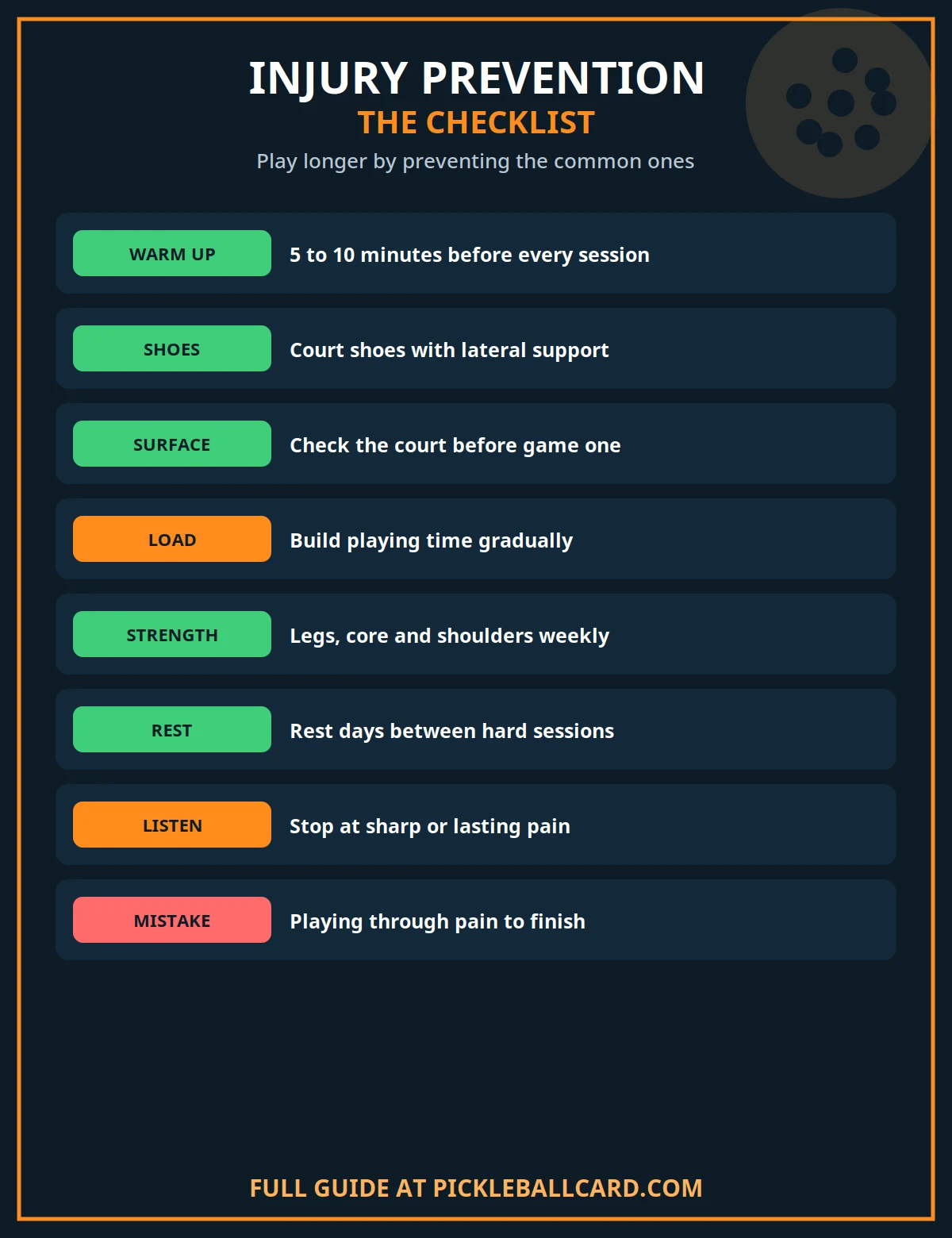
Use this checklist before and after play. It takes only a few minutes, and it covers the habits that matter most.
- Warm up with light movement, dynamic stretches, and easy rallies before competitive points.
- Wear court shoes with lateral support, and check soles and sides for wear.
- Inspect the court for wet patches, leaves, cracks, and stray balls.
- Agree with partners on calls for middle balls and stray balls.
- Turn and run for lobs instead of backpedalling.
- Consider protective eyewear, especially in fast doubles play.
- Keep your grip relaxed and check that your paddle grip size suits your hand.
- Build playing time gradually, and add only one load factor at a time.
- Include strength and balance work away from the court each week.
- Rest between sessions, hydrate, and note any pain that keeps returning.
- Stop playing and seek care if pain is sharp, swelling grows, or a joint feels unstable.
Warning Signs: Stop Playing and Seek Care
Most players know the difference between tired muscles and something wrong. Trust that difference, and act on it early rather than finishing the match first.
Stop playing and seek professional care promptly if you notice any of the following general red flags. This list is a safety guide, not a diagnosis.
- Sharp, sudden, or severe pain during play.
- Swelling that grows quickly or a joint that looks deformed.
- Inability to bear weight, move a joint, or grip normally.
- A joint that feels unstable, locks, catches, or gives way.
- Numbness, tingling, weakness, or loss of feeling.
- Pain that worsens over days instead of easing with rest.
- Any head strike, confusion, dizziness, or loss of consciousness.
- Chest pain, severe breathlessness, or collapse — seek emergency care immediately.
If you are unsure whether a problem is serious, seeking advice is the safer choice. Early assessment often leads to simpler care and a faster return to play.
Returning too soon is a common cause of re-injury. Follow professional guidance on return to play, and rebuild volume gradually rather than jumping back to full sessions.
Playing Longer, Not Just Harder
Pickleball rewards consistency. Players who protect their bodies tend to play more often, improve steadily, and enjoy the social side of the game for longer.
The health benefits of regular, enjoyable activity are real, and they are worth protecting. Our guide to pickleball health benefits explains why so many players find the game such a sustainable way to stay active.
Start with one change this week. Add a proper warm-up, replace worn shoes, or shorten your next session slightly. Small, repeatable habits protect your game better than any single dramatic fix.
Frequently Asked Questions
What are the most common pickleball injuries?
Ankle sprains, knee pain, elbow irritation, shoulder strain, wrist problems, Achilles issues, and falls are among the injuries players report most often.
The exact pattern varies with age, fitness, technique, and playing volume. Sudden movement, overuse, and falls explain most cases, rather than a single dramatic cause.
How can beginners avoid pickleball injuries?
Beginners should warm up every time, wear court shoes, start with shorter sessions, and learn basic footwork and technique early.
Building playing time gradually matters most. Enthusiasm is welcome, but several long sessions in a first week can overload tissues that have not yet adapted.
Should I play through pain?
No, not if the pain is sharp, sudden, worsening, or linked to swelling, instability, or numbness. Stop playing and seek professional advice in those cases.
Mild muscle tiredness after play is different from joint pain that changes how you move. When in doubt, rest and seek advice rather than pushing through.
Are court shoes really necessary for pickleball?
Court shoes are strongly recommended. They are built for lateral movement, with side support and a stable base that running shoes often lack.
Good shoes will not prevent every injury, but they reduce ankle twisting risk and give more predictable grip during quick direction changes.
How long should I warm up before pickleball?
A short warm-up of a few minutes is far better than none. Include light movement, dynamic stretches, and easy rallies before competitive points.
Older players, morning players, and anyone returning from a break may need a longer, gentler warm-up. Let your body, not the clock, guide the pace.
When should I see a health professional about a pickleball injury?
Seek care promptly for sharp pain, growing swelling, instability, numbness, weakness, or pain that does not ease with rest.
Also seek urgent care for any head injury, chest pain, severe breathlessness, or collapse. Early professional assessment is safer than self-diagnosis.

Shoaib is the publisher of Pickleball Card. He oversees the site’s guides to pickleball rules, ratings, strategy and gear, all researched from primary sources — the USA Pickleball Rulebook, DUPR and manufacturer documentation — and updated as the game changes.