Pickleball elbow is lateral epicondylitis — the same overuse tendon problem as tennis elbow. The forearm extensor tendons that attach at the bony bump on the outside of your elbow break down under repeated gripping and wrist extension, especially on backhands. The good news is that it is mostly preventable: build playing time gradually, warm up properly, use a grip size that does not force you to squeeze, loosen your grip pressure, use your shoulder and core instead of flicking with your wrist, and strengthen the whole arm chain. This guide explains what it is, why pickleball players get it, and exactly how to lower your risk — without selling you a paddle as a cure.
Disclaimer: This article is educational information only and is not medical advice. It does not diagnose any condition. If you have persistent elbow pain, weakness, or pain that does not settle with rest, see a qualified health care professional or physical therapist for an individual assessment.
Key Takeaways
- Pickleball elbow is an overuse problem, not a single bad shot. Repeated gripping and wrist extension overload the tendon at the outside of the elbow.
- The biggest risk is a sudden load spike — going from no play to long sessions, several days in a row, without building up.
- Grip size and grip pressure matter. A handle that is too small forces you to squeeze harder on every shot.
- Technique protects the tendon. A two-handed backhand shares the load, and using your shoulder and core reduces wrist flick.
- Warm up, strengthen, and recover. A short warm-up, whole-chain strengthening, post-play stretching and icing are the habits Harvard Health and Mayo Clinic guidance point to most consistently.
- Rest is part of prevention. If self-care — rest, ice and modifying the activity that hurts — does not ease pain and tenderness, see a health care provider.
What Pickleball Elbow Actually Is
When players say “pickleball elbow,” they usually mean pain on the outside of the elbow, around the bony prominence called the lateral epicondyle. The forearm muscles that straighten and raise your hand and wrist — the extensors — attach there through a common tendon. Every time you grip a paddle, stabilise your wrist at contact, or hit a one-handed backhand, those muscles pull through that attachment.
Repeated tensing of those muscles, without enough recovery or strength to handle the load, can degrade the tendon fibres over time. Pain may spread into the forearm and wrist, and grip weakness is a hallmark players describe: shaking hands, turning a doorknob, or holding a cup becomes uncomfortable. That description is a reason to get checked, not a diagnosis you should make yourself — other elbow problems can feel similar, and only an in-person assessment can tell them apart.
Outer Elbow vs Inner Elbow
Pickleball elbow / tennis elbow affects the outside of the elbow. Pain on the inside of the elbow involves a different tendon group (the flexors, sometimes called golfer’s elbow). The distinction matters because the exercises and load advice differ. If you are unsure which you have, do not guess from an article — get it assessed.
Symptoms Players Describe
- Aching or burning pain around the outside bony bump of the elbow, sometimes spreading down the forearm
- Pain that is worse when gripping, shaking hands, lifting with the palm down, or hitting backhands
- Weak or painful grip — the paddle feels harder to control late in a session
- Tenderness when you press on the outside of the elbow
- Stiffness first thing in the morning or at the start of a session that eases, then returns afterwards
None of these on their own proves lateral epicondylitis. They are signals to reduce load and, if they persist, to seek care — especially if you have numbness, swelling, a recent fall or impact, fever, or pain that wakes you at night. Those features need prompt, individual medical attention.
Why It Happens: Four Loads That Add Up
1. A Sudden Spike in Playing Time
The classic pattern described by sports-medicine specialists is a player who goes from no play — or occasional play — to long sessions too fast, without physical preparation. Tendons adapt more slowly than enthusiasm. A three-hour debut, followed by three more days that week because the sport is fun, is exactly the spike that overloads an unprepared forearm.
2. Over-Gripping
If your grip is too small, or you simply hold the paddle in a death grip, your extensors work hard on every single shot — including the soft shots that should be relaxed. Over a two-hour session that is hundreds of unnecessary hard contractions. Grip pressure should rise for a drive and fall for a dink; many players keep it high for everything.
3. Wrist-Flick Technique
Hitting backhands mainly by flicking the wrist, leading with the elbow, or muscling the ball from the forearm alone concentrates force through the extensor tendon. Better mechanics move the work up the chain: turn your shoulders, step into the shot, and let the larger muscles of the shoulder, trunk and legs do more of it. A one-handed backhand hit late, behind your body, is a particularly common overload pattern — which is why a two-handed backhand is so often suggested as a load-sharing alternative.
4. Equipment Setups That Fight Your Arm
A head-heavy paddle, or a setup with high swing weight, is the configuration most likely to make your forearm work harder on every swing, because swing weight — not just the number on the scale — is what your forearm fights as the paddle moves. Vibration and repeated off-centre hits do not help either. Equipment is one factor among several, never the whole story — see the honest paddle-weight discussion below.
Prevention: The Habits That Matter Most
Ramp Up Gradually
Build court time over weeks, not days. Start with shorter sessions, leave at least a day between early sessions, and increase total weekly time modestly when the previous week felt comfortable during play and the next morning. If your elbow is talking to you the day after, that is information: hold or step back before you add more.
Warm Up Before You Play — Every Time
Warm up for about five minutes before play: walk or march in place to raise your temperature, circle your arms and shoulders, and move your wrists and elbows gently through their range. Then hit progressively — start with cooperative dinks and easy volleys before you drive hard. Our guide to effective stretches and warm-up exercises for pickleball walks through a full routine you can copy.
Get Your Grip Size Right — Then Loosen Your Grip
A handle so narrow that you must squeeze hard to control it overloads the extensors. The standard check is to measure from the middle crease of your palm to the tip of your ring finger — most adults land around 4 to 4.5 inches, matching typical paddle grip circumferences — and to cross-check with the finger-gap test in store. If you are between sizes, sizing down and building up slightly with an overgrip is the usual approach; an overgrip adds roughly 1/16 inch. Do not rebuild the whole decision here: our dedicated guide to how to measure your pickleball paddle grip size covers the measurement, the tests, and what to do if you are between sizes.
Size is only half of it. Consciously practise grip pressure: loose between shots, firm only at contact, loose again on soft shots. Between rallies, open and close your hand a few times to reset a creeping death grip.
Share the Load: Technique Changes That Help
- Try a two-handed backhand. It shares the load across both arms instead of one forearm, and it is specifically recommended in Harvard Health’s pickleball injury guidance for players prone to elbow pain.
- Use your shoulder and core. Turn, step, and rotate instead of flicking from the wrist and forearm.
- Meet the ball in front. A contact point in front of your body, with a stable wrist, is kinder than a late, reaching backhand.
- Take a lesson if pain is technique-linked. A short coaching session to fix a wrist-flick backhand can do more than any brace.
Strengthen the Whole Chain
Stronger bigger muscles unload the forearm. Harvard Health’s advice is to strengthen the whole chain — shoulder, arm, core, hips and legs — ideally with input from a trainer or physical therapist, rather than only squeezing a ball with the sore arm. For the forearm itself, gradual stretching and strengthening is the physical-therapy staple, and eccentric work — raising the wrist with help, then lowering it very slowly under control — is singled out in Mayo Clinic guidance as particularly helpful for tennis elbow. Do strengthening progressively and pain-guided; if an exercise sharply increases pain, stop and get individual advice.
Stretch and Ice After Play
Stretch shoulders, arms and wrists after play while you are warm. Icing the elbow after a session — even when it does not hurt yet — is a habit Harvard Health suggests for players who are building load, as a way to calm the tissue after work. Combine it with the simplest recovery rule of all: do not play hard on consecutive days while you are building up or while symptoms are settling.
The Paddle-Weight Question, Answered Honestly
Players will tell you two opposite things, and both camps sound certain. One argues a slightly heavier paddle helps because more mass gives more plow-through, so the paddle does more work and transmits less shock. The other argues lower swing weight is what reduces elbow strain, because swing weight is what your forearm fights on every swing.
The honest position is that the sources conflict, and this article will not pretend otherwise. What can be said safely is this: balance and swing weight matter more than the headline weight alone, and a head-heavy paddle is the risky configuration. If you have symptoms, demo before you buy, pay attention to how your elbow feels during play and the next morning, and stop if pain rises. Do not treat any paddle — at any weight — as a medical treatment, and do not buy your way out of a load or technique problem. For the specifications side of the decision, see our guide to how to choose the right pickleball paddle weight, including how static weight and swing weight differ.
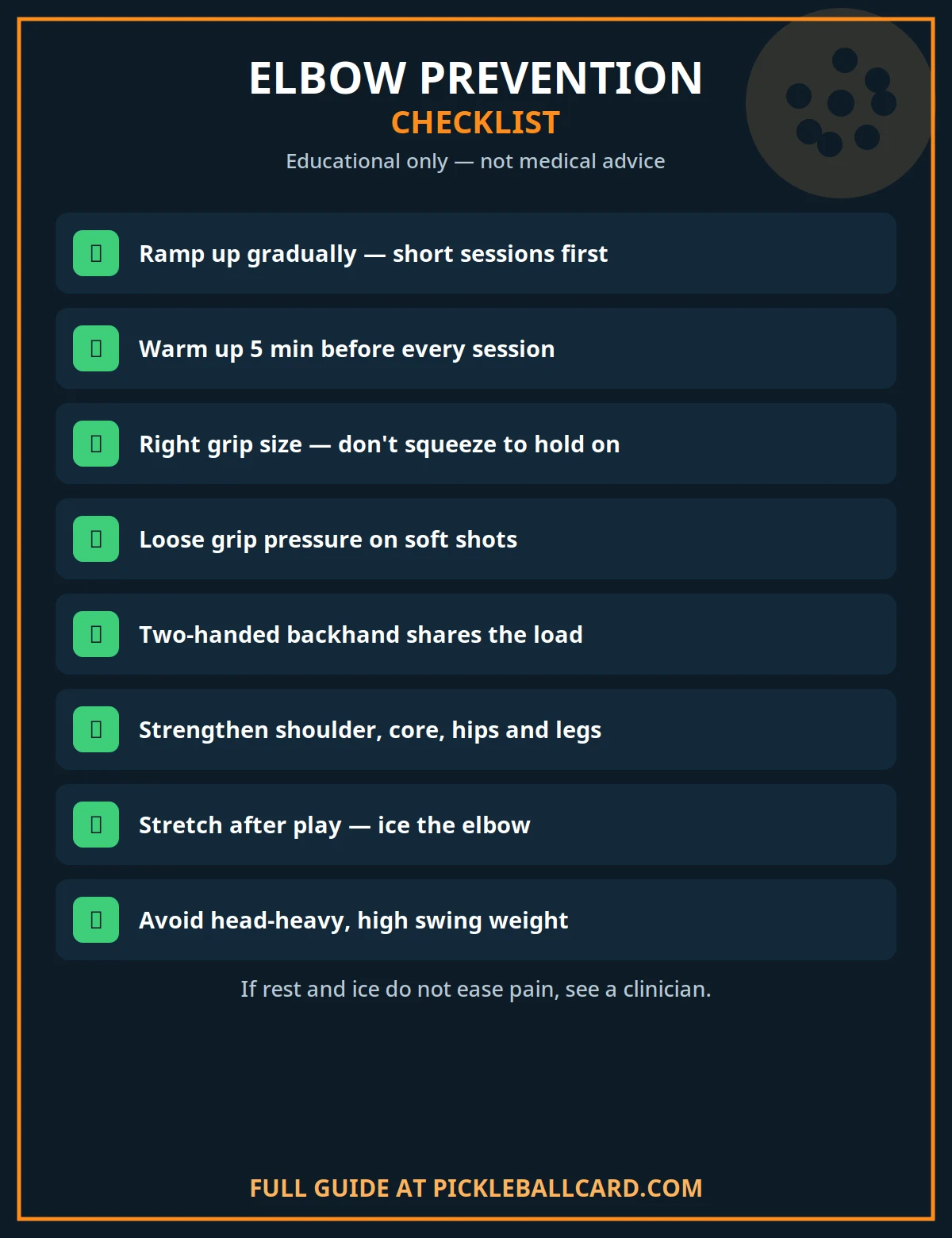
Pickleball Elbow Prevention Checklist
| Habit | What to do | Why it helps |
|---|---|---|
| Ramp up | Short first sessions; build weekly court time gradually; rest days between early sessions | Tendons adapt slowly; spikes are the classic trigger |
| Warm up | About 5 minutes: walk/march, arm circles, gentle wrist and elbow movement, then progressive hitting | Warm tissue tolerates load better than cold tissue |
| Grip size | Measure palm crease to ring-finger tip (most adults ~4–4.5 in); finger-gap cross-check | Too small = you squeeze harder on every shot |
| Grip pressure | Loose between shots and on soft shots; firm only at contact | Cuts hundreds of unnecessary hard contractions per session |
| Backhand | Try two-handed; meet the ball in front; turn shoulders instead of flicking the wrist | Shares load across both arms and larger muscles |
| Strengthen | Whole chain — shoulder, arm, core, hips, legs — plus gradual forearm work, PT-guided if sore | Stronger big muscles unload the forearm tendon |
| After play | Stretch shoulders, arms and wrists; ice the elbow after sessions while building load | Supports recovery before the next session |
| Equipment | Avoid head-heavy / very high swing weight if prone; demo and judge by next-morning feel | Balance and swing weight drive forearm effort |
If It Already Hurts: Sensible First Steps
Mayo Clinic’s first steps for tennis elbow are straightforward: rest or modify the aggravating activity, use ice, and consider over-the-counter pain relief as directed on the label or by your clinician. “Modify” is the key word for most pickleball players — you may not need to stop entirely, but you do need to stop doing the exact load that keeps provoking it, at the same volume, while expecting a different result.
- Cut the load first: shorter sessions, fewer days per week, no hard backhand drilling while it settles.
- Ice after play and after any activity that provokes the ache.
- Start gradual stretching and strengthening — ideally taught by a physical therapist, who can grade eccentric wrist work to your stage and check your technique and equipment at the same time.
- A forearm strap or brace is an option some players use to reduce stress on the tendon during activity. Treat it as a support while you fix load and strength, not as a fix on its own.
- Return gradually: when daily activities are comfortable and a short, easy session leaves no next-day flare, build time and intensity back in steps — the same ramp-up rules as prevention, just starting lower.
Do not play through steadily worsening pain to “test” it every day. Repeated provocation without recovery is how a manageable overload becomes a long layoff.
When to See a Doctor
Talk to a health care provider if self-care — rest, ice and pain relievers used as directed — does not ease the pain and tenderness. Seek care sooner if grip weakness is progressing, pain is interfering with work or sleep, you have numbness or tingling, there was a specific injury, or the elbow is swollen, red or hot.
A doctor may discuss a range of next steps depending on your examination, which can include physical therapy progression, injections, other procedures, and — only after many months (often 6 to 12 months) of failed conservative care — surgery. Those are decisions for you and your clinician, based on your elbow, not recommendations from this article. The article’s job is narrower: help you prevent the problem, recognise when home care is not enough, and arrive at that appointment able to describe your playing load, your technique and what you have already tried.
Frequently Asked Questions
Is pickleball elbow the same as tennis elbow?
Yes, in the usual case. Both names refer to lateral epicondylitis — overload of the forearm extensor tendon at the outside of the elbow. The sport that provoked it differs; the tissue and the load principles are the same, which is why tennis elbow guidance from medical authorities applies to pickleball players.
Can I play pickleball with elbow pain?
That depends on severity, and it is a question for your clinician if pain persists. As a general principle, modify rather than push through: reduce session length and frequency, avoid the shots that provoke it most, and stop if pain is worsening session to session or lingering longer each time. Pain that does not settle with rest and ice needs an in-person assessment.
Does a heavier paddle help pickleball elbow?
There is no settled single answer, and anyone who gives you one ideal weight as a medical fact is overselling. Balance and swing weight matter more than headline weight; a head-heavy paddle is the risky setup. Demo any change, judge it by how your elbow feels during play and the next morning, and fix load, grip and technique first — equipment is an adjustment, not a treatment.
Does a forearm strap or elbow brace work?
A strap can reduce stress on the tendon during activity and some players find it helpful as part of a broader plan. It does not replace load management, strengthening, or technique work, and it is not a proven cure on its own. If you rely on it for months without improvement, that is a sign to get assessed.
How long does pickleball elbow take to settle?
It varies widely with how long it has been building, how completely you modify the load, and your individual assessment — which is why this article gives no timeline or cure rate. Tendon problems are generally slow: expect gradual improvement over weeks to months with consistent load management and strengthening, not days, and seek care if you are not progressing.
What is the single best exercise for pickleball elbow?
There is no single best exercise for every elbow. Eccentric wrist work — lowering the wrist very slowly after raising it — is the exercise most often singled out in medical guidance, but the right starting point, load and progression depend on your stage. A physical therapist can teach it correctly in one session; guessing the dose from the internet is how players flare themselves up.
The Bottom Line
Pickleball elbow is rarely bad luck. It is usually a load story: too much gripping, wrist flick and court time, added too fast, on a tendon that was never prepared for it. Reverse that story and you prevent most cases — ramp up gradually, warm up for five minutes, size your grip so you do not have to squeeze, share the backhand load across two hands and bigger muscles, strengthen the whole chain, and ice and stretch afterwards. If it already hurts, cut the load, use the self-care steps above, and see a health care provider if rest, ice and pain relief do not ease it. Play the long game: a few sensible weeks now are what keep you on court for years.
Sources: Harvard Health Publishing, How to avoid this common pickleball injury; Mayo Clinic, tennis elbow (lateral epicondylitis) guidance on causes, self-care, therapy and when to seek care. This article is educational only and is not medical advice.