Here is a complete guide on Pickleball paddle weight range to find a paddle that is best suited for your playing style.
Pickleball Paddle Weight
Pickleball paddle weight is a critical element, considering that it influences the physical performance, control, spin, power, stability, and other components of the game. Hence, it is always preferred that you do a detailed analysis of your playing style and then choose a paddle that has the appropriate weight.

If you are confused about what weight of pickleball paddle is comfortable for your game, follow this guide on classes of pickleball paddle. So, don’t waste more time, and let’s get in.
Pickleball Paddle Weight Classes
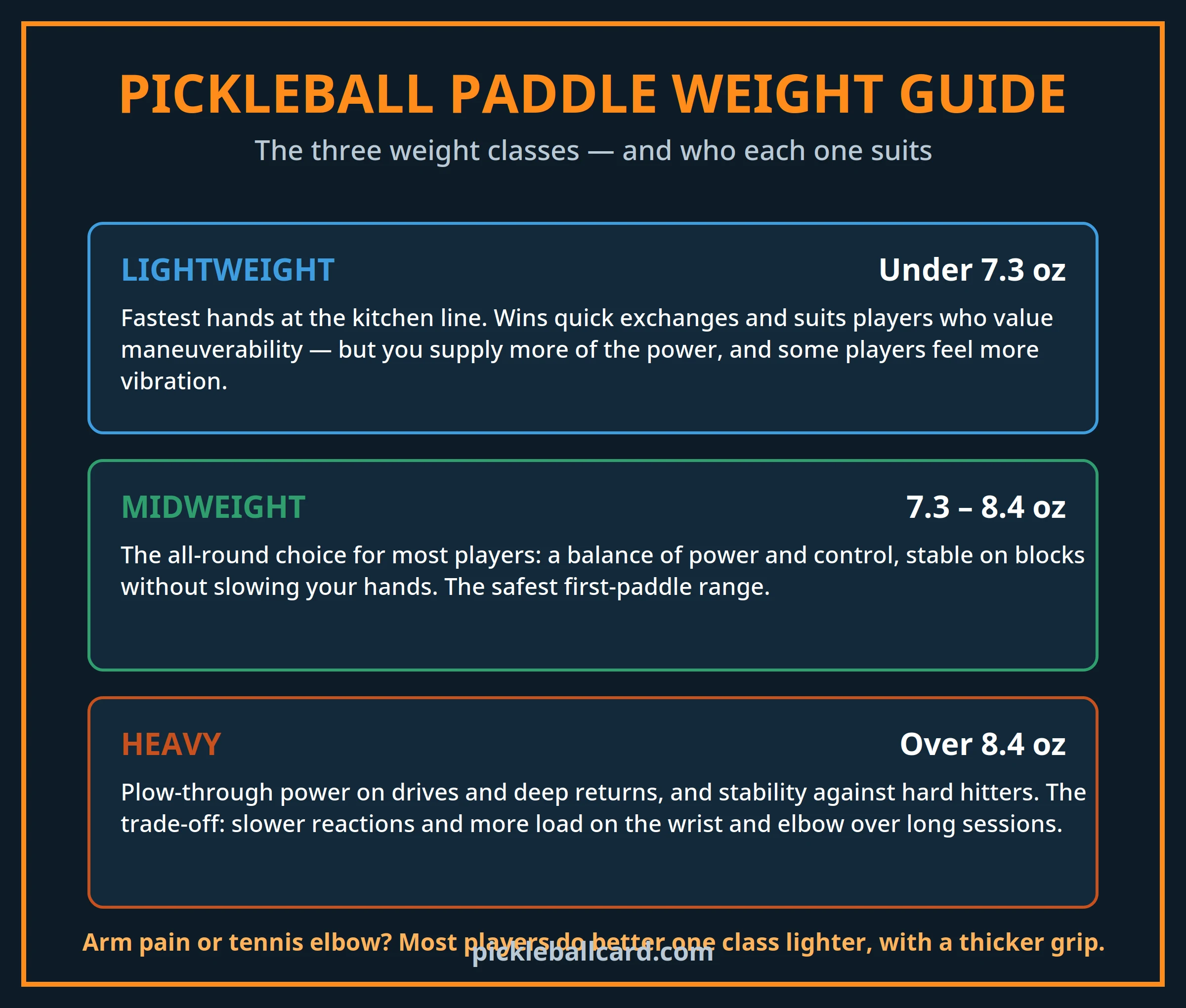
Pickleball paddles are divided into three classes when it comes to the weight range, including light, medium, and heavyweight. The playing style, physical ability, and comfort level of the player determine each. Here is a breakdown of each of these three classes, along with advantages and disadvantages.
Lightweight Paddles
The most commonly used paddles among pickleball players are the lightweight ones, with an average pickleball paddle weight between 7 and 7.8 ounces. These are designed for players who want speed and control and get easily fatigued out by heavy paddles. The lightest pickleball paddle is definitely the best suited for a quick, flick-tastic playing style.
Light pickleball paddles have the least amount of resistance to speed and wind, which is why they are easy to control and achieve accuracy. If you are someone who likes playing soft dinks and drop shots that require minimal power, they may be the most suitable for you. Given that they are light, the movements and style come naturally to players using these paddles.
Advantages
- These paddles are great for double matches
- Offers incredible speed and quick movements
- Easy to hold
- No fatigue or uneasiness around the wrist muscles
- Offers amazing controls
- The movements are natural
Disadvantages
- Power is not the best suit for these paddles
- Not the best in windy conditions
- They may produce more vibrations
- Players cannot play power shots with a lighter paddle
Mediumweight Paddles
Mediumweight paddles are the ones that typically weigh between 7.8 and 8.3 ounces. These are probably the best bet for anyone who is confused about which one to go for, partly because they have a balanced ratio of stability and power. Players don’t have to put in extra effort with these paddles to master deep shots.
They also have amazing wrist mechanics, as they swing conventionally and generate enough power. Hence, given the fact that they generate medium-level power, it is easy for players to balance them in both double and single matches. Similarly, you won’t feel stress and tension on your wrist, making them great for long practice sessions or drills.
Advantages
- Great for single and double matches
- They generate a medium-level power
- Easy on hands and wrist muscles
- Balanced power and control
- Incredible potential to hit balanced shots
Disadvantages
- It has no scope to lean towards specialization of a playing style
Heavy Paddles
The last category on this list of the pickleball paddle weight classes is the heavyweight. Usually, these paddles are heavier than 8.3 ounces and lie on the power advantage. That said, these are extremely difficult to control and require players to have immense practice.
These pickleball paddles are designed to absorb the energy coming from the other side so that the hits are stable and the weight is distributed evenly. If you are transitioning from a lighter paddle directly to a heavier one, it will require extra effort, even by an active player.
Advantages
- Great for hard-hitting shots
- Generates incredible power
- Resist windy conditions
- Ideal for professionals
- Best for single matches
Disadvantages
- Difficult to control
- It may cause fatigue and discomfort in the arm and wrist area
- Not the best for double matches
How Does Weight Of The Pickleball Paddle Impact Physical Performance?
The weight of the pickleball paddle doesn’t only influence the physical performance of the player but all components of the game. For the most part, the weight is directly proportional to the power and stability that is behind the ball for each hit. Hence, in return, it determines everything from speed to control, strength, and comfort level of the player in the entire game.

Now, the rule of thumb says that the heavier the paddle is, the more power it will generate, but at the expense of control and speed. So, if you are someone who wants speed and agility, a lighter paddle would be a better option. And if you are confused, a middleweight paddle may be the right choice.
Now, coming to its impact on physical performance, it wouldn’t be wrong to say that weight is inversely proportional to comfort. A lighter pickleball paddle means a comfortable wrist and no fatigue at all, even for long hours of the game. On the contrary, handling the heaviest pickleball paddle can result in extreme fatigue and discomfort in the hand muscles.
How To Find The Right Pickleball Paddle Weighs Suitable For Your Playing Style?
It can be a challenge for players who are confused as to what weight the pickleball paddle is. Hence, it is ideal to look into some things that can help you in making the right decision. Here is a list of all these basic prerequisites for buying the right pickleball paddle.
- Playing Style: The most important factor that counts when it comes to pickleball weight is the playing style. For instance, if you have a quick finesse style of game with incredible control and stability, the lightweight paddle is a wise option. In contrast, a heavy paddle is better for players with a power-oriented playing style.
- Experience Level: Likewise, if you are just starting with pickleball, a lighter paddle is the correct answer. These can balance out softer dinks with incredible speed and control. In contrast, experts who are fond of playing power shots usually prefer using heavy paddles.
- Physical Ability: If you are someone who gets easily tired and is unable to bear the weight of a paddle in your hand for a long time, a lightweight paddle (between 7 and 7.8 ounces) may be the right choice, and vice versa. That said, for experts who love playing power shots, heavy paddles are my absolute recommendation.
- Budget: Weight is not what sets a paddle’s price — materials, construction and brand do, and one model often comes in two weights at the same price. If your budget is tight, choose the model first and then pick its weight; do not take a heavier paddle just because it looks like the cheaper route.
Should I Change My Paddle Weight Over Time?
Yes, you should change the weight of your paddle over time while progressing in the game. This is especially true for players who are changing their playing style or are experiencing an injury. In a nutshell, I would say don’t be afraid of trying a new style of playing if you have just started playing pickleball.
Can You Make A Pickleball Paddle Heavier?
Yes, if you want to add more weight to your existing paddle to increase power generation, you can definitely do this. All you need is lead tape, added a few grams at a time while you test the feel. Tuning a paddle this way is standard practice and stays within USA Pickleball’s equipment rules as long as the paddle’s size and hitting surface stay legal, and tape along the rim doubles as edge protection against scrapes. What tape will not do is improve your paddle grip and control.
Frequently Asked Questions
What Is The Best Pickleball Paddle Weight For Mid-Level Players?
If you are a beginner or mid-level player who is looking for a paddle, I would advise you to go for a weight between 7.3 and 7.8 ounces. It allows you to achieve a balance of both power and control during single and double games. Moreover, it feels comfortable during intense, long practice sessions.
Can I Play Power Shots With A 7.3 Ounces Pickleball Paddle?
Yes, you can. A 7.3-ounce paddle sits in the light class, which trades free power for control, but it still drives and smashes well when your technique supplies the pace. What you give up is plow-through: off-centre hits and windy days punish a light paddle sooner.
Can I Add Weight To My Pickleball Paddle?
Yes, you can definitely add weight to a pickleball paddle as you progress in the game. This is especially true if you are experimenting with different playing styles. Similarly, if you are feeling like power is an issue, adding lead tape to your paddle can solve this issue.
Which Pickleball Paddle Weight Is Best For Beginners?
Any pickleball paddle with a weight between 7 and 7.8 ounces is great for beginners. This is because it allows them to practice control and stability for softer dinks and fewer power shots.
What Is The Best Pickleball Paddle Weight For Tennis Elbow?
A lighter pickleball paddle can reduce the strain on your elbow and arm while playing pickleball. A paddle with a weight range between 6.5 to 7.8 ounces is recommended for a person with tennis elbow or any discomfort.
What Weight Pickleball Paddle Do The Pros Use?
There is no single pro weight. Most tour players end up in the upper midweight range once their lead tape is on — roughly 8.0 to 8.6 ounces all-in — but plenty play a lighter base paddle and add head weight with tape instead. What the pros optimise is swingweight and balance for their own game, not the biggest number on the scale.
Does Paddle Weight Affect Spin?
Only indirectly. Spin comes mainly from the face’s texture and your swing path. Weight plays a supporting role: a slightly head-heavier paddle can hold its line through contact and keep the face angle you set, while a very light paddle can get pushed around by hard-hit balls. If spin is the goal, shop for face finish first and weight second.
How Much Lead Tape Should I Add?
Start small: 3 to 6 grams in total, placed where you want the effect — high on the paddle for plow-through, at the sides for stability — then play several games before adding more. Tape is reversible, so build up in steps you can actually feel rather than jumping to a heavy setup you then have to unlearn.
The Number on the Scale Is Only Half of It: Swing Weight
Two paddles can both weigh 7.9 ounces yet feel completely different in your hand. The missing figure is swing weight — how heavy a paddle feels in motion — set by its balance point. A head-heavy paddle carries mass toward the top edge, adding plow-through on drives but slowing your hands in the fast net exchanges covered by our volley guide. A head-light paddle feels quicker and rewards a relaxed grip. This is why lead tape placement matters: tape at the top raises swing weight, tape on the sides adds stability, and tape under the grip changes the swing least.
Weight Classes Are Conventions, Not Standards
No governing body defines lightweight, midweight or heavy. USA Pickleball’s equipment rules care that a paddle is approved and inside the size limits; the class labels on shop pages are conventions, and they drift. One published table calls 7.8 ounces light, while another calls the same paddle midweight.
That is why the ranges in this guide and in our guide to choosing a paddle do not match to the decimal. Both sit inside the spread of tables different brands and shops publish. Treat the boundaries as neighbourhoods, not lines, and never reject a paddle over a label.
Judge a paddle by the two things you can actually feel: its static weight on your arm across an hour of play, and its swingweight while it is moving. If both suit you, the class name it shipped with is trivia.
Final Thoughts
Lightweight vs heavyweight pickleball paddle; which one is better? This is the most asked question among players, and rightfully so. Weight determines a great deal of your pickleball game, including control, stability, and power. And I hope this pickleball paddle weight guide has been helpful for you in choosing which weight is the most comfortable for you.
Other Related Posts:
- How To Hold A Pickleball Paddle?
- How To Clean Pickleball Paddle?
- Best Pickleball Paddles Under 100
- Best Onix Pickleball Paddles
- Intermediate Pickleball Paddles

Jeena Noven is one of Pickleball Card’s main writers for rules, ratings and everyday play. She focuses on the questions players actually argue about on court — scoring, faults, ratings and match situations — and checks each answer against the current USA Pickleball rulebook before it goes live. Her guides are written for real club players: clear first, technical when it matters, and updated when the rules change.