Your knee is the part of your body most likely to be injured playing pickleball. Two kinds of evidence point the same way: a hospital study of players who needed specialist care, and a survey of nearly 1,800 regular players.
Most knee problems were slow, twisting, overuse ones — and prevention is mostly strength, balance, footwork and not ramping up too fast.
What the Evidence Actually Shows
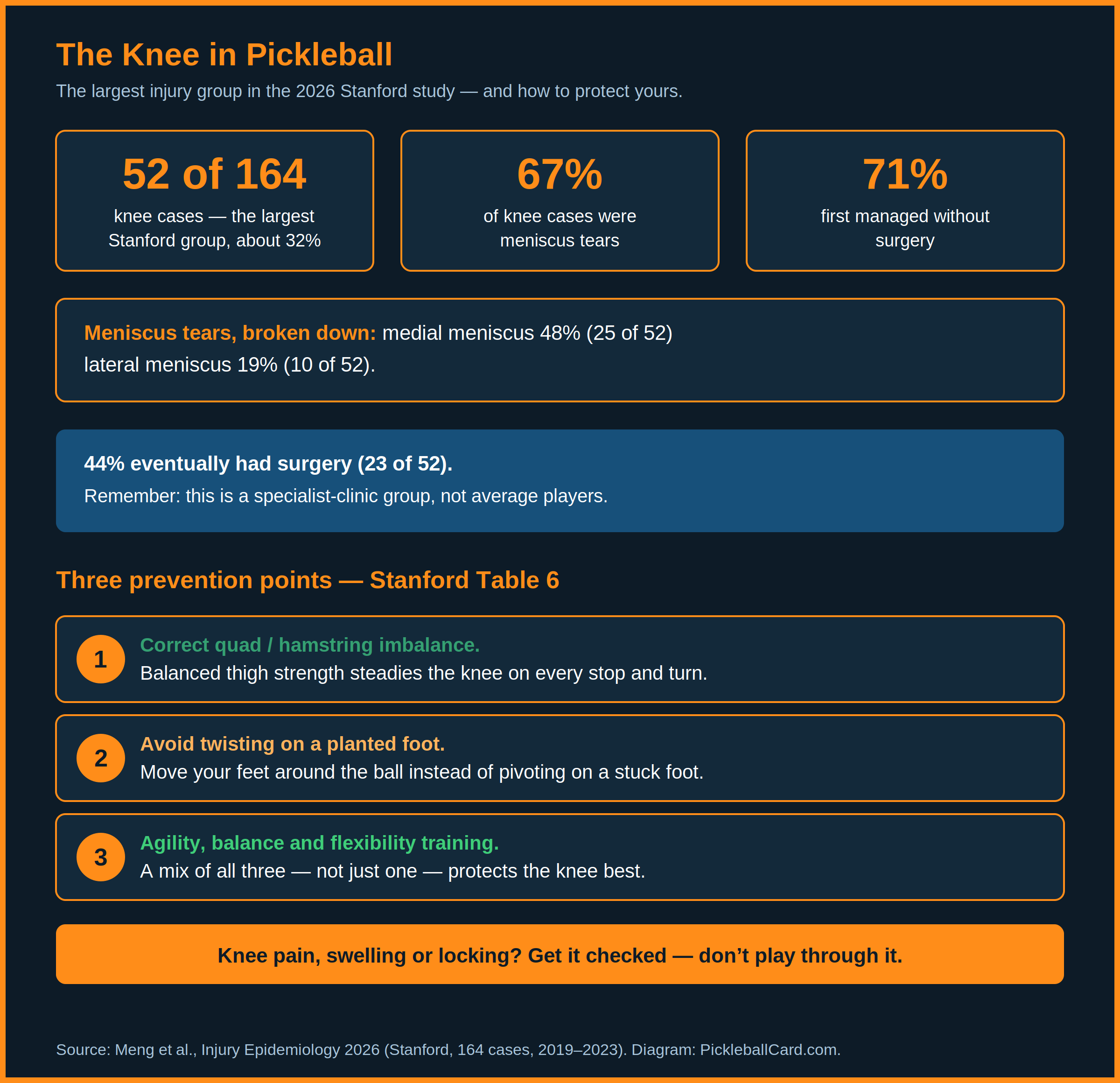
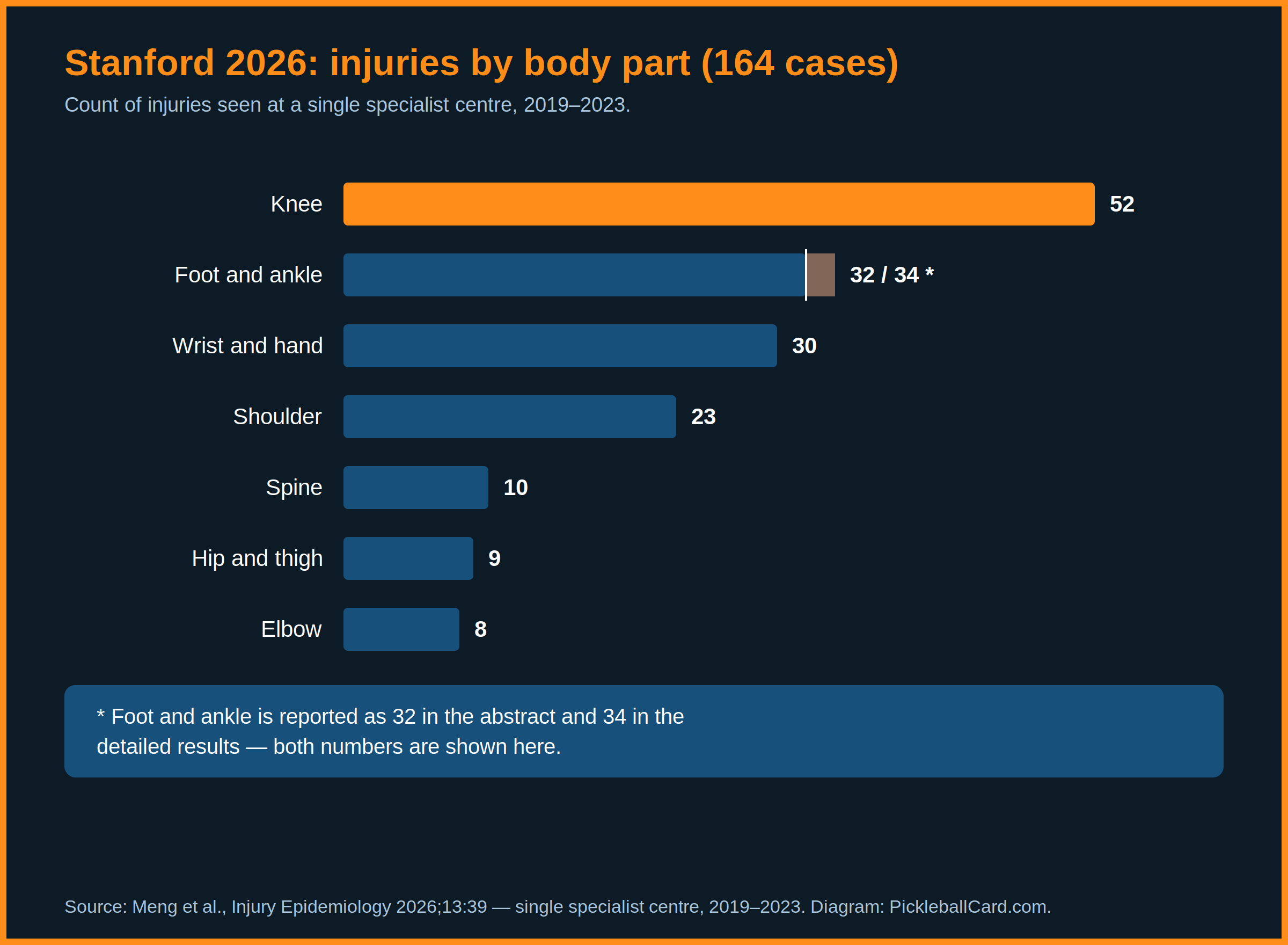
A 2026 Stanford study looked at 164 pickleball injuries seen in outpatient orthopaedic and sports-medicine clinics in 2019–2023. The knee was the largest group by a clear margin: 52 of the 164 cases, or about 32%.
The next largest groups were the foot and ankle (32–34 cases) and the wrist and hand (30 cases). It was a single specialist centre, so it skews towards more serious injuries — the kind that send someone to a clinic, not a sore knee that settles at home.
A nationwide survey of 1,758 players, published in 2025, asked what had bothered them in the past year. Again the knee came first: 29.1% reported a knee complaint, ahead of the shoulder at 22.2%, the back at 19.9% and the elbow at 18.4%.
Overall, 68.5% reported at least one complaint in the previous 12 months.
Meniscus Tears: The Most Common Knee Diagnosis
One diagnosis dominated the Stanford knee group: meniscal tears accounted for 67% of knee cases. The medial meniscus — the cartilage cushion on the inner side of the knee — was torn in 25 of the 52 knee cases (48%), and the lateral meniscus in 10 cases (19%).
Why the meniscus? A pickleball point asks your knee to stop suddenly, change direction, lunge wide, and twist while your foot is planted.
Houston Methodist’s orthopaedic guidance describes exactly that pattern, and the Stanford authors’ prevention table makes the same point: avoid twisting on a planted foot, and correct any imbalance between the quadriceps and hamstrings.
These injuries are not always minor: about 71% of Stanford knee patients were first managed without surgery, but 44% eventually had surgery (23 of 52 cases).
That is a specialist-clinic figure, not a prediction for the average player — but it shows why knee pain that keeps coming back deserves a clinician’s opinion rather than being played through.
Ligaments, Arthritis Flares and Falls
Meniscus tears are the headline, but not the whole knee story. Houston Methodist lists knee ligament strains — the medial and lateral collateral ligaments, the MCL and LCL — alongside meniscus tears, calf and hamstring strains, and flares of knee arthritis.
Emory Healthcare’s orthopaedic guidance adds anterior cruciate ligament (ACL) injuries and knee pain.
Pickleball does not cause arthritis in a healthy knee, but hard stops and lunges can flare one that already has arthritis — ask your clinician how much pickleball suits your knee.
Falls can also twist a knee: in US emergency-department data for 2013 to 2022, falls were the most common mechanism of pickleball injury overall, at 65.5% of presentations, and players aged 65 to 80 accounted for 61.1% of presentations.
Who Is Most at Risk?
Two risk factors stand out, and both are about how you play rather than how old you are. In the 2025 survey of 1,758 players, playing three or more times a week was linked to 45% higher odds of reporting an injury or complaint, compared with playing twice a week or less.
Having played for less than five years was linked to 50% higher odds. Both figures are from the 2025 all-complaint analysis, not the later upper-extremity study (which found 64% higher odds for frequent play).
The most consistent predictor was attitude, not age or fitness: players who rated injury prevention as low or moderate in importance had about twice the injury odds as players who rated it highly. The study was cross-sectional, so it cannot prove causation.
Age is more complicated. In the upper-extremity analysis, players aged 63 and over had no higher odds of an upper-body injury than players aged 18 to 32; the highest odds were in the 33-to-62 age bands.
A separate 2021 study found that 86% of emergency-department visits for pickleball injuries between 2010 and 2019 were in people over 60 — older players are more likely to reach an emergency department, often after a fall.
Our guide to pickleball tips for seniors covers managing a session when your body needs more recovery time.
How Knee Injuries Happen on Court
Most knee injuries in pickleball are not caused by a collision. They come from four everyday movements.
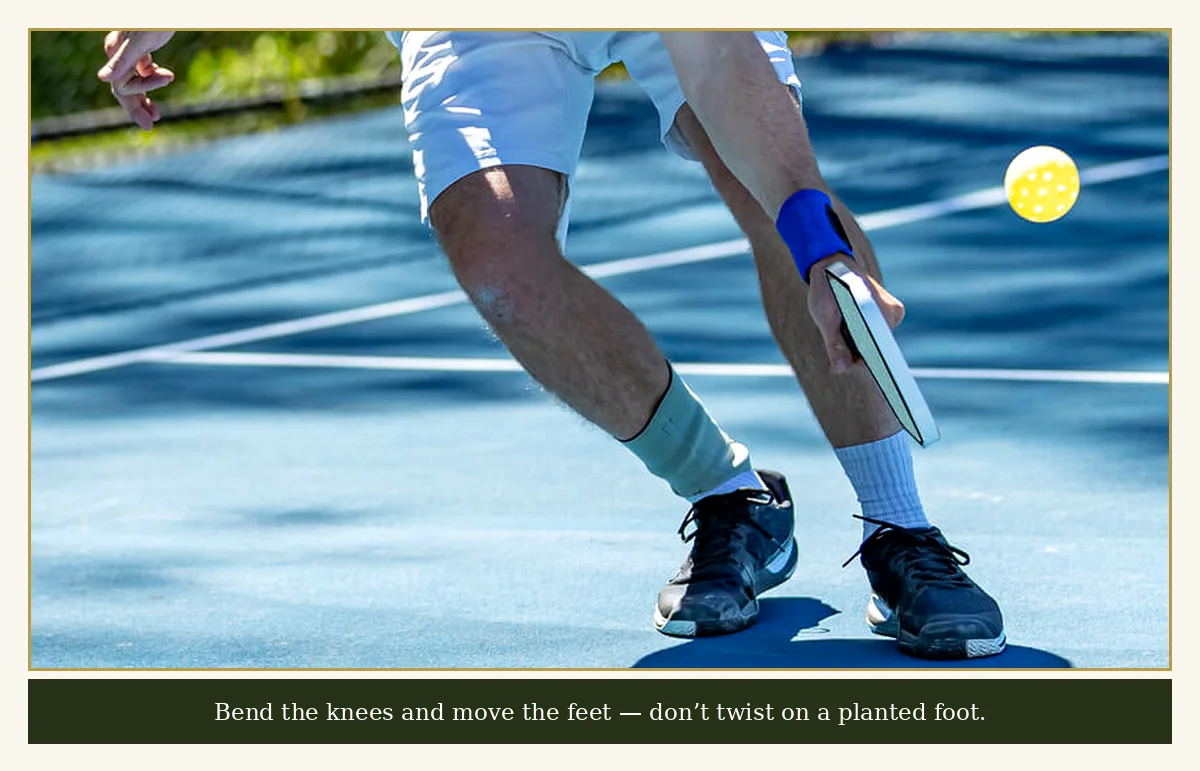
Twisting on a planted foot. You reach for a wide dink, your foot stays stuck, and your body rotates over it. Move your feet to the ball instead of reaching, and plant your foot under your centre of mass.
Our footwork and agility drills and the split step both train that habit.
Sudden stops and sharp cuts. Houston Methodist’s footwork guidance warns that sudden stops and sharp cuts stress knee ligaments: shuffle with your feet under your body rather than lunging across it. Small, quick steps beat long lunges.
Backpedalling for a lob. Running backwards is the riskiest way to chase a lob, for your knees and for your balance. Turn your hips and run diagonally, or let the ball go.
Our guide on how to defend the lob shows the turn-and-shuffle method.
Ramping up too fast. Starting from little activity and suddenly playing several days a week, for hours at a time, is a classic set-up for knee trouble.
Dr. Christopher Wu, a sports-medicine doctor quoted by the American Medical Association in July 2026, said strains, shoulder and knee pain and elbow problems often result from ramping up too quickly.
The University of Iowa Health Care advises starting at twice a week for 30 to 45 minutes.
Prevention: What Has Evidence Behind It
No study has tested a pickleball-specific injury-prevention programme, so nobody can honestly promise a routine that cuts pickleball knee injuries by a set percentage.
What exists is good evidence from other court and field sports: strength and balance work helps, stretching alone does not. A 2014 meta-analysis in the British Journal of Sports Medicine pooled 25 randomised trials with 26,610 participants.
Stretching alone had no beneficial effect. Multicomponent programmes — combining strength, balance and flexibility work — cut injuries by about a third, and strength training alone cut them by about two-thirds. Those are general-sport figures, not pickleball figures.
Stanford’s authors recommend correcting quadriceps and hamstring imbalance, avoiding twisting on a planted foot, and multicomponent agility, balance and flexibility training.
The American Medical Association adds: warm up dynamically, stay active outside pickleball with resistance and aerobic exercise, and get lessons on technique.
Our pickleball strength training plan and warm-ups and cool-downs guide are the places to start.
Shoes matter more than most players think. Houston Methodist and the American Medical Association both recommend court shoes with firm sides and good grip, and warn against running shoes, which have soft soles and little side-to-side support.
If you already have knee pain, our guide to the best pickleball shoes for knee pain is a useful next read, alongside our general best pickleball shoes guide.
The knee picture at a glance:
| Knee problem | What the evidence says | What helps |
|---|---|---|
| Meniscus tear | 67% of Stanford knee cases; medial 48%, lateral 19% | Avoid twisting on a planted foot; strengthen quads and hamstrings |
| Ligament strain | MCL, LCL and ACL strains listed by Houston Methodist and Emory | Small steps, shuffle, plant under your centre of mass |
| Fall-related injury | Falls caused 65.5% of pickleball emergency-department presentations | Never backpedal; balance training; court shoes with firm sides |
When to Get Your Knee Checked
This article is general information, not medical advice, and it cannot diagnose your knee.
Seek prompt medical care if you cannot bear weight on the leg, the knee locks or gives way, it swells quickly after a twist or fall, you heard a pop at the time of injury, or the pain keeps returning every time you play.
Numbness, tingling, weakness or deformity after a fall also need prompt care. If the same pain returns session after session, ask a clinician or physiotherapist to check the knee and set any strengthening work at the right load.
A Note on Medical Information
Everything in this article is general information about pickleball knee injuries, based on the published studies and hospital guidance listed in the editor’s notes. It is not medical advice, and it cannot diagnose or treat an injury.
Only a clinician who examines you can tell which cause applies. If you are new to exercise, have heart or lung problems, or have an existing knee condition, get medically cleared before starting a new exercise routine.
Frequently Asked Questions
What is the most common pickleball knee injury?
A meniscus tear. In a 2026 Stanford study, meniscal tears accounted for 67% of the 52 knee cases: medial meniscus 48%, lateral meniscus 19%.
Why does my knee hurt after pickleball?
The most common reasons in the evidence are twisting on a planted foot, sudden stops and sharp cuts, lunging instead of taking small steps, and ramping up playing time too quickly. Persistent pain should be checked by a clinician.
Can I play pickleball with a meniscus tear?
Only a clinician who has examined your knee can answer that. In the Stanford study, about 71% of knee patients were first managed without surgery, but 44% eventually had surgery — a specialist-clinic group, not average players.
Do knee braces prevent pickleball knee injuries?
No — there is no pickleball-specific trial evidence in this article’s sources for braces preventing knee injuries. Ask a clinician whether one suits your knee.
Are running shoes bad for pickleball knees?
Running shoes are not designed for pickleball. Houston Methodist and the American Medical Association both recommend court shoes with firm sides and good grip, because running shoes have soft soles and little side-to-side support.
How often should I play to protect my knees?
Start twice a week for 30 to 45 minutes if you are new or returning after a long break, building up gradually with rest days between hard sessions. In the 2025 survey, playing three or more times a week was linked to 45% higher odds of reporting an injury or complaint.

Shoaib is the publisher of Pickleball Card. He oversees the site’s guides to pickleball rules, ratings, strategy and gear, all researched from primary sources — the USA Pickleball Rulebook, DUPR and manufacturer documentation — and updated as the game changes.