The best senior pickleball players are rarely the fastest people on court. They are the calmest.
They stand in the right place early, keep the ball low, target the middle, and let impatient opponents donate the errors.
This guide is the senior game as one system: start safely, win position, play soft, move safely, and manage your session like part of the match.
Key Takeaways
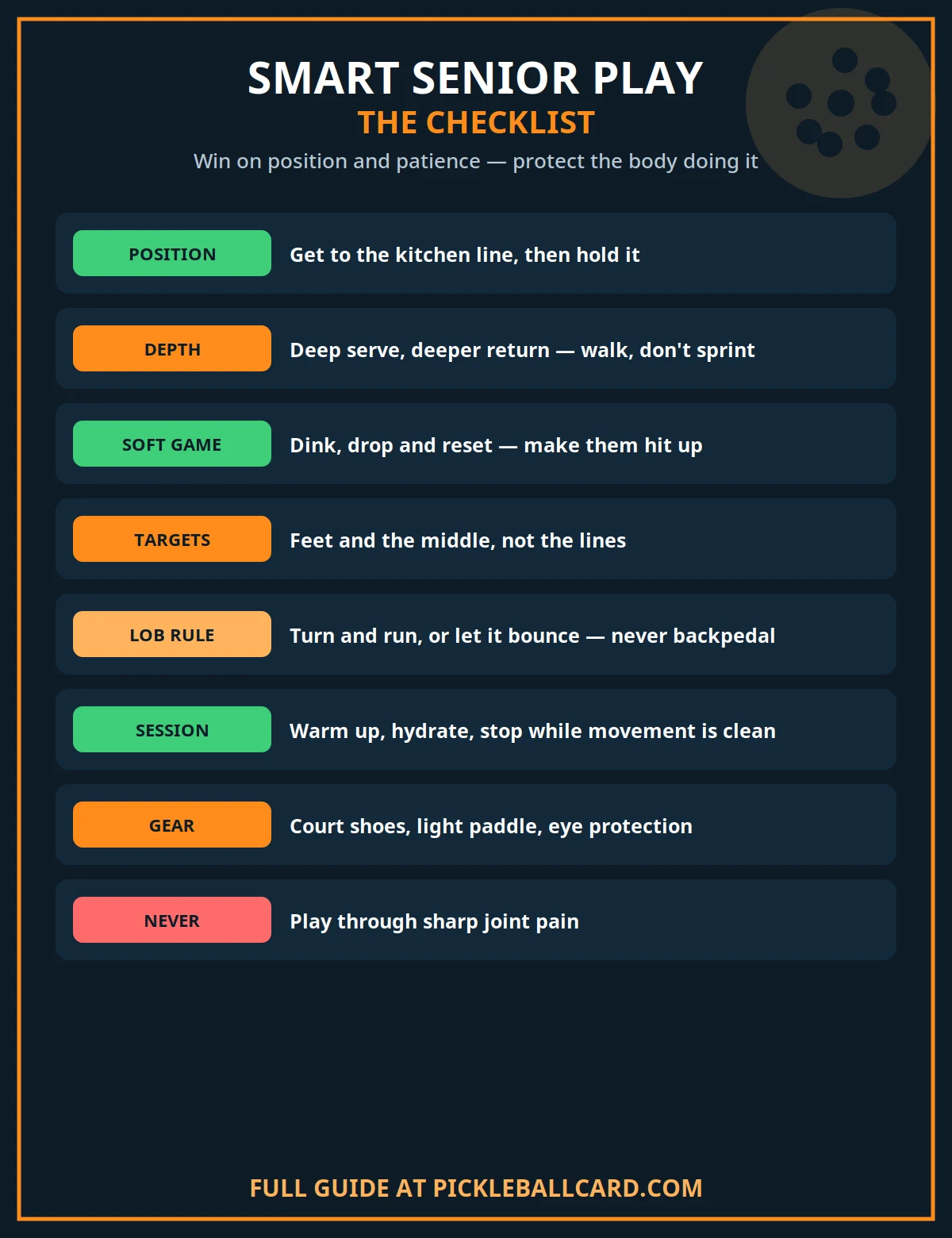
- Position beats speed. Arriving at the kitchen line early removes most of the running younger players rely on.
- Deep serve, deeper return. Depth buys you walking time instead of sprinting time on every single rally.
- The soft game is your power game. Dinks, drops and resets force opponents to hit up, where your put-away waits.
- Never backpedal for a lob. Turn and run, or let it bounce. One point is never worth a fall.
- Target feet and the middle. Low balls to the middle cause confusion and pop-ups without any extra swing speed.
- Manage the session, not just the rally. Warm up, pace yourself, hydrate, and take rest days seriously.
The Short Answer
Play doubles, get to the kitchen line behind a deep return, and stay there. Keep the ball low, aim at feet and the middle, and be patient.
Most recreational points end on errors, not winners. The senior advantage is simple: experienced players make fewer of them, and recognise patterns sooner.
Add three safety habits — a real warm-up, no backpedalling, sensible session length — and the same game that wins points also protects your body.
Before You Play: Start Safely
Health note: this article is general information for recreational players, not medical advice. If you have a heart condition, joint replacement, balance problem or any new pain, talk to your doctor or physiotherapist before playing, and follow their guidance over anything here.
The CDC recommends that adults 65 and older build toward at least 150 minutes of moderate aerobic activity each week, plus muscle-strengthening activity on two days and regular balance work.
Pickleball can contribute to the aerobic part of that week. It does not replace strength and balance work, which matter just as much for staying on court.
The CDC also stresses that some activity is better than none, and that you should be as active as your abilities and conditions allow. Start where you are.
For the broader picture, our guide to the health benefits of pickleball covers what regular play does for heart, mood and mobility.
Warm Up Like It Counts
Arrive ten minutes early. Walk the court, swing gently, hit easy dinks, and only then start a game.
Cold muscles and cold joints are where most senior strains begin. The first game of the day should feel like part of the warm-up, not a final.
Our routine of stretches and warm-up exercises for pickleball takes a few minutes and covers shoulders, calves, hips and ankles.
Positioning Beats Speed
Win the Kitchen Line, Then Refuse to Leave It
The non-volley zone line is the strongest address in pickleball. From there you cut off angles, volley balls at opponents’ feet, and shrink the court you must defend.
Getting there calmly is a skill. Move forward behind shots that push opponents back, stop and split-step as they swing, then continue.
Once established, slide sideways with your partner like a connected wall. Most senior points are won by the pair that holds the line longest.
Stand Where the Next Ball Is Going
Anticipation is free court coverage. Watch your opponents’ paddle angle and habits for three rallies, and you will start moving before the ball is hit.
Favour the middle with your positioning. The middle is the most attacked target in doubles, and covering it removes the easiest ball your opponents own.
Call the middle balls out loud. A simple “mine” or “yours” prevents both the collisions and the silent gaps that cost senior pairs points.
The Soft Game Is Your Power Game
Dink With a Purpose
A good dink lands softly in the kitchen and bounces low. Hit enough of them and your opponent must eventually lift one — that lift is your real attacking ball.
Move opponents side to side with patient cross-court dinks. Every extra step they take is energy spent and balance loaned to you.
Resist the speed-up from below net height. From low balls, power mostly produces errors or easy counters back at your feet.
Reset Instead of Swinging Bigger
When a hard ball arrives at your body or feet, block it softly into the kitchen instead of swinging back. That reset turns their attack into a neutral rally.
Loosen your grip and let the paddle absorb the pace. A soft hand is a trainable skill, and it is the highest-value one for senior players.
Players who reset well become miserable to attack. Bangers stop driving at the person who keeps quietly handing the ball back at their shoelaces.
Drop the Third Shot
After your serve, a soft third shot that arcs into the kitchen lets your pair walk to the line together instead of being pinned back by a drive.
The drop does not need to be perfect. It needs to be low enough that the return must be hit upward, buying your steps.
Serve and Return: Depth Buys Time
A deep serve pushes returners behind the baseline and slows their approach. Aim for the back third of the service box, with margin for error.
The return matters even more. Return deep, ideally to the weaker backhand side, then move forward behind it while the ball is still travelling.
That one habit — deep return, immediate walk forward — is the closest thing senior pickleball has to a cheat code. It converts defence into position every rally.
Vary serve placement occasionally to the wide corner. The point is not the ace; it is making the returner take one extra step before hitting.
Footwork That Protects Your Body
Never Backpedal
Backpedalling is how falls happen. When a lob goes over your head, turn your shoulders, run back sideways-on, and play the ball after it bounces if needed.
If you cannot get there safely, let it go. Conceding one lob costs a point; chasing it badly can cost a season.
Stand a half-step off the kitchen line if lobs trouble you. That small cushion turns an emergency sprint into a comfortable turn and run.
Small Steps, Early Split
Shuffle sideways rather than crossing your feet in fast exchanges. Small adjustment steps keep your balance centred and your knees out of twisting trouble.
Split-step — a small hop landing balanced — as your opponent contacts the ball. Flat feet are stuck feet, at any age.
Wear proper court shoes with lateral support, not running shoes. Running shoes are built to tip you forward; pickleball moves you sideways.
Shot Selection: Feet, Middle, Patience
Aim at feet, not at lines. A low ball at an opponent’s shoes forces an awkward lift, and lifts are what experienced players put away.
The middle is the safest attacking target in doubles. It is the longest court over the lowest part of the net, and it tests partner communication.
Use one well-timed lob per game against a team crowding the line. Even when it does not win the point, it changes where they stand afterwards.
Above all, count errors honestly. If your last three speed-ups missed, the pattern is the message: return to dinks, drops and resets until the rally tilts.
Playing Younger and Harder-Hitting Opponents
Take pace off everything. Younger players feed on speed; a slow, low, patient game removes the ball they want and hands them the ball they mishit.
Keep returns and resets away from their forehand drive. Most hard hitters are far less dangerous hitting a backhand from below the net.
Slow the game between points too. Use your full time, towel off, and set your feet. Rhythm belongs to whoever refuses to be hurried.
Manage the Session, Not Just the Rally
| Habit | Why it matters | Simple standard |
|---|---|---|
| Warm-up | Cold tissue strains more easily | Ten minutes of walking, swings and easy dinks |
| Session length | Fatigue wrecks footwork before it wrecks shots | Stop while your movement is still clean |
| Hydration | Dehydration slows reactions and recovery | Drink before you feel thirsty, every changeover |
| Rest days | Adaptation happens between sessions | Alternate hard days with light or off days |
| Pain signals | Small aches become layoffs when ignored | Sharp or joint pain ends the session, full stop |
Build playing time gradually across weeks, not across one enthusiastic Saturday. Your second month should be bigger than your first week, not your second day.
Cool down with a short walk and gentle stretching. It takes five minutes and tomorrow’s stiffness will be noticeably less for it.
Sore elbow or forearm after sessions? Read our guide to pickleball elbow prevention early — grip size, swing habits and load are usually fixable.
Find Games at Your Level
Open play is where senior pickleball lives, and choosing the right session matters as much as choosing the right paddle.
Most venues run beginner and intermediate sessions, and many run senior-specific court times. Start one level below where you think you belong; moving up is a pleasant errand.
Level-matched games are safer games. Wild mismatches produce lunging, scrambling and frustration on one side, and boredom on the other.
Tell new partners your level and any movement limits honestly. “I do not chase lobs” is useful information, not an apology.
Be the Partner Everyone Wants
Rotate willingly, encourage beginners, and keep games moving. Reputation travels fast in a senior playing community, and good partners get invited back.
Share the middle shots generously early in a partnership. Trust built in game one pays out for the rest of the session.
Build a Weekly Rhythm That Lasts
Two or three sessions a week suits most senior players starting out. That rhythm leaves recovery days between court days, which is when fitness actually improves.
Add the CDC’s other two ingredients around your pickleball: muscle-strengthening activity on two days a week, and regular balance practice.
Neither needs a gym membership. Sit-to-stands, heel raises, wall push-ups and heel-to-toe walking cover both, in your own hallway, in ten minutes.
Keep one session a week light — drilling, dinking games or social play. Not every court day should be a tournament in disguise.
Track your weeks honestly for the first month. If Tuesdays after Monday sessions feel heavy, your schedule — not your toughness — needs adjusting.
Gear That Helps Senior Players
- Paddle: a light-to-midweight paddle you can manoeuvre without gripping hard. Excess weight and a too-small grip both make your forearm do the work.
- Shoes: genuine court shoes with sideways support and a durable outsole. This is the single most protective purchase a senior player makes.
- Eye protection: a deflected ball at the kitchen line arrives faster than anyone’s blink. Lightweight protective eyewear is cheap insurance.
- Sun and heat kit: hat, sunscreen and water for outdoor play. Heat tolerance drops quietly with age; plan for it instead of discovering it.
Common Senior Mistakes
| Mistake | Cost | Fix |
|---|---|---|
| Staying back after the return | Kitchen line — and the rally — conceded | Return deep, then walk forward immediately |
| Backpedalling for lobs | Falls and wrist injuries | Turn, run, or let it bounce |
| Speeding up low balls | Errors and easy counters | Reset and dink until the ball sits up |
| Swinging big from the shoulder | Elbow and shoulder strain | Compact swing, loose grip, let placement score |
| Playing through sharp pain | Weeks off instead of one day off | Stop, ice, and get checked if it persists |
| Skipping the warm-up | First-game strains | Ten easy minutes before the first serve |
A Simple Pre-Session Checklist
- Arrive early. Ten minutes for walking, mobility and easy dinks before any game starts.
- Check your kit. Court shoes tied, eyewear on, water bottle full, hat if you are outdoors.
- Pick your partners’ plan. Agree who takes the middle before the first serve, not during the first argument.
- Set a session limit. Decide your finish time now, while you are fresh and honest.
- Finish with a cool-down. Walk, stretch gently, and note anything that aches for next time.
Frequently Asked Questions
Is pickleball safe for seniors?
For most healthy older adults, yes — it is a moderate, social, stop-start sport on a small court. It is not risk-free: falls and strains happen, which is why warm-ups, court shoes and no backpedalling matter.
What is the best age to start pickleball as a senior?
There is no cut-off. People start in their sixties, seventies and beyond. Start with doubles, beginner sessions and shorter playing blocks, and build up over several weeks.
How long should a senior play pickleball in one session?
Let movement quality decide. Many senior players do well with 60 to 120 minutes including breaks, stopping while footwork is still clean rather than when exhaustion forces it.
Is singles or doubles better for senior players?
Doubles, for almost everyone. A partner halves your court, doubles adds the social side, and the running load is far more manageable than in singles.
What paddle weight suits senior players?
Generally a light-to-midweight paddle that you can move quickly without squeezing the grip. If your elbow or shoulder aches after play, paddle weight and grip size are the first things to check.
Can senior players beat younger, faster opponents?
Regularly. The small court limits raw speed, and recreational games are decided by errors. Placement, patience, deep returns and a stubborn soft game close the athletic gap quickly.
The Bottom Line
Senior pickleball rewards the player who moves early instead of fast: deep serve, deeper return, a calm walk to the kitchen line, and a soft game played at opponents’ feet.
Protect that game with the unglamorous habits — warm up, never backpedal, wear court shoes, pace the session, and respect pain early.
Do those things and age stops being the story of your matches. Your positioning, patterns and patience become the story instead.
Sources: CDC, Older Adult Activity: An Overview (150 minutes weekly, muscle-strengthening and balance guidance) and USA Pickleball, Official Rules (non-volley zone and serve rules). Coaching content in this article is original; no competitor content is linked or reproduced.