Ankle sprains are one of the most common leg injuries in pickleball: a sudden stop, a sharp cut, a lunge for a ball just out of reach — and the ankle rolls before the rest of the body catches up. The good news is that ankles are also one of the most preventable injuries.
The right shoes, better footwork and a bit of balance work cover most of the risk.
Achilles tendon injuries get their own article — see our separate article on pickleball Achilles injuries. This article covers ankle sprains and instability.
How Common Are Pickleball Ankle Injuries?
There is no single clean count of ankle sprains, because studies group foot and ankle together. A 2026 Stanford study reviewed 164 pickleball injuries seen at its outpatient orthopaedic and physical medicine clinics in 2019–2023.
The foot and ankle was one of the larger groups — the abstract says 32 cases, the detailed results 34, so take it as about 32 to 34 cases. The knee was the largest group at 52.
About half were Achilles tendon tears (16 cases), leaving ankle sprains, fractures and other foot injuries to make up the rest.
The survey evidence points the same way. In a 2025 analysis of 1,758 players by Owoeye and colleagues, 68.5% reported at least one injury or complaint in the past year, and the combined lower extremity — thigh, leg and foot — accounted for 26.9%.
Clinicians list ankle sprains near the top of lower-limb injuries: Houston Methodist’s Dr. Bobby Song includes them among the leg injuries players should expect, and Scripps lists ankle sprains first among common injuries.
Falls are the other half of the story.
A 2025 study of US emergency-department data by Yu and colleagues estimated about 66,350 pickleball-related injuries presenting to emergency departments in 2013–2022, with falls the most common mechanism (65.5%) and strains and sprains the second most common diagnosis (30.8%).
See our common pickleball injuries guide.
Why Ankles Get Hurt
Pickleball is a stop-start game on a small court, and that is exactly what ankles dislike.
Houston Methodist’s Dr. Haris Vakil, writing in February 2026, describes the mechanisms plainly: sudden stops and sharp cuts stress the knee ligaments, while the drop step strains the calf and Achilles.
Princeton Sports and Family Medicine lists the same triggers: quick starts and stops, lateral movement, reaching, lunging and twisting.
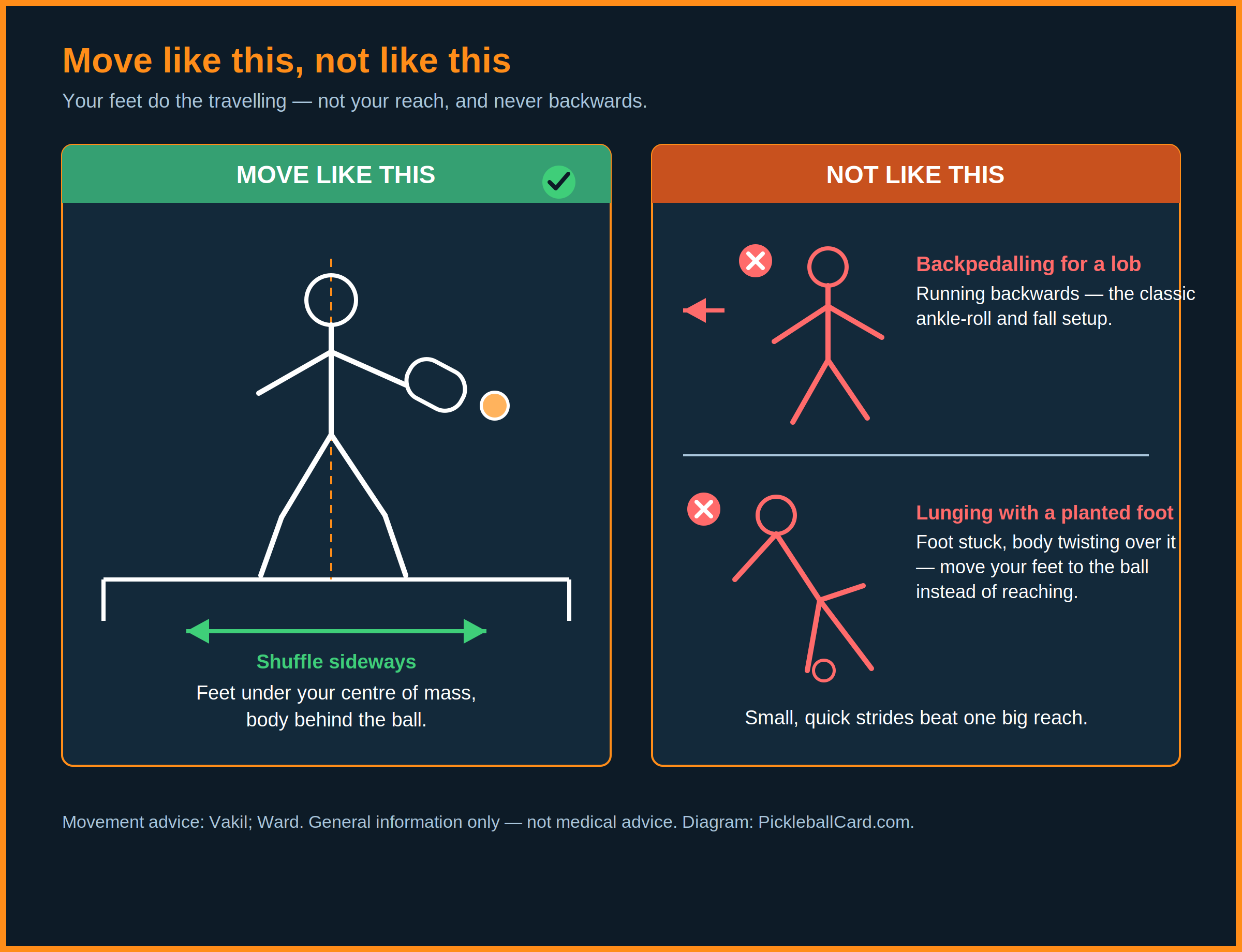
Three habits load the ankle most. The first is reaching instead of moving your feet: when a ball lands two feet to your side and you stretch for it, your ankle takes the load at a bad angle. Dr. Vakil’s advice is to take small, quick strides and get your body behind the ball.
The second is backpedalling. Chasing a lob by running backwards is the single most warned-against movement in pickleball injury advice.
Orthopaedic surgeon Dr. Steven Ward puts it bluntly: “Never backpedal. Turn and shuffle back for lobs, or let the ball go.” Scripps gives the same advice, and Dr. Vakil recommends turning the hips and running the diagonal rather than going straight back.
Our defending the lob guide covers the safer alternatives.
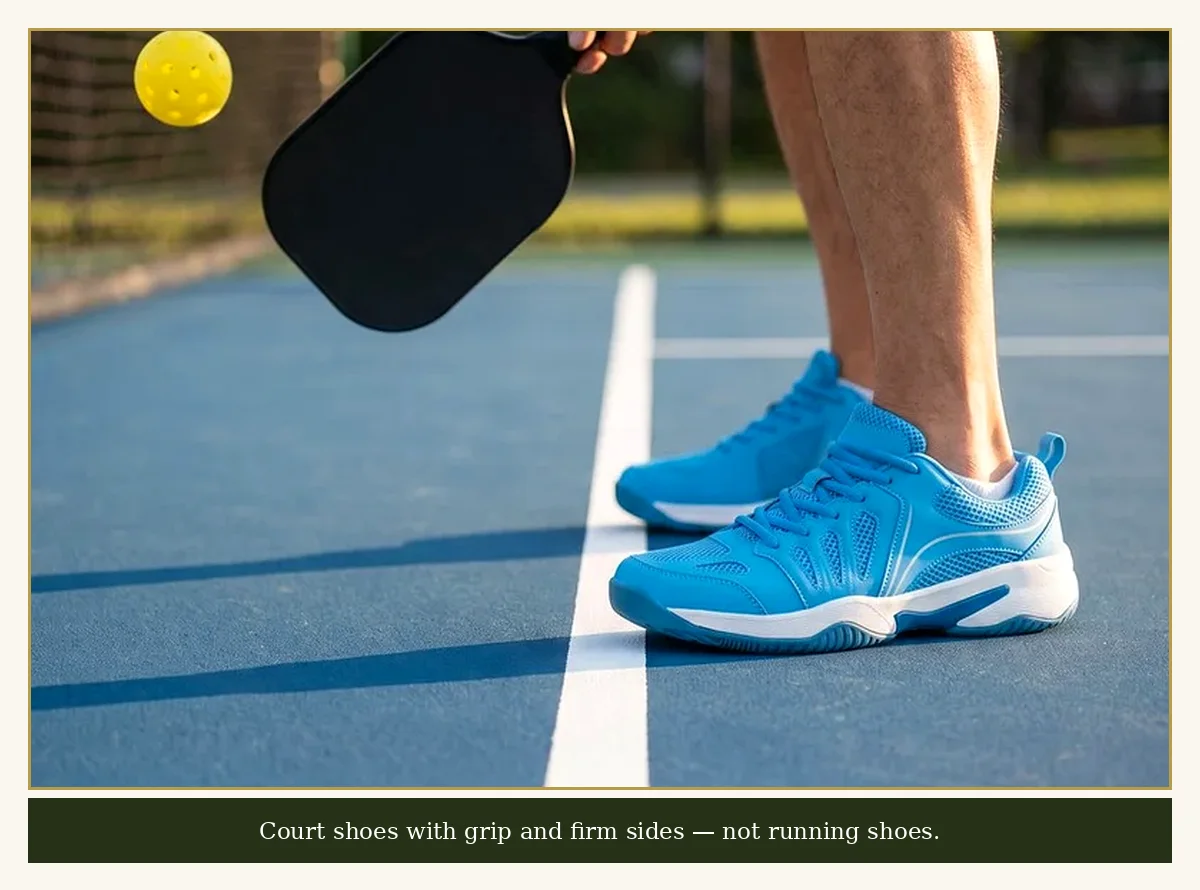
The third is the wrong shoes. Running shoes are built for moving forward in a straight line, with soft soles and little side support. Pickleball moves sideways, stops hard and pivots — and a soft-soled running shoe lets the ankle roll when it does.
Houston Methodist’s Dr. Song writes that shoes designed for tennis or pickleball can significantly decrease the risk of injury, because they provide better side-to-side support and court traction.
The AMA’s Dr. Christopher Wu agrees: look for court shoes with firm sides and grip, and avoid running shoes with soft soles.
| What loads the ankle | What helps |
|---|---|
| Sudden stops and sharp cuts | Plant under your centre of mass, use shuffles (Vakil) |
| Backpedalling for lobs | Turn and shuffle back, or let the ball go (Ward) |
| Reaching and lunging | Small, quick strides; get your body behind the ball (Vakil) |
| Running shoes | Court shoes with firm sides and grip (Song; AMA) |
| Weak balance and leg strength | Balance and strength work (Lauersen; Healthcare 2025) |
Footwork and Shoes
Good footwork is ankle protection, because most sprains happen when the feet are in the wrong place. Dr. Vakil’s rules are simple: small, quick strides; get your body behind the ball; plant under your centre of mass; use shuffles for sideways movement.
The split step is part of the same picture — landing balanced and ready as your opponent hits, so your first step goes in the right direction instead of a panicked lunge.
See our pickleball split step guide and footwork and agility drills.
At the kitchen, move your feet to the ball even when it is only a step away: players who plant their feet and stretch for a dink load the ankle at its weakest angle, while one small shuffle step keeps you balanced.
Check two things when you buy court shoes. First, the shoe should resist twisting sideways — if you can wring it like a towel, it will not hold your ankle on a hard cut.
Second, replace worn shoes: Princeton lists worn shoes among the risk factors, and worn tread loses the grip that stops a slide turning into a fall.
See our best pickleball shoes guide, and our best pickleball shoes for knee pain guide for supportive options that also suit sore knees.
Strength and Balance Work
Strong, well-balanced legs protect ankles — and the evidence is better than for almost anything else in injury prevention.
A 2014 BJSM meta-analysis of 25 randomised trials with 26,610 participants found balance (proprioception) training cut injuries by about 45% (risk ratio 0.550).
Strength training cut them to under a third (0.315), and multicomponent programmes combining strength, balance and flexibility cut them by about a third (0.655).
Stretching alone did not reduce injury risk. Those are general-sport findings, not pickleball findings — no trial has tested a balance programme in pickleball specifically — but they match what clinicians recommend.
One small pickleball-specific study points the same way. A 2025 study in Healthcare followed 29 regular players aged 55 and over who had fallen or limited their play because of fear of falling.
Twelve did a 10-week programme of strength, balance, change-of-direction and agility work, while 17 did not.
The training group got 0.7 seconds faster on a change-of-direction test, and at five-month follow-up falls during play were reported by 25% of the training group versus 44% of the control group.
The trainers held their hip strength while non-trainers lost 12%, though the trainers’ own small gain was not statistically significant. Small and non-randomised, so encouraging rather than proof.
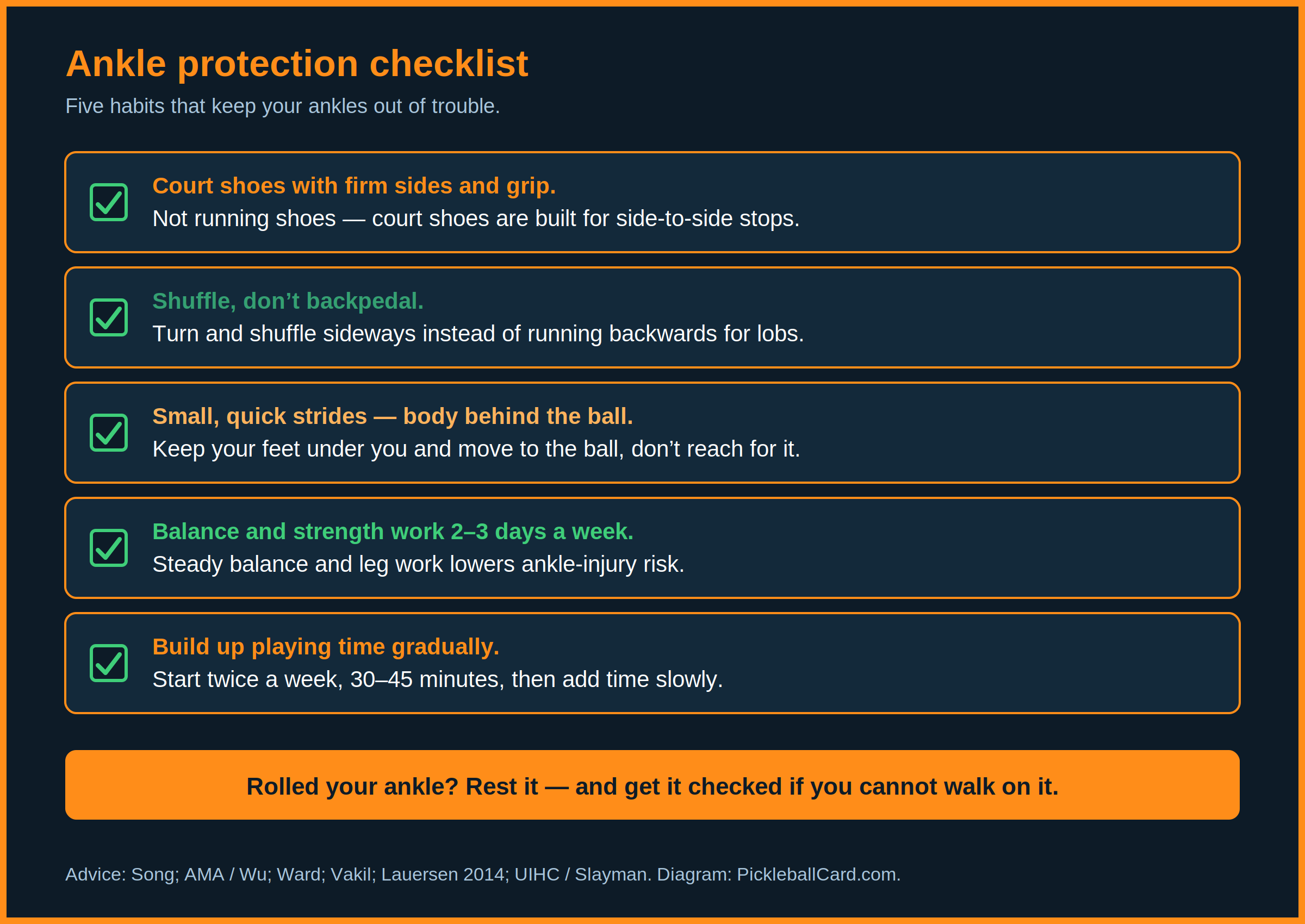
Our pickleball strength training plan covers lower-body and balance work, and Dr. Ward recommends strength and balance work two to three days a week to protect every joint.
Build Up Gradually and Warm Up
Ankle injuries often follow doing too much too soon. The University of Iowa’s Dr. Tyler Slayman suggests starting at twice a week for 30 to 45 minutes, rather than seven days a week for three hours at a time, and adding time gradually.
Warm up for 5 to 10 minutes before play (Scripps), with a dynamic warm-up before the first match (AMA’s Dr. Wu). See our pickleball warm-ups and cool-downs guide.
Our pickleball tips for seniors cover positioning that reduces sudden lunges, and our pickleball drills include low-impact options.
If You Sprain Your Ankle
Most ankle sprains are ligament injuries from the ankle rolling, and most settle with rest and time — but this article cannot say how bad yours is.
Seek prompt medical care if you cannot bear weight on the ankle, there is obvious swelling or deformity, you feel numbness, or the pain does not ease over a few days. Those are reasons to get checked promptly, not a checklist to diagnose yourself from.
Typical ranges reported in player guides run 1 to 12 or more weeks for a lateral ankle sprain — a guide’s typical range, covering anything from a mild twist to a severe sprain, not a promise. A clinician who has examined it can give you a better sense of what to expect.
Do not rush back: a still-weak ankle is the one most likely to roll again.
A Note on This Article
This article is general information only — not medical advice, and it cannot diagnose or treat an injury. Figures come from the studies named in the text.
If you have ankle pain or a previous ankle injury, speak to a qualified health professional before starting a new exercise routine or returning to play.
Frequently Asked Questions
What is the most common pickleball ankle injury?
An ankle sprain — the ankle rolling when you stop, cut or land awkwardly.
Clinicians list ankle sprains near the top of the lower-limb injuries they see: Houston Methodist’s Dr. Bobby Song includes them among the leg injuries players should expect, and Scripps lists ankle sprains first among common injuries.
Are court shoes better than running shoes for pickleball?
Yes. Running shoes are built for straight-line forward movement, with soft soles and little side support. Court shoes have firmer sides and outsoles designed for cutting, pivoting and lateral movement.
Houston Methodist’s Dr. Song says court shoes can significantly decrease the risk of ankle sprains and Achilles injuries.
Should I backpedal for a lob?
No. Turn and shuffle back for lobs, or let the ball go. Orthopaedic surgeon Dr. Steven Ward is blunt about it — “Never backpedal” — and Scripps and Houston Methodist give the same advice.
How long does a sprained ankle take to heal?
It varies widely. Typical ranges reported in player guides run 1 to 12 or more weeks for a lateral ankle sprain — a guide’s typical range, not a promise.
Do balance exercises really help prevent ankle sprains?
Yes. A 2014 BJSM meta-analysis of 25 randomised trials found balance training cut injuries by about 45% and strength training cut them to under a third — general-sport findings, not pickleball findings.
When should I see a doctor for an ankle injury?
Seek prompt care if you cannot bear weight, there is obvious swelling or deformity, you feel numbness, or pain does not ease over a few days. Repeated sprains in the same ankle deserve a clinician’s attention — they can point to instability.

Shoaib is the publisher of Pickleball Card. He oversees the site’s guides to pickleball rules, ratings, strategy and gear, all researched from primary sources — the USA Pickleball Rulebook, DUPR and manufacturer documentation — and updated as the game changes.