The Achilles tendon is the thick cord at the back of your ankle, joining the calf muscles to the heel bone. It is the strongest tendon in the body — and in pickleball, one of the most seriously injured.
In a 2026 Stanford study of 164 pickleball injuries, Achilles tendon tears made up about half of all foot and ankle cases. Most were men in their late forties, and every one opted for surgery.
This guide explains the evidence — slow-burn tendonitis and sudden tears — who is most at risk, and how to protect yours.
How Common Are Pickleball Achilles Injuries?
A 2026 Stanford study reviewed 164 pickleball injuries seen at Stanford’s outpatient orthopaedic and physical medicine clinics in 2019–2023.
The foot and ankle group was about 32 to 34 cases — the abstract says 32, the detailed results 34 — and Achilles tendon tears accounted for 16 of those cases, or about half — the single biggest diagnosis in the group.
The people affected were not who many would guess. The Achilles-tear group had a mean age of 49 — younger than the shoulder patients in the same study (mean age 67) — and 81% were men.
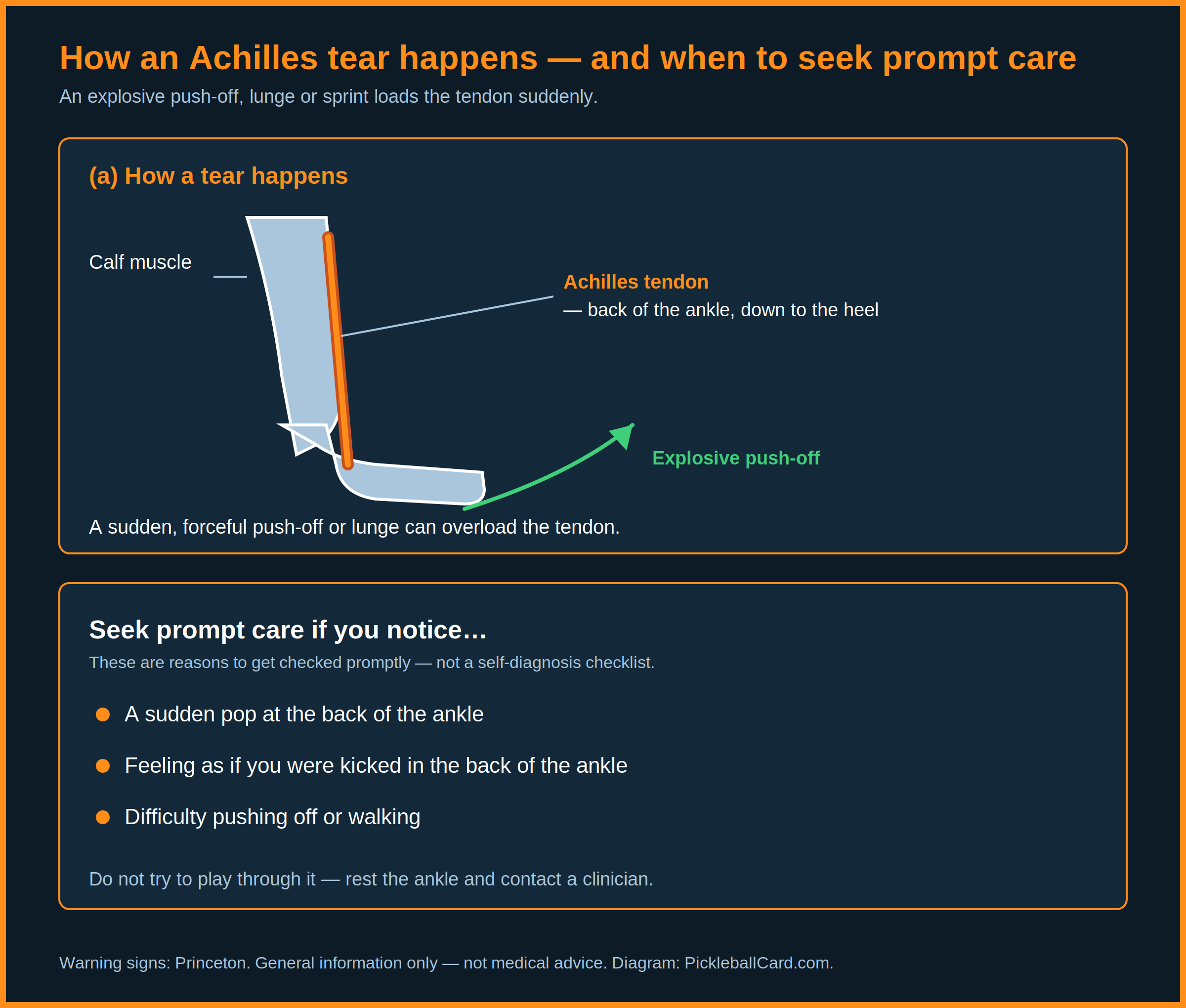
The mechanism was almost always the same: what the Stanford authors call an “explosive maneuver such as running after a ball, lunging, or pushing off”.
All 16 with an Achilles tear opted for surgery, although one was cancelled because the patient developed a blood clot (a pre-operative deep vein thrombosis) before surgery. Across the foot and ankle group, 15 of 34 cases — 44.1% — had surgery.
Stanford is a single tertiary centre, so these figures describe the serious end of the spectrum. Emory Healthcare lists Achilles tears and ruptures among players’ lower-extremity injuries.
See our common pickleball injuries guide.
Tendonitis vs a Tear
Achilles problems come in two very different forms.
Achilles tendonitis (tendinopathy) is the slow version: the tendon becomes painful, stiff and less tolerant of load after weeks or months of overuse. It often aches at the start of a session, eases as you warm up, then aches again.
It is an overuse problem — and a warning light, because a tendon that is already irritated is a tendon under strain.
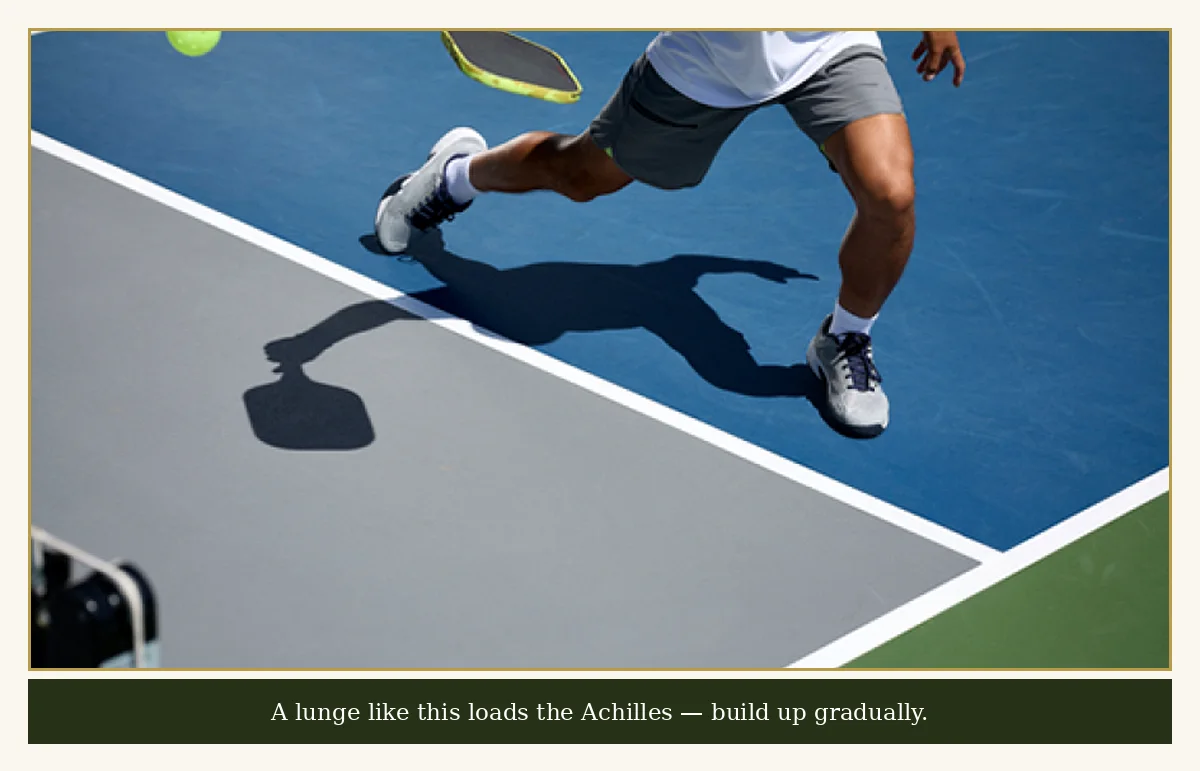
Achilles tear or rupture is the sudden version: the tendon splits, partly or completely, usually during one explosive push-off, lunge or sprint for a ball.
Princeton Sports and Family Medicine lists the signs that should send you for prompt care: a sudden pop, a feeling of being kicked in the back of the ankle, difficulty pushing off or walking, and calf-raise weakness.
Those are reasons to seek prompt medical care, not a checklist to diagnose yourself from — only a clinician who examines the ankle can say whether the tendon is torn.
Who Is Most at Risk?
The Stanford numbers point to a clear profile: men around 50, playing hard and pushing off explosively. But the risk is broader.
The University of Iowa’s Dr. Tyler Slayman warns that an Achilles tendon can rupture in players whose previous physical activity consisted mainly of walking and who are not used to explosive forward, backward and side-to-side movements.
Pickleball looks gentle from the sidelines, so people who have not exercised hard in years pick it up and play all out. Dr. Slayman adds: “Folks who were more sedentary will be at higher injury risk.”
Ramping up too quickly is also a risk. The AMA’s Dr. Christopher Wu notes that strains and joint pain often result from ramping up too quickly.
The survey evidence supports that: in the 2025 all-complaint analysis of 1,758 players by Owoeye and colleagues, playing three or more times a week carried 45% higher odds of an injury or complaint than playing twice a week or less (odds ratio 1.45).
And fewer than five years of experience carried 50% higher odds (odds ratio 1.50).
Those are all-complaint figures, not Achilles-specific ones.
Princeton lists limited calf and Achilles strength, worn shoes and shoes not designed for court movement among the risk factors. The calf and Achilles work as one unit: the calf generates the push-off force and the Achilles transmits it.
The drop step is a particular trigger — Houston Methodist’s Dr. Haris Vakil notes that it strains the calf and Achilles. The Stanford table also lists playing fatigued: a tired calf does not absorb load as well, and a tired player lunges more.
| Risk factor | What helps |
|---|---|
| Rapid increase in play | Build up gradually; start twice a week, 30–45 minutes (Iowa) |
| Weak calves and feet | Intrinsic foot and ankle strengthening (Stanford Table 6) |
| Poor heel support | Footwear with good heel support; court shoes (Stanford Table 6; Song) |
| Playing fatigued | Do not play fatigued (Stanford Table 6) |
| Drop step and lunging | Small, quick strides; get your body behind the ball (Vakil) |
| Skipping the warm-up | Dynamic warm-up before play (AMA) |
How to Protect Your Achilles
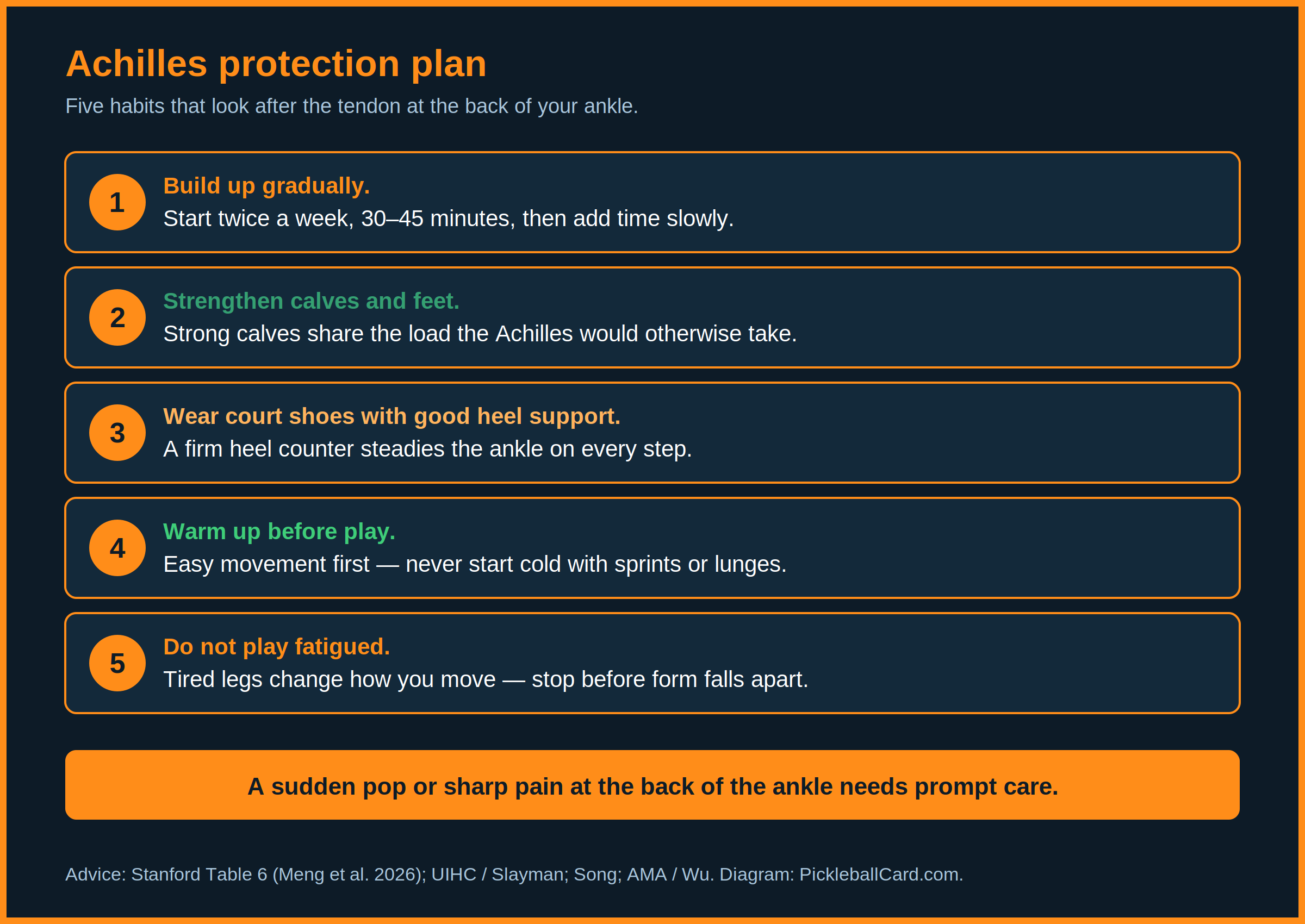
No pickleball-specific trial proves a particular Achilles routine prevents injury. The Stanford prevention table, clinician advice and general evidence agree.
Build up gradually. The Stanford table lists avoiding rapid training increases, and Dr. Slayman gives a starting point for people new to the game: twice a week for 30 to 45 minutes, rather than seven days a week for three hours at a time.
That is general advice, not a personal prescription. Returning after a break? Treat yourself as a new player for the first few weeks.
Warm up before you play, too — see our pickleball warm-ups and cool-downs guide.
Strengthen the calves and feet. The Stanford table recommends intrinsic foot and ankle strengthening and stretching.
General sports evidence supports the strength part: a 2014 BJSM meta-analysis of 25 randomised trials with 26,610 participants found strength training alone cut injuries to under a third (risk ratio 0.315), and multicomponent programmes cut injuries by about a third (0.655).
Those are general-sport findings, not pickleball findings. Our pickleball strength training plan includes lower-body work. Ask a clinician or physiotherapist to set the exercises and load.
Do not copy a named loading protocol from the internet: the right programme depends on whether the tendon is irritated or torn.
Wear court shoes with good heel support. The Stanford table lists footwear with good heel support, and Houston Methodist’s Dr. Song says shoes designed for tennis or pickleball can significantly decrease the risk of Achilles injuries.
The AMA’s Dr. Wu adds: look for court shoes with firm sides and grip, and avoid running shoes with soft soles. See our best pickleball shoes guide.
Move your feet instead of lunging. Dr. Vakil’s advice is to take small, quick strides and get your body behind the ball rather than reaching or lunging. The split step helps — landing balanced and ready as your opponent hits.
See our pickleball split step guide and footwork and agility drills.
Our defending the lob guide covers the safer movement for lobs; our pickleball tips for seniors and pickleball drills cover positioning and low-impact options.
If Your Achilles Hurts
Achilles pain that comes on gradually — aching at the start of a session, tenderness at the back of the ankle — is a reason to back off and get advice, not to play through it. Cut back on sessions, avoid explosive push-offs and lunges, and see a clinician or physiotherapist.
A sudden pop, a feeling of being kicked in the back of the ankle, or sudden difficulty pushing off or walking needs prompt care — the same day, not next week. Do not test the tendon yourself by hopping or doing calf raises.
Recovery from a rupture is long. Typical ranges reported in player guides run 6 to 12 months for an Achilles rupture — a guide’s typical range, not a promise. A clinician who has examined your ankle can say more about what to expect.
That range alone is a reason to take prevention seriously: this injury can cost you a season, not a weekend.
A Note on This Article
This article is general information only — not medical advice, and it cannot diagnose or treat an injury. Figures come from the studies named in the text.
If you have Achilles pain or a previous Achilles injury, speak to a qualified health professional before starting a new exercise routine or returning to play.
Frequently Asked Questions
What is the difference between Achilles tendonitis and an Achilles tear?
Tendonitis is the slow version: the tendon becomes painful, stiff and less tolerant of load over weeks or months of overuse. A tear is the sudden version: the tendon splits during one explosive push-off, lunge or sprint.
A tear needs urgent assessment; tendonitis needs load management and advice. Only a clinician who examines the ankle can say which one you have.
How common are Achilles injuries in pickleball?
In the 2026 Stanford study of 164 pickleball injuries, Achilles tendon tears made up about half of all foot and ankle cases — 16 cases. Emory Healthcare lists Achilles tears and ruptures among the lower-extremity injuries players face.
Who is most at risk of an Achilles tear?
In the Stanford study, the Achilles-tear group had a mean age of 49 and was 81% male. The University of Iowa’s Dr. Tyler Slayman adds that previously inactive players are at particular risk, because their tendons are not used to explosive movements.
Can shoes really help protect the Achilles?
Yes. The Stanford authors’ prevention table lists footwear with good heel support, and Houston Methodist’s Dr. Song says court shoes can significantly decrease the risk of Achilles injuries.
Running shoes, with soft soles and little side support, are the wrong tool for cutting and pivoting.
How long does an Achilles rupture take to recover?
It is a long recovery. Typical ranges reported in player guides run 6 to 12 months for an Achilles rupture — a guide’s typical range, not a promise.
Can I play through Achilles pain?
No — not without advice. Achilles pain that comes on gradually is a reason to back off the load and see a clinician or physiotherapist. Playing through it risks turning irritation into something much more serious.
A sudden pop or difficulty pushing off needs prompt care the same day.

Shoaib is the publisher of Pickleball Card. He oversees the site’s guides to pickleball rules, ratings, strategy and gear, all researched from primary sources — the USA Pickleball Rulebook, DUPR and manufacturer documentation — and updated as the game changes.