A good lob does not beat you with power. It beats you with indecision. The ball goes up, both partners glance at each other, somebody backpedals, and by the time anyone commits, the point is already lost.
Defending the lob is a learnable system, not a scramble. It has four parts: read the lob early, move without backpedaling, choose the right response for the depth you are facing, and recover as a pair.
This guide covers defence only. It explains how to anticipate a lob, how to position and move, when to take an overhead, when to let the ball bounce, and when a lob is simply the wrong shot — so you can punish it.
If you want the offensive side — how and when to hit a lob yourself — read our separate guide to the pickleball lob shot after this one. The two posts are designed to work together.
Key Takeaways
- Never backpedal. Turn sideways, drop-step, and move to the ball. Backpedaling is slow, unbalanced, and a common cause of falls.
- Call it early and loudly. One clear call — “Mine”, “Yours”, “Help” or “Switch” — prevents the two-player freeze that loses most lob points.
- Short lob: take the overhead. If you can get set with the ball in front of you, hit a controlled overhead. Do not try to hit a winner every time.
- Deep lob: let it bounce. If the ball is passing beyond your comfortable reach, turn, run to its landing side, and play it off the bounce.
- The partner covers, not chases. While one player tracks the lob, the other moves to cover the space left open and calls the switch if sides change.
- A lob is often the wrong shot. Against set, balanced opponents with good overheads, a lob invites a smash. Learning when it fails tells you when to expect — and punish — it.
What a Lob Is Trying to Do to You
A lob is a high, deep shot meant to push you off the non-volley zone line, buy the hitter time, or force a weak reply from the back of the court. It is rarely hit to win the point outright.
Its real target is your formation. At the kitchen line, you and your partner control the rally. A good lob breaks that control for a few seconds, and what happens in those seconds decides the point.
That is why lob defence is a team skill before it is a shot skill. The overhead matters, but the read, the call, and the recovery matter more. Teams lose to lobs through hesitation far more often than through weak smashes.
Reading the Lob Early: The Tells
You gain the most time before the ball is hit. Most club players show a lob one or two movements early, if you know what to look for.
Paddle and Body Tells
- A longer, lower backswing than a dink needs, with the paddle dropping below the wrist.
- An opening paddle face angled up toward the sky instead of forward toward the net.
- Extra knee bend and weight settling back, as the player prepares to lift rather than push the ball.
- Eyes lifting early or a glance toward the back of your court before contact.
None of these guarantees a lob. Together, they are a warning. When you see two or more, take a small ready step back, raise your paddle, and prepare to turn — without leaving the kitchen line early.
Situational Tells
- Your opponents are pinned deep and under pressure. A defensive lob is their reset option when a drop is too risky.
- You have just hit a strong overhead or speed-up. Some players answer pressure with height in the next rally almost automatically.
- The same player has lobbed twice already. Patterns repeat. Note who lobs, from where, and to which side — usually the backhand side of the less mobile defender.
- Sun, wind or lights are behind you. Skilled opponents will lob toward the difficult look deliberately. Expect it on those points and shade your positioning accordingly.
Positioning Before the Lob Comes
Good lob defence starts from a position you can move from, not from the furthest forward position you can reach.
- Stand at the kitchen line, balanced, not leaning in. Weight forward onto the balls of your feet, with your paddle up in front of your chest.
- Do not hug the line so tightly that every deep ball is behind you. A half-step of depth costs nothing against a dink and buys real time against a lob.
- Know your roles before the rally. As a default, the player with the forehand to the middle takes middle lobs. The more mobile player takes the deepest balls behind a partner.
- Agree your calls in advance. Mine, yours, help, and switch mean the same thing to both of you, every time, with no discussion mid-rally.
These defaults connect directly to middle-ball responsibility. If your pair already has a clear system for who owns the middle, lob calls become much simpler — see our guide to who should take the middle in pickleball.
The Movement Rule: Turn, Do Not Backpedal
This is the single most important safety and performance rule in this article. When a lob goes over your head, do not shuffle or run backwards facing the net.
Backpedaling keeps you blind to where you are on court, puts your weight behind your heels, and gives you no power if you do reach the ball. It is also how players trip and fall.
The Drop-Step and Turn, Step by Step
- Drop-step with the paddle-side foot, turning your shoulders and hips sideways as the lob passes over you.
- Point at the ball with your non-paddle hand. This turns your shoulders correctly, helps you track depth, and can shade sun or lights.
- Move sideways and back in a controlled run or shuffle, keeping the ball in front of your intended contact point, not directly above or behind you.
- Plant and set before you swing whenever time allows. A balanced overhead at controlled power beats a falling smash almost every time.
- Recover forward immediately after contact, returning toward the kitchen line as a pair once the immediate danger has passed.
Choosing Your Response: A Decision Framework
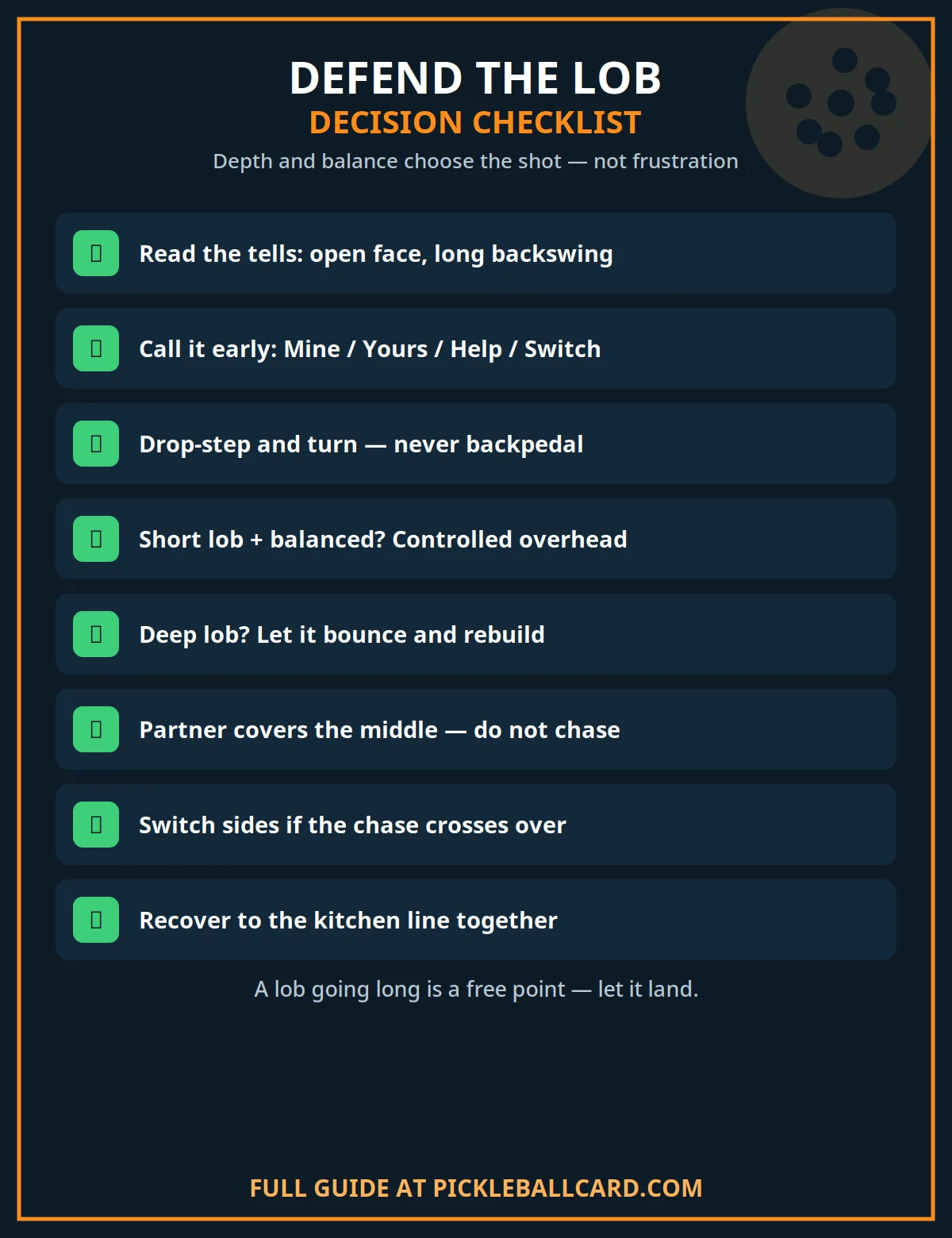
Not every lob should be smashed. Use the depth and your balance — not your frustration — to choose.
| What you face | Best response | Why | Avoid |
|---|---|---|---|
| Short lob, you can set in front | Controlled overhead | You keep pressure and keep the opponents back | Swinging at maximum power and missing long |
| Mid-depth lob, you are moving but balanced | Firm overhead to feet or middle, or a high deep return if unsure | You stay in the rally without giving an attackable ball | Reaching behind your head while still moving backwards |
| Deep lob beyond comfortable reach | Let it bounce, chase to its side, then drop or lob back | You regain balance and time to rebuild the rally | Backpedaling and flicking at the ball blindly |
| Lob clearly heading long | Call it, let it land, watch it out | Free points should stay free | Hitting a ball that would have gone out |
| Lob over your partner, not you | Cover and, if needed, switch | The team stays connected instead of both chasing | Both players running to the same landing spot |
Hitting a Controlled Overhead
Set sideways, paddle up near your ear, and contact the ball slightly in front of your body at comfortable reach. Aim first for depth and placement — at feet, into the middle, or to an open angle.
Think in targets, not in winners. An overhead that forces another defensive shot has done its job. The spectacular smash that misses by two feet has not, however good it felt to swing.
After contact, do not admire it and do not fall into the kitchen. If you volleyed the ball, your feet and momentum must still obey the non-volley zone rules in the USA Pickleball Official Rules. Recover forward legally and ready.
Playing It Off the Bounce
When the lob is too deep for a balanced overhead, commit fully to the bounce. Turn, run to the side of the ball rather than directly under its flight, and let it drop into a hittable position.
From deep court, your best replies are usually a soft drop toward the kitchen, which lets both partners advance again, or a high defensive lob of your own, which buys the most time.
What you should not do from the baseline is drive hopefully at two set opponents. That ball comes back faster than you can recover, and the lob has then achieved exactly what its hitter wanted.
Partnerwork: Cover, Call and Switch
- “Mine” means I am balanced and taking it. Your partner then stops, covers the middle and front space, and prepares for the reply.
- “Help” or “Yours” means the lob has beaten the first player. The partner takes the diagonal route to the ball — usually a safer and faster path than the first player’s turn.
- “Switch” means cross and stay. If the chasing partner ends up on the other side of the court, both players keep their new sides for the rest of the rally. Do not cross back mid-point.
- The non-hitting partner moves back a step or two. This buys reaction time if the chaser’s return is attacked, and it keeps the team connected rather than split between baseline and kitchen.
- Re-form at the line together. After the return, advance as a pair. One player sprinting forward alone simply opens the gap the next lob will find.
When a Lob Is the WRONG Shot — and How to Punish It
Understanding bad lobs helps you in two ways: you will stop hitting them yourself, and you will recognise — a fraction earlier — the lobs you should attack.
- Against opponents who are set, balanced and overhead-ready. A lob here is an invitation. If that describes you and your partner, expect the smash opportunity and take it calmly.
- From a comfortable, balanced position at the kitchen with better options available. A needless lob surrenders a strong position for a low-percentage hope. Punish it by holding your ground and making the overhead.
- Into the wind, or with sun in the hitter’s own eyes on the return. Conditions cut both ways. A floated lob into wind often drops short — the easiest overhead in pickleball.
- Repeatedly, to the same side, with the same shape. Predictability is the lob’s fatal flaw. Once you have seen it twice, shade back half a step against that player and dare them to try a third.
- When the hitter is off balance or reaching. A lob needs lift and control. A stretched lob usually lands short or long, so hold your position longer before retreating.
Conversely, do not become so eager to punish that you chase every high ball. A genuinely good lob — deep, high, behind your backhand shoulder, hit from disguise — deserves the respectful bounce-and-rebuild response, not a heroic miss.
Brief Recap: What a Good Lob Looks Like (So You Can Spot It)
For defence, you only need the outline. A good offensive lob is disguised as a dink until late, lifts over the reach of the net players, and lands in the back third of the court.
It is most effective against players who crowd the line, turn slowly, or have a weak backhand overhead. That short description is the checklist of what you are defending against — nothing more is needed here.
Full hitting mechanics, disguise drills and shot selection for the attacking side live in the companion guide linked at the top of this article. Keep the two skills separate in practice and they will both improve faster.
Drills That Build Lob Defence
- Read-and-call drill. A feeder mixes dinks and lobs from the kitchen. Defenders must call “dink” or “lob” before the ball crosses the net, then play the point out. Ten minutes trains the read, not just the smash.
- Drop-step ladders. Without a ball, practise the drop-step turn to both sides, pointing with the non-paddle hand, for sets of eight. Footwork grooved slowly is footwork available under pressure.
- Overhead-or-bounce choices. A feeder lobs to varied depths. The defender must announce “air” or “bounce” early and then execute that choice. Score the decision, not only the shot.
- Switch rallies. Play points where every lob that crosses a partner must end with a called switch, and the rally continues from the new sides. This removes the mid-court crossing confusion that costs real matches.
- Two-lob survival. Attackers may lob twice in a row; defenders must defend both and re-form at the line between them. The second lob, against a disorganised pair, is the one this drill exists to save.
Common Lob-Defence Mistakes
- Backpedaling. Slow, blind and unsafe. Turn, always.
- Silence. Two players hoping the other will take it is the lob’s best friend. Call early, even if you are sometimes wrong.
- Trying to smash everything. Deep lobs should bounce. Forcing an overhead from behind your head turns defence into an error.
- Hitting balls that are going out. Track deep lobs to the line. Free points are only free if you let them land.
- Both partners chasing. One chases, one covers. Every time.
- Staying back after the return. Defending the lob and then remaining at the baseline simply concedes the kitchen you just saved.
- Forgetting the kitchen rules on the overhead. A great smash with a foot in the non-volley zone on a volley is still a fault.
Frequently Asked Questions
Should I take a lob in the air or let it bounce?
Take it in the air only if you can get set, balanced, with the ball in front of you. If you would have to reach behind your head or hit while moving backwards, let it bounce and rebuild.
Who should take a lob down the middle?
By default, the player with the forehand to the middle, unless your pair has agreed otherwise. What matters most is that one player calls it early and the other covers, rather than which default you choose.
Why is backpedaling so dangerous in pickleball?
Backpedaling puts your weight behind your heels, hides the court behind you, and removes your balance for both the shot and the landing. Turning sideways and running to the ball is faster, safer, and produces a stronger overhead.
What should my partner do while I chase a lob?
Cover, do not chase. Move back a step or two, protect the middle and front space, call a switch if the chase crosses sides, and then re-form at the kitchen line together after the return.
How do I defend a lob if I am not very mobile?
Position half a step deeper, read tells earlier, communicate more, and rely on your partner’s diagonal help for the deepest balls. From deep court, answer with a drop or a high defensive lob rather than a drive, and advance together.
Can I volley an overhead from inside the kitchen?
No. Volleying while standing in the non-volley zone, or with momentum carrying you into it, is a fault under the official rules.
Set behind the line, and let your feet — not just the ball — decide whether the overhead is legal.
The Bottom Line
Lob defence is a system: read the tells, turn instead of backpedaling, call it early, choose the overhead only when you are balanced, let deep balls bounce, and recover as a pair.
Master that sequence and a lob stops being a threat and becomes information. It tells you your opponents are under pressure, out of ideas at the kitchen, or testing a defence that no longer works on you.
Then make them pay for testing it — calmly, in balance, and together. That, more than any single smash, is how you defend the lob in pickleball.
Sources: USA Pickleball, Official Rules (non-volley zone and volley rules). Coaching content in this article is original; no competitor content is linked or reproduced.