Most middle balls in doubles are not lost on technique. They are lost in the half-second when both partners think the other one has it — or both go for it and clash paddles. The fix is not a faster reaction. It is a shared system agreed before the rally starts. The most useful system for most teams is called Respect the X: instead of automatically giving every middle ball to the forehand, you give it to the player on the diagonal the ball is travelling along. This guide explains how the X works, when the old forehand rule still helps, when to break the X on purpose, and how to practise it until middle balls stop being an argument and start being routine.
Key Takeaways
- Respect the X beats “forehand always takes the middle” as a default, because it follows the ball’s path instead of a fixed half-court split.
- The cross-court player is connected to the middle. If the ball is travelling along your diagonal, it is yours — even on your backhand.
- The line-side player protects the line first. Their first job is the down-the-line ball, not lunging across for the middle.
- Fast balls are decided by the paddle already in the path; slow balls give you time to call, compare balance, and choose the better contact.
- Agree the system before the match and call early. “Mine,” “yours” and “switch” — said early — prevent most middle errors.
- Break the X only with a purpose: a planned poach, a high ball you can attack, or a partner pulled wide and out of position.
The Middle Problem: Why Good Players Still Miss These Balls
Picture the court from above. You and your partner stand side by side at the kitchen line. Your opponents are opposite you. Any ball hit between you has two plausible owners, which is exactly why it causes trouble. Add three facts of doubles — the ball is fast, the middle is the lowest part of the net at 34 inches in the centre versus 36 inches at the sidelines, and both of you have been told different rules growing up — and hesitation is almost guaranteed.
The traditional answer taught to beginners is simple: the forehand takes the middle. In a standard right-handed pairing that means the left-side player, whose forehand faces the centre, takes balls down the middle. That rule is easy to remember and it is not useless — which is why it survives. Its problems only appear when you look at where the ball is actually coming from and what happens to the court after the forehand player lunges for it.
What “Forehand Takes the Middle” Gets Wrong
Consider the most common rally pattern in pickleball. Your partner, on the right side, hits a cross-court dink or a return toward the opponent diagonally opposite them. That opponent replies toward the middle of your court. The ball is therefore travelling diagonally — from their left side toward your right side — and it is moving into your right-side partner’s body. For your right-side partner it is a comfortable ball arriving on a predictable line. For you, on the left, it is a ball moving away from you that you must reach across your partner to reach.
If the forehand rule wins that argument, three things go wrong at once. First, you are reaching and often off balance, so your contact is weaker and less controlled than your partner’s would have been. Second, by crossing over you leave the entire side of the court you came from open — if your stretched shot sits up, the opponents have an empty court to hit into. Third, you have effectively pinned your partner behind your shot: they cannot move forward or cover the next ball cleanly because you have taken their space as well as their ball. None of this means a forehand can never take a middle ball. It means forehand-first is the wrong default.
Our comparison of forehand vs backhand in pickleball makes the related point: a well-struck backhand hit in balance is a better shot than a forehand hit while lunging. Position and balance beat the name of the stroke.
Respect the X: The System in Plain Language
Draw two diagonal lines across the full court, corner to corner. That is your X. Each line connects a player to the opponent diagonally opposite them. Respect the X says: a ball travelling along your diagonal line is your responsibility, wherever it crosses the middle. A ball travelling along your partner’s diagonal is theirs.
In practice that produces a clear division that moves with the rally:
- If the opponents hit from their right side across toward your right side, your right-side player is on that diagonal for the middle ball, and your left-side player holds position and protects against the next shot.
- If the opponents hit from their left side across toward your left side, the roles reverse: your left-side player takes the middle ball on that diagonal.
- The player who is directly in front of the ball — the line-side player — keeps first responsibility for the straight down-the-line shot on their side. They are not asked to abandon the line to chase the middle.
Notice what this system does not do. It is not an official rule. The USA Pickleball Official Rules govern legal play — faults, the non-volley zone, serving and scoring — they do not assign ownership of a middle ball. Respect the X is a partnership agreement, a first answer you both trust so neither of you has to invent a decision at full speed.
Why the Diagonal Player Has the Better Ball
The diagonal player has three quiet advantages. The ball is travelling toward them, so they can meet it in front rather than reaching sideways. Their feet and court stay intact — taking the ball does not drag them out of position. And their partner remains free: free to stay at the line, free to cover the line ball, and free to move forward if the middle ball floats high. Good doubles is less about who hits a spectacular shot and more about which team still has its shape after the shot. The X preserves shape.
The X at Different Heights of the Rally
The X is most often taught for the third shot — the serving team’s third ball after the return — because that is where the forehand-lunge error is most expensive. But the same geometry helps everywhere: on returns that are pushed through the middle, on cross-court dink rallies where one player suddenly redirects through the centre, and on defence when you are both back and a drive comes between you. Wherever two players could both claim a ball, ask first: which diagonal is it travelling on?
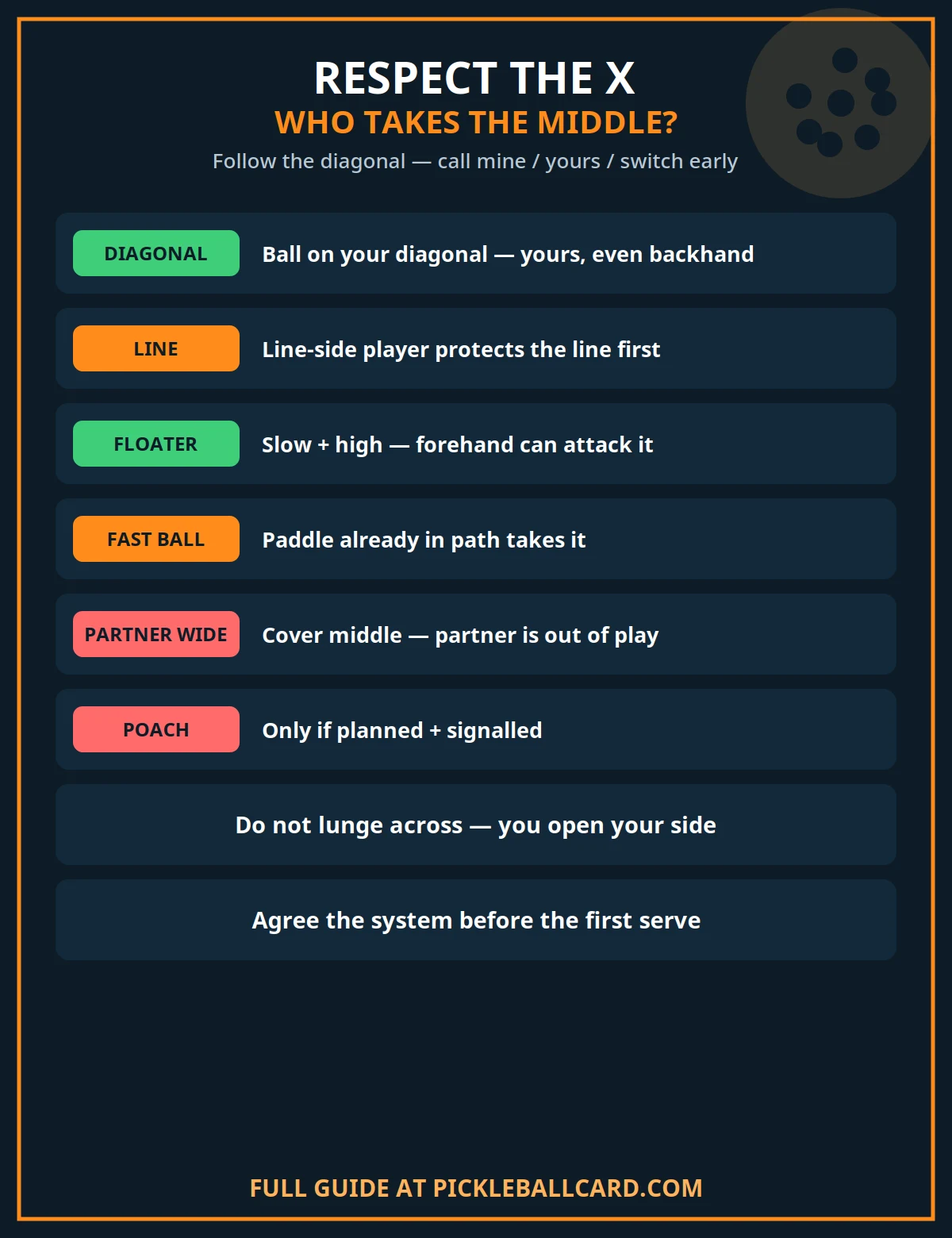
The Decision Table: Who Takes It?
| Situation | Who takes it | Why |
|---|---|---|
| Ball travelling cross-court along your diagonal into the middle | You — even on your backhand | It is coming into your body; you are balanced and your partner stays in position |
| Ball travelling along your partner’s diagonal into the middle | Your partner | Reaching across means lunging, opening your side, and pinning your partner |
| Straight ball down your sideline | The line-side player | Protecting the line is that player’s first job under the X |
| Slow, floating middle ball, both players set | Whoever calls first and can hit down — often the forehand | With time, shot quality beats geometry; communicate and commit |
| Fast speed-up straight through the middle at the kitchen | The paddle already in the path | There is no time to reassign; pre-set paddles and a prior agreement decide it |
| Your partner is pulled wide or is off balance / recovering | You cover the middle | The X assumes both players are in position; a displaced partner changes the picture |
| High middle ball you have agreed to poach | The poacher, with a pre-arranged signal | A planned break of the X, not a spontaneous lunge — see below |
When to Break the X — On Purpose
Respecting the X is a default, not a cage. Strong teams break it deliberately in a few recognisable situations, and the difference between a good break and a bad lunge is that the good one is planned, signalled, or obvious to both players.
The Planned Poach
If you have read that an opponent always dinks cross-court and then floats the next ball through the middle, stepping across to intercept it can win the point outright. That is poaching, and it works when your partner knows it might happen and is ready to switch behind you to cover the court you left. Use a quiet pre-point agreement or a hand signal behind your back, commit fully once you go, and accept that occasionally the opponent will hit behind you. A half-hearted poach — crossing late, without your partner switching — is just the forehand-lunge error with a better name. Teams that use stacking in pickleball plan these movements in advance for the same reason: positioning systems only work when both players share them.
The Partner Who Is Out of the Play
If your partner has been pulled wide by an angled dink, is scrambling back from a lob, or has just hit a ball while falling backwards, the diagonal picture no longer describes reality. Cover the middle, call “mine” loudly, and let your partner recover to the line rather than demanding they also honour a system that assumes they are standing where they are not.
The Ball That Is Simply Yours
Some balls allow no debate: a ball hit directly at your chest, a sitter that lands on your side of the centre line at your feet, a ball your partner clearly cannot reach. Take it, call it, and do not let a diagram talk you out of a ball in front of your nose. The X settles the ambiguous balls. It was never meant to create new ambiguity about obvious ones.
Left-Handed Partners and Stacking: Adjusting the Picture
When one partner is left-handed, a standard pairing can put two forehands in the middle — or two backhands — depending on which sides you choose. Many lefty-righty teams deliberately arrange themselves so both forehands face the centre when they can, which makes middle balls simpler: the forehand-in-the-middle advantage and the X often point to the same player. When they do not, the X should still lead on travelling balls, with the double-forehand arrangement treated as the tie-breaker on slow, floating balls where either player could hit down.
Stacking changes starting positions but not the principle. While a stacked team is unfolding into its preferred sides, middle responsibility can be genuinely unclear for a rally or two. Agree it explicitly before you stack: during the transition rally, name who owns the middle on each diagonal, and revisit it once you are set. Most stacking errors are not movement errors; they are two players applying different middle rules in the same rally.
Communication: The Calls That Make the X Work
No positional system survives silence. Build three calls into every game until they are automatic:
- “Mine” — early, loud, before the ball crosses the net if possible. A late “mine” is commentary, not communication.
- “Yours” — just as valuable. It frees your partner from doubt and lets them set their feet instead of hesitating.
- “Switch” — when you have crossed or poached and your partner must cover the side you left.
Add a ten-second pre-match agreement, even in recreational play with a new partner: “Let’s respect the X on middle balls — diagonal takes it — forehand only on floaters. Sound good?” That one sentence prevents the two most common post-point conversations in doubles: “I thought that was yours” and “You took my forehand.” If a ball does drop between you, do not litigate it mid-match. Note the pattern, restate the agreement between games, and move on. Our guide to pickleball dinking strategies shows why this matters most in long cross-court exchanges: the team that stays patient and organised in those rallies is usually the team that has removed decisions like this from the rally entirely.
How to Practise Respect the X
You do not need a coach or a full court session to install this. Three simple progressions work:
- Diagonal third shots. One player feeds returns cross-court toward the middle while the receiving pair practises letting the diagonal player take the third shot — backhand included — and the partner practises staying home. Ten balls each diagonal, then swap. This directly rehearses the exact rally where the forehand lunge does most damage, and pairs naturally with work on the third shot drop itself.
- Cross-court dink plus redirect. Dink cross-court cooperatively. Every fifth ball, one player redirects through the middle. The defending pair scores a point for a correct, called take — regardless of whether the shot wins — and loses a point for a silent hesitation or a paddle clash.
- Call-only games. Play a game to 11 where every middle ball must be called before contact. No call, lost point — even if you win the rally. Two games of this rewires calling faster than any lecture, because the cost of silence becomes immediate and memorable.
Common Mistakes With Middle Balls
- Treating “forehand takes the middle” as a law. It is a beginner shortcut. As rallies get faster and opponents learn to push balls along the diagonals, it produces lunges, open court and pinned partners.
- Guarding a fixed half. Standing as if an invisible wall splits the court means neither player follows the ball’s path — the exact problem the X was designed to solve.
- Both players going, or neither. Usually a communication failure, not a skill failure. Decide the system beforehand and call during the rally.
- Breaking the X without telling your partner. A surprise poach leaves the same hole as a lunge. Planned and signalled, it is a weapon; spontaneous, it is a leak.
- Arguing the last ball instead of agreeing the next one. Middle balls you have already missed teach you nothing unless they change the agreement for the rest of the match.
- Forgetting the line. In chasing the middle, the line-side player abandons the down-the-line ball — the one shot that was unambiguously theirs.
Frequently Asked Questions
Is Respect the X an official rule?
No. It is a doubles strategy and partnership convention, not part of the USA Pickleball rulebook. The rulebook governs whether play is legal; it does not tell partners which of them should hit a legal ball. That decision is yours to agree as a team.
So should the forehand ever take the middle?
Yes — on slow, floating balls where both players are set and the forehand player can step in and hit down, on balls that are clearly on the forehand player’s side of the centre, and in lefty-righty pairings arranged with two forehands in the middle. The point is not that the forehand is banned from the middle; it is that forehand-first should not override the ball’s diagonal path on travelling balls.
What about balls hit straight at the middle from straight ahead?
If the ball is not clearly travelling along either diagonal — a drive hit straight through the centre from the middle of the opposite court — use your tie-breakers in order: whoever called first, whoever’s paddle is already in the path, and, if there is time, the player who can hit the stronger shot from balance, which is often the forehand. Agree that order before the match so the rally does not have to host the debate.
Does Respect the X apply in the transition zone and on defence?
Yes. The geometry does not change because you are further back; if anything it matters more on defence, where a lunge leaves even more court open. The same diagonal responsibility applies to drives and third shots you are defending from mid-court or the baseline, adjusted only when a partner is pulled out of position.
How do I introduce this to a recreational partner without sounding bossy?
Frame it as a question and a trial, not a correction: “Want to try the X for this game — diagonal takes the middle? It stops us both hesitating.” Most players are relieved to have any clear system, because the alternative — guessing — is what causes the awkward points. If they prefer forehand-first, play their system for that game rather than mixing two systems in one match.
What if my backhand is much weaker than my partner’s forehand?
Then this system is asking something real of you, and the honest answer is twofold. In the short term, agree a modified version with regular partners if you must — but in the longer term, a backhand that opponents can exploit on diagonal balls will be targeted whether you use the X or not. The diagonal backhand you need here is not a power shot; it is a controlled dink, drop or block hit in balance. That is a very learnable shot, and learning it removes the weakness instead of organising your whole partnership around hiding it.
The Bottom Line
Who should take the middle in pickleball? On most balls, the player on the diagonal the ball is travelling along — even if that means a backhand, and even if their partner has a forehand waiting. That is Respect the X, and it works because it follows the ball instead of a slogan: the diagonal player meets the ball coming into their body, in balance, without abandoning their side of the court or pinning their partner. Keep the forehand for floaters you can attack, break the X only for planned poaches and emergency cover, protect your line first if you are the line-side player, and call every middle ball early. Agree it before the first serve, and the seam between you and your partner — the place opponents love to attack — becomes one of the most organised parts of your game.
Sources: USA Pickleball, Official Rules of Pickleball hub (net dimensions and legal play). Strategy in this article is original coaching guidance; no competitor content is linked or reproduced.