Watch a strong 4.0 player for one rally and you will spot a small hop you may never have noticed. As their opponent swings, both feet leave the ground for a fraction of a second.
They land balanced, knees soft, paddle up. Then they move — instantly, in any direction, with no stumble and no wasted motion.
That hop is the pickleball split step. It is the single most under-taught piece of footwork in the recreational game.
Most players learn strokes first and footwork never. They drill dinks, drives, and drops, then wonder why none of it holds up in a real rally.
The answer is usually timing — not shot timing, but foot timing. This guide explains the split step completely: what it is, the exact timing cue, how it changes at every court position, and how to make it automatic.
Key Takeaways
- The split step is a small two-footed hop timed to land as your opponent strikes the ball, loading your legs to push in any direction.
- The timing cue is the opponent’s forward swing, not the ball. Hop as they swing, land as the ball crosses the net.
- It is not a jump for height. Two inches of lift is plenty; bigger hops land late and destroy your balance.
- The split step changes by position: wider and earlier at the baseline, shorter and more frequent in the transition zone, subtle and constant at the kitchen line.
- Without it you will run through shots, react late, and reach instead of stepping — the three most common reasons rallies fall apart.
- Your drills will not transfer to matches until the split step is automatic, because drills feed you predictable balls and matches do not.
What the Pickleball Split Step Actually Is
The split step is a short hop that splits your feet apart. It lands you in a loaded athletic stance at the exact moment your opponent reveals the next ball.
It has nothing to do with jumping high or covering ground. Think of it as a reset button for your feet.
Between shots your weight drifts: forward as you chase a ball, backward as you retreat, sideways as you slide to cover an angle. A drifting body can only push in one direction.
The split step stops the drift and returns you to neutral. Neutral means feet roughly shoulder-width apart, knees bent, and weight on the balls of your feet.
Your hips and chest stay square to the net, paddle up and in front of your body. From neutral you can explode left, right, forward, or back with equal speed.
The mechanics in one breath
As your opponent begins their forward swing, take a small hop. Both feet leave the ground together, with one to three inches of lift.
While airborne, your feet separate slightly. You land softly on the balls of your feet, knees bending to absorb the landing, and your legs load like coiled springs.
The landing is the whole point. The hop itself does nothing. It simply un-weights your body and redistributes your weight evenly.
A flat-footed player must first lift their weight, then shift it, then move. A player landing from a split step is already loaded and moves on the first read.
One detail matters more than any other: land on the balls of your feet, never your heels. Heel landings lock the knees and add a visible pause before you can push.
If your heels thump on every landing, your hop is too high or your knees too straight. Shrink the hop and soften the knees.
Why the Split Step Exists
Pickleball punishes the player who moves last. The court is small, the ball travels fast, and drives at the kitchen line give you a fraction of a second to respond.
Reaction speed is not a talent. It is mostly preparation. Human reaction has two parts: perceiving the ball’s direction, then moving the body.
Perception is fast — everybody sees the ball leave the paddle. Movement is slow when the body starts from rest. The split step eliminates that penalty by keeping your legs loaded.
There is a second benefit. When you sprint toward the kitchen, your momentum commits you to that path. If the opponent hits behind you, you must brake, re-balance, and redirect.
That sequence costs the point. The split step interrupts committed momentum at exactly the moment new information arrives: the opponent’s contact.
This is why advanced players seem to glide while beginners scramble. They are not faster. They simply never arrive at the ball carrying momentum in the wrong direction.
The Timing Cue: Hop as They Strike, Land as It Crosses
Timing is the entire technique. A well-executed split step with bad timing is just bouncing. Here is the cue coaches teach: start your hop as your opponent’s paddle begins its forward swing.
Aim to land just as the ball is struck or crossing the net. Watch the swing, not the ball. The ball tells you where it went, which is too late.
The swing tells you contact is imminent. Pick a visual trigger and stick with it: the paddle changing direction from backswing to forward swing is the most reliable one.
You want to be airborne at contact and landing just after. Landing exactly at contact is ideal. Landing a beat after still works.
What fails is landing well before contact — you will have settled and lost the advantage. Starting the hop after contact is just reacting late with extra steps.
The three timing mistakes that ruin it
Splitting too early. You hop while the opponent is still setting up, land, and stand waiting. By the time the ball comes, your weight has committed to one side.
If you find yourself guessing direction, you are splitting early. Wait for the forward swing, not the preparation.
Splitting too late. You start the hop as the ball is already traveling toward you. Now you are airborne while the ball arrives — the worst possible state.
You cannot change direction mid-air. Late splits happen when you watch the ball instead of the swing.
Splitting too big. A dramatic leap feels athletic but lands late and hard. Height adds airtime, and airtime is time you cannot react.
Big hops also tend to land on the heels with straight knees. Shrink the hop until it feels almost embarrassingly small. That is the correct size.
A useful self-check: film yourself for one rally. Count how many opponent contacts you split-stepped on. Most recreational players split on fewer than half.
Raising that number is worth more than any new shot in your bag. Consistency of timing beats perfection of form.
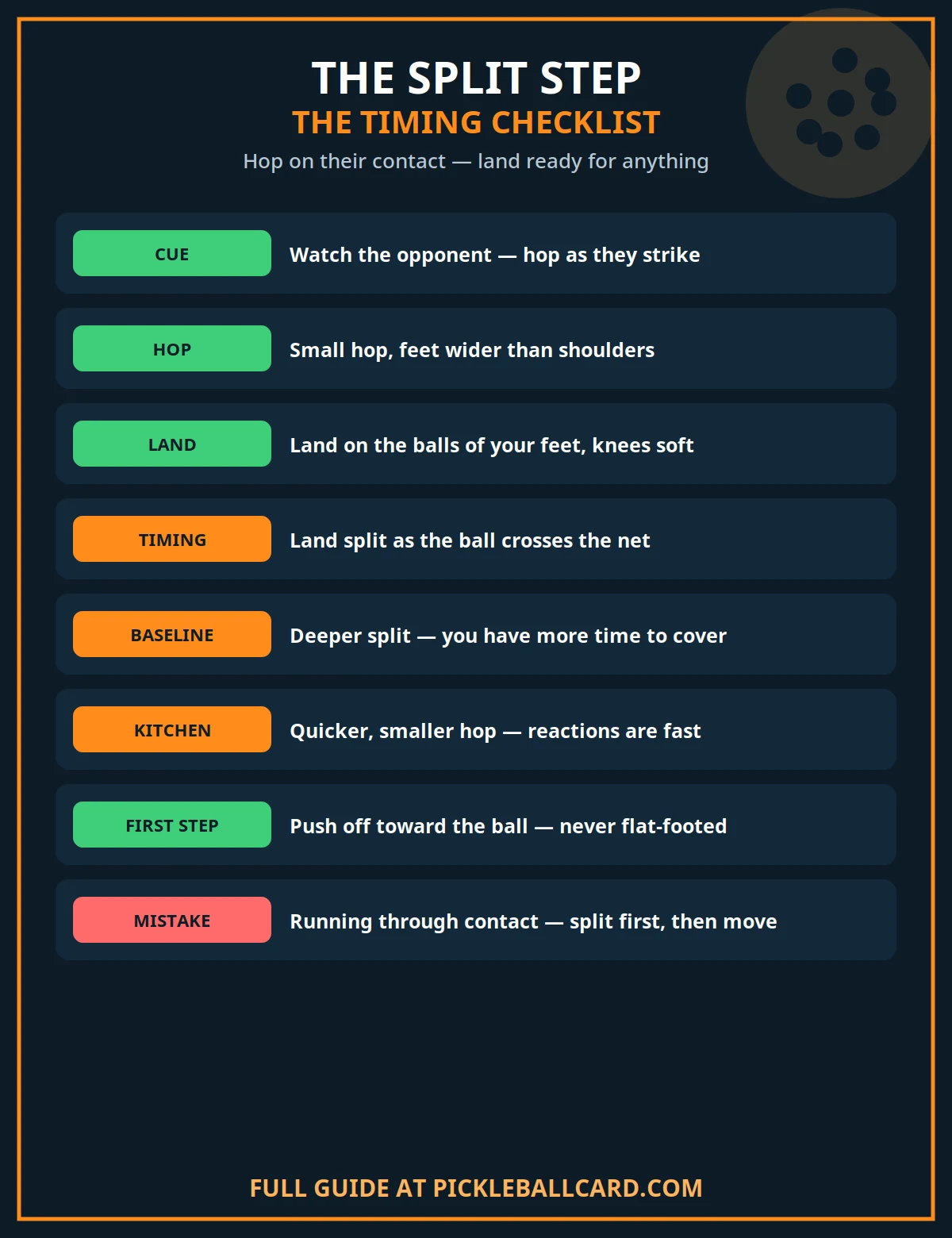
The Split-Step Timing Checklist
Run through this checklist during your next three rallies. Check one line per rally until each becomes background habit.
- Eyes on the swing: my trigger is the opponent’s forward swing, not the ball leaving the paddle.
- Both feet together: I leave the ground with both feet at the same time — no stutter steps.
- Small lift: my hop is one to three inches, quiet enough that my shoes barely whisper.
- Balls of the feet: I land on the balls of my feet with soft knees, never on my heels.
- Square to the net: my hips and chest stay facing the net through the landing.
- Paddle up: my paddle is in front of my body at landing, not dangling at my side.
- Loaded, not frozen: I land ready to push, not planted — my next move starts on the read.
- Every contact: I split-step on every opponent strike, not just the fast ones.
How the Split Step Changes by Court Position
The split step is not one identical hop. Its size, frequency, and purpose shift with your court position. The principle is constant — reset to neutral at opponent contact.
| Situation | Timing cue | Split-step adjustment | Watch out for |
|---|---|---|---|
| Baseline (returning serve) | Server’s toss and forward swing | Wide, deliberate split as the serve is struck; you need full lateral coverage from a standstill | Standing flat while the serve comes — the deep return then catches you leaning |
| Baseline (after your return) | Opponent loading the third shot | Split even while moving forward; stop your feet mid-stride if the opponent is about to strike | Sprinting to the kitchen without stopping — you arrive off balance and eat the drive |
| Transition zone | Every opponent backswing | Short, frequent splits — sometimes several per rally — since you are moving and resetting repeatedly | Running through the zone in one continuous jog with no reset between contacts |
| Kitchen line (dinking) | Opponent’s paddle preparation | Subtle unload-and-reload of the feet; a full hop is unnecessary when you are already set | Bouncing high on every dink, which slows your hands and wastes energy |
| Kitchen line (speed-up threat) | Opponent raising the paddle to attack | Deeper knee bend on landing and a half-step back to buy time against the speedup | Leaning over the kitchen line as they wind up — you cannot retreat from a lean |
At the baseline: the return and the run
Returning serve is the most under-split moment in recreational pickleball. The server strikes, and the returner stands flat-footed, watching.
Then the deep serve pushes them back and the return becomes a defensive stab. A deliberate split step timed to the server’s contact fixes this completely.
The second baseline moment is trickier. After you hit your return, you sprint toward the kitchen while the serving team prepares the third shot.
Most players run straight through the opponent’s contact. Instead, read the swing and split step mid-stride — even if you have advanced only two steps.
Stopping your feet for that instant turns a panicked block into a controlled reset. Our guide to return of serve positioning and depth covers the return itself; the split step makes the positioning work.
In the transition zone: split early, split often
The transition zone is where split steps pay the highest dividend. You are moving forward, the ball is coming back, and every contact arrives while your momentum points the wrong way.
The method is simple. Hit your shot, take one or two steps forward, and split step the moment your opponent begins their swing.
Land, read, and either continue forward or deal with the ball. Then repeat. You may split three or four times crossing the zone in one rally. That is correct.
Each split is a checkpoint that keeps you from arriving at the kitchen line as a runaway train, paddle trailing, exactly as the opponent drives at your body.
At the kitchen line: subtlety wins
At the kitchen the split step shrinks. When you are already in a good ready position, a full hop is wasted motion.
A slight unloading and reloading of the feet, timed to the opponent’s paddle preparation, does the same job. The discipline is doing it on every exchange, including safe dinks.
The critical kitchen moment is the speed-up. When your opponent raises their paddle to attack, land your split with a deeper knee bend and your weight slightly back.
Some players add a small step backward — not a retreat, just six inches of extra time against a drive-speed ball. That time is often the difference between a clean counter and a ball off your chest.
Against players who live on pace, pair this habit with the positioning ideas in how to beat bangers to make their speed-ups far less threatening.
What Goes Wrong Without It
Three failures trace back to a missing split step so reliably that coaches use them as diagnostic signs. If any sound familiar, your footwork — not your strokes — is the project.
Running through your shots. You hit while your body is still traveling, usually forward. Contact happens beside or behind you, the paddle face wobbles, and the ball sprays.
Running through shots is the signature of a player who never interrupts momentum at opponent contact.
Late reactions that feel like slow hands. You see the ball fine, but your first step comes a beat late, so every ball arrives on top of you.
Players blame their hands or eyes. But the delay is in the legs: from a flat stance, the body must un-weight, shift, then push. The split step pre-pays the first two stages.
Reaching instead of stepping. When the feet arrive late, the arm compensates by stretching. Reaching pulls contact away from your body, kills balance, and pops the ball up.
It also slows recovery, because a stretched body must re-collect itself before the next move. Good players look like they never reach. Their feet simply arrive first.
These three feed each other. Running through a shot leaves you off balance, which makes the next reaction late, which forces a reach, which leaves you more off balance.
One consistent split step breaks the cycle at its source.
Why Your Drills Are Not Transferring
Here is the uncomfortable truth behind most practice sessions: drills feed you predictable balls, and matches do not.
In a drill, you know roughly where the ball is going before it is hit. Your feet pre-position. Your split step — if you do one at all — is ceremonial.
In a match, every ball is new information. The opponent’s contact is the moment that information arrives. If your feet are not resetting then, your practiced strokes fire from unpracticed positions.
The stroke is fine. The platform underneath it is chaos. This is why players say they play great in drills and fall apart in games.
The drill never tested the skill the game demands: arriving at each ball from a neutral, loaded stance. The split step is the bridge between the two.
Grooving it into muscle memory
Muscle memory is built through frequency, not intensity. The split step becomes automatic when you attach it to a trigger you already watch: the opponent’s swing.
First, narrate it silently for one full game. Every time your opponent swings, think the word “split” as your feet leave the ground.
The narration forces attention onto the trigger until the trigger fires the movement on its own. One deliberate game typically carries into the next two unprompted.
Second, make it non-negotiable on easy balls. Splitting only when you expect trouble keeps the habit conscious. Splitting on soft dinks moves it from decision to reflex.
Easy balls are free repetitions. Use them.
Third, attach a physical anchor. Some players tap their paddle against their non-dominant hand as the opponent swings. The tap becomes the hop’s starting gun.
Any consistent anchor works. What matters is that it fires before conscious thought, because in a fast exchange conscious thought arrives too late.
Expect an awkward phase of two to three weeks where the split step feels mechanical. That friction is the learning signal, not a sign it is failing.
Players who push through report the same milestone: one day they split-stepped on a ball they never consciously prepared for. That is the habit installed.
Once installed, every shot you own gets better without changing your swing. Dinks get steadier because your base is quieter. Volleys get crisper because your weight is centered.
Browse the full pickleball shots index and you will notice the pattern: every advanced technique assumes a balanced, ready body underneath it. The split step supplies one.
Frequently Asked Questions
How high should my split step hop be?
One to three inches — barely enough to un-weight your feet. If your hop is visible from the next court, it is too big.
Height adds airtime, and airtime is time you cannot react. Think “light and quick,” not “high and athletic.”
Should I split step on every shot my opponent hits?
Yes. Selectivity is the enemy of the habit. Splitting only on difficult balls keeps the movement conscious and slow.
Splitting on every contact — including soft dinks — is what makes it reflexive. Reflexive is the entire point.
What is the difference between a split step and bouncing on my toes?
Bouncing is continuous and untimed. It keeps you moving but never resets your weight to neutral at the moment of new information.
The split step is a discrete event synchronized to the opponent’s contact. Bouncing is background noise. The split step is a signal.
Can the split step help against hard hitters?
It is one of the best defenses against pace. Hard hitters win by shrinking your reaction time. The split step buys that time back by pre-loading your legs.
Pair it with a deeper knee bend and a half-step of extra space when you read a speed-up coming.
Does my partner’s positioning change my split step in doubles?
The technique does not change, but your trigger awareness should widen. Split on the opponent who is about to strike, which means tracking the ball across the net.
Many doubles errors come from splitting to the wrong opponent’s rhythm. Watch the hitter, not your partner.
How long until the split step feels natural?
Most players feel mechanical for two to three weeks, then report a sudden shift where the hop happens without conscious thought.
Frequency beats session length. Splitting deliberately in every game installs it far faster than one long weekly drilling session.
The Bottom Line
The pickleball split step is a small hop with an outsized payoff. Land it as your opponent strikes, and you buy a balanced, loaded stance for every ball that follows.
Time it to the swing, keep it small, and do it at every court position. Strokes win highlights. Footwork wins rallies.
Install the split step and watch how many of your “bad shots” turn out to have been bad feet all along.
For a deeper look at the mechanics, see Selkirk’s guide to improving reaction time with the split step and Engage’s step-by-step split step breakdown.

Shoaib is the publisher of Pickleball Card. He oversees the site’s guides to pickleball rules, ratings, strategy and gear, all researched from primary sources — the USA Pickleball Rulebook, DUPR and manufacturer documentation — and updated as the game changes.