Bangers win when you feed them pace and height. Beat them by taking both away: keep your returns deep, drop your third shot instead of driving back, block hard balls softly so they land in the kitchen, let out-balls go, and aim your soft game at their backhand and their feet. A banger who has to hit up, off balance, or from below net height stops being dangerous. This guide walks the whole rally — return, third shot, transition zone and kitchen — as one anti-banger game plan, with a block-vs-counter decision table for the moment a drive is coming straight at you.
Key Takeaways
- Bangers need pace and height. Every strategy in this guide removes one or both.
- Return deep, ideally to the backhand, and get to the kitchen line before they can drive at your feet.
- Drop the third shot; do not drive back harder. Driving into a banger feeds the exact game they want.
- Block softly, counter selectively. Absorb hard balls into the kitchen; counter only balls you can hit down or from a set position.
- Let out-balls go. A hard drive at shoulder height from behind the baseline is often a free point — swinging at it gives it back.
- Target the backhand and the feet. Soft balls low to the weaker side force bangers to hit up, and hitting up is how rallies turn.
Why Bangers Win — And Why They Stop Winning
A banger is a player whose default answer is power: hard serves, driving third shots, and speed-ups at the kitchen, hit with a full swing and little interest in dinking. That style looks — and feels — dominant against players who panic, back off the line, pop balls up, or try to out-drive them. Every one of those reactions gives the banger more of what they need.
Power has conditions. A drive is dangerous when the ball sits up, when the banger is balanced and moving forward, and when you are caught mid-court or retreating. The same player is ordinary when the ball is below net height, at their feet, on their backhand, or when they are reaching and off balance — because from there a hard swing produces either a net ball or a ball that sails long. You do not need to become a better banger. You need to keep manufacturing those second situations, rally after rally. USA Pickleball’s own coaching material on the speed-up makes the same core point from the attacker’s side: attacking works when the ball and balance allow it. Your job is to make sure they rarely do.
Step 1: The Return — Deep, and to the Backhand
Your return of serve is the first anti-banger shot of the rally, and its job is time, not a winner. Hit it deep — ideally within a few feet of the baseline — because a banger who has to hit their third shot from deep, moving backwards or standing still, cannot step into a drive the way they can from mid-court. A short return against a banger is an invitation.
Aim the deep return at the backhand side where you can. Most bangers have a forehand drive they trust and a backhand they protect; a deep return to the backhand often produces a weaker third shot, a reluctant drop, or a drive hit from a worse position. Then use the time your deep return bought: move forward immediately and get set at the kitchen line with your partner. The worst place to meet a drive is halfway — the transition zone is where drives catch your feet. Arrive early, or the return’s good work is wasted.
Step 2: The Third Shot — Drop It, Don’t Drive Back
When your team serves and the banger is waiting to drive your third shot, the instinct to drive back harder is understandable — and wrong as a default. Driving at a set banger at the kitchen line gives them a fast ball at a comfortable height to block, counter or volley, and the rally speeds up on their terms. Worse, your drive is hit from deep, so you are still far from the kitchen when their reply comes back.
The drop is the answer because it reverses the geometry. A third shot that arcs and falls into the kitchen forces the banger to let it bounce, move forward, and hit up from below net height — with you advancing behind your drop toward the line. Even a mediocre drop that sits a little high is usually better than a drive, because it at least changes the rally from their game to a neutral one. Our full guide to the third shot drop covers the mechanics and trajectory in detail.
When a Drive Is Actually Right
Dropping is the default, not a law. Drive your third shot when the return is short and high and you can step in and hit down the middle or at a target; when the banger is off balance, retreating or caught out of position; or when a player has just shown they cannot handle pace and your team is ready to follow the drive in and contest the next ball — the drive-and-crash pattern. The test is simple: are you driving because the ball and their position invite it, or because you are annoyed? Only the first reason counts.
Step 3: The Transition Zone — Reset, Don’t Swing
If a drive catches you between the baseline and the kitchen, your job is survival with softness: the reset. Split-step as they contact the ball so you are balanced, get your paddle low and in front, loosen your grip, and absorb the pace — angle the ball down into the kitchen or at least low over the net in front of you. Do not take a full swing from mid-court against pace; you are adding speed you cannot control from the worst position on the court.
Think of the reset as buying one more shot. A reset that lands in the kitchen, even softly and without ambition, forces the banger to hit the next ball up — and lets you take two more steps toward the line. Two resets in a rally is not failure; against a banger, it is the plan working. Keep your paddle face slightly open, let the ball come to you, and resist the highlight-reel counter from your shoelaces.
Step 4: At the Kitchen — Block vs Counter
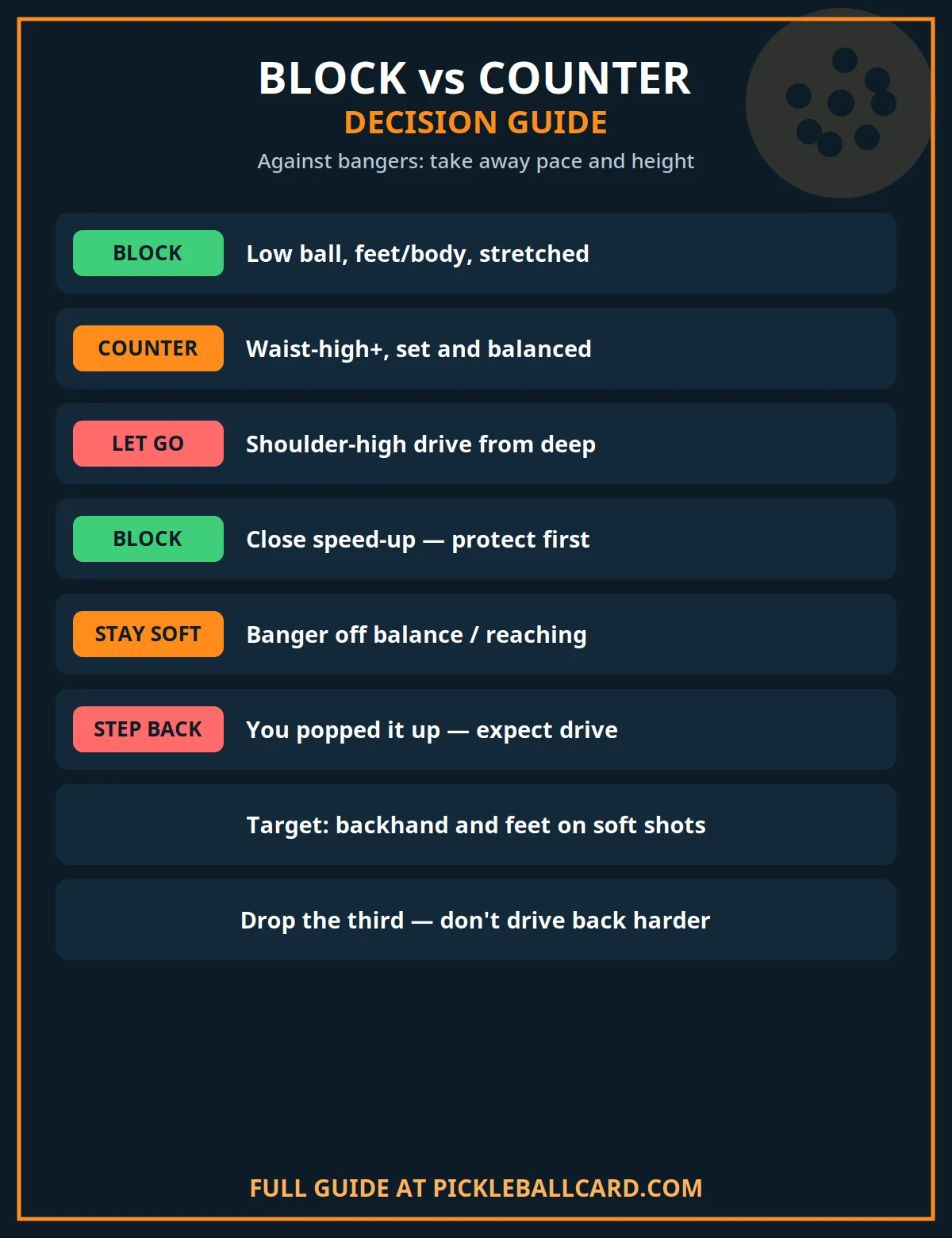
Once both teams are at the line, the banger will try to end the soft game with drives and speed-ups through the middle and at your body. This is where points are actually decided, and it is a decision, not a reflex. Use the table, then the detail below it.
| Situation | Best answer | Why |
|---|---|---|
| Hard ball below net height, at your feet or body, you are stretched or moving | Block / reset — soft hands, drop it into the kitchen | You cannot attack a low ball without lifting it; a soft block makes them hit up next |
| Hard ball at waist height or above, you are set, balanced and at the line | Counter — short punch volley, target feet or backhand | Height plus balance is the one combination where your counter can go down |
| Ball at shoulder / head height, hit hard from the baseline or mid-court | Let it go | Drives that high from that deep sail long far more often than they dip in |
| Ball at shoulder height, hit from close at the kitchen line | Duck / block down — do not assume out | Close-range speed-ups can dip; protect first, judge second |
| Banger off balance, reaching, or hitting on the run | Keep it low and soft — dink to backhand / feet | Their next hard swing from that position produces errors for free |
| You popped the ball up and they are winding up | Step back one step, paddle low, expect the drive | A half-step of space turns a body shot into a blockable ball |
How to Block Softly
A good block is almost no swing at all. Paddle up and in front of your body before they hit — not as they hit. Loosen your grip so the paddle absorbs pace instead of trampolining it back high. Angle the face slightly down toward the kitchen on their side, meet the ball in front of you, and let their pace do the work. The ball should leave your paddle slower than it arrived and fall short. If your blocks keep popping up, the cause is almost always a tight grip or a small swing you do not realise you are taking. Practise it directly: have a partner drive at you from mid-court at seven-out-of-ten pace while you aim every block into the kitchen, and only raise their pace when your blocks stay low.
How to Counter Without Feeding Them
Counter when the ball is high enough and you are set: a compact punch or roll volley, aimed down at their feet, through the middle, or at the backhand hip — never a full swing from the line. A counter hit upward from below net height is just a faster pop-up, and bangers punish those. If in doubt, block. The rally you keep alive with a block is worth more than the counter you miss trying to end it.
Step 5: Let It Go — The Free Points Bangers Give Away
The most profitable anti-banger skill costs no energy at all: leaving out-balls. Hard-hit balls carry a simple physics problem for the hitter — from deep, a drive hit hard and flat at your shoulder height usually cannot both clear the net and land in. Yet players swing at those balls constantly, either volleying them back into play or deflecting them with the paddle, and turn a free point into a lost rally.
Build the read deliberately. Judge height first: a ball arriving at shoulder height or above that was hit from behind the baseline is leaving until proven otherwise — step aside or duck and watch it. Judge pace second: the harder and flatter it was hit from deep, the less it can dip. Judge position third — the exception in the table above: close-range attacks at the line can dip, so do not gift-wrap those. In doubles, call “leave” or “out” early and loudly for your partner; half of all balls swung at were swung at by the partner who never got the call. In our etiquette guide we note the same discipline from the other side — see pickleball etiquette and the unwritten rules for why clear, early calls are part of good doubles play.
Targets: Where Your Soft Game Should Go
- The backhand. Dink and drop persistently to the backhand side. Most bangers protect it, move around it, and eventually pop one up trying to run around it — or drive a backhand they do not own.
- The feet. A ball dropping at a banger’s feet in the transition zone or at the line can only be hit up or half-volleyed weakly. Feet beat corners against power players.
- The middle, on counters. A counter through the middle creates the classic doubles hesitation between partners — who takes it — and bangers who are both winding up are worst at deciding.
- The weaker mover, not just the weaker hitter. In doubles, direct soft balls at the partner who is slower to get to the line or worse on the backhand, and keep them in the soft rally longest.
One boundary matters in recreational play: targeting a player’s weaker side is normal strategy, but repeatedly slamming at a beginner’s body in a social game is not — that is a sportsmanship line, not a tactic. Adjust the aggression to the setting; in competitive and rated play, play your full strategy without apology.
Build the Soft Game That Makes This Work
None of the above survives contact with a rally unless your dinking can hold up for ten shots at a time. Bangers do not only lose to tactics; they lose patience, and patience only breaks if your soft balls stay unattackable while theirs are being waited on. Work on the patterns in our guide to pickleball dinking strategies — cross-court dinks that pull a banger wide and open their backhand, and dinks that stay below net height even when you are stretched. Practise in this order: cooperative dinking with height discipline, then blocks against driven balls, then resets from the transition zone, then full games where your team scores a bonus point every time an opponent’s drive sails long because you left it. That last drill rewires the out-ball reflex faster than any lecture.
Common Mistakes Against Bangers
- Driving back harder. You are volunteering to play their game, from worse positions, with less practice at it than them.
- Backing off the kitchen line. Retreating gives drives more room to land and turns blockable balls into balls at your feet. Hold the line; step back only for a genuine overhead threat, then recover.
- Popping up blocks. Tight grip, small swing, paddle late — fix the block before you blame the banger.
- Swinging at out-balls. Every shoulder-high drive you volley back from deep defence is a point you chose to replay on their terms.
- Feeding the forehand. Returns, drops and dinks drifting helpfully to the forehand side are an engraved invitation. Keep a target — backhand, feet — on every soft shot.
- One soft shot, then panic. A single drop does not beat a banger; a sequence does. Expect to reset twice and dink six times. That is not losing slowly — that is the strategy.
Frequently Asked Questions
Is driving back at a banger ever the right play?
Yes — when the ball and their position invite it: a short, high return you can step into, a banger off balance or retreating, or a drive-and-crash third shot your team is set to follow in. What loses is driving as a reflex, from deep, at a set opponent, because you are frustrated. Choose the drive; never let the banger choose it for you.
What if both opponents are bangers?
The plan does not change; it matters more. Return deep to the weaker backhand, drop thirds, and be even more disciplined about leaving out-balls — two bangers produce twice as many. In the soft game, keep the ball with the partner whose backhand and dinking are weaker, and expect longer rallies: your edge is patience, and it compounds.
What paddle is best for blocking drives?
This is a strategy problem before it is a gear problem, and no paddle fixes a tight grip or a swinging block. In general, control-oriented paddles with a softer feel make absorbing pace easier than stiff power paddles, but technique — loose hands, paddle early and in front, almost no swing — accounts for far more. Fix the block first; shop second, if at all.
How do I practise resets and blocks?
Use a simple progression with a partner: they drive from mid-court at moderate pace while you block every ball into the kitchen from the line; then they drive while you start in the transition zone and reset, then step in; then play games starting every rally with a drive at the receiving team. Ten focused minutes of this twice a week changes your results against bangers faster than general open play does.
Does this work in singles?
The principles transfer — deep returns, low balls, backhand and feet targets, leaving out-balls — but the geometry differs: in singles there is more court to cover, passing shots and drives are more valuable, and you will drive more often yourself because there is no partner at the net to set up. The kitchen and non-volley zone rules themselves are identical in singles and doubles; what changes is shot selection, not the rules. Use the soft game in singles to move a banger, not only to neutralise one.
The Bottom Line
You beat bangers by refusing their game and insisting on yours. Return deep to the backhand and take the line. Drop the third shot instead of driving back. Reset from mid-court with soft hands instead of swinging. At the kitchen, block low balls, counter only from height and balance, and let shoulder-high drives from deep fly long while you watch. Do that for a whole match — patiently, boringly, six soft shots at a time if needed — and the banger’s biggest weapon becomes their biggest source of errors. Power needs pace and height. Starve it of both, and the game slows down to the one you came to play.
Sources: USA Pickleball, What is a Speedup? training guidance, and the Official Rules of Pickleball hub. Strategy in this article is original coaching guidance; no competitor content is linked or reproduced.