The return of serve is the most under-coached shot in pickleball, and it might be the most important one you hit. It is the only shot where the rules hand you a built-in advantage: the serving team must let your return bounce before they can play it, and they start the rally back while you are allowed to move forward. Used well, a deep, unhurried return pushes the servers back, buys you the time to take the kitchen line, and decides who controls the rally before the third shot is even hit. Used badly — short, rushed, or followed by standing still — it hands that entire advantage back. This guide covers the whole return as one job: where to stand, where to aim, how high to hit it, how to handle pace and spin, and what to do in the two seconds after contact.
Key Takeaways
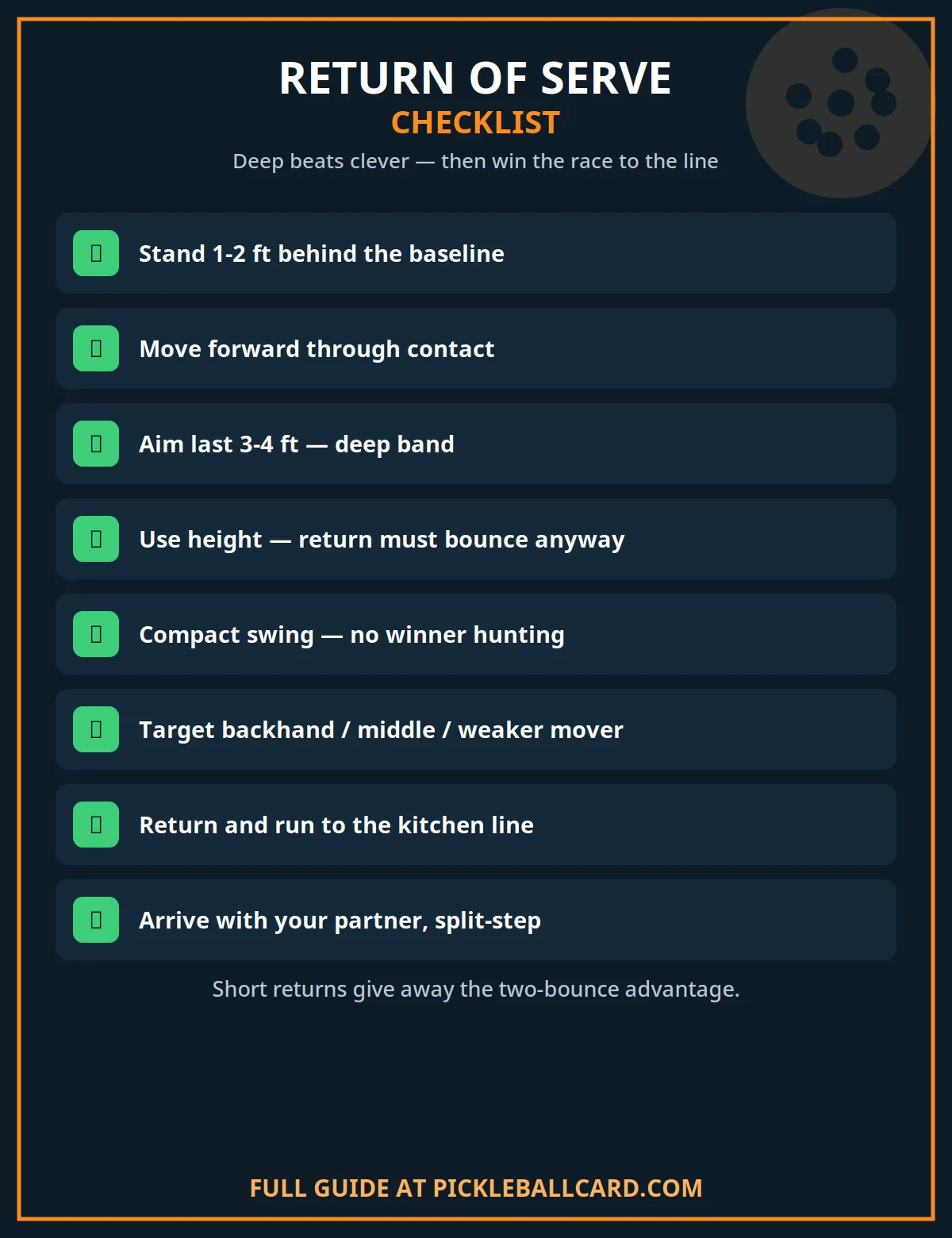
- Deep beats clever. Aim for the last few feet of the court, ideally toward the backhand or the middle — depth is what buys you time.
- Height is your friend on this one shot. Because of the two-bounce rule the servers must let it bounce, so a higher, slower return that lands deep is safer and more effective than a low skimmer that lands short.
- Stand behind the baseline and move forward through the ball. Never be caught backing up or standing on the line when a deep serve arrives at your feet.
- Return and run. The shot is only half the job — getting to the kitchen line before the third shot is the other half.
- Do not hunt winners. Big swings on returns produce errors on a shot that only needs to be safe, deep and boring to be excellent.
- Target with a purpose: the weaker backhand, the player who struggles moving backwards, or the middle to create hesitation.
Why the Return Matters More Than the Serve
In most racket sports the server holds the clear advantage. Pickleball flips much of that logic. The serve must bounce, your return must also bounce before the serving team can play it — the double bounce rule — and crucially, nothing stops you from advancing after you hit your return. The serving team, by contrast, must stay back long enough to let the return bounce and hit a third shot from wherever your return puts them.
That creates the central race of every rally: the returning team sprinting forward to claim the non-volley zone line, the serving team trying to hit a third shot good enough to stop them. A deep return tilts that race heavily in your favour. It forces the third shot to be hit from deep, often by a player moving backwards or standing still, and it stretches the time between your return and their contact — time you spend arriving at the line, set and balanced. A short return reverses everything: the third shot is hit moving forward, from mid-court, at a returning team that is still scrambling. When coaches call the return the most important shot in pickleball, this geometry is what they mean.
Step 1: Where to Stand
Stand one to two feet behind the baseline as your default. That buffer does two things: it gives you room to handle a deep serve without being jammed at your feet, and it means your natural movement for almost every serve is forward, into the ball — which adds control and starts your journey toward the kitchen in the same motion. Standing on the baseline, by contrast, guarantees that any well-hit deep serve forces you to back up, and a player backing up hits weaker, higher-risk returns while losing the race forward.
Adjust within that default rather than abandoning it. Against a player with a genuinely short or soft serve, shade half a step closer so a dinked serve does not drop in front of you. Against the biggest servers, take one extra step back and accept that you will hit the return while moving forward from deeper — depth of return matters more than where you started. In doubles, communicate with your partner about who takes a serve pushed through the middle, especially if one of you is stacking or has just switched sides; middle serves cause the same hesitation as middle balls later in the rally.
Finally, be moving before contact, not after you see where the serve goes. Split-step or stay on light feet as the server swings, so your first step is a reaction rather than a recovery. Flat-footed returners mishit serves they are perfectly capable of handling.
Step 2: Where to Aim — Depth First, Then Target
The Deep Zone
Your primary target is the last three to four feet of the court, just inside the baseline. Picture a deep band across the back of the service court and put your returns in it. Returns landing near the service line or in mid-court are the single most common return error at club level: they look safe because they went over and in, but they invite the serving team forward and turn your built-in advantage into theirs.
| Return lands… | What happens next | Verdict |
|---|---|---|
| In the deep band, near the baseline | Third shot hit from deep, often off the back foot; you reach the kitchen line set and early | Excellent — this is the goal |
| Mid-court, around the service line extended | Third shot hit on the move forward; race to the line is even | Playable, but you gave away your edge |
| Short, inside the service boxes area | Serving team steps in and drives or drops at a still-moving returner | Poor — the classic return mistake |
| Deep but wide into the sideline / long | Either a fault or an angled third-shot opportunity for the servers | Over-ambitious — depth through the middle is safer |
Choosing a Target Inside the Deep Zone
- To the backhand. Most players drive and drop less well from the backhand, and a deep return there often produces a weaker or more predictable third shot. If one opponent’s backhand is clearly the weakest shot on the court, live there.
- Through the middle. A deep return down the centre reduces the angle available for the third shot and can create a moment of hesitation between partners about who takes it. It is also the largest target — the right choice when you are under pressure, stretched, or facing heavy pace.
- At the weaker mover / the player who stays back. Some players hit fine third shots standing still but struggle hitting them while backpedalling. Deep returns at their feet as they retreat are worth more than outright pace.
- Away from the strongest third-shot hitter. If one server has a punishing drive, returning deep to their partner is not cowardice; it is match management. Just vary it enough that you do not become predictable.
What not to chase: the sidelines. A return that clips the line looks brilliant and misses often, and even when it lands it opens angles. The margins of the deep middle and deep backhand are large enough to win rallies. Use them.
Step 3: How to Hit It — Loft, Pace and Contact
Use More Height Than Feels Right
Here is the return’s best-kept secret: it is the one groundstroke where a high ball cannot be punished the way it would be later in the rally, because the serving team is required to let it bounce. A return that crosses the net with comfortable clearance and arcs deep gives you the largest margin for error, the most reliable depth, and the most time to advance. Players who try to skim every return low over the tape introduce net errors and short landings for no benefit — low only matters once volleys are legal for your opponents, and on the return, they are not. Aim to clear the net by a generous margin and let the arc do the work of depth. Review the serving side of this exchange in our guide to serving rules in pickleball and you will see why the rules protect a lofted return completely.
Swing Smaller Than You Want To
A compact, controlled swing — think of a firm groundstroke at seven out of ten effort — produces deep returns far more reliably than a full swing. The return is not a winner-hunting shot: the serving team is deep, the court behind them is small, and a ball hit hard from behind your own baseline has very little room to land in. Overswinging mostly manufactures two errors, netted balls from trying to add pace to a low serve and balls sailing long from a deep serve you tried to crush. Let depth, not speed, be your weapon.
Contact in Front, Weight Moving Forward
Meet the ball in front of your body with your weight transferring toward the target. Contact beside or behind you — the natural result of being jammed by a deep serve or of backing up — produces defensive slices that float short. This is the mechanical reason for standing behind the baseline and stepping in: it makes in-front contact the default rather than the rescue.
Step 4: Return and Run — The Two Seconds After Contact
More returns are wasted after the shot than during it. The pattern at club level is depressingly familiar: a player hits a genuinely good deep return, admires it for half a second while standing near the baseline, and then has to sprint through the transition zone as the third shot is already travelling toward their feet — the worst place on the court to receive it.
Treat the return and the run as a single movement. As you swing, your momentum should already be carrying you forward; the moment contact is made, continue toward the kitchen line, ideally arriving before or as the opponent hits their third shot, and split-step as they contact it so you are balanced for a drive at your feet or a drop you must move in for. If your return was deep, you will usually win this race comfortably — which is the entire point of hitting it deep. If your return sat up short, keep coming anyway but expect a drive and get your paddle low and in front; standing back after a short return compounds the error by conceding the line as well.
In doubles, move up with your partner. One player at the line and one stranded at the baseline creates a diagonal gap that good third-shot hitters aim into automatically, and puts the advanced player under unfair pressure. Glance across as you advance, match your partner’s pace, and arrive as a wall.
Handling Difficult Serves
Against Power Serves
Shorten everything: grip, backswing and swing. Use the serve’s own pace — a compact block-stroke with a firm wrist and an open-enough face to loft the ball deep will often return a hard serve deeper than your own full swing would. Stand that extra step back to give yourself time, aim for the big target through the deep middle, and do not try to match their power. The power server’s plan depends on rushed, short returns; a calm, deep, boring return is its antidote.
Against Spin Serves
Watch the ball all the way onto your paddle and expect the bounce to behave unusually — to kick sideways, stay low, or check. Give yourself margin: aim higher over the net and deeper in the target band than usual, because trying to finesse a spinning ball low is how returns dribble into the net. Move your feet so the ball is in your comfortable contact zone rather than reaching for it, and favour your more reliable side if the server is targeting a weakness — stepping around a backhand to take a spinning serve on your forehand is legitimate if you can do it without being caught out of position.
Against Short or Soft Serves
The trap is over-eagerness. Move in early, let the ball bounce as it must, and resist slapping at it on the run — a rushed swipe at a short serve produces either a net error or a popped-up return the serving team can attack. Take the extra half-step, set, and hit the same deep target. A soft serve is an invitation to advance, not to show off.
The Return in Singles
The principles survive the move to singles — depth first, move forward through contact, do not hunt winners — but the geometry sharpens. With the whole court to cover alone, placement matters more: deep returns to the backhand corner and deep returns that move the server wide gain value, because the server’s third shot must then be hit on the move with open court behind them. You will also advance more selectively than in doubles: charging the line after every return in singles exposes you to passing shots in a way doubles does not. Many strong singles players return deep, take a few steps in to a ready position around mid-court, and advance fully only when the return has genuinely pushed the server back. Adapt the race to the format; do not abandon depth in either.
A Simple Practice Routine
- Deep-band targets (10 minutes). Place a towel or target in the deep band on each side. A partner serves normally; you score a point only for returns landing in the band, regardless of what happens next. This retrains your sense of “good” from over and in to deep.
- Return-and-arrive (10 minutes). Same drill, with a second condition: you must be at the kitchen line, split-stepped, before your partner’s third-shot contact. Have them call “late” whenever you are caught in the transition zone. The call makes the invisible error audible.
- Pressure ladder (5 minutes). Ten returns: you need eight in the deep band to complete the ladder, restarting the count after two consecutive misses. Practising the return under even mild consequence is what makes it survive match nerves.
Good returns are built with the same deliberate practice you would give the third shot drop — and they pay off faster, because unlike the third shot, you get to hit one in every single rally you receive.
Common Return Mistakes
- Standing on the baseline. Deep serves jam you at your feet and force you backwards. Start behind the line and move in.
- Hitting short. The most damaging common error: it erases the two-bounce advantage and invites the serving team forward.
- Skimming the net for style. Low returns risk the tape and land short; the rules protect a lofted return, so take the free margin.
- Swinging for a winner. There is almost no winner available against a deep serving team; there are many errors available to you.
- Watching your return instead of running. The shot and the advance are one job. Arrive late and even a good return loses its value.
- Advancing at a different pace from your partner. A split formation is a target. Move up together, arrive together.
Frequently Asked Questions
How deep should a pickleball return of serve be?
Aim for the final three to four feet of the court, just inside the baseline. That depth forces the third shot to be hit from deep, often by a player moving backwards, and buys you the time to reach the kitchen line. Returns landing around the service line have given most of that advantage away.
Should I hit my return hard or soft?
Neither extreme. A controlled, lofted return hit with a compact swing at moderate effort is the most reliable route to depth. Hard returns from behind the baseline sail long or find the net; dinked, overly soft returns land short. Depth comes from arc and contact in front, not from effort.
Is it okay for my return to go high?
Yes — on this shot, height is protected by the rules. The serving team must let your return bounce before playing it, so they cannot volley a high return the way they could later in the rally. Clearing the net comfortably and letting the ball arc deep is sound strategy, not a mistake, as long as the ball still lands in the deep band rather than floating short.
Where should I stand to return a very hard serve?
One or two extra steps behind your normal position, which itself should already be a step or two behind the baseline. The extra room lets you move forward into the ball instead of being jammed, and a shortened, blocking swing can redirect the server’s pace deep. Then advance immediately — starting deeper makes winning the race to the line slightly harder, which is another reason your return must be deep.
Who takes a serve hit down the middle in doubles?
Agree it before the match. A common default is the player whose forehand faces the middle, but teams using diagonal-responsibility systems assign it by the serve’s path. Either system works; silence does not. Call “mine” early on any serve that could belong to either of you.
What is the biggest difference between a beginner and an advanced return?
Not power or spin — it is what happens after contact. Beginners hit the return and stay near the baseline to watch it; advanced players treat the return as the start of a sprint, arriving at the kitchen line before the third shot and forcing the serving team to hit a perfect drop to dislodge them. Depth enables that sprint, which is why advanced returns are consistently deep rather than occasionally spectacular.
The Bottom Line
A great pickleball return is not flashy. Stand a step or two behind the baseline, move forward into the ball, and hit a lofted, controlled return into the deep band — to the backhand, through the middle, or at the feet of the weaker mover. Then, without pausing to admire it, run: arrive at the kitchen line with your partner, split-stepped, before the third shot is hit. Do that rally after rally and you will feel the whole geometry of pickleball tilt: serving teams hitting third shots from their shoelaces while backing up, your team starting every rally from the strongest position on the court. Depth, height and the run — get those three right and the second shot becomes the quiet foundation of your entire game.
Sources: USA Pickleball, Official Rules of Pickleball hub (two-bounce rule and serving rules). Strategy in this article is original coaching guidance; no competitor content is linked or reproduced.