Your DUPR rating is only half the story. Next to it sits the Reliability Score, answering a different question: how much should anyone trust the rating?
DUPR’s own guide says a score of 60% or higher means your rating is reliable, and 100% means it is fully reliable. Below 60%, your rating is a rough sketch rather than a settled number.

What the Reliability Score Is
The Reliability Score is a percentage between 1 and 100 beside your rating, separately for singles and doubles. DUPR introduced it in May 2024, and its help centre describes it plainly: the score shows how reliably your rating represents your current skill level.
Your rating says how good DUPR thinks you are; your reliability says how sure DUPR is. One recorded match gives you a rating, but almost no evidence behind it.
New to DUPR? Our What Is DUPR? guide covers the rating first, and our how to get a DUPR rating guide walks through the first match.
Reliability is separate for each format: play a lot of doubles and no singles, and only your doubles number will climb.
What the Numbers Mean
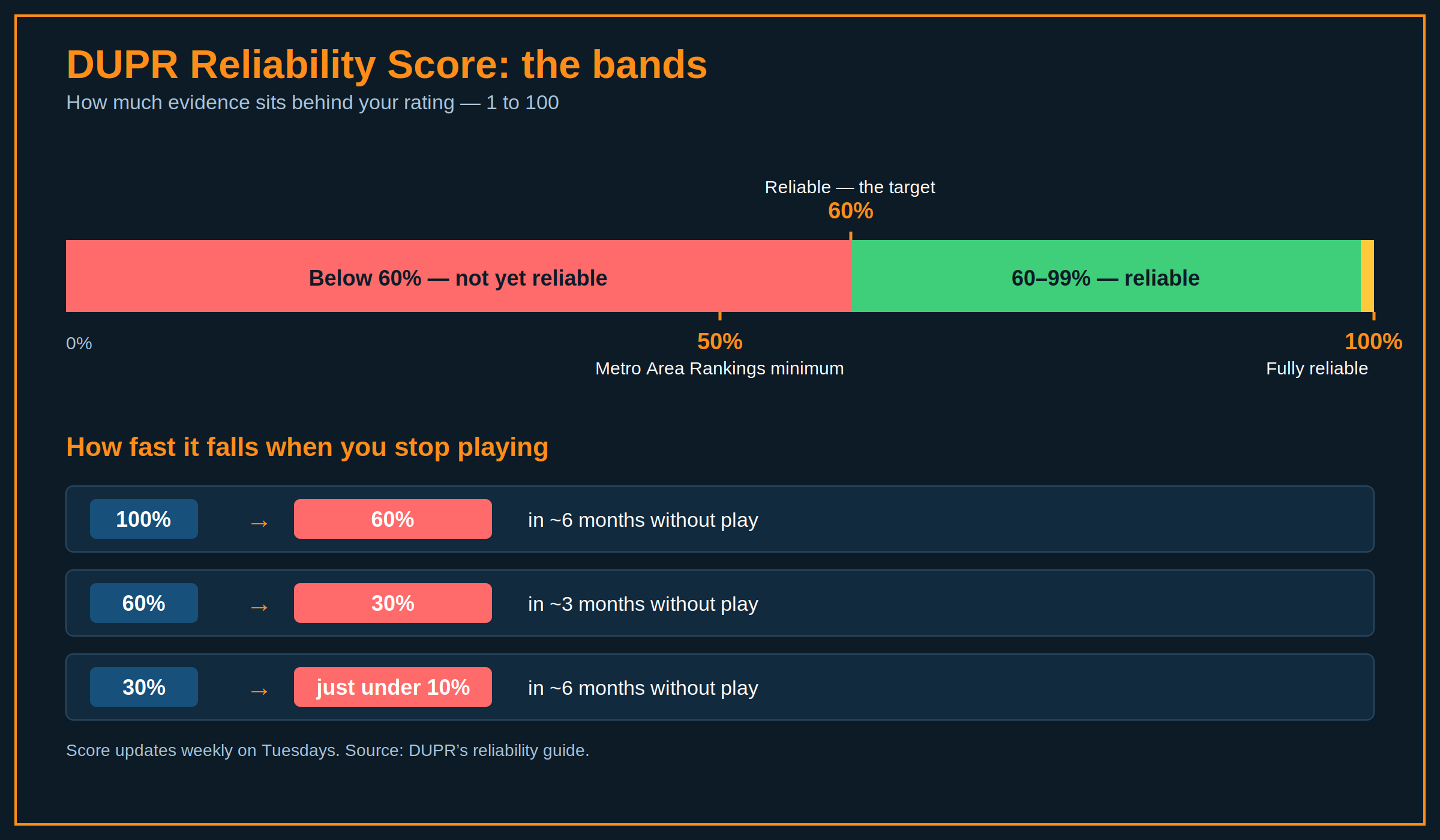
DUPR’s thresholds: 60% or more is a reliable rating and a good score, and 100% is fully reliable.
| Reliability Score | What DUPR says | What it means for you |
|---|---|---|
| 100% | Fully reliable | As well supported as it can be. |
| 60–99% | Reliable — a good score | Trustworthy — the target. |
| 50–59% | Below the reliable mark | Below reliable, but meets the 50% Metro minimum. |
| 30–49% | Not yet reliable | Treat the rating as provisional. |
| Below 30% | Very low | Very little evidence behind the rating. |
Two warnings. First, 60% is a threshold, not a grade: a player at 61% and a player at 98% both clear it, but the second rating rests on far more evidence. Second, reliability is about evidence, not ability.
A strong player with two logged matches can sit at a low reliability, while a weaker player at verified events every week can sit at a high one. The score never says how good you are, only how much evidence backs the number. For where your rating itself sits, see our What Is a Good DUPR Rating? guide.
How DUPR Works It Out
DUPR publishes no exact formula or weights for the Reliability Score — only the inputs: match count and source, plus partner and opponent variety over the last 6 to 12 months.
Recency is the fourth input: how many results are in the system, how recently you played, and how varied your opposition was. Matches submitted by a club or a verified data partner give DUPR higher-confidence data than self-posted matches.
One caution: DUPR advises playing highly reliable players, but its help centre does not name opponents’ reliability as a formula input — report it as advice, not as a confirmed input.
Your score does not move the moment a match is entered: DUPR updates Reliability Scores weekly, on Tuesdays, so a Wednesday match will not show until the following Tuesday. Our pickleball ratings hub explains how DUPR fits alongside the other rating systems.
How Many Matches Before You Trust the Number
Here the guidance gets messy, so it is worth showing the mess: DUPR’s own blog says twice, in September and October 2026 posts, to log at least 10 to 15 matches before fully trusting your number.
A different figure circulates elsewhere: some guides report DUPR’s homepage as saying 10 to 20 results make a rating more accurate. That could not be confirmed against a DUPR page, and it conflicts with DUPR’s own 10 to 15 — the figure this guide uses, noted here so you know why you may see it quoted.
A second conflict comes down to units: one guide says about 30 to 40 games are needed to reach 60%, while DUPR’s pathways show 60% in as few as 6 club matches in one weekend. The two cannot be compared directly — DUPR counts matches, the guide counts games, and one match can be a single game or a best-of-three.
DUPR’s Own Pathways to 60% and 100%
DUPR publishes sample pathways showing how different playing patterns reach 60% or 100% reliability: CLUB means a club match, Rec a recreational match; each match represents one game, and matches with more games count for more.
| Pattern | Opponent reliability | Result |
|---|---|---|
| Doubles: 2 CLUB a week, 4 weeks | 60% | 60% |
| Doubles: 6 CLUB in one weekend | 60% | 60% |
| Doubles: 1 CLUB + 1 Rec a week, 4 weeks | 100% | 100% |
| Doubles: 1 CLUB + 1 Rec a week, 6 weeks | 60% | 60% |
| Doubles: 5 Rec a week, 7 weeks | — | 60% |
| Doubles: 5 Rec a week, 5 weeks | 100% | 100% |
| Singles: 1 CLUB a week, 3 weeks | 60% | 60% |
| Singles: 2 Rec a week, 5 weeks | — | 60% |
Club matches get you there faster than recreational matches, and highly reliable opponents faster still: six club matches in one weekend can do what takes seven weeks of recreational play.
Try our DUPR Match Impact Calculator to test a scoreline before you play, and our Pickleball Rating Estimator for a rough starting point.
Summaries of DUPR’s tables put the same road at roughly two partners and six opposing teams for 60% in doubles, and four partners and twelve teams for 100% — a summary, not a quotation.
How Fast Reliability Falls When You Stop Playing
Your rating does not fall when you stop playing; your reliability does — and the fall is not a straight line.
| Starting score | What happens without entering results |
|---|---|
| 100% | To 60% over about 6 months |
| 60% | To 30% over about 3 months |
| 30% | To just under 10% over about 6 months |
A player at 100% who stops recording matches for half a year comes back at roughly 60%, still reliable but only just; a player at 60% who takes three months off comes back at roughly 30%.
The rating will be waiting where you left it, but the evidence behind it will have thinned: reliability is built on recent results.
How to Raise Your Reliability
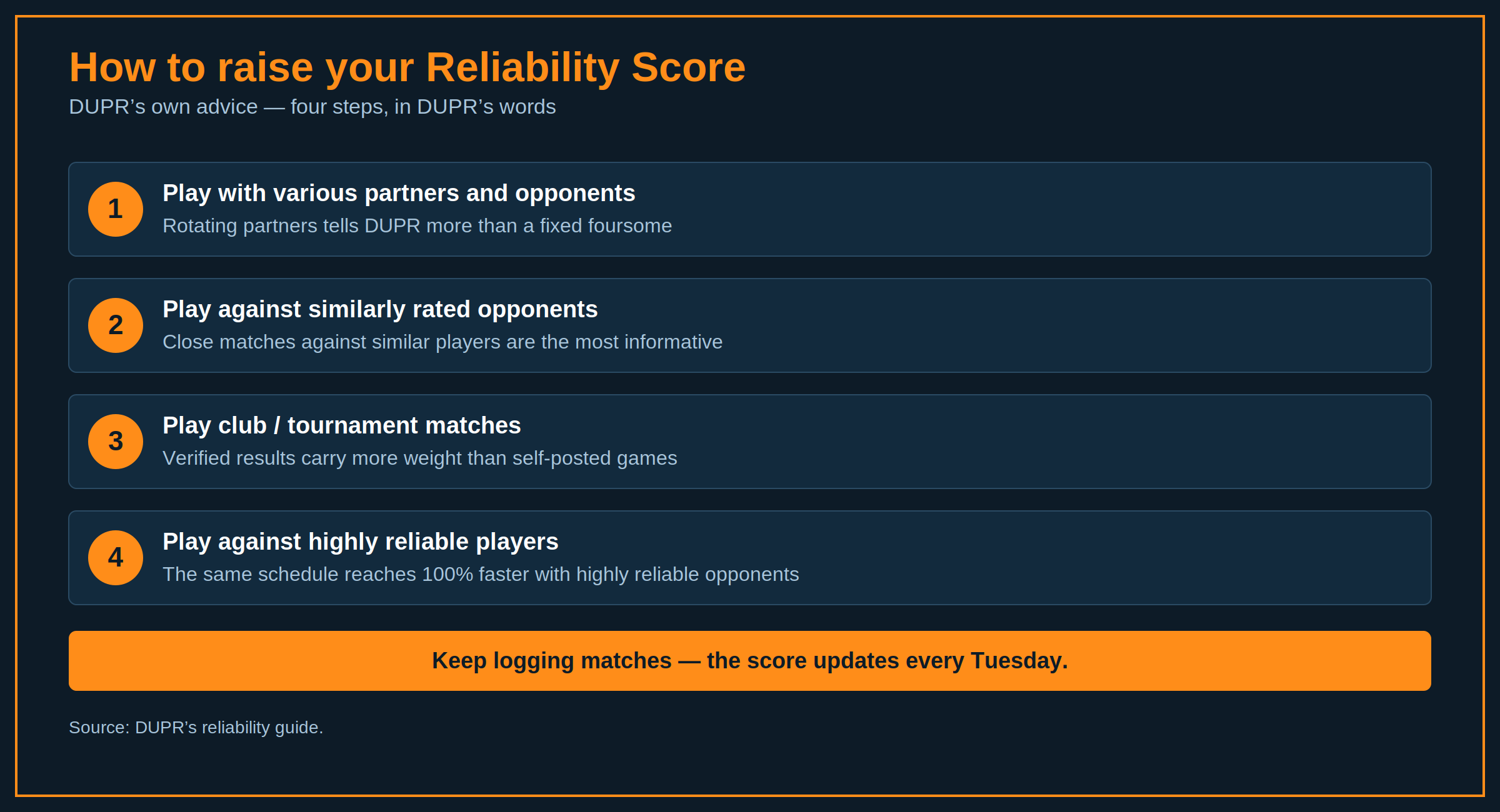
DUPR’s own advice is a short list: play with various partners and opponents; play against similarly rated opponents; play club or tournament matches; and play against highly reliable players.
Variety comes first: the same partner against the same two opponents every week gives DUPR very little new information, while rotating partners and facing different teams tells it far more about your level.
Matches against players near your own level give DUPR the most useful evidence: the expected score is close, so the actual score says something real. Our why your DUPR dropped after a win guide explains that expected-score logic.
Club and tournament matches are the strongest lever: verified results carry more weight than self-posted games, so play in your club’s DUPR-reported events.
Finally, play against highly reliable players where you can: the same schedule reaches 100% rather than 60% when the people around you are at 100%. You cannot control who shows up, but a regular session with established players does your score more good than the same games against new accounts.
Where Reliability Actually Matters
Reliability matters wherever a rating is used as a trust signal: the score shows how reliably your rating represents your current skill level. A club organiser or a future partner can see whether the number is backed by evidence or rests on a couple of old results.
One threshold is verified: DUPR’s Metro Area Rankings, a DUPR+ feature, require 50% reliability. No DUPR rule tying a reliability score to league placement or tournament seeding was verified for this guide, so none is claimed here — an event’s own requirement is the organiser’s rule.
DUPR is also the rating the professional game runs on: the official rating of the PPA Tour and Major League Pickleball, and the official exclusive rating system for USA Pickleball’s own events. Our PPA Tour guide and Major League Pickleball guide explain those tours.
The Bottom Line
Aim for 60%: the line between a rating you can trust and one you should not lean on yet. Get there by playing regularly, varying partners and opponents, and favouring club and tournament matches — and keep playing, because the score decays without fresh results.
Frequently Asked Questions
What is a good DUPR Reliability Score?
60% or higher. DUPR’s guide says 60% or higher is a good score, and players at 60% or above have a reliable rating. Anything above 60% is good, and 100% is fully reliable.
What does 100% reliability mean on DUPR?
It means your rating is fully reliable — as well supported as it can be. It does not mean you are a perfect player, only that DUPR has plenty of recent, varied, verified evidence behind it.
How is my DUPR Reliability Score calculated?
DUPR publishes no exact formula or weights. Its help centre says the calculation takes into account match count and source, partner and opponent variety over the last 6 to 12 months, and recency — with club and verified matches providing higher-confidence data.
How many matches do I need for a reliable DUPR rating?
DUPR’s own blog says to log at least 10 to 15 matches before fully trusting your number; some guides report its homepage as saying 10 to 20, but that could not be confirmed against a DUPR page. DUPR’s pathways show 60% in as few as 6 club matches in one weekend.
Does my Reliability Score drop if I stop playing?
Yes. Your rating itself does not fall, but your reliability does: DUPR’s blog says 100% can fall to 60% over about 6 months without results, 60% to 30% over about 3 months, and 30% to just under 10% over about 6 months.
How can I raise my DUPR Reliability Score?
Follow DUPR’s own list: play with various partners and opponents, play against similarly rated opponents, play club or tournament matches, and play against highly reliable players — logging matches consistently and favouring verified results.

Shoaib is the publisher of Pickleball Card. He oversees the site’s guides to pickleball rules, ratings, strategy and gear, all researched from primary sources — the USA Pickleball Rulebook, DUPR and manufacturer documentation — and updated as the game changes.