Someone at open play asks for your number, and they do not mean your phone number. They mean your DUPR. In pickleball today, that single number is how players, clubs, leagues, and tournaments judge competitive level at a glance.
This guide explains what DUPR is, how the rating is actually calculated, and how you can get your own. It also answers the question every new player asks next: what counts as a good rating?
Key Takeaways
- DUPR stands for Dynamic Universal Pickleball Rating, a match-based rating on a scale from 2.000 to 8.000.
- New players start as NR, meaning Not Rated, until a recorded match result gives them a first rating.
- Your rating moves on performance against expectation, not on wins and losses alone.
- Club and tournament results carry more weight than self-posted recreational games.
- Singles and doubles have separate ratings, each with its own Reliability Score.
- A Reliability Score from 1 to 100 percent shows how established your rating is, with 60 percent marking a reliable rating.
- One recorded match can produce a first rating, while roughly 10 to 20 results give a much more accurate picture.
- Level bands on the scale are general guidance, not official cutoffs, and a good rating depends on your goals.
What Is DUPR?
DUPR is a rating system that estimates your current pickleball skill level from real match results. It is not a self-assessment, a coach’s guess, or a lifetime achievement award. It is a number that changes as you play.
The name spells out the idea. Dynamic means the rating updates when new results arrive. Universal means one shared scale applies across clubs, regions, ages, and genders. The rating itself is the estimate of competitive strength.
DUPR is run by the DUPR organisation, and it is the official rating of the Professional Pickleball Association and Major League Pickleball. It is also used across USA Pickleball events, which is why it has become the default language of level in organised play.
That reach matters for ordinary players too. When a club runs a level-gated open play session, or a tournament sets division cutoffs, DUPR is usually the standard used. For a wider overview of how ratings fit together, see our guide to pickleball ratings.
What DUPR Is Not
DUPR is not a ranking list. Two players can share a similar rating without ever having played each other, and the number alone does not say who would win a particular match on a particular day.
It is also not a measure of effort, sportsmanship, or potential. A player returning from injury, or one who only plays doubles, may hold a number that understates their best game. The rating reflects recorded results, nothing more.
How the DUPR Rating Works
DUPR starts from your last rating and updates it after each recorded result. The system compares the expected outcome of a match, based on the ratings involved, with the actual outcome. The gap between expectation and reality is what moves your number.
DUPR itself describes four factors that shape every update. Understanding those four factors explains almost every surprising movement you will ever see in your rating, including drops after wins.
1. Performance Against Expectation
This is the most important factor. Before a match, DUPR calculates an expected score from the ratings of the players or teams involved. After the match, it compares that expected score with the actual score.
Beat expectation and your rating rises. Fall short of expectation and it falls, even if you won the game. A narrow win in a match you were expected to dominate can therefore cost you a little ground.
The reverse also applies. A close loss against a much stronger opponent can lift your rating, because you performed better than the system expected. This is why win-loss record alone never tells the full DUPR story.
2. Type of Match
Not all matches carry equal weight. A club or tournament result influences your rating more than a self-posted recreational game. Verified, organised play gives the system more reliable data about where you stand.
Self-posted games still count, but their impact is smaller. That design choice protects the system from casual or unverified scores swamping results from structured competition.
3. Match Recency
Recent matches matter more than older ones. If your game has genuinely improved, that improvement shows up faster because recent results carry greater weight in the calculation.
The same principle softens old form. A poor stretch from months ago has less pull on your current rating than it did immediately after it happened. Your rating is meant to describe your current level, not your history.
4. Match Volume
The more matches on your record, the more stable and accurate your rating becomes. Early on, when your history is thin, a single result can shift your rating noticeably.
As you log more matches, each individual result has a smaller relative impact. Your rating settles into a more precise reflection of your level, and one surprising result stops swinging it wildly.
This is the strongest practical reason to play rated events regularly. More data means a steadier number, and a steadier number means fairer placement for everyone in your group.
For the full official explanation, read how DUPR explains its own calculation, which sets out these four factors in DUPR’s own words.
The Reliability Score
Every DUPR profile carries a second number: the Reliability Score. It is a percentage from 1 to 100 that shows how reliably your rating represents your current skill level.
Reliability is not skill. A 4.1 at 25 percent reliability and a 4.1 at 90 percent reliability are very different claims, even though the headline number matches. The second player has far more evidence behind the number.
DUPR calculates reliability from factors including how many matches you have played, the source of those matches, and the variety of partners and opponents over the last 6 to 12 months. Club and verified results build reliability faster than self-posted games.
A Reliability Score of at least 60 percent marks a reliable rating. Clubs often use that threshold for event eligibility, and DUPR uses reliability for ranking lists, so it is worth treating as a goal in its own right.
Reliability rises as you add matches, and it falls after an extended period without play. It updates weekly, on Tuesdays, so a match played midweek may not move your reliability figure until the following Tuesday.
Singles vs Doubles Ratings
DUPR gives you separate ratings for singles and doubles. Your doubles rating says nothing official about your singles game, and your singles rating says nothing official about your doubles game.
That separation exists because the formats demand different skills. Singles rewards court coverage, fitness, and passing shots. Doubles rewards teamwork, kitchen play, positioning, and communication with a partner.
Many players hold ratings that differ by a wide margin between formats. A strong doubles player who rarely plays singles may carry a modest singles rating, or none at all, and that is entirely normal.
Each format also has its own Reliability Score. You can hold a reliable doubles rating and a thin, low-reliability singles rating at the same time, if most of your recorded play is doubles.
How to Get Your First DUPR Rating
Getting started is free and simpler than most new players expect. One recorded match result is enough to produce a first rating, though that first number will move a lot until more results arrive.
Follow these steps in order, and check for an existing profile before creating a new one. Duplicate profiles split your results and slow everything down.
Step 1: Search for an Existing Profile
If you have ever played a tournament, league, or club event that reports results, you may already have a profile. Search for your name on the official DUPR platform before signing up.
Claiming an existing profile preserves your history. Creating a second profile by mistake means your old results sit elsewhere, and merging accounts later is an avoidable hassle.
Step 2: Create Your Account
If no profile exists, create a free account through the DUPR app or website. Use one email address consistently, since your account is tied to it.
Step 3: Join a Club or League
Join a local DUPR club, or enter a league or ladder that reports results automatically. This is the easiest route to verified results, because the organiser submits scores for you.
Ask before you join whether results are submitted to DUPR, and in which format. A fun weekly session that never reports scores will not build your rating, however competitive it feels.
Step 4: Log Verified Matches
Play matches, then make sure the results reach DUPR. Club, league, and tournament results usually arrive automatically through the organiser or event platform.
For casual games, you can self-report a result in the app, and the other players confirm it. Self-reported games count, but remember they carry less weight than verified, organised results.
Step 5: Build Toward a Reliable Rating
Keep playing and logging results. DUPR’s own guidance suggests that roughly 10 to 20 match results give a much more accurate rating than a single early result.
Mix up partners and opponents where you can. Variety strengthens your Reliability Score, because results against a wide field say more than repeated games against the same two people.
An alternative route exists for players who want a starting number without match history: a coach-assessed rating from a credentialed DUPR coach. This suits players entering a tournament soon, or anyone who wants a professional benchmark first.
What Counts, and What Does Not
Club matches, league games, ladder sessions, and tournaments that report to DUPR all count. Self-reported games with confirmed scores count too, at lower weight. Coach-assessed ratings provide a verified starting point.
Unrecorded casual games do not count, no matter how competitive they were. Practice drills, lessons, and social rallies with no recorded score also leave no trace on your rating.
Playing in a tournament is the fastest way to gather verified results in one weekend. If that step feels daunting, read our guide to your first pickleball tournament before you sign up.
What Is a Good DUPR Rating?
There is no single number that counts as good. A good rating is one that places you in fair, enjoyable games and opens the doors you actually want, whether those are social sessions or competitive divisions.
Start with the scale itself. DUPR runs from 2.000 to 8.000, and new players begin as NR. DUPR groups that range broadly into novice, intermediate, advanced, and professional territory, but the finer bands below are general guidance only.
They are not official cutoffs. No organiser is bound to them, and DUPR itself does not publish them as division rules. Use them to understand where you sit, not as a verdict on your game.
| DUPR Range | General Level | What It Usually Looks Like |
|---|---|---|
| Below 3.000 | Developing | Learning fundamentals, building consistency, rallying with patience |
| 3.000 to 3.499 | Recreational | Steady rallies, basic strategy, comfortable in social play |
| 3.500 to 3.999 | Strong recreational | Consistent shots, kitchen play, regular league and ladder play |
| 4.000 to 4.499 | Advanced | Controlled aggression, third shots, competitive tournament divisions |
| 4.500 to 4.999 | Highly competitive | Top club and regional play, sharp execution under pressure |
| 5.000 and above | Elite and professional | Pro and semi-pro competition, exceptional consistency and tactics |
A Good Rating at Recreational Level
At recreational level, a good rating is simply an honest one. A 3.5 with solid reliability will get you into balanced games far more reliably than an inflated 4.0 built on a handful of results.
Most regular club players sit somewhere in the 3.0 to 4.0 range. If your rating lands there with decent reliability, you are in the heart of recreational pickleball, with plenty of fair games available.
A Good Rating at Competitive Level
Competitive players need a rating that matches the divisions they want to enter. A 4.5 opens strong tournament brackets, while a 4.0 opens a different, still demanding set of divisions.
At this level, reliability matters as much as the number. Tournament directors and clubs trust a well-evidenced 4.2 far more than a thin 4.6, and some events set reliability thresholds for entry.
How to Improve Your Rating Honestly
The honest route is also the only route that lasts. Play more verified matches, against varied opponents, at or slightly above your current level, and let the results follow your improvement.
Target the skills that lose you points in real matches. For most players between 3.0 and 4.0, that means serve returns, third shots, dinking patience, and kitchen positioning, not highlight-reel winners.
Play with partners near your level in doubles. A large gap between partners muddies the data, because the system cannot easily separate each player’s contribution to the result.
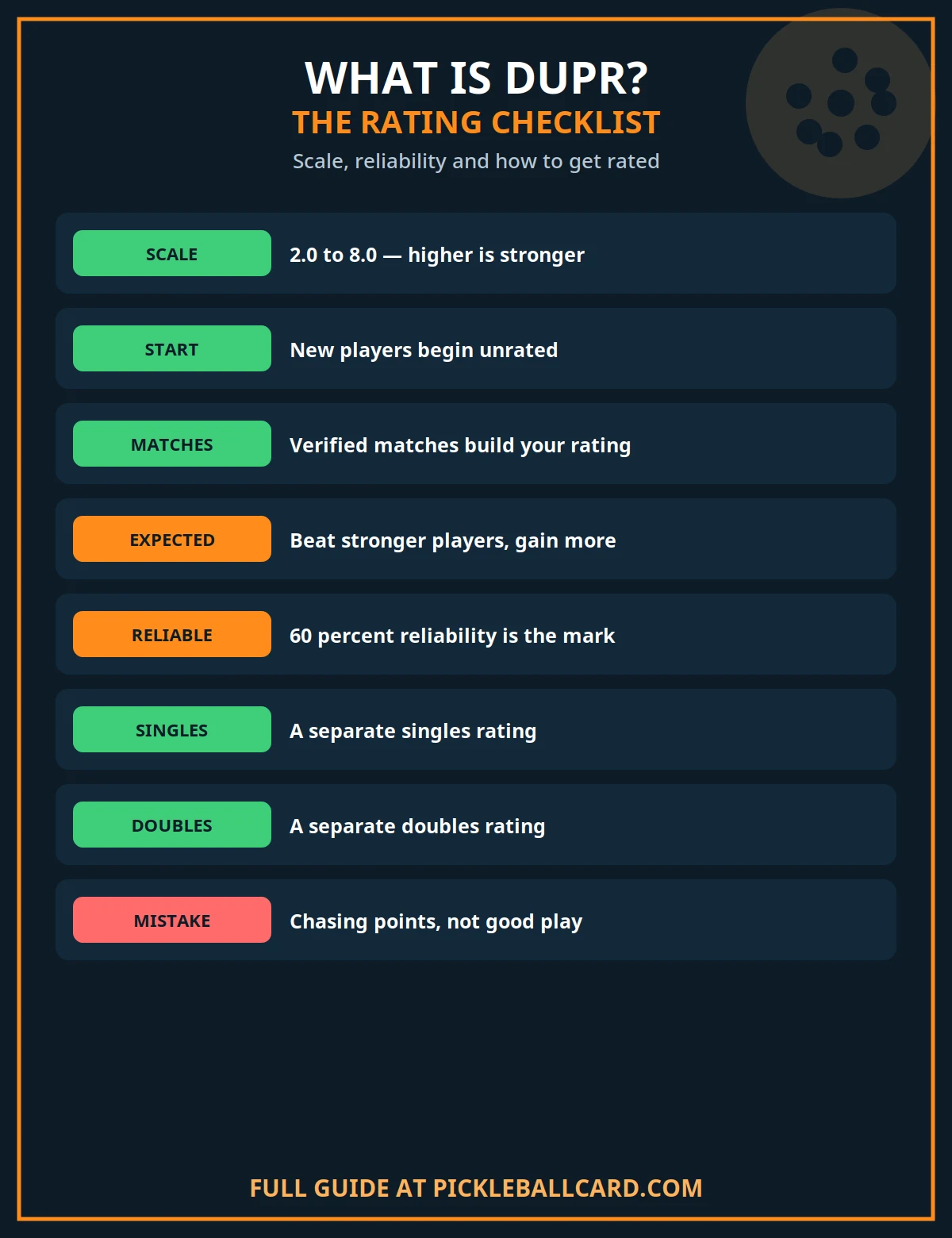
Good Rating Checklist
- Your rating comes from recent, verified results, not a single old match.
- Your Reliability Score is at least 60 percent, marking a reliable rating.
- Your rating matches the level of games you actually enjoy playing.
- You have results in the format you quote, singles or doubles.
- Your recent results reflect your current game, not last year’s form.
- You are improving skills, not hunting for easy opponents to inflate the number.
Common Misunderstandings About DUPR
The most common surprise is a rating drop after a win. That happens when you win by less than expected, as explained under performance against expectation above.
Our dedicated guide covers this in full, including worked examples of how expectation shapes the outcome. Read why your DUPR rating can drop after a win if this has happened to you.
Another misunderstanding is treating reliability as skill. A low Reliability Score does not mean you are a weak player. It means the system has too little evidence to be confident about your rating yet.
Finally, some players believe only tournament results matter. Club, league, and confirmed self-reported games all feed the system, even though verified organised results carry the most weight.
DUPR vs Self-Rating and Skill Levels
Self-rating asks you to place yourself on a familiar scale, often from 2.5 to 5.0, based on a skills checklist. It is quick, free, and useful for a first social session, but it depends entirely on your own judgement.
That judgement is often generous. Players tend to rate themselves by their best shots, not their average rally, and two clubs can apply the same checklist very differently. Self-ratings therefore vary widely between groups.
DUPR replaces opinion with evidence. Two players with the same DUPR in different cities have at least been measured by the same system, even if their playing styles differ completely.
Think of the two as complements. Self-rating says where you believe you belong. DUPR says where your recorded results place you. When they disagree, trust the results, then work on closing the gap.
Frequently Asked Questions
Is DUPR free?
Yes. Creating a standard DUPR account and receiving a rating from recorded results is free. Clubs, leagues, tournaments, and optional services may charge their own separate fees.
How long does it take to get a DUPR rating?
One recorded match result can produce a first rating. Expect that early number to move quickly, and allow roughly 10 to 20 results before treating it as a settled picture.
Can my DUPR go down if I keep winning?
Yes, if you win by less than the system expected. DUPR judges performance against expectation, so a narrow win over a much weaker opponent can lower your rating slightly.
Do I need separate ratings for singles and doubles?
You do not need both, but DUPR tracks them separately. Play the format you care about, and quote the matching number when someone asks.
What Reliability Score should I aim for?
Aim for at least 60 percent, which DUPR treats as a reliable rating. Build it with regular verified matches against a variety of opponents.
Should I worry if my rating drops?
A small drop after one match is normal, especially early on. Look at the trend across recent results and your Reliability Score before worrying about a single movement.
Getting Started With DUPR
DUPR works best when you treat it as a tool, not a verdict. Get rated, build reliability with regular verified play, and use the number to find games that challenge you fairly.
Check your profile on the official DUPR site, join a club that reports results, and give your rating time to settle. The number will follow your game, if you let it.

Shoaib is the publisher of Pickleball Card. He oversees the site’s guides to pickleball rules, ratings, strategy and gear, all researched from primary sources — the USA Pickleball Rulebook, DUPR and manufacturer documentation — and updated as the game changes.