You won. You shook hands, logged the score — and your DUPR rating went down. It feels like a bug, but under DUPR’s current algorithm it is usually the system working exactly as designed. DUPR does not reward wins on their own. Before every match it works out the score it expects from the ratings of everyone on court. If your team scores more than that expectation, your rating rises. If you score less than expected, your rating falls — even if less still turned out to be enough to win the game.
That single idea explains almost every confusing rating move players are seeing now: the narrow win that costs you points, the close loss that gains you points, and the partner whose number moved by a different amount from yours in the very same match. This guide works through each case with concrete scorelines, explains why DUPR changed the system this way, and sets out what actually makes a rating climb.
Key Takeaways
- DUPR is a measurement, not a reward. A win can earn a medal or a better seed, but the rating only tracks how you performed compared with what your current rating predicted.
- Margin against expectation is what moves you. Beat a much weaker team 11–8 when the system expected 11–3, and you have underperformed — your rating can dip while theirs rises.
- You can go up in a loss. Push a stronger opponent far closer than expected and the system reads that as evidence you are better than your number.
- One match never defines a rating. DUPR builds the number from your full body of results; well-established ratings move less per match than new or inactive ones.
- Playing down is no longer a climbing strategy. Under the old approach any win lifted you; now routine wins over weaker players can hold you back unless you win by at least the expected margin.
The Short Answer: You Scored Less Than DUPR Expected
Think of every rated match as a prediction test. DUPR lines up the four ratings in a doubles game (or the two in singles), calculates the scoreline those ratings imply, and then compares reality with the forecast. Win 11–3 when 11–3 was expected and you have confirmed your rating — a small rise, or almost no change. Win only 11–9 in the same matchup and the evidence points the other way: either you are slightly weaker than your number suggests, or your opponents are slightly stronger than theirs. The system nudges both ratings toward each other so the next prediction starts closer to the truth.
Nothing in that logic requires you to have played badly. An 11–9 win is still a win, your opponents may have played the game of their month, and a couple of net cords may have gone against you. DUPR is not judging effort or fairness in a single afternoon — it is updating a statistical estimate, and it expects those one-off effects to cancel out across many matches.
How DUPR Actually Decides: Expected Score Explained
Three steps sit behind every rating change:
- Pre-match ratings set the expectation. The bigger the rating gap between the teams, the bigger the expected winning margin. A 4.5 pair facing a 3.5 pair is expected to win comfortably; two evenly matched pairs are expected to trade points to a close finish.
- The actual score is compared with the expectation. Points scored matter, not just the final W or L. That is why 11–2 and 11–9 against the same opponents can move a rating in opposite directions.
- Ratings adjust toward the new evidence. Overperform and you rise; underperform and you fall. DUPR says updates now land almost immediately after a result is entered, and you can see the effect match by match rather than waiting for a weekly recalculation.
If you are still working out where the number itself comes from, our full guide to pickleball ratings and the rating chart covers the skill levels behind DUPR, self-ratings and tournament ratings side by side.
Expected vs Actual: Four Scenarios That Explain Everything
| Scenario | Expected score | Actual score | What happens to the favourite’s rating | Why |
|---|---|---|---|---|
| Strong favourite wins narrowly | Win 11–3 | Win 11–8 | Down | Won, but scored five fewer points than predicted — underperformance |
| Favourite wins, but closer than predicted (DUPR’s own example) | Win 11–5 | Win 11–9 | Down slightly | Both ratings move closer together so the next forecast is more accurate |
| Underdog loses narrowly (singles, 3.5 vs 4.0) | Lose 5–11 | Lose 9–11 | Up | The underdog scored four more points than expected — overperformance in defeat |
| Favourite wins as predicted or better | Win 11–3 | Win 11–3 or 11–1 | Up | Met or beat the expectation — the rating is confirmed or improved |
The first three rows follow worked examples DUPR itself has published to explain the update. The fourth row is the same logic run in reverse, included as an illustration.
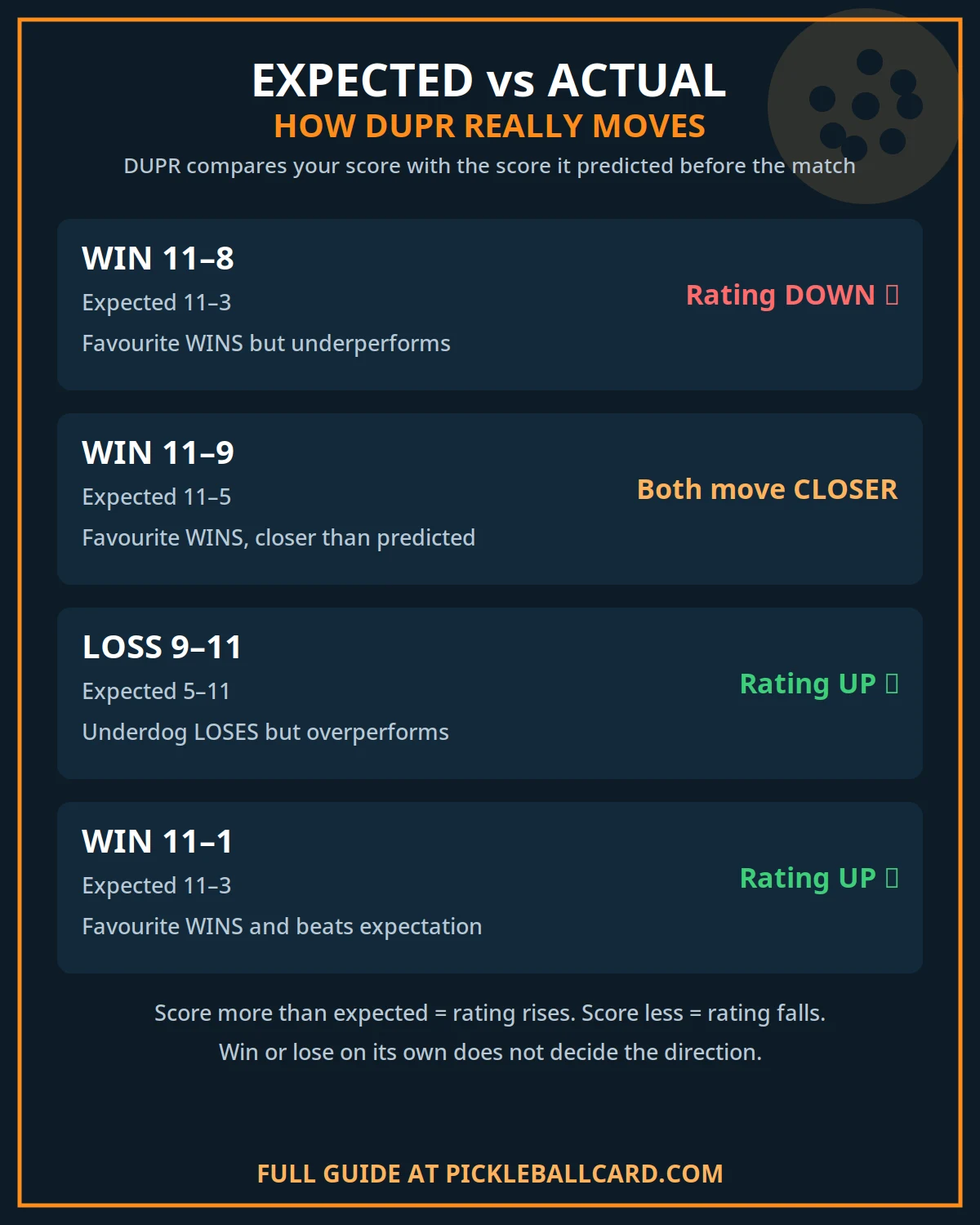
Expected vs actual: the margin against DUPR’s prediction — not the win itself — is what moves your rating.
Read the table once and most “strange” rating moves stop being strange. The result column in the app — win or loss — is only half the story. The other half, the margin against expectation, is the half that moves the number.
Why Did My Partner’s Rating Move Differently From Mine?
Partners share a scoreline but not a rating history, so identical matches routinely produce different movements. Four factors drive the difference:
- Different starting ratings. If you are the higher-rated player on your team, the expectation placed on the team leans more heavily on you — and an underperformance is charged more to the player the system thought would carry the result.
- Different reliability. Alongside the rating, DUPR tracks a Reliability Score — a measure of how established and current the number is. More matches, more recent matches, and a wider mix of partners and opponents all raise it. High-reliability players see smaller shifts per match; newer or less active players see bigger swings from the same result.
- Different match volume. A rating built on hundreds of logged games barely moves on one result. A rating built on a handful of games is still calibrating, and every new scoreline carries more weight.
- Singles and doubles are separate. DUPR keeps singles and doubles ratings apart because the two formats test different skills. A doubles result does nothing to your singles number, however dramatic it felt.
So if your partner dropped 0.03 and you dropped 0.01 from the same win, neither figure is a mistake. You simply brought different histories into the same match.
Why DUPR Designed It This Way
Two problems with the old win-always-rises approach pushed DUPR to change. The first is inflation: if winners can only rise and losers are protected from falling in the “wrong” result, the whole rating pool drifts upward over time and a 4.0 stops meaning the same thing from one season or one region to the next. Moving one side up and the other down in each match keeps the overall distribution stable.
The second is playing down. When any win lifted a rating, the safest way to climb was to beat weaker players repeatedly — while players who tested themselves against stronger competition were punished for narrow losses that actually proved their level. Rating performance against expectation reverses both incentives: routine wins over weaker opponents stop paying, and competitive losses against stronger opponents start counting in your favour. DUPR’s stated aim throughout is accuracy — a number that predicts future results as closely as possible, for seeding, bracketing and level-based play.
When a Drop After a Win Is Normal — and When to Check the Entry
Almost certainly normal if:
- You were clear favourites and won by less than a comfortable margin.
- Your Reliability Score is low, or you have few logged matches — early ratings swing more.
- Your opponents were rated well below you, even if they played above their usual level on the day.
- The drop is small. Established ratings typically move in hundredths, not tenths, on a single match.
Worth checking if:
- The score in the app does not match the score you actually played — a transposed 11–6 entered as 6–11 flips the entire calculation.
- A match was validated that you did not play, was a friendly hit-around rather than a competitive game, or was entered under the wrong format (singles vs doubles).
- Your rating moved by an unusually large amount despite a long, active match history.
DUPR offers a rating-review request route for results you believe are wrong, so a genuine data error is fixable — start by confirming the entered score with everyone who played before querying the movement itself. And keep the basics straight when you log games yourself: our guide to how to score in pickleball runs through the scoring calls that feed those entries.
How to Make Your Rating Actually Go Up
There is no loophole, and DUPR is blunt about that — but the new system does reward specific habits:
- Play at or above your level. Matches against players near or above your rating are where overperformance is possible in both wins and losses. Matches far below your level demand near-perfection just to stand still.
- Compete for every point. Because margin matters, easing off at 9–2 or going through the motions in a losing cause now has a rating cost. The last three points of a lost game can be the difference between a drop and a rise.
- Build reliability. Log matches regularly, across varied partners and opponents, in leagues, clubs and tournaments that record results. A higher Reliability Score steadies the number and makes each result count as it should.
- Log enough matches. A thin match history is the most common reason players feel mis-rated. More recorded games give the system the evidence it needs to place you correctly.
- Get better — it is still the main route. The algorithm is trying to predict your typical performance, not your best day. Consistent improvement, repeated across matches, is what moves the needle permanently.
Three Myths the Update Retired
“A win always raises your rating.” That was the old behaviour, and older club guides and PDFs still state it as an absolute rule. Under the current algorithm it is simply false — performance against expectation decides the direction.
“Playing down is an easy way to climb.” It was, once. Now a favourite who wins narrowly can slide, and DUPR expects some previously inflated ratings to settle downward as players keep logging matches under the new model. That settling is a correction, not a penalty.
“One match wrecked my rating.” DUPR’s position is that a single result never defines a rating. Conditions cut both ways over a season — the wind, the net cords and the off day that hurt you on Saturday help you on another. If your number truly reflects your level, a dip after one underperformance is followed by rises when you perform to it again. New to rated play entirely? Start with how to play pickleball, then get some logged matches in before judging the number.
Frequently Asked Questions
Can my DUPR rating go up after a loss?
Yes. If you score more points than the system expected — for example losing 9–11 to a player it predicted would beat you 11–5 — you overperformed, and your rating can rise despite the loss.
Does the winning margin really matter in DUPR?
Yes — it is the core of the current model. DUPR compares the actual score with the expected score derived from pre-match ratings, so an 11–2 win and an 11–9 win over the same opponents can move your rating in opposite directions.
Why did my rating drop more than my partner’s in the same match?
Because you brought different histories into it. Starting rating, Reliability Score and total logged matches all shape how much one result moves a player, so partners routinely see different changes from an identical scoreline.
Do singles and doubles results affect each other?
No. DUPR maintains separate singles and doubles ratings because the formats test different skills. Only doubles results move your doubles rating, and vice versa.
How long does it take for a DUPR rating to stabilise?
There is no fixed official match count, and you should be wary of any site that quotes one as a DUPR rule. In practice, ratings settle as match volume, recency and variety of opponents build your Reliability Score — the more representative games you log, the smaller the swing from any single result.
What can I do if a result was entered incorrectly?
First confirm the entered score, format and players with everyone involved — a wrong scoreline is the most common cause of a “wrong” rating move. If the entry itself is incorrect, DUPR provides a rating-review request process for exactly that situation.
The Bottom Line
A drop after a win is not DUPR punishing success. It is the system saying: “You won that match by less than a player of your rating should have — so your rating needs a small correction, and your opponents deserve a small one upward.” Win by the margin your rating predicts (or better), compete for every point when you are losing, play opponents who test you, and log enough matches for your reliability to grow — and the number will follow your game instead of confusing you after it.