
A good DUPR rating depends on who you play with and what you play for. For most recreational players, a rating in the 3s is normal.
A 4.0 puts you ahead of about 84% of rated doubles players, according to DUPR’s own percentile figures. A 5.0 puts you in roughly the top 1%.
That short answer needs context. DUPR rates players from 2.000 to 8.000, and its own bands run from Novice to Professional. Where your number sits matters less than what it is measured against: doubles or singles, how many matches sit behind it, and how reliable DUPR considers it.
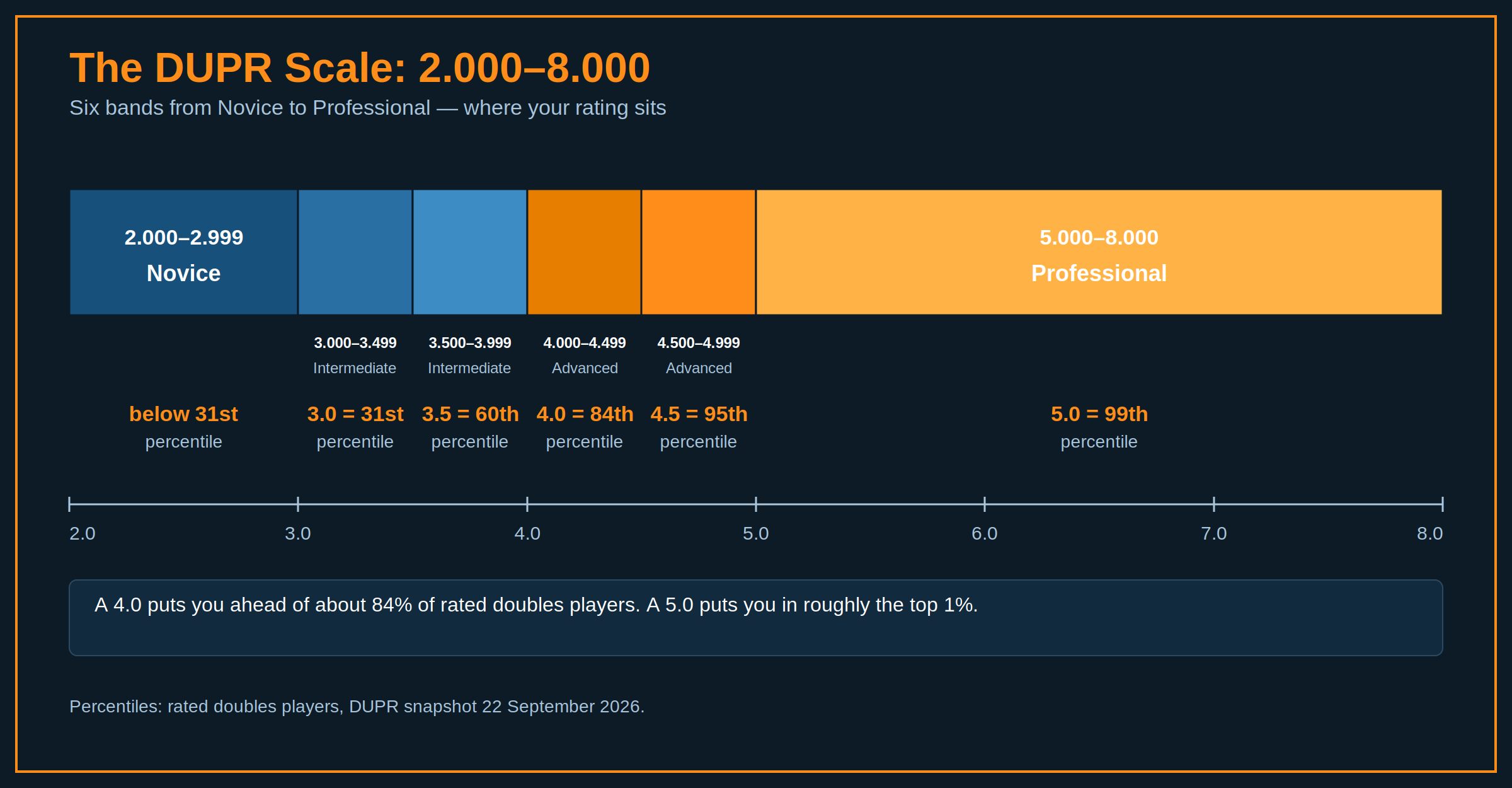
The DUPR Scale at a Glance
DUPR’s scale runs from 2.000 to 8.000. New players show as NR, which means Not Rated, until a first match is submitted or a DUPR Coach assigns a provisional rating.
DUPR tracks singles and doubles separately, so one player can hold two different numbers. The table below uses DUPR’s wording for the band names, and DUPR’s own percentile figures for rated doubles players.
| DUPR band | DUPR label | Percentile (doubles) | What it means |
|---|---|---|---|
| 2.000–2.999 | Novice | Below 31st | Learning the game |
| 3.000–3.499 | Intermediate | 31st to about 60th | The largest group of rated players |
| 3.500–3.999 | Intermediate | About 60th to 84th | Strong recreational play |
| 4.000–4.499 | Advanced | 84th to 95th | Strong club level |
| 4.500–4.999 | Advanced | 95th to 99th | High-level amateur play |
| 5.000–8.000 | Professional | 99th and above | Professional level, in DUPR’s wording |
The percentiles come from DUPR’s percentile blog post, published 12 October 2026. They describe rated doubles players only, not every person who plays pickleball.
Our guide to what DUPR is and our pickleball ratings hub explain the wider system.
Where Most Players Sit
More than half of active rated players sit somewhere in the 3s. DUPR’s own snapshot, taken on 22 September 2026, puts 53% of players in the 3.000–3.999 range. The single biggest band is 3.000–3.499, with 29% of players.
The numbers thin out quickly above 4.0. Only about 16% of active doubles players have reached 4.0, about 5% have reached 4.5, and about 1% have reached 5.0.
The middle of the distribution sits just below 3.5. DUPR says the median active doubles player falls in the 3.000–3.499 band, and its own clearly labelled estimate puts the median at around 3.3. That is an estimate, not an official number.
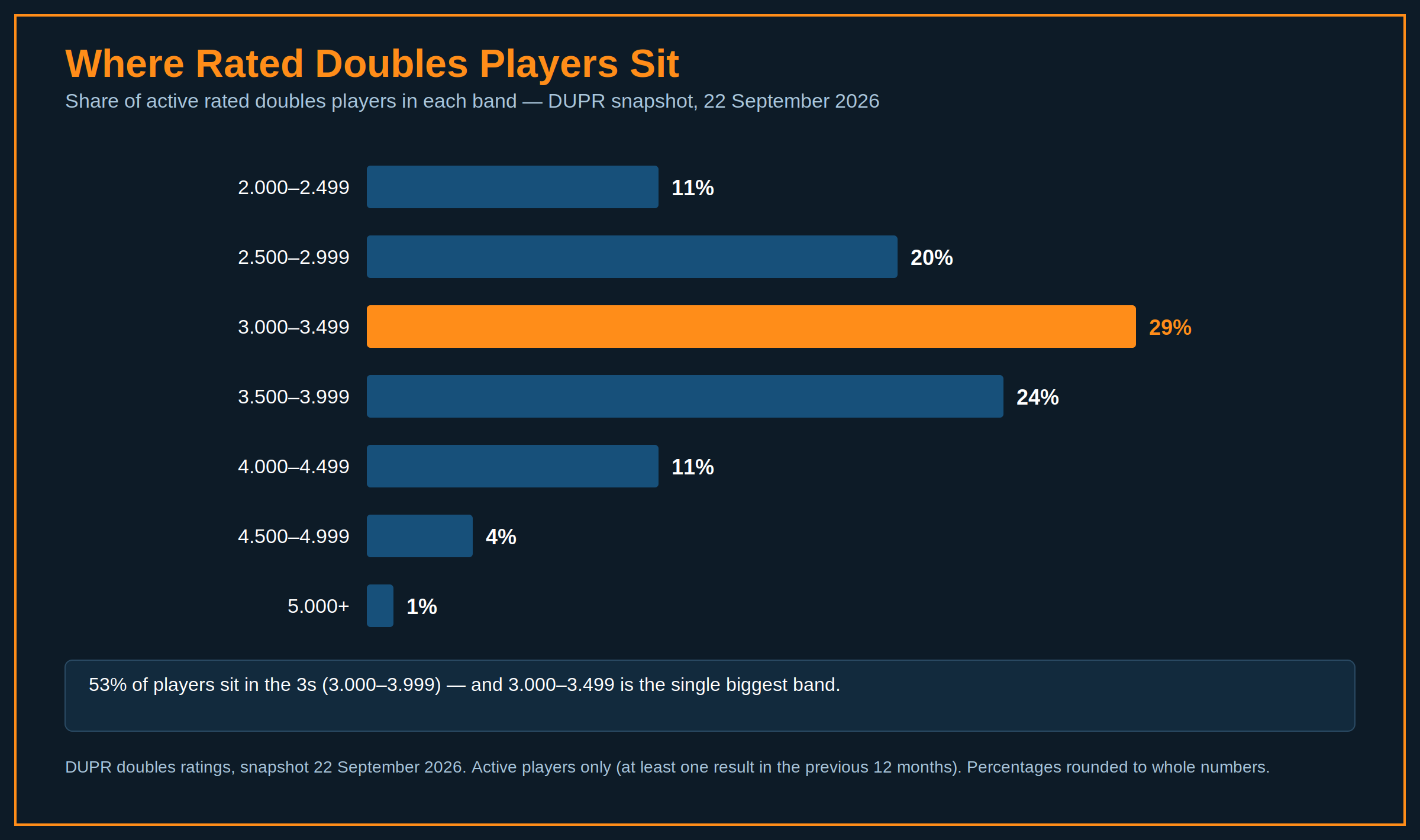
Three caveats travel with every figure here, because DUPR states them itself. The figures cover doubles only, and active players only — players who recorded at least one result in the previous 12 months.
They also cover DUPR players, not all players. Many recreational players never log matches on DUPR, and those who do are likely to skew more competitive. The percentages are rounded to whole numbers, so the percentiles are approximate.
What Counts as Good for You
A good rating is a rating that matches the games you want to play. DUPR’s bands describe skill, not worth. The descriptions below are glosses on DUPR’s band labels, not DUPR’s own wording, except where DUPR’s label is quoted.
In the 2s: you are learning. A rating in the 2s means you are building the basics — consistent serves and returns, keeping rallies going, and learning court positioning. That is a normal starting point. Our pickleball rules guide covers those basics.
In the 3s: you are a regular recreational player. This is where most rated players sit. A 3.0 is at about the 31st percentile among rated doubles players, and a 3.5 is at about the 60th. At this level you can hold rallies, play club sessions comfortably, and enter recreational events without feeling out of place.
At 4.0: you are a strong club player. A 4.0 is ahead of about 84% of rated doubles players, or roughly one player in six at 4.0 or above. DUPR labels this band Advanced. At this level you are competitive in local tournaments and comfortable against most players at a club night.
At 4.5: you are near the top of amateur play. A 4.5 sits at about the 95th percentile, ahead of roughly 19 in 20 rated doubles players. Only about 5% of active doubles players reach this level.
At 5.0 and above: you are at professional level, in DUPR’s wording. DUPR’s own label for 5.000–8.000 is Professional — not “advanced tournament”, a phrase an earlier draft of this site’s keyword plan used by mistake. Reaching 5.0 puts a player in roughly the top 1% of active rated doubles players. Our guides to the PPA Tour and Major League Pickleball describe where those players compete.
Before You Compare Your Number
A rating is only as useful as the matches behind it. DUPR itself recommends logging at least 10 to 15 matches before fully trusting your number, in two of its own blog posts. One match is enough to get a rating, but that first number is a starting point, not a settled measure.
That is where DUPR’s Reliability Score comes in. It is a separate percentage, from 1 to 100, for singles and doubles, and DUPR’s own blog says a score of 60% or higher is a good, reliable rating. A rating with low reliability can move a long way as more matches are added.
Our DUPR Reliability Score guide explains it in full.
Check the format too. Singles and doubles ratings are separate, so a strong doubles number says nothing about your singles game, and the percentiles in this article are doubles figures. If you play singles, use the same bands but do not borrow the doubles percentiles.
Finally, remember that your rating is not a reward for winning. DUPR compares your actual score against the score it expected from you. That is why a narrow win can lower a rating and a close loss can raise one.
Our guide to why a DUPR rating can drop after a win explains this with worked examples. If you have not yet got a rating, our guide on how to get a DUPR rating walks through the three steps.
What Moves Your Rating
Four factors move a DUPR rating, in DUPR’s own words: performance against expectation, the type of match played, match recency, and the number of matches played. Verified matches from tournaments, leagues and clubs can carry more weight than self-posted recreational matches, and recent matches carry more weight than older ones.
One recent change is worth knowing before you read too much into a single result. Since November 2026, DUPR has applied an exception when the gap between the two doubles teams’ average ratings is 0.5 or more and the higher-rated team wins: nobody’s rating moves, whatever the score.
DUPR announced the rule on 24 November 2026, tested it from 4 to 22 November, and applied it to all matches submitted from 23 November 2026. It is not retroactive, and it applies by submission date, not by the date the match was played.
The exception only covers the case where the higher-rated team wins. If the lower-rated team wins, ratings move as normal, and the upset is rewarded.
When the teams are within 0.5 of each other, the normal rule still applies — a win by fewer points than expected can still lower a rating. For doubles, the gap is worked out on team averages, not individual ratings.
To see how a particular scoreline might move your number before you play, try our DUPR Match Impact Calculator. To estimate where you might sit before you have a rating, try our Pickleball Rating Estimator.
Both are PickleballCard’s own tools, not DUPR’s own Forecast tool. DUPR’s tool is called DUPR Impact and sits in the Forecast tab of the DUPR app.
The Short Version
There is no single number that counts as good for everyone. A 3.5 is ahead of about six in ten rated doubles players, a 4.0 is ahead of about eight in ten, and a 5.0 is ahead of about 99 in a hundred. Most rated players sit in the 3s, and that is normal.
Frequently Asked Questions
What DUPR rating is considered good?
It depends on your goals. For recreational play, a rating in the 3s is good — that is where 53% of active rated doubles players sit, according to DUPR’s September 2026 snapshot.
A 4.0 is a strong club rating, ahead of about 84% of rated doubles players. A 5.0 is professional level in DUPR’s own wording, in roughly the top 1%.
Is a 3.5 DUPR rating good?
Yes, for most recreational players. A 3.5 sits at about the 60th percentile among rated doubles players, according to DUPR, so it is ahead of roughly six in ten of them.
Is a 4.0 DUPR rating good?
Yes. A 4.0 sits at about the 84th percentile among rated doubles players, according to DUPR, which means about one player in six reaches 4.0 or above. DUPR labels the 4.000–4.999 band Advanced.
Is a 5.0 DUPR rating good?
Yes — it is at the top of the scale for practical purposes. DUPR labels 5.000–8.000 Professional, and a 5.0 sits at about the 99th percentile among rated doubles players, or roughly one in a hundred.
What is the average DUPR rating?
There is no official average published by DUPR. The closest published figure is the median: DUPR says the median active doubles player falls in the 3.000–3.499 band, and its own clearly labelled estimate puts it at around 3.3. Treat that as an estimate, not an official number.
How many matches do I need before I trust my DUPR rating?
DUPR itself recommends logging at least 10 to 15 matches before fully trusting your number, in its own blog posts. One submitted match is enough to get a rating, but that first number can move a long way. Also check your Reliability Score: DUPR’s blog says 60% or higher is a good, reliable rating.

Shoaib is the publisher of Pickleball Card. He oversees the site’s guides to pickleball rules, ratings, strategy and gear, all researched from primary sources — the USA Pickleball Rulebook, DUPR and manufacturer documentation — and updated as the game changes.