Pickleball is a paddle sport played on a badminton-sized court with a perforated plastic ball and a low net. It blends elements of tennis, badminton, and table tennis — and it is the easiest racket sport a complete beginner can pick up and enjoy on day one.
That is the short answer. The full answer covers where the game came from, what you need to play, the rules that make it different, and how to start.
If you have heard the name everywhere but never held a paddle, this guide is your starting point.
Pickleball is played as singles (one against one) or doubles (two against two), indoors or outdoors, by players of every age. Games are usually played to 11 points, and you must win by two.
Once you know the basics here, the next step is our step-by-step guide to how to play pickleball, which walks through your first game point by point.
Key Takeaways
- Pickleball is a paddle sport on a 20-by-44-foot court, played with a perforated plastic ball over a net 36 inches high at the sides and 34 inches at the center.
- It was invented in 1965 on Bainbridge Island, Washington, by Joel Pritchard, Bill Bell, and Barney McCallum.
- The game’s signature rules are the two-bounce rule, the non-volley zone (“the kitchen”), and underhand serving.
- Only the serving side can score points, and games are usually played to 11, win by two.
- All you need to start is a paddle, a ball, court shoes, and a court — most beginners can rally within their first session.
- Pickleball’s small court and slower ball make it far more accessible than tennis, while still rewarding skill at the highest levels.
What Is Pickleball? The Definition
Pickleball is a paddle sport in which players hit a perforated plastic ball over a net, aiming to land it where the opponent cannot return it.
It is played on a court 20 feet wide and 44 feet long — the same size as a doubles badminton court — with a net 36 inches high at the sidelines and 34 inches at the center.
The paddle is solid, larger than a table tennis paddle and smaller than a tennis racket, with no strings. The ball is light, hollow plastic with holes punched through it, which slows it down and keeps rallies under control.
That combination — a small court, a slow ball, and a solid paddle — is why the game is so accessible. You do not need to cover a huge court or generate enormous power. Placement, patience, and soft touch matter as much as athleticism.
Pickleball vs Tennis vs Badminton vs Table Tennis
Pickleball borrows from all three of its parent sports. From tennis it takes the net, the court layout, and the idea of groundstrokes and volleys. From badminton it takes the court size and the fast, close-to-the-net exchanges.
From table tennis it takes the solid paddle and the emphasis on spin and touch.
The differences matter too. The court is a quarter the size of a tennis court, so rallies last longer and movement demands are lower. The ball travels slower than a tennis ball, so beginners can track it.
And the underhand serve removes the hardest skill in tennis from the equation entirely.
A Brief History of Pickleball
Pickleball was invented in the summer of 1965 on Bainbridge Island, Washington. Joel Pritchard, a congressman, and his friends Bill Bell and Barney McCallum wanted a game their families could play together.
They improvised on Pritchard’s badminton court: they lowered the net, used plywood paddles, and batted a perforated plastic ball back and forth.
The game caught on with neighbors, then across the Pacific Northwest. The first permanent court followed, the first tournament was held in 1976 in Tukwila, Washington, and the first rulebook arrived with the formation of the USA Pickleball Association in 1984.
From there, growth was steady and then explosive. Pickleball spread to all 50 states, into schools and community centers, and then internationally. Today it is played in parks, gyms, and dedicated facilities around the world, by millions of players — and it remains one of the fastest-growing sports in the United States.
Where Does the Name Come From?
There are two stories, and both are told by the founders’ families. One says the game was named after the Pritchards’ dog, Pickles, who chased the ball.
The other says it comes from the “pickle boat” in rowing — a crew made up of leftover rowers — because the game itself was made from leftover equipment of other sports.
Either way, the name stuck, and it is now one of the most recognizable in sport.
The Court, Explained
A pickleball court is 20 feet wide and 44 feet long, with lines 2 inches wide.
The most important feature is the non-volley zone, universally known as “the kitchen”: a 7-foot zone on each side of the net where you may not volley the ball (hit it out of the air) while standing in it.
The court is divided by a centerline into left and right service courts. The baseline is the back line, and the sidelines run the length of the court.
In doubles, the full 20-foot width is in play. In singles, recreational games generally use the same sidelines, with the centerline marking the service boxes.
The Kitchen: The Rule That Defines the Game
The kitchen exists to prevent players from standing at the net and smashing every ball. You can step into the kitchen to hit a ball after it bounces, but you cannot volley from inside it, and your momentum cannot carry you into it after a volley.
This single rule creates the soft game — the dinking rallies at the net — that makes pickleball unique. For the full rule, read our guide to pickleball kitchen rules (linked from our rules hub).
The Basic Rules of Pickleball
You can learn the full rules from the USA Pickleball Official Rulebook, but these are the essentials every beginner needs:
Serving
The serve must be underhand, with the paddle below the waist, and hit diagonally into the opponent’s service court. The serve must clear the kitchen — it cannot land in the non-volley zone.
Only one serve attempt is allowed (except in the case of a let, where the ball touches the net and lands in). The server continues serving until their side loses a rally.
The Two-Bounce Rule
Each side must let the ball bounce once before volleying: the receiver must let the serve bounce, and the server must let the return bounce. After those two bounces, players may volley or let the ball bounce — their choice.
This rule stops the serving team from rushing the net and volleying the return immediately. It is the reason every rally starts with a serve, a return, and a third shot.
Scoring
Only the serving side can score points. Games are usually played to 11 points, and a team must win by at least two points. Some games are played to 15 or 21 in tournaments.
In doubles, each player on the serving team gets a turn to serve (except at the very start of the game), and the score is called as three numbers: serving team’s score, receiving team’s score, and the server number (1 or 2).
Faults
A fault ends the rally. Common faults include hitting the ball out of bounds, into the net, volleying from inside the kitchen, or violating the two-bounce rule. The full list is covered in our rules hub.
For the complete ruleset, start with our pickleball rules hub, which links to every detailed rule guide on this site.
Equipment You Need to Start
Starting pickleball takes very little gear, and most of it can be borrowed for a first session:
| Item | What to look for as a beginner |
|---|---|
| Paddle | A mid-weight (7.5–8.5 oz) composite or wood paddle with a comfortable grip. Do not buy a professional paddle yet. |
| Ball | Outdoor balls have smaller, harder holes; indoor balls have larger, softer holes. Match the ball to where you play. |
| Shoes | Court shoes with lateral support — not running shoes, which are built for forward motion and roll on side steps. |
| Court | Public parks, community centers, and gyms increasingly offer courts. Many offer free beginner sessions. |
| Net | Portable nets make any flat surface a court. Permanent courts are appearing in parks everywhere. |
That is genuinely all you need. Fancy paddles, specialized bags, and training aids can wait until you know you love the game — which, for most people, takes about one session.
The Beginner’s First-Game Checklist
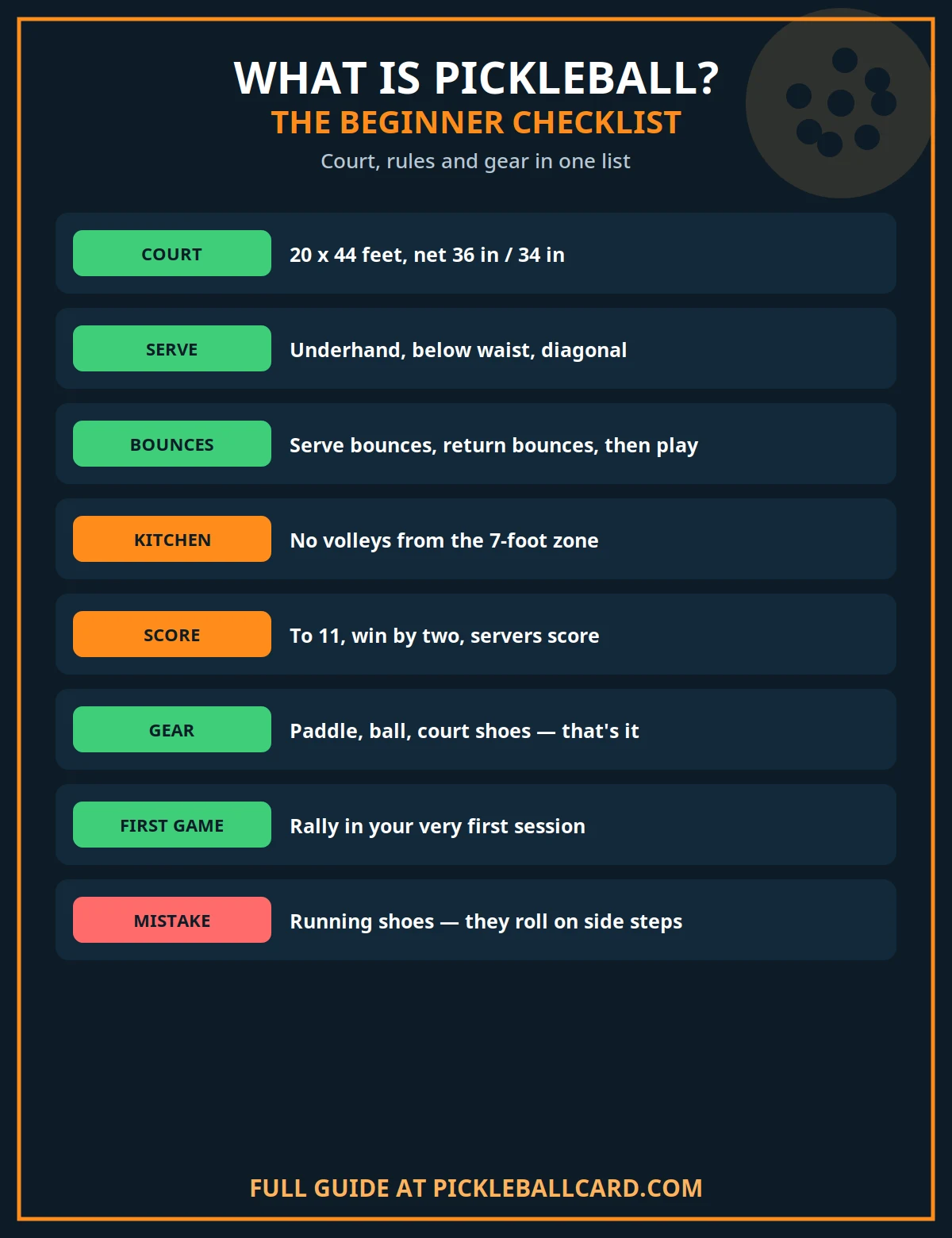
Use this checklist for your first time on court:
- Learn the serve: underhand, below the waist, diagonal, and clear of the kitchen.
- Remember the two bounces: let the serve bounce, let the return bounce, then play freely.
- Stay out of the kitchen on volleys: you can step in after a bounce, never to volley.
- Call the score: server’s score, receiver’s score, server number — before every serve.
- Get to the kitchen line: after the return, advance with your partner. The line is where points are won.
- Keep the ball low: low balls are hard to attack; high balls get put away.
- Have fun: pickleball’s social side is the point. Rotate partners, laugh at the mishits, stay for the next game.
A Sample Rally, Point by Point
Here is a typical beginner doubles rally, shot by shot. Team A serves from the right service court, underhand and diagonal. The score is called: 0-0-2 (the second server serves first at the start of a game).
Team B’s receiver lets the serve bounce, then returns it deep down the middle. Team A must let the return bounce too — that is the two-bounce rule — then hits a third shot: a soft drop that lands in Team B’s kitchen.
Team B steps in after the bounce and dinks it back. The teams trade dinks until Team A lifts a ball slightly high. Team B volleys it softly at Team A’s feet, Team A cannot return it, and Team B wins the rally — but scores no point, because they were not serving.
Team B now serves, and the cycle repeats. That is the whole game: serve, return, third shot, kitchen rally, and a result. Everything else is refinement.
Why Is Pickleball So Popular?
Four reasons explain the boom. First, it is easy to learn: a beginner can rally within minutes, where tennis takes weeks. Second, it is social: doubles is the default, games are short, and players rotate constantly.
Third, it is gentle on the body relative to other racket sports: the court is small, the ball is slow, and the rallies reward placement over power.
Fourth, it is cheap: public courts are often free, and a starter paddle costs less than a dinner out.
Those four reasons compound. Easy to learn means friends join. Social means players stay. Gentle means all ages play together. Cheap means nobody is priced out.
Formats: Singles, Doubles, and Mixed Doubles
Doubles is the most common format: two players per side, the full court in play, and teamwork at the center of every point. Mixed doubles — one man and one woman per side in competition, or any mixed pairing socially — is the most popular competitive format of all.
Singles is one against one on the same court. It is faster, more physical, and more demanding on movement, and it rewards groundstrokes and passing shots over the soft kitchen game.
Other formats include skinny singles (played on half the court, a great training game), round robins (rotating partners across many short games), and wheelchair pickleball, which follows adapted rules.
Our guide to pickleball terminology defines every term you will hear on court, from “dink” to “erne” to “kitchen.”
Frequently Asked Questions
What is pickleball in simple terms?
Pickleball is a paddle sport played on a small court with a perforated plastic ball. Two or four players hit the ball over a low net, trying to land it where the opponent cannot return it. Games go to 11 points, win by two.
Is pickleball easy for beginners?
Yes — it is one of the easiest racket sports to learn. The court is small, the ball is slow, and the underhand serve removes the hardest skill in tennis. Most beginners rally in their first session.
What do you need to play pickleball?
A paddle, a ball, court shoes, and access to a court. Beginners should start with a mid-weight paddle and match the ball type (indoor or outdoor) to where they play.
How is pickleball different from tennis?
The court is much smaller, the paddle is solid rather than strung, the ball is slower and perforated, the serve is underhand, and the kitchen rule creates a soft net game that tennis does not have.
How long does a pickleball game take?
A game to 11 points usually takes 15–25 minutes, depending on the players. Most sessions run several games with rotating partners.
Can kids play pickleball?
Absolutely. The small court and light equipment suit young players, and many schools now teach pickleball in physical education. See our guide to pickleball for kids for age-specific advice.
Is pickleball good exercise?
Yes. A session of doubles provides moderate aerobic activity, balance work, and quick lateral movement — and because games are social and fun, players tend to play longer than they would exercise otherwise.
Final Word
Pickleball is a simple game with surprising depth. The basics take an afternoon to learn; the strategy takes years to master. That combination — instant fun, lasting challenge — is why it has grown from a Bainbridge Island backyard into a global sport.
Your next step is simple: find a court, borrow a paddle, and play a game. Then come back and learn the rules in depth, the shots one by one, and the strategy that turns a fun rally into a won point.
The rules in this guide follow the USA Pickleball Official Rulebook. When you are ready for your first full game, our how to play pickleball guide takes you there point by point.

Shoaib is the publisher of Pickleball Card. He oversees the site’s guides to pickleball rules, ratings, strategy and gear, all researched from primary sources — the USA Pickleball Rulebook, DUPR and manufacturer documentation — and updated as the game changes.