Pickleball looks gentle from the sidelines. The court is small, the ball is light, and the rallies feel friendly.
That friendly look hides a real risk. At the kitchen line, players stand just fourteen feet apart, and a hard-driven ball can reach your face before you can react.
Eye injuries in pickleball are uncommon, but they can be serious. A scratched cornea heals, yet a torn retina can threaten your sight.
The good news is that most of these injuries are preventable. The right eyewear, a few court habits, and a sensible warm-up routine cover almost every common hazard.
This guide explains what to wear, what to watch for, and what to do if a ball or paddle ever strikes your eye.
Key Takeaways
- Wear protective eyewear rated for racquet sports every time you play, even in casual games.
- Ordinary glasses and sunglasses are not safety eyewear and can shatter on impact.
- Look for shatter-resistant polycarbonate lenses and a snug, wrap-around frame.
- Most eye impacts come from deflected balls and close-range kitchen exchanges, not serves.
- Check the court surface, clear stray balls, and warm up before your first game.
- After any eye impact, stop playing and get prompt professional advice, especially if vision changes.
Why Pickleball Puts Your Eyes At Risk
The kitchen line is where most eye danger lives. Four players crowd a small space, and fast exchanges leave almost no reaction time.
A pickleball serve can travel up to 40 miles per hour, according to research cited by the American Academy of Ophthalmology. Hands battles at the net can be faster still.
Speed alone is not the whole story. Deflections are the sneakier threat, because a ball glancing off a paddle can change direction without warning.
One ophthalmology resident who studies the sport put it plainly: injuries often happen when a ball bounces off your own paddle, or your partner’s, at an odd angle toward your face.
You cannot train your reflexes to cover that. No one reacts fast enough to a deflection from a few feet away, which is why a physical barrier matters more than quick hands.
Doubles adds another hazard: a partner’s paddle swing. In a fast exchange, a partner reaching across your body can bring a paddle edge close to your face.
The injuries reported by eye doctors range from mild to severe. Bruising and black eyes are common, and corneal abrasions are painful but usually heal.
More serious injuries include bleeding inside the eye, tears in the retina, and detached retinas. These are rarer, but they can require surgery and threaten vision.
Older players face extra risk. Reaction times slow with age, and pre-existing eye conditions can make an impact more dangerous.
Despite all this, many players still skip protection. A survey presented at the American Academy of Ophthalmology’s 2025 annual meeting found that only 20 percent of professional players wore protective eyewear.
Among amateur players in the same survey, 54.5 percent wore eye protection. Younger amateurs were the least likely group to wear it.
The most common reasons players gave were simple: they did not realise the risk, or they worried the eyewear would feel uncomfortable or hurt their game.
That gap between risk and habit is exactly what this guide aims to close. Protection is cheap, light, and easy to forget about once you are wearing it.
The American Academy of Ophthalmology’s survey of pickleball eye protection is a useful reminder that even experienced players underestimate the danger.
What Counts As Real Eye Protection
Not every pair of glasses protects your eyes. The distinction matters, because the wrong eyewear can fail exactly when you need it.
Real sports eye protection uses polycarbonate lenses. Polycarbonate is a strong, lightweight plastic that resists shattering on impact.
Ordinary prescription glasses usually use thinner, weaker materials. They can crack or break under a direct hit, turning the lens itself into a hazard.
Standard sunglasses have the same weakness. Dark lenses do nothing to stop a ball, and a broken fashion frame can cause cuts around the eye.
The survey mentioned above found that many players who believed they were protected were not. Of 67 players who endorsed protective eyewear, 41 were simply wearing their regular prescription glasses.
For racquet sports, look for eyewear that meets the ASTM F3164 standard. This is the safety standard developed for sports involving small, fast balls.
Check the product labelling before you buy. A genuine sports frame will state its standard clearly, and reputable sellers will list it in the specifications.
Fit matters as much as the lens material. A frame that slides down your nose or bounces during play will not be in place when a ball arrives.
Try this quick test in the shop: look down and shake your head firmly. If the frame shifts or lifts, the fit is wrong for sport.
Wrap-around frames offer the best coverage. They shield your eyes from angled shots and keep out glare from the sides.
Choose a lens tint that suits your playing conditions. Clear lenses work indoors, while amber or brown tints can improve contrast outdoors.
Avoid very dark lenses for evening or indoor play. If you cannot track the ball clearly, your reaction time suffers and your risk rises.
Finally, make eyewear part of your kit, not an afterthought. Put it on with your court shoes, before your first warm-up rally.
Prescription Options For Players Who Wear Glasses
Players who need vision correction have several good options, and none of them requires choosing between seeing clearly and staying safe.
Prescription sports glasses are the simplest choice. An optician fits polycarbonate prescription lenses into a sports frame rated for impact.
These frames grip better than everyday glasses. They use straps or curved temples that hold the frame steady during quick movement.
Some sports frames accept prescription inserts. A small prescription carrier clips behind a protective outer lens, giving you clear vision plus full impact protection.
Inserts cost less than a second full pair of glasses. They also let you swap outer lenses for different light conditions without changing your prescription.
Contact lens wearers can wear non-prescription protective goggles over their lenses. This combination gives sharp vision and a certified barrier in front of the eye.
Whichever route you choose, ask your optician about sports use specifically. Mention pickleball by name, and confirm the frame and lens combination meets a racquet-sport standard.
Never assume your everyday glasses qualify. If the frame was not designed for sport, it was not tested for a ball strike.
Body Shots And Kitchen-Line Risks
Most eye injuries do not come from serves. They come from the fast, close exchanges at the non-volley zone line.
At the kitchen line, the ball crosses the net in a fraction of a second. A speed-up aimed at your body can climb toward your face if it catches an edge.
Defensive blocks are another source of trouble. A hard shot blocked at close range can rebound at an unpredictable angle.
Your own paddle can betray you too. A ball striking the edge of your paddle may deflect upward, straight toward your eyes.
The safest response is boring but effective: keep your paddle up in front of your chest, and turn your face slightly away when a body shot arrives.
Ducking is a poor strategy at the net. A ball aimed at your body that you duck under can still clip your head, and you lose your balance in the process.
Instead, practise the defensive posture that keeps your paddle between you and the ball. A compact block, with the paddle face square, absorbs pace safely.
If you are learning that defensive game, our guide to the pickleball chicken wing shot explains the tucked-elbow block many players use against body shots.
Communication with your partner matters just as much. Call “mine” early, and agree who takes balls down the middle before the rally starts.
Most partner collisions happen when both players chase the same ball. A clear call prevents two paddles swinging into the same space.
Court manners help too. Aiming deliberately at an opponent’s head is poor sportsmanship, and most groups frown on it even in competitive play.
If you hit someone, apologise at once and check they are all right. Our guide to pickleball etiquette and the unwritten rules covers court courtesy in more depth.
Beginners deserve extra care. New players react late and often stand too close to the net, so experienced players should soften their shots in mixed games.
Finally, respect the pace of the game you are in. A friendly social rally is no place for full-power speed-ups aimed at someone’s face.
Falls And Court-Surface Hazards
Eye injuries are not the only safety issue on court. Falls are a leading cause of pickleball injuries overall, and a fall can injure your eyes as well as your wrists and hips.
Wet courts are the most obvious danger. Morning dew, light rain, and condensation on indoor surfaces all reduce grip without warning.
Check the surface before you play. Walk the court, look for damp patches, and wipe up standing water with a towel or squeegee.
Leaves, grit, and loose sand also cause slips. Outdoor courts near trees collect debris quickly, especially in autumn.
Stray balls are a tripping hazard that players constantly underestimate. A ball rolling underfoot during a rally can send you down hard.
Make it a habit: if a ball rolls onto your court, call “ball on court” loudly and stop the point at once.
Retrieve stray balls promptly, and never chase one across a neighbouring court while a rally is in progress there.
Footwear matters enormously. Court shoes with lateral support and non-marking soles grip during side-to-side movement far better than running shoes.
Running shoes are built for forward motion. Their high soles can catch during a lateral lunge, which is exactly how ankles roll.
Replace worn shoes before the tread goes smooth. A shoe that slides on a dusty indoor court is an accident waiting to happen.
Court surroundings deserve a glance too. Fences, benches, and net posts sit close to the playing area on many courts.
Leave a clear run-off zone behind the baseline where possible. Chasing a lob should not end with a collision against a fence.
Older players should pay special attention to balance and footing. Strength and balance training, even a few minutes a week, reduces fall risk noticeably.
For a fuller picture of what can go wrong, see our guide to common pickleball injuries and how to avoid them.
Warm Up Before You Play
Cold muscles tear more easily, and cold reactions are slower. A proper warm-up protects your body and sharpens your eyes for the first rally.
Start with five minutes of light movement. Walk briskly around the court, then jog gently or shuffle sideways along the baseline.
Add dynamic stretches next. Leg swings, arm circles, and gentle torso twists loosen the joints you will rely on during play.
Skip static stretching before games. Holding long stretches on cold muscles can temporarily weaken them, which is the opposite of what you want.
Move on to ball work. Begin with soft dinks at the kitchen line, then progress to volleys, groundstrokes, and finally a few serves.
This progression matters for eye safety too. Your tracking improves as your eyes adjust to the ball speed, so build up gradually rather than starting at full pace.
Include a few lateral shuffles and short sprints. Pickleball demands sudden stops and direction changes, and your ankles should be ready for them.
Hydration And Heat
Heat illness creeps up quietly, and a dizzy player is a danger to themselves and everyone on court. Hydration is a safety issue, not just a comfort issue.
Drink before you feel thirsty. Thirst lags behind actual fluid loss, so by the time you crave water you are already dehydrated.
Keep a water bottle at the side of the court and sip between games. Small, regular drinks beat a large gulp once an hour.
On hot or humid days, add electrolytes. Sweat carries away salts as well as water, and plain water alone may not replace them.
Watch for early warning signs in yourself and your partners. Headache, nausea, unusual fatigue, and confusion all signal trouble.
If someone looks unsteady or confused, stop play and move them into the shade. Cool them down and seek medical help if symptoms do not improve quickly.
Hazard And Prevention At A Glance
| Hazard | What Can Happen | Prevention |
|---|---|---|
| Fast ball at the kitchen line | Direct eye impact | Wear ASTM-rated polycarbonate eyewear every game |
| Deflected ball off a paddle | Unpredictable eye strike | Wrap-around frames; keep paddle up in defence |
| Partner paddle swing | Facial and eye contact | Call shots early; agree middle-ball coverage |
| Wet or debris-covered court | Slip, fall, head impact | Inspect and dry the surface before play |
| Stray ball underfoot | Trip and fall | Call “ball on court” and stop the point |
| Wrong footwear | Ankle roll or fall | Wear court shoes with lateral support |
| Glare and poor lighting | Missed ball, mistimed swing | Choose suitable lens tint; avoid dark lenses indoors |
| Heat and dehydration | Dizziness, collapse | Drink regularly; rest in shade; avoid midday summer play |
| No warm-up | Muscle strain, slow reactions | Five minutes of movement plus progressive ball work |
Your Court Safety Checklist
Run through this list before your first serve. It takes less than a minute, and it covers the hazards most players forget.
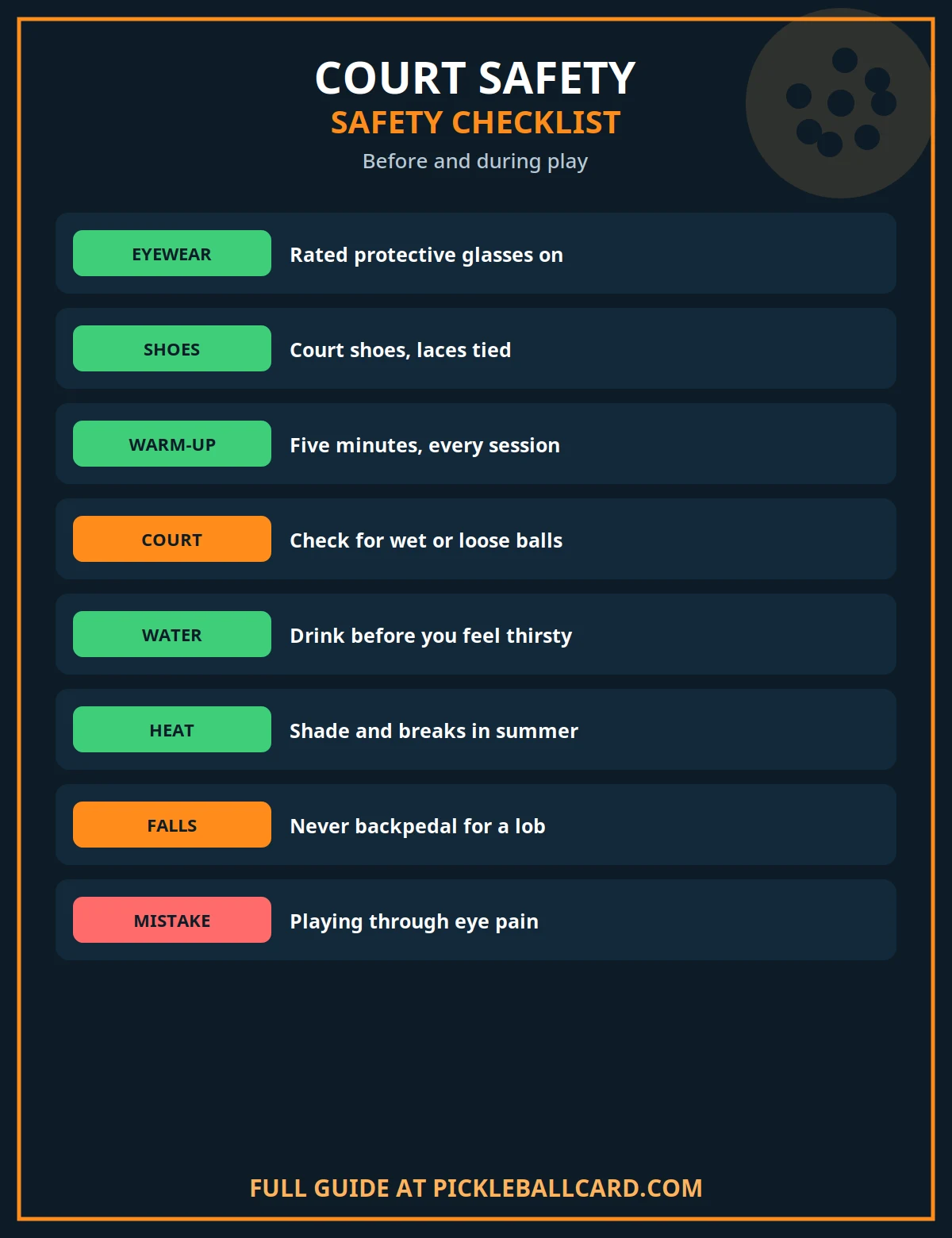
- Protective eyewear on, fitted snugly, lenses clean and unscratched.
- Court shoes laced, with good tread and lateral support.
- Court surface checked for water, leaves, grit, and cracks.
- Stray balls cleared from the court and surrounding area.
- Water bottle filled and placed at the side of the court.
- Warm-up completed: movement, dynamic stretches, progressive rallies.
- Partner communication agreed: who takes middle balls, and clear calls.
- First aid kit and phone accessible, with the court address known.
- Weather checked: heat plan, shade breaks, and lightning rule agreed.
- Any eye impact or dizzy spell means stop playing and get checked.
What To Do After An Eye Impact
Even with protection, impacts happen. What you do in the next few minutes can make a real difference to the outcome.
Stop playing immediately. Do not try to finish the game or “see how it feels” through another rally.
Do not rub the eye. Rubbing can worsen a scratched cornea and push debris deeper into the eye.
If you wear contact lenses, leave them in place unless a professional advises otherwise. Removing a lens can disturb an injured surface.
Cover the eye lightly with a rigid shield if one is available. A paper cup taped gently over the eye works as an improvised shield.
Apply a cold compress around, not directly on, the eye to reduce swelling. A bag of frozen peas wrapped in a towel does the job.
Seek professional advice promptly for any impact that causes pain, redness, or vision changes. Eye injuries can worsen quietly over hours.
Certain symptoms need urgent care. These include vision loss, double vision, flashes of light, new floaters, or a dark shadow across your vision.
Bleeding inside the eye, severe pain, a visibly misshapen eyeball, or an object stuck in the eye are emergencies. Call emergency services at once.
Even a mild impact deserves a check if symptoms linger beyond a day. Corneal scratches usually improve quickly, so worsening pain is a warning sign.
The CDC tracks eye injury prevention through its Vision and Eye Health Surveillance System, which monitors protective eyewear use in sports and other risky activities.
Frequently Asked Questions
Do I Really Need Eye Protection For Casual Pickleball?
Yes. Most injuries happen in ordinary social games, not tournaments, because casual players rarely wear protection and often stand close at the net.
Deflections are unpredictable at every level. A friendly rally can produce a ball strike just as easily as a competitive match.
Are Regular Prescription Glasses Good Enough?
No. Regular glasses are not tested for ball impacts, and their lenses can crack or shatter under a direct hit.
Prescription sports glasses with polycarbonate lenses give you both clear vision and genuine impact protection.
What Standard Should Pickleball Eyewear Meet?
Look for the ASTM F3164 standard for racquet sports, with shatter-resistant polycarbonate lenses and a secure, wrap-around fit.
Check the labelling carefully. If a product does not state its safety standard, treat that as a reason not to buy it.
Can I Wear Sunglasses Instead Of Safety Glasses?
Ordinary sunglasses are not a substitute. They lack impact certification, and their frames can break and injure the eye area.
If you need sun protection, choose sports eyewear with a tinted polycarbonate lens that also meets the safety standard.
What Should I Do If A Ball Hits My Eye?
Stop playing, avoid rubbing the eye, and cover it lightly with a rigid shield if one is available.
Seek professional advice promptly, and get urgent care for vision changes, severe pain, flashes, floaters, or bleeding inside the eye.
Is Eye Protection Required In Official Pickleball?
USA Pickleball does not currently mandate protective eyewear in its rulebook, so wearing it remains a personal choice in most play.
Eye doctors strongly recommend it anyway, and the absence of a rule should not be read as evidence that the risk is small.
Important Note: General Information Only
This article provides general information about pickleball safety and eye protection. It is not medical advice, and it does not replace professional guidance.
If you suffer an eye injury, have ongoing eye pain, notice vision changes, or have concerns about your eyes, see a qualified eye care professional promptly.
For serious symptoms such as vision loss, severe pain, or bleeding in the eye, seek emergency medical care immediately.

Shoaib is the publisher of Pickleball Card. He oversees the site’s guides to pickleball rules, ratings, strategy and gear, all researched from primary sources — the USA Pickleball Rulebook, DUPR and manufacturer documentation — and updated as the game changes.