It happens in a blink. You are holding the kitchen line when a fast ball rockets at your paddle-side shoulder. Your elbow flares out sideways and your wrist twists into an awkward, cramped block.
The ball pops up, your opponent puts it away, and you mutter under your breath. That cramped, elbow-out defensive motion has a name: the pickleball chicken wing.
Every player has been chicken-winged, and most hate it — but it is not a curse. It is a positioning problem with a practical fix, and this guide delivers it.
You will learn what the chicken wing is, how to defend body shots with a compact block and soft hands, and how to reposition so you stop getting jammed. You will also learn how to target the chicken wing yourself when the situation is right.
Body shots are fully legal in pickleball, so the skill that matters is handling them — not complaining about them.
Key Takeaways
- The “chicken wing” is the jammed, elbow-out defensive stab you make when a fast ball hits your paddle-side shoulder or hip.
- It happens because your paddle is too low, too far back, or your stance is too upright when the ball arrives.
- The fix is a compact block: paddle up and out front, a short motion, soft hands to absorb pace, and a reset into the kitchen.
- Stop getting jammed by repositioning — hold an athletic stance, shade your paddle side, and recover fast after every shot.
- You can also attack the chicken wing: the paddle-side hip and shoulder are the hardest targets for opponents to defend.
- Body shots are legal in pickleball. No rule bans aiming at a player.
What Is the Pickleball Chicken Wing Shot?
In pickleball, a chicken wing is the awkward defensive shot you produce when a fast ball hits your body — usually your paddle-side shoulder, upper arm, or hip. Your elbow lifts out to the side like a chicken wing.
Your wrist bends into an unnatural angle and your paddle barely controls the ball. It is not a shot you choose. It is a reflex — your instincts pull your arm back and your elbow up when something fast comes at your torso.
That instinct protects your face, not your rally. It leaves your paddle face open and your arm disconnected from your body.
Why It Happens at the Kitchen
The chicken wing almost always happens at the non-volley zone line. At the kitchen, reaction time is at its shortest. A ball fired into your midsection arrives where your arm has almost no room to swing.
Your forehand and backhand zones are comfortable because your arm can extend and rotate. Your body is different. Your brain has no clean answer for a ball jammed into your hip — so the elbow flares and you “wing” it.
Why It Is Different From a Normal Block
A good volley block is compact and controlled: paddle out front, stable wrist, ball met cleanly. A chicken wing is that same idea executed in panic, with contact too close to the body.
The difference is almost entirely about where contact happens. Out front, the same defensive motion produces a clean reset. Jammed against the body, it produces the wing. This guide is about moving your contact point forward.
Why the Chicken Wing Costs You Points
The chicken wing is not just ugly — it is tactically expensive. When your elbow flares and your paddle face opens, the ball almost always pops up high. At the kitchen, a high ball is an invitation your opponent accepts every time.
Worse, the motion takes time. The awkward wrist and elbow adjustment means you are still recovering while the next ball is already on its way. One jammed ball becomes a lost rally.
Repeat victims develop a second problem: anticipation anxiety. They back up, flinch, or grip the paddle so tightly their whole game stiffens. Relaxation is part of the fix — and it starts with trusting a technique you have practiced.
How to Defend Body Shots: The Technique
Defending body shots is not about bigger swings. It is about smaller ones, combined with the right ready position. Work through this technique in order and the chicken wing starts to disappear.
1. Hold the Paddle Up and Out Front
Everything starts with the ready position. Hold your paddle at about chest height, roughly a paddle length in front of your torso, face angled slightly toward the net. This is the single biggest chicken wing prevention measure in the sport.
When your paddle is already up and out front, a ball at your body needs only a short adjustment — a tuck of the elbow, a small wrist rotation.
When your paddle hangs by your knee, that same ball demands a full repositioning you do not have.
Watch better players and you will see the habit: paddle up, elbows soft, ready. Players who get targeted at the body almost always show the tell first — the paddle drops.
2. Use a Compact Backswing
When the ball is already at your body, there is no time for a backswing — and you do not need one. The correct motion is a short block: a few inches to meet the ball, then let the ball’s pace do the work.
Think of it as catching the ball with your paddle face rather than hitting it. A compact motion keeps your wrist strong and your elbow close. A big swing from a jammed position only magnifies the awkwardness.
This matters most in fast exchanges. The shorter your defensive motion, the faster you recover for the next ball. Players who struggle against aggressive opponents should also read our guide to how to beat bangers in pickleball, which covers reset and block fundamentals in depth.
3. Soften Your Hands to Absorb Pace
Fast body shots arrive with serious pace, and a rigid grip turns that pace into a trampoline. The fix is soft hands: loosen your grip slightly at contact and let the paddle absorb the ball’s energy instead of reflecting it.
Imagine catching a hard-thrown ball with a stiff glove versus a relaxed one. The relaxed glove absorbs. In pickleball, that absorption turns a rocket at your shoulder into a soft ball dropping into the opponent’s kitchen.
Try this drill: have a partner hit firm balls at your torso from the kitchen line while you practice loosening your grip at contact. You will feel the difference within minutes — balls that used to ricochet now die off the paddle face.
4. Reset the Point, Don’t Try to Win It
When you are jammed, your job is not to counterattack. It is to reset. Aim your block to drop softly into the non-volley zone on your opponent’s side, near their feet at the kitchen line.
A low reset forces the attacker to hit up on the next ball, which takes away their angle and buys you recovery time. Trying to hit a winner from a cramped, late position is how rallies end. A humble reset keeps you alive.
The mental shift matters as much as the mechanics. Accept the jammed ball as a defensive situation. Survive it cleanly and the next ball is a fresh rally.
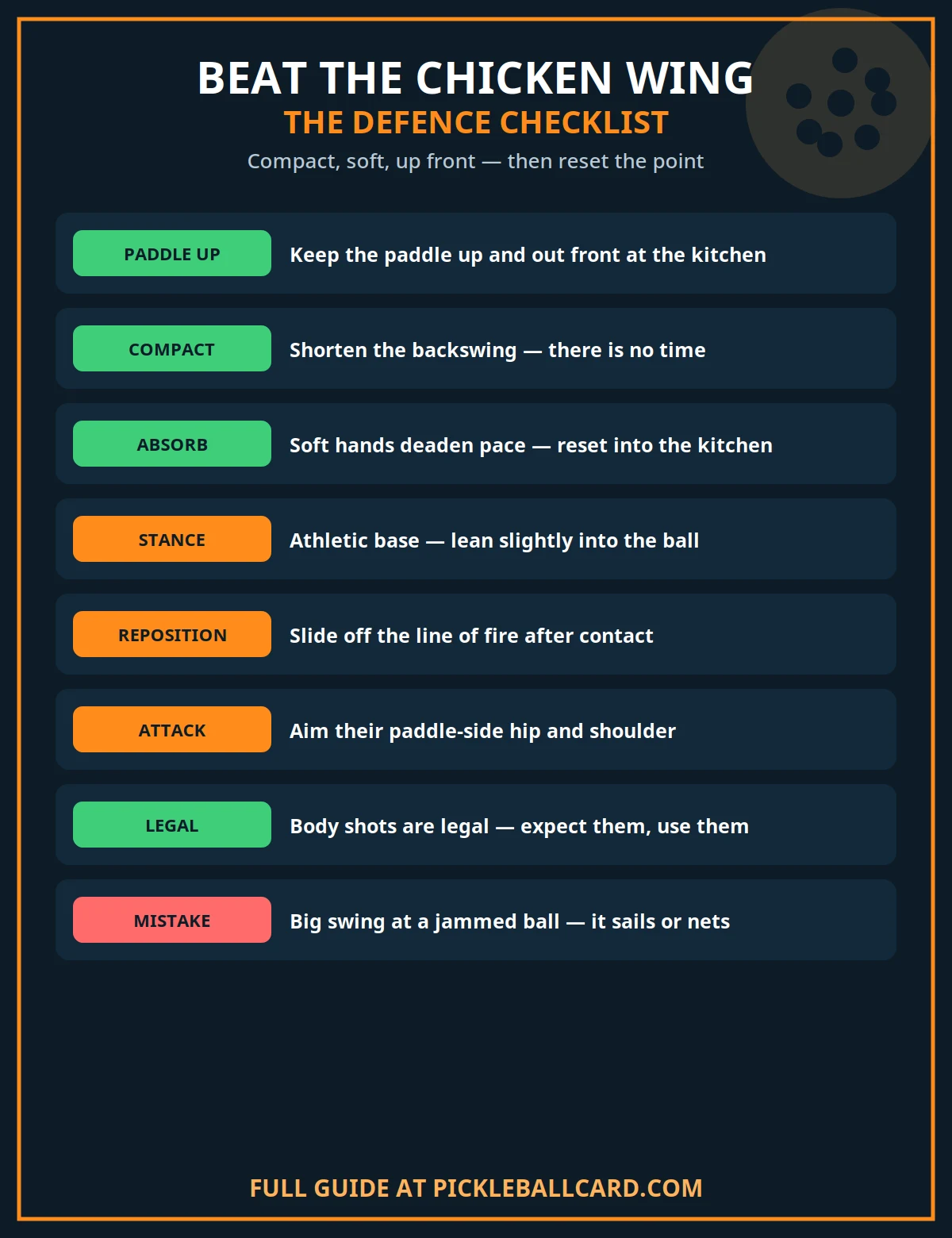
The Body-Shot Defence Checklist
Run through this checklist between points until every item is habit:
- Paddle position: Paddle held up at chest height, out in front of the torso, face toward the net.
- Stance: Athletic base — knees bent, weight on the balls of your feet, slight forward lean.
- Elbow: Relaxed and close to the body, never locked or flared before the ball arrives.
- Contact: Meet the ball out front with a compact block — no full swing from a jammed position.
- Grip: Slightly relaxed at contact so the paddle absorbs pace instead of reflecting it.
- Reset: Direct the block low into the opponent’s kitchen, near their feet, not back at chest height.
- Recover: Immediately return to the paddle-up ready position after every defensive contact.
Stop Getting Jammed: Repositioning Strategy
Technique handles the ball that is already at your body. Positioning stops it from getting there. Players who get chicken-winged constantly are usually giving attackers a stationary, predictable target.
Stay in an Athletic Stance
An upright stance with straight legs is a chicken wing factory. You cannot adjust quickly, your paddle drifts low, and your torso becomes a big, static target. Stay low with bent knees and a slight crouch — like guarding someone in basketball.
The low stance does two things: it keeps your paddle naturally up, and it lets you slide or pivot when a ball comes at your hip. Movement options are the difference between a clean block and a desperate wing.
Shade Your Paddle Side
Most body-shot attacks target your paddle-side hip and shoulder — your right side if you play right-handed. That zone is mechanically the hardest to defend because the arm has no room to extend there.
Shade slightly toward your paddle side in your ready stance, keeping your elbow tucked and your paddle guarding that channel. Do not overcommit — a good attacker will notice and switch to your backhand hip.
Don’t Back Up
The most common bad habit after getting jammed is retreating from the kitchen line. It feels safer, but it gives the attacker more angle and more time. You still get hit at the body, just from farther away.
Hold your ground at the line. The closer you are, the less time the ball has to dip into your body, and the more of your torso is covered by a simple paddle-up block. Courage at the kitchen beats distance every time.
Recover Between Shots
The chicken wing often arrives on the second ball of a fast exchange. The first block was fine, but you never returned to ready position — so the follow-up catches you with the paddle low and the elbow drifting.
Make recovery a habit: after every contact at the kitchen, snap the paddle back up and out front. In doubles, coordinate middle balls so neither partner is caught flat — our guide on who should take the middle in pickleball covers that teamwork.
Body-Shot Target Zones: A Quick Reference
Understanding where attackers aim helps you defend — and lets you use the same targets yourself. Not all body zones are equal.
| Target Zone | Why It Works | How to Defend It |
|---|---|---|
| Paddle-side hip | The hardest zone to handle — the arm cannot extend, and the player must choose between an awkward backhand tuck and a late forehand rotation. | Keep the paddle guarding this channel; slide or pivot so contact happens out front, not at the hip. |
| Paddle-side shoulder | Forces the elbow up and the wrist into an unnatural angle; most players pop the ball up or hit it out. | Paddle up and out front meets this ball cleanly before the elbow has to flare. |
| Chest / sternum | Triggers a reflexive pullback; players either block high (attackable) or abbreviate their swing (pop-up). | Compact block with soft hands; let the pace die into a low reset. |
| Backhand hip | Effective but slightly easier to handle — most players have a usable backhand block ready here. | Stay balanced; do not over-rotate toward the paddle side. |
| Feet / lower legs | Not a chicken wing target — forces a low volley or half-volley instead of a jammed block. | Stay low and volley down; this is where you want to be attacked. |
Notice the pattern: the zones that produce chicken wings are the ones where the arm has no room to work. Your entire defensive system — paddle up, compact block, athletic stance — exists to deny attackers clean access to those zones.
How to Target the Chicken Wing Yourself
Once you understand the chicken wing, you can cause it. Attacking the body is a legitimate, high-percentage tactic — especially against players who drop their paddles or stand upright at the kitchen.
Pick Your Moment
The chicken wing attack works best as a speed-up off a dink rally. After two or three soft dinks, your opponent relaxes. A sudden firm ball at their paddle-side hip or shoulder arrives before their ready position resets — and the wing comes out.
Look for the tell: a paddle that has drifted below the waist, an upright stance, a player leaning back. Those are invitations. Do not force body shots from low-percentage positions; the setup matters more than the swing.
Aim for the Paddle-Side Hip and Shoulder
The paddle-side hip is the money zone. A right-handed opponent faces an ugly choice when a ball arrives at the right hip: tuck the elbow into the ribs for a cramped backhand, or rotate late for a forehand already past them.
Both answers are bad, and the hesitation between them is where you win the point. The paddle-side shoulder works similarly but produces more outright pop-ups. Either target beats the chest, where many players hold a serviceable block.
Keep It Firm, Not Wild
Precision beats power here. A controlled ball at the hip does more damage than a wild swing at the torso. Overhitting risks the ball sailing long or catching your opponent somewhere it should not.
For more on building the full attacking toolkit — speed-ups, counters, and the shots that set them up — browse our pickleball shots index for technique guides on every major shot in the game.
A Note on Etiquette
In competitive play, body shots are expected and nobody apologizes for a legal tactic. In casual open play with clearly less experienced players, repeatedly targeting the body can feel unsporting.
Read the room: against advanced players, the body is fair game. Against beginners who are just learning to hold a paddle, aim for open court and keep the game fun.
Are Body Shots Legal in Pickleball?
Yes — body shots are completely legal in pickleball. The USA Pickleball Official Rulebook contains no prohibition on aiming at an opponent. The rules govern faults like volleying from the non-volley zone, not where your shots are directed. See the official USA Pickleball rules.
One related rule: if a ball hits you — other than your paddle hand below the wrist — it is a fault and the rally ends. Play body shots with the paddle, not your torso. The same rulebook is published by the Global Pickleball Federation.
The takeaway is simple: nobody breaks the rules by hitting at you, and you break none by hitting at them. The skill gap is entirely in the defence — which is what this guide is for.
Drills to Kill the Chicken Wing
Technique only sticks with repetition. These three drills target the problem directly:
The Torso Target Drill
Stand at the kitchen line with a partner across the net. Your partner hits firm but controlled balls at your torso — alternating hip, chest, and shoulder height. Your only job: compact block, soft hands, reset into their kitchen.
Start slow and build pace over several sessions. Control first, speed later.
The Paddle-Up Punishment Drill
Play normal kitchen dink rallies with one rule: if your paddle drops below your waist, your partner may speed up at your body immediately. You will develop the paddle-up habit fast when there is a price for dropping it.
The Recovery Snap Drill
Have a partner feed two quick balls — the first at your forehand, the second at your paddle-side hip. The drill trains recovery between shots: block, snap back to ready, block again.
Most chicken wings happen on ball two, so this is where the fix lives.
Frequently Asked Questions
Are body shots legal in pickleball?
Yes. No rule in the USA Pickleball Official Rulebook prohibits shots aimed at an opponent’s body. Body shots are a legal and widely used tactic, especially at the kitchen line.
What exactly is a chicken wing in pickleball?
It is the jammed, elbow-out defensive motion you make when a fast ball hits your paddle-side shoulder or hip. Your elbow flares sideways, your wrist twists awkwardly, and the contact rarely produces a controlled return.
Why do I keep getting chicken-winged?
The usual causes: a paddle held too low, a stance that is too upright, a backswing that is too big, or failing to recover to ready position between shots. Fix the ready position first — it solves most cases.
Should I counterattack when I am jammed?
No. When jammed at the body, reset the point: block softly with a compact motion and aim low into your opponent’s kitchen. Counterattacking from a cramped position produces pop-ups that get punished.
Where should I aim when attacking someone’s body?
The paddle-side hip and paddle-side shoulder are the two most effective targets. Both force the awkward elbow-out motion. The hip is slightly better because the defender also faces footwork they have no time for.
Is it rude to hit body shots in recreational play?
In competitive play, no — it is an expected tactic. In casual games with beginners, repeatedly targeting the body can feel unsporting. Match your tactics to the level: fair game against advanced players, dial it back with new players.
Final Word
The chicken wing is not a character flaw. It is what happens when the ball beats your preparation — and preparation is trainable.
Paddle up and out front, a compact block, soft hands, a low reset, and a mobile stance turn the most-feared shot at the kitchen into just another ball.
And once you can defend it, start dealing it. The paddle-side hip is waiting.

Shoaib is the publisher of Pickleball Card. He oversees the site’s guides to pickleball rules, ratings, strategy and gear, all researched from primary sources — the USA Pickleball Rulebook, DUPR and manufacturer documentation — and updated as the game changes.