Skinny singles is pickleball played on only half the court. Two players share one court, but each player covers just one side of the centerline. The result is a fast, focused game that rewards accuracy over power.
It is one of the easiest ways to get a real game with only two players. You do not need a fourth player, a full court, or a long warm-up. You need a paddle, a ball, and an agreement on which half counts.
Key Takeaways
- Skinny singles is a half-court singles game where each player defends only one side of the centerline.
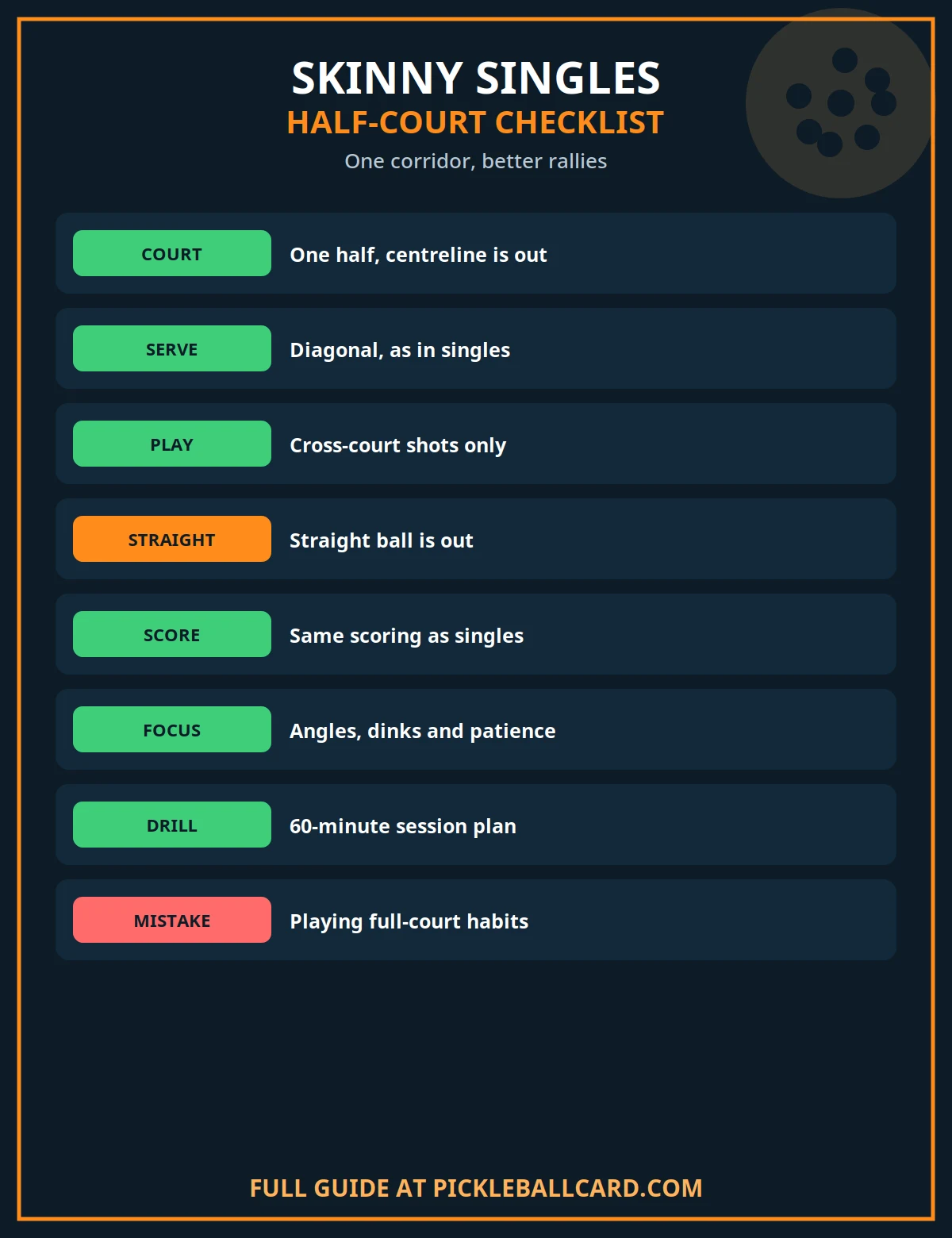
- In the standard cross-court version, every shot must land in the opponent’s diagonal half, or it is out.
- The full-court singles rules for serving, the two-bounce rule, and the kitchen still apply.
- Skinny singles is an informal variant with no single official rulebook, so agree on house rules before the first serve.
- It is a superb practice format because it forces precise placement, patient rallies, and smart angles.
- Games are usually played to 11 points, win by 2, with only the serving player able to score.
- Down-the-line and combination versions exist, but cross-court is the most common starting point.
What Is Skinny Singles?
Skinny singles takes the familiar singles game and narrows it. Instead of covering the full 20-foot width of the court, each player is responsible for about 10 feet. That single change transforms how every rally feels.
There is nowhere to hide a loose shot. A ball hit a few feet wide is no longer a recoverable error. It is out of the active half, and the rally ends.
That is exactly why coaches and regular players love the format. It punishes lazy placement and rewards players who aim with intent. Every shot has a target, and every target is small.
Skinny singles also sits neatly between singles and doubles. Like doubles, you cover only half the court. Like singles, you have no partner to rescue you. You must make every shot yourself.
The format works for almost any level. Beginners get longer, more controlled rallies without sprinting corner to corner. Advanced players get a sharp test of angles, dinks, and passing shots.
The Court Setup
Skinny singles uses a standard pickleball court. The court stays 20 feet wide and 44 feet long. Only the playable area changes, not the court itself.
The centerline becomes the key boundary. Imagine it extended from the baseline, through the kitchen, all the way to the net. That line now acts as a sideline for the active half.
In the standard cross-court version, the two players stand diagonally opposite each other. If you start on the right half, your opponent plays from their right half across the net.
The kitchen stays fully in play. The non-volley zone is still 7 feet deep on each side of the net. Kitchen faults still apply, exactly as they do in a full game.
Which Half Is In Play?
In cross-court skinny singles, the active half follows the server’s score. When the server’s score is even, both players use their even, or right, halves. When it is odd, both use their odd, or left, halves.
This means the active half can switch during a game. Players move to the correct half as the score changes. It keeps both sides of the game honest and balanced.
In down-the-line skinny singles, the setup is different. The two players stand directly opposite each other, and the rally is played straight ahead. That version is covered in the variations section below.
For a first game, cross-court is the simplest choice. It matches the diagonal serve that pickleball already uses. It also produces the long diagonal rallies that make the format so useful.
Which Service Boxes Are Used?
Only the service box inside the active half counts. A serve must land diagonally in the opponent’s correct service box, within that half. A serve landing in the other half is out.
The serve must also clear the kitchen and the kitchen line. A serve that lands in the kitchen, or on its line, is a fault. That rule is unchanged from full-court singles.
The Standard Rules As Commonly Played
Skinny singles has no single official rulebook. The rules below describe how the game is most commonly played in casual and practice settings. They adapt full-court singles rules to a half court.
Because house rules vary, agree on the details before you start. A two-minute conversation prevents most arguments. Settle the version, the scoring target, and what happens on a straight-ahead shot.
For the full-court rules that skinny singles adapts, the USA Pickleball official rules are the authoritative reference. The summary below follows those rules, with the half-court adjustment applied.
The Serve
The serve follows standard singles mechanics. It must be hit underhand, with paddle contact below the waist. For a volley serve, the paddle head must be below the wrist at contact.
At least one foot must be behind the baseline when the ball is struck. Neither foot may touch the baseline or the court before contact. A foot fault ends the rally.
The serve goes diagonally into the opponent’s service box within the active half. It must clear the kitchen and the kitchen line. Only one serve attempt is allowed per rally.
Server position follows the score, as in singles. Serve from the right half when your score is even, and from the left half when it is odd. The receiver stands in the matching diagonal half.
Call the score before every serve, server’s score first. In skinny singles, only two numbers are needed: your score, then your opponent’s score. Clear score calls prevent most disputes.
Scoring
Scoring follows traditional side-out scoring. Only the serving player can win a point. If the receiver wins a rally, no point is scored, and the serve changes hands.
The server keeps serving until they lose a rally. After a side-out, the new server serves from the side matching their own score. Games are commonly played to 11 points, win by 2.
Some groups play to 15, especially for longer practice games. Others play timed games or first to 7 for quick rotations. Any of these is fine, provided both players agree in advance.
Cross-Court-Only Play
Cross-court-only play is the defining rule of standard skinny singles. Every shot, not just the serve, must travel diagonally into the opponent’s active half.
That means dinks, drives, drops, and volleys all go cross-court. You cannot win a point by hitting straight ahead into the inactive half. The diagonal is the only legal target.
This rule changes shot selection completely. Wide angles become more valuable, because the diagonal court is longer than a straight shot. The diagonal measures about 48 feet, compared with 44 feet straight ahead.
What Happens On A Straight-Ahead Shot?
In standard cross-court skinny singles, a straight-ahead shot is out. If your ball lands in the opponent’s inactive half, you lose the rally. It does not matter how well you struck it.
The same applies if your ball lands beyond the active half on your opponent’s side. The inactive half is treated as out of bounds for that rally. Call it promptly and honestly.
When in doubt, the stricter reading is the standard one. A ball that does not land in the active diagonal half is out, and the rally goes to the other player.
Faults
Most faults in skinny singles match full-court singles faults. A serve that lands in the kitchen, or on the kitchen line, is a fault. A serve that lands outside the correct service box is a fault.
Hitting the ball into the net is a fault. Hitting it beyond the baseline, or beyond the active half’s sideline, is a fault. The centerline extension counts as a sideline in this format.
Volleying while standing in the kitchen, or touching the kitchen line during a volley, is a fault. Momentum carrying you into the kitchen after a volley counts too. Kitchen discipline matters even more on a narrow court.
Violating the two-bounce rule is a fault. The serve must bounce before the return, and the return must bounce before the server’s next shot. After those two bounces, volleys are allowed.
If the serving player faults, the serve passes to the opponent. If the receiving player faults, the server wins a point. That side-out structure is identical to full-court singles.
For a deeper look at the full-court rules behind these faults, see our guide to pickleball singles rules. It explains serving, scoring, and faults in the standard game.
Skinny Singles Vs Full-Court Singles
The two games share a rulebook foundation, but they feel very different in practice. Skinny singles narrows the court, and that narrowing changes movement, tactics, and fitness demands.
Full-court singles is a test of coverage. You must defend the entire width, sprint to wide balls, and recover quickly. Skinny singles is a test of precision within a smaller space.
| Feature | Skinny Singles | Full-Court Singles |
|---|---|---|
| Court width in play | About 10 feet, one half only | Full 20 feet |
| Legal shot direction | Cross-court only, in the standard version | Any direction within the court |
| Movement demand | Shorter sprints, more lateral control | Full-width sprints and recovery |
| Key skill rewarded | Accuracy, angles, and patience | Coverage, speed, and stamina |
| Serve target | Diagonal box inside the active half | Full diagonal service box |
| Scoring | Side-out, usually to 11, win by 2 | Side-out, usually to 11, win by 2 |
| Kitchen and two-bounce rules | Same as full-court singles | Standard rules apply |
| Players needed | Two | Two |
| Best use | Practice, drills, and small groups | Competition and full match play |
If you want to compare the two main formats more broadly, read our guide to the difference between pickleball singles and doubles. It puts singles coverage and doubles positioning side by side.
Why Players Use Skinny Singles
Players reach for skinny singles for practical reasons first. It solves the two-player problem, the crowded-court problem, and the short-session problem in one format.
With only two players, full-court singles can feel punishing. The court is wide, the rallies are short, and weaker players spend more time chasing than hitting. Skinny singles keeps rallies alive longer.
Small groups benefit too. Three players can rotate through skinny singles easily, with the winner staying on. Four players can run two games on one court, or rotate in pairs.
Skinny Singles Strategy
Good skinny singles strategy starts with accepting the narrow court. You cannot win by hitting through your opponent, because there is no open court to hit through. You win by moving them and opening angles.
Patience is the most valuable skill in this format. Rallies last longer, and the player who forces an error usually wins. Wait for a genuinely attackable ball before going for a winner.
Use Angles, Not Power
The diagonal gives you angles that reward placement over pace. A sharp cross-court dink pulls your opponent wide and opens the court behind them. A deep cross-court drive pushes them back and buys you time.
Aim for the corners of the active half. The deep corner near the baseline and the short angle near the kitchen are the two most useful targets. Alternating between them keeps your opponent guessing.
Win At The Kitchen Line
Soft kitchen play matters more in skinny singles than in most casual games. With less court to cover, both players reach the kitchen quickly. Many points are decided there, not from the baseline.
Keep your dinks low and cross-court. A high dink invites an attack, and an attack on a narrow court is hard to defend. Aim for your opponent’s feet or their backhand side.
Passing Shots And Patience
Passing shots still matter, but the window is smaller. With only half the court available, your opponent covers the passing lane more easily. Choose your moment carefully.
The best passing chance comes when your opponent is stretched wide or caught moving forward. A ball hit behind them, or at their feet as they approach, is far more effective than a hopeful blast.
Patience also means knowing when to reset a rally. If you are out of position, a high, deep return buys time. It is better to stay in the point than to force a low-percentage winner.
For a broader look at full-court tactics you can adapt here, see our pickleball singles strategy guide. Its phase-based approach transfers well to the half court.
Common Local Variations
This section matters, because skinny singles is an informal variant. There is no single official rulebook for it, and no governing body publishes one set of skinny singles rules. Local groups adapt the format freely.
That freedom is a strength, not a flaw. It lets groups tailor the game to their court, their players, and their goals. It only becomes a problem when players assume everyone plays the same version.
Always confirm the version before you play. Ask three questions: cross-court or down-the-line, what counts as out, and what score you play to. Those answers define your game.
Cross-Court Skinny Singles
Cross-court is the standard version described in this guide. Every shot goes diagonally into the opponent’s matching half. The active half follows the server’s score.
Down-The-Line Skinny Singles
Down-the-line skinny singles plays straight ahead instead of diagonally. The two players stand directly opposite each other, and every shot travels straight across the net.
This version is excellent for practising down-the-line drops and volleys. Those shots are underused in doubles, where cross-court play dominates. Down-the-line practice fills that gap.
Combination Skinny Singles
Combination skinny singles mixes both directions. The game starts cross-court, and the direction changes as players score and move. It is the most dynamic version, and the hardest to follow at first.
In a typical combination game, the server moves to the other half after winning a point. The receiver stays where they are. The next rally is therefore played in the new direction.
Other House Rules You May Meet
Some groups play rally scoring to keep games short. Others allow a second serve for beginners, or replay net cords without penalty. A few groups forbid around-the-post shots entirely.
Do not present any local version as official. If someone claims a particular version is the official rule, ask which body published it. For casual skinny singles, there is no such publication to point to.
A 60-Minute Skinny Singles Practice Session
Skinny singles shines as a practice format, so treat it like one. The session below fits two players, one court, and one hour. It builds accuracy, kitchen play, and match awareness in that order.
Practice Session Checklist
- 0 to 5 minutes: Warm up with soft cross-court shots and easy groundstrokes from the baseline.
- 5 to 15 minutes: Cross-court soft rally, first to 21, with a reset after every error.
- 15 to 25 minutes: Third-shot drop practice, serving cross-court and dropping into the active half.
- 25 to 35 minutes: Skinny singles game to 11, standard cross-court rules, side-out scoring.
- 35 to 45 minutes: Down-the-line version, focusing on straight-ahead drops and volleys.
- 45 to 55 minutes: Second skinny singles game to 11, with a target of fewer unforced errors.
- 55 to 60 minutes: Cool down with slow dinks, then agree on one skill to practise next time.
Frequently Asked Questions
What is skinny singles in pickleball?
Skinny singles is a half-court singles game for two players. Each player covers only one half of the court, and in the standard version every shot must travel cross-court into the opponent’s matching half.
Is skinny singles an official USA Pickleball format?
No, casual skinny singles is an informal variant with no single official rulebook. It adapts full-court singles rules to a half court, and local groups set their own house rules. Always agree on the version before play.
What happens if I hit a straight-ahead shot in cross-court skinny singles?
In the standard cross-court version, a straight-ahead shot is out. A ball landing in the opponent’s inactive half loses the rally, just like a ball hit wide in a full game. Some groups allow exceptions, so confirm the rule first.
Do players switch sides during a skinny singles game?
In the standard version, the active half follows the server’s score. Players use their even halves when the server’s score is even, and their odd halves when it is odd. Fixed-half and combination versions handle movement differently.
Can beginners play skinny singles?
Yes, skinny singles suits beginners very well. The smaller court means less running, longer rallies, and more chances to practise placement. Beginners may also agree on softer house rules, such as replaying straight-ahead shots.
How long does a skinny singles game take?
A game to 11 points usually takes 15 to 25 minutes, depending on rally length and skill level. That makes it ideal for short sessions, lunch-break games, and rotations when courts are busy.

Shoaib is the publisher of Pickleball Card. He oversees the site’s guides to pickleball rules, ratings, strategy and gear, all researched from primary sources — the USA Pickleball Rulebook, DUPR and manufacturer documentation — and updated as the game changes.