Singles pickleball looks like doubles played alone. It is not. It is a different game wearing the same court.
One player covers everything, every rally is a footrace and a chess problem at once, and the shots that win doubles points routinely lose singles points.
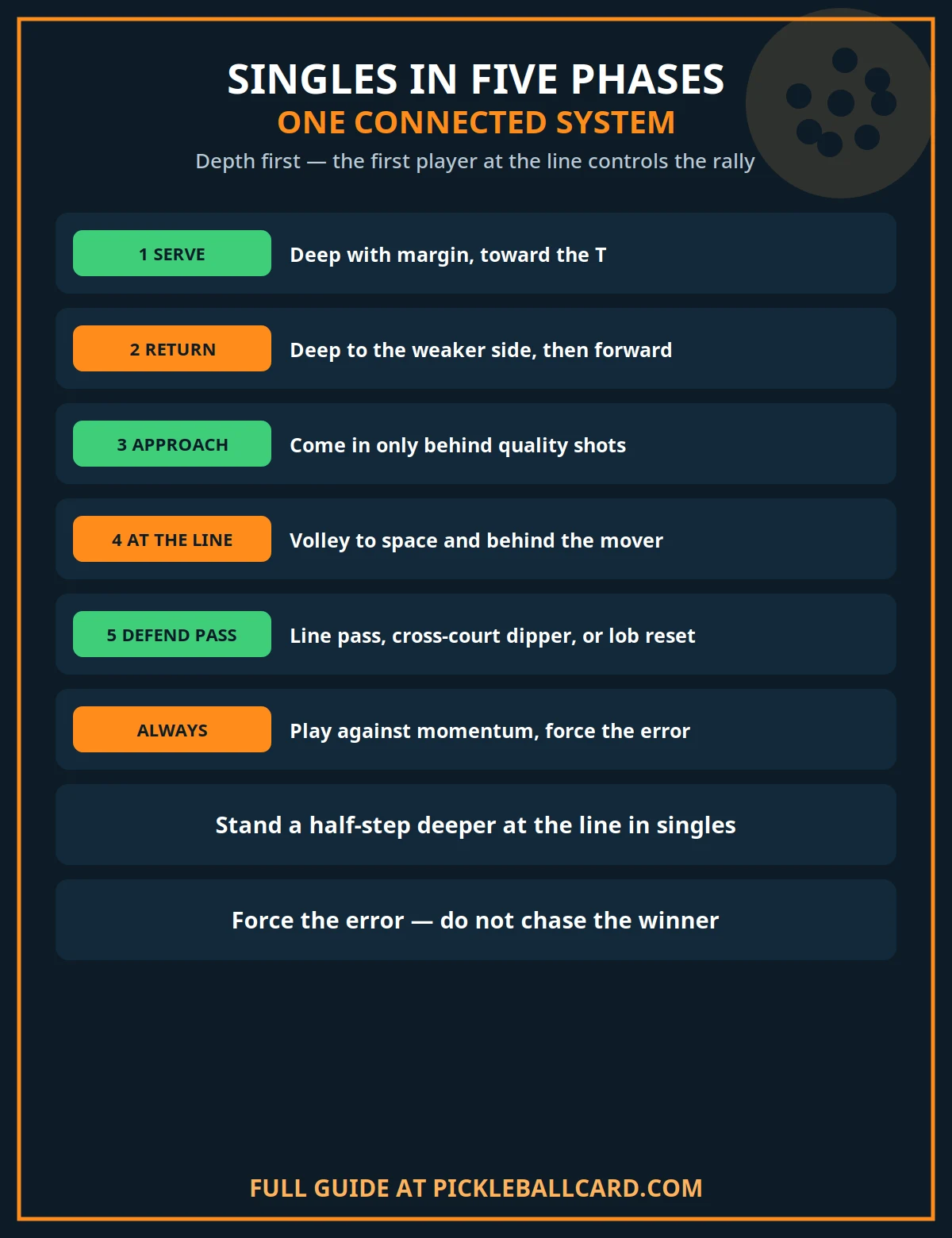
This guide organises singles as one connected system: serve, return, approach, life at the kitchen line, and defending the pass when your opponent gets there first.
Key Takeaways
- Depth wins singles. Serve deep and return deep; short balls are invitations your opponent will accept.
- The T is your home serve. Serving toward the middle cuts return angles and shortens your own recovery run.
- Track your shot forward. The first player established at the kitchen line controls most rallies.
- Come in behind quality only. Approach behind deep, low balls that push your opponent back — never behind a floater.
- Play against momentum. A moving opponent is beaten by the ball behind them more often than by open space.
- Force the error, do not chase the winner. In a full-court game, consistent pressure outscores highlight shots.
The Short Answer
Singles is won by depth and court position, not by winners. Serve deep, mostly toward the T, and return deep to your opponent’s weaker side.
Then follow your own shot forward. The player who reaches the kitchen line first, behind a ball that deserves it, dictates where the next ball goes.
USA Pickleball’s singles guidance makes the same core points: deep serves with margin, the T serve, deep returns, playing against momentum, tracking forward, and letting the opponent make the mistake.
What follows turns those points into a phase-by-phase system you can run through during a match, one rally at a time.
How Singles Differs Strategically From Doubles
The rules barely change. The same court, the same non-volley zone and the same two-bounce rule apply, with one server instead of two.
The full rules are covered in our guide to pickleball singles rules. This article assumes them and stays with strategy.
What changes is coverage. In doubles, a partner owns half your problems. In singles, the sideline you ignore is the sideline the ball finds.
That single fact reshapes everything: depth matters more, patience matters more, recovery position matters more, and low-percentage winners matter far less.
If you are still choosing between formats, our comparison of singles and doubles pickleball covers the differences in rules, fitness and feel.
Phase One: The Serve
Deep, With Margin
A deep serve pushes your opponent behind the baseline and makes a strong return physically harder to produce.
Aim for the back third of the service box, not the back line itself. Margin matters because a missed serve in singles is a point handed over with no rally at all.
Height helps depth. A serve with a comfortable arc clears the net safely and still lands deep, while a flat, skimming serve faults too often to build a game on.
The T as Your Home Serve
Serve toward the T — the junction of the centre line and the non-volley zone’s opposite service box — as your default location.
A T serve cuts the returner’s angles. They cannot open the court wide without hitting a much sharper angle, and most returns come back through the middle, close to you.
It also shortens your recovery. After a T serve you are already near where the rally will develop, instead of stranded out wide.
The Occasional Wide Serve
The wide serve is a change-up, not a home. Used sometimes, it drags the returner off court and opens the middle for your next ball.
Used often, it opens angles against you and lengthens your run back. Serve wide to remind, serve to the T to live.
Phase Two: The Return
The return is your first approach shot, and in singles it may be your most important one. Treat it as the start of your advance, not a defensive reply.
Deep, to the Weaker Side
Return deep, ideally to your opponent’s weaker side — for most players, the backhand corner.
Depth does two jobs at once. It pushes the server back for their third shot, and it buys you the seconds you need to move forward.
A short return does the opposite. It invites the server to step in, drive or drop on their terms, and leave you covering the whole court from the baseline.
The depth principles are shared with doubles. Our guide to pickleball return of serve tips covers stance, height and handling pace in full.
Then Forward, Immediately
Do not admire the return. The steps you take in the first second after contact decide where you play the next ball from.
Move forward behind your return, split-step as the server swings, and be ready to keep coming if your return has done its job.
Returning and staying back is the most common singles error at club level. It concedes the kitchen line — and usually the rally — before the third shot lands.
Phase Three: The Approach Decision
This is where most club singles points are actually decided: not at the line, not at the baseline, but in the choice of whether to come in.
Come In Behind Quality
Approach behind balls your opponent cannot attack: deep balls at their feet, low balls that push them backward, balls that move them off balance.
Behind those shots, your opponent must hit up, from behind the baseline, while you close the net. That is the exchange singles strategy is built to create.
Track the ball’s flight as you move. Following your shot in means your position mirrors its quality, step for step.
Stay Back Behind Anything Weak
A short or floating approach shot is not an approach shot. Following it in simply moves you closer to the passing shot it invites.
Behind a weak ball, hold or retreat, re-balance near the baseline’s centre, and rebuild the rally with your next deep ball.
Discipline here feels passive and wins matches. The points you save by refusing bad approaches outnumber the points any extra rush would steal.
| Your shot | Decision | Why |
|---|---|---|
| Deep, low, opponent moving backward | Come in fully | They must hit up; you own the line |
| Deep but sitting up, opponent set | Come in cautiously, split-step early | Expect a firm pass attempt at your feet |
| Mid-court, neutral ball | Advance halfway, stay balanced | Take space without selling out to the pass |
| Short or floating | Stay back and rebuild | Approaching behind it concedes the pass |
| You are stretched or off balance | Recover to centre first | Position beats speed when you are beaten |
Phase Four: At the Kitchen Line
Arriving is not the end of the system. What you do at the line decides whether the long approach was worth it.
Volley to Space — and Behind the Mover
Your first volley target is the open court your opponent has just left. Your second, often better target is directly behind a still-moving opponent.
A player sprinting wide cannot reverse instantly. The ball placed back into the space they came from wins without needing pace or a line-hugging angle.
Keep volleys low and deep rather than spectacular. A deep volley at the baseline keeps your opponent pinned while you hold the position they want.
Stand a Half-Step Deeper Than Doubles Habit
Doubles players hug the kitchen line. In singles, a half-step deeper buys reaction time against the pass and the lob, and costs almost nothing on volleys.
From that half-step you can still step in to volley low balls. What you gain is the extra fraction of a second that passing shots are designed to steal.
Expect the Lob
A pinned opponent’s escape is often upward. A deep lob over a net player is a legitimate singles reset, especially against a player camped tight to the line.
Your half-step depth helps, but the movement still matters: turn, do not backpedal, and decide early between overhead and letting it bounce.
Our guide to how to defend the lob in pickleball teaches that full movement system, and it transfers directly to singles.
Phase Five: Defending the Pass From the Baseline
Sometimes your opponent reaches the line first. Your game then becomes passing shots and patience, played from behind the baseline.
The Two Passing Shots
Down the line is the shorter, faster pass. It suits a ball you meet early and in balance, and it punishes a net player leaning toward the middle.
The cross-court dipper is the safer, cleverer pass. Topspin or a soft, angled ball drops below net height as it crosses, forcing the volleyer to hit up from their feet.
Choose by the volleyer’s position, not by preference. A line pass into a player waiting on that line is a donation; the dipper was there instead.
The Lob as a Reset
When you are stretched wide or pushed deep, the lob buys back the rally. Hit it high and deep, recover to centre, and make the net player prove the overhead.
Used sparingly, it also changes your opponent’s positioning. A player who respects your lob stands deeper, and a deeper net player volleys less sharply at your feet.
Used constantly, it becomes a feeding drill for their overhead. The lob is a reset button, not a game plan.
Playing Against Momentum
Open space is visible. Momentum is decisive, and most club players never look for it.
Watch your opponent’s hips and direction of travel as you choose a target. A player moving strongly one way is weakest in the space directly behind that movement.
Against a set, balanced opponent, open space is the right target. Against a committed mover, the wrong-footing ball wins more often and needs less precision.
This is why deep balls to a corner work twice in singles. First they move the opponent, then the reply behind them ends the rally the move created.
Rally Patience and Shot Tolerance
Singles rewards the player who can hit one more good ball. Not one more spectacular ball — one more deep, low, unglamorous ball.
Build points in layers: depth first, position second, angle third, winner last and only when the rally has already been won twice over.
Manage your errors across the whole match, not the rally. Track which shot is leaking points — often the rushed approach or the low-percentage pass — and simplify that one choice.
Between points, reset deliberately. Singles rallies are sprints; the walk back, the breath and the next serve target are part of the system, not downtime.
Fitness supports all of this as repeat effort, not general cardio. Short rallies, full recoveries and honest shot tolerance are what the strategy actually demands from your legs.
Common Singles Mistakes
| Mistake | Cost | Fix |
|---|---|---|
| Serving short | Returner steps in and owns the rally | Aim for the back third, with arc and margin |
| Returning, then staying back | Kitchen line conceded before the third shot | Move forward in the first second after contact |
| Camping on the baseline | Every drop and angle plays against you | Track quality shots forward, phase by phase |
| Following a weak approach in | Passing shot passes a stranded player | Stay back behind short or floating balls |
| Going for winners from defence | Errors end rallies you were still in | Pass, dip or lob — then rebuild |
| Hugging the kitchen line | Lobs and passes steal your reaction time | Hold a half-step deeper in singles |
A Simple Singles Practice Session
Strategy only survives if practice rehearses decisions, not just strokes. This short session trains the phases in order, in about forty minutes.
- Deep serve and return game. Play points where serve and return must land in the back third to count. Ten minutes builds the depth habit under score pressure.
- Approach-or-stay calls. A feeder plays mixed third shots while you call approach or stay before moving. The call trains the decision, which is the skill that decides points.
- First-to-the-line points. Play rallies where the first player established at the kitchen line scores double for winning the point. The incentive rewires passive baseline habits quickly.
- Passing-shot rotations. One player holds the line while the other alternates down-the-line passes and cross-court dippers. Five of each, then swap roles.
- Wrong-footing rallies. Finish with live points where a winner hit behind a moving opponent counts double. Momentum reading becomes instinct instead of theory.
Finish every session with ordinary games to fifteen. Practice incentives are scaffolding; the real score is where the new habits must learn to live.
Frequently Asked Questions
Are the kitchen rules different in singles?
No. The non-volley zone works exactly as in doubles: no volleying with a foot in the zone or on its line, and momentum carrying you in after a volley is still a fault.
Should I always come to the net in singles?
No. Come in behind quality — deep, low balls that push your opponent back. Behind short or floating shots, staying back and rebuilding wins more points than rushing in.
Where should I stand to receive serve in singles?
Just behind the baseline, near the middle of your service box, favouring your weaker side slightly if an opponent targets it. Depth matters more than the exact spot.
Is singles good practice for doubles?
Yes. Singles builds deep returns, approach judgement, passing shots and honest footwork — all of which transfer. It will not teach partner communication or stacking, which remain doubles skills.
What is skinny singles?
It is a half-court practice format played in one diagonal corridor. It is useful training, and it deserves its own guide rather than a section here.
How do I beat a faster opponent in singles?
Slow the geometry, not just the ball. Serve and return deep, play behind their momentum, extend rallies with depth, and make speed run the longest possible distances.
The Bottom Line
Pickleball singles strategy is a system, not a tip list: serve deep to the T, return deep to the weaker side, and track your shot forward.
Come in only behind balls that earn it, hold a half-step deeper at the line, volley behind the mover, and defend the pass with the dipper, the line ball or the resetting lob.
Above all, let depth and patience do the scoring. The opponent who must hit one more ball, from one step further back, is the opponent who eventually misses.
Sources: USA Pickleball, Pickleball Singles Strategy Tips and Official Rules (non-volley zone and singles scoring). Coaching content in this article is original; no competitor content is linked or reproduced.