Mixed doubles is the format most club players actually play. Two men and two women, or any mixed pairing at the recreational level, share a court — and the team that understands roles, targeting, and movement wins far more often than the team with the harder shots.
Mixed doubles strategy is different from generic doubles strategy. The court is the same size, but the patterns are not. Who covers the middle, who poaches, who gets targeted, and how you move as a pair all change when the pairing is mixed.
This guide covers the whole system: the two roles, the positioning that holds up under pressure, the targeting patterns that win points, and the mistakes that hand points back. It assumes you already know the basic rules and can hold a dink rally.
If you are new to doubles formations, start with our guide to what stacking is in pickleball — it explains how partners arrange themselves on the court before the first serve.
Key Takeaways
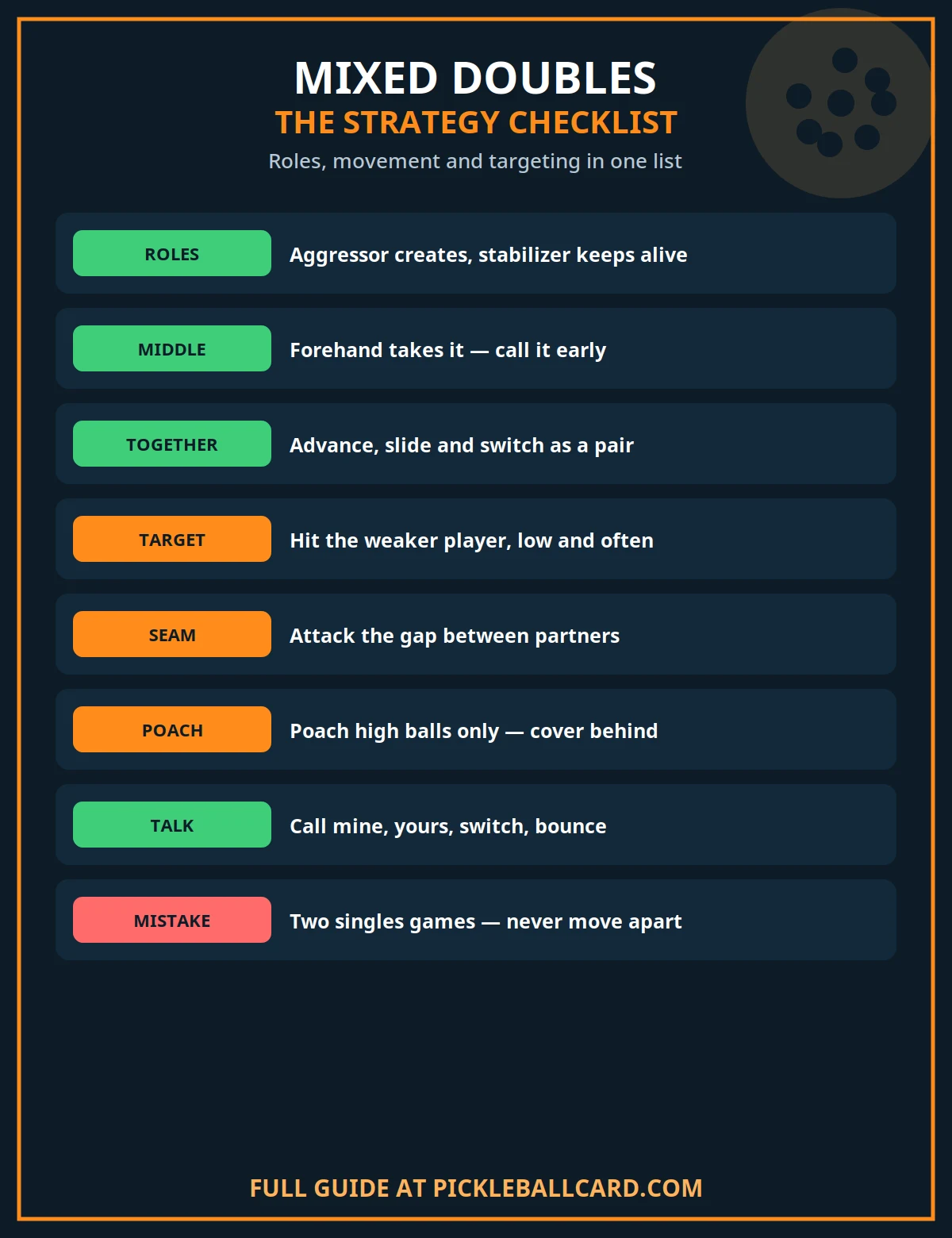
- Mixed doubles is won on roles and movement, not power: the pair that covers the middle and moves together wins the kitchen.
- The stronger player usually takes more court, but both partners must hold their own side — hiding a weak side is a plan opponents exploit.
- Target the weaker or less mobile opponent, and attack the middle — the seam between partners causes more errors than any single shot.
- Poach only when you can finish or force a pop-up; a failed poach leaves your side of the court wide open.
- Move as a unit: when one partner moves forward, the other moves forward. A split pair is two singles players sharing a court.
- Communication is strategy: call “mine,” “yours,” “switch,” and “bounce” before the ball arrives, not after.
The Two Roles in Mixed Doubles
Every mixed doubles pair has two roles, even if nobody names them. One partner is usually the aggressor — the player who poaches, speeds up, and finishes points at the kitchen.
The other is usually the stabilizer — the player who keeps balls in play, resets, and sets up the aggressor.
These roles are about strengths, not gender. At the recreational level the split often follows who volleys better and who moves faster, and it can flip mid-match as form changes.
The mistake is treating the roles as fixed positions. The aggressor who never defends gets exposed, and the stabilizer who never attacks lets opponents camp on their side.
The Aggressor: Creating Pressure
The aggressor’s job is to make opponents uncomfortable. They poach on floaters, speed up high dinks, and close on short balls. Their paddle stays up at the kitchen and they look for the first ball they can attack.
A good aggressor is selective. Attacking every ball produces errors and leaves the court open. Attacking the right ball — a high dink, a short return, a pop-up — produces weak replies the partner can finish.
The Stabilizer: Keeping the Point Alive
The stabilizer’s job is to make the aggressor’s job possible. They return serve deep, dink patiently, block speed-ups, and reset balls that come at their body. They keep the rally neutral until the pair earns an attacking ball.
Stability is not passivity. A stabilizer who dinks with purpose — low, to the feet, to the backhand — creates the high balls the aggressor needs. Read our guide to pickleball poaching to see how the two roles combine on a poach.
When to Swap Roles Mid-Match
Swap roles when the current split stops working. If opponents are targeting your aggressor successfully, let the stabilizer take more balls for a few points. If your stabilizer is winning dink rallies, let them attack the first high ball.
Discuss it between points, not during them. A one-sentence plan — “I’ll take more middle this game” — is enough.
Positioning: The Foundation of Mixed Doubles Strategy
Positioning in mixed doubles follows one rule above all: move together. When your partner steps to the kitchen line, you step to the kitchen line. When your partner drops back to return a lob, you drop back with them.
A pair split across the court — one at the line, one at the baseline — gives opponents a diagonal they can exploit all match.
The player at the line cannot cover the deep court, and the player at the baseline cannot finish at the net.
The Kitchen Line Is Home
Both partners belong at the kitchen line whenever the rally allows it. From the line you cut off angles, volley balls before they drop, and pressure opponents into lifting the ball.
Getting to the line is a team move. After the return of serve, the returning team should advance together behind the return. The serving team advances after the third shot, again together.
Who Takes the Middle?
The middle is the most contested ball in doubles, and mixed pairs argue about it more than anything else. The default answer: the forehand takes the middle.
If both partners have a forehand on a ball, the player with the forehand down the middle takes it.
When both partners have a backhand on a middle ball, the stronger or more aggressive player takes it — and says so. Silence on middle balls loses more points than any technical weakness.
For the full system, read our guide to who should take the middle in pickleball, which covers the “respect the X” rule in detail.
Shading: Covering the Weaker Side Without Hiding It
Shading means the stronger player slides slightly toward the middle, covering more court. A small shade — a foot or two — helps. A large shade abandons the sideline and invites opponents to hit behind you.
Shade on defense, not on offense. When your pair is attacking, both players hold their lines and look to finish. When defending, the stronger player shades middle and the weaker player guards the line.
Targeting: Where to Hit the Ball
Targeting is where mixed doubles is won. Opponents will target your weaker side; you should target theirs. That is not unsporting — it is the game, and it applies at every level.
Target the Weaker or Less Mobile Player
Every pair has a player opponents prefer to hit to. Identify yours early: who moves slower, whose backhand is shakier, who pops up dinks under pressure? Direct a steady diet of balls there until they prove they can handle it.
Target with placement, not power. A low dink to the feet beats a hard drive at the body. Forcing a weak reply from the weaker player sets up the finish against either opponent.
Attack the Middle Seam
The middle seam — the gap between partners — is the highest-percentage target in doubles. Balls down the middle force a decision: who takes it? Hesitation produces late, weak contact.
Hit the seam on serves, returns, and third shots. A deep return down the middle pushes both opponents back and opens the kitchen for your advance.
Go Behind the Poacher
When an opponent poaches aggressively, the counter is to hit behind them — into the space they just left. A poacher who crosses in front of their partner leaves their sideline open.
This is the classic answer to aggressive mixed doubles poaching. Wait for the poach, then drive or dink into the vacated court. Two or three balls behind the poacher will make them hesitate, and a hesitant poacher is no threat.
The Mixed Doubles Decision Table
Use this table to choose the right play in common situations:
| Situation | Best play | Avoid |
|---|---|---|
| Opponent floats a high dink | Poach or speed up at the middle seam | Letting it drop and re-dinking |
| Your partner is under pressure | Shade middle, cover the line, call “yours” | Watching without moving |
| Opponent poaches every other ball | Hit behind the poacher into open court | Continuing to hit to the poacher |
| Both opponents back at the baseline | Drop short and advance to the kitchen together | Staying back and trading drives |
| You are both at the kitchen, rally neutral | Dink low to the weaker player’s feet | Speeding up a low ball |
| Opponent lobs over your partner | Switch sides, partner covers, you cover the lob | Both players chasing the same ball |
Movement Patterns That Win Points
Good mixed doubles pairs move in patterns opponents can predict but cannot stop. The three that matter most are the advance, the switch, and the slide.
The Advance: Getting to the Line Together
After a good return or third shot, advance as a pair. The player who hits the advancing shot moves first; the partner follows a half-step behind. Arrive at the line together, paddles up, ready for the next ball.
Never advance alone. A single player at the line against two opponents at the line is outnumbered, and the deep player cannot help.
The Switch: Covering the Lob
When a lob goes over one partner, the pair switches: the lobbed player drops back to retrieve, and the other partner slides across to cover the vacated side. Call “switch” early so both players move with purpose.
Practice the switch before you need it. Pairs that have never drilled it collide, hesitate, or leave half the court open.
The Slide: Following the Ball Sideways
As the ball moves side to side, the pair slides with it. When the ball goes wide to your partner’s side, shift that way; when it comes back to your side, shift back. The pair stays centered on the ball, not on the court.
Sliding keeps the middle covered and the angles small. A pair that stands still while the ball moves wide gives up the middle seam for free.
Serving and Returning in Mixed Doubles
Serve and return strategy in mixed doubles is about setting up the third and fourth shots, not winning the point outright. Aces are rare; weak returns are common.
Serve Deep and to the Weaker Returner
Serve deep, with pace and placement, to the opponent who returns least well. A deep serve pushes the returner back and makes their return shorter, which sets up your third shot.
Vary the serve location. Serving to the same spot every time lets the returner settle. Alternate body, backhand, and deep middle.
Return Deep and Down the Middle
Return deep, preferably down the middle, and advance behind it. A deep middle return forces the serving team to decide who takes the third shot, and it buys your pair time to reach the line.
Never return short and stay back. A short return invites the serving team forward, and your pair will spend the rally defending instead of attacking.
Mixed Doubles at Different Levels
At the beginner level, mixed doubles strategy is simple: get to the kitchen together, keep the ball in play, and call every ball. Most points end on unforced errors, so consistency beats cleverness.
At the intermediate level, targeting and poaching enter the game. This is where most club players live, and where the patterns in this guide pay off fastest. Learn one pattern per week — middle coverage first, then poaching, then targeting — rather than trying to add everything at once.
At the advanced level, mixed doubles becomes a chess match of stacking, switching, and disguised attacks. Pairs at this level study each other’s tendencies between games and adjust targeting mid-match. The movement rules do not change; the speed and precision do.
Whatever your level, the same habit separates good pairs from struggling ones: talk between every point. A pair that plans together improves together.
Common Mixed Doubles Mistakes
Most mixed doubles points are lost, not won. These are the mistakes that cost the most:
- Playing two singles games: partners who never move together, never cover each other, and never communicate.
- The stronger player taking every ball: it tires them, exposes their side, and leaves the partner cold when a ball finally comes to them.
- Poaching without a plan: crossing on a low ball you cannot finish, leaving your court open for an easy winner.
- Ignoring the middle: both partners assuming the other has it, while the ball drops between them untouched.
- Staying back after the return: the returning team that never advances gives the serving team the kitchen for free.
- Blaming the partner: one bad exchange becomes a bad game when partners stop talking and start sulking.
Mixed Doubles Drills to Practice
Three drills build the whole system. Practice them in order, one per session.
Drill 1: Move Together
Play normal rallies with one rule: both partners must be within a step of the same depth at all times. If one advances, the other advances. This feels awkward at first and becomes automatic within weeks.
Drill 2: Target the Weakness
Play games where one pair must hit two out of every three balls to the same opponent. The targeted player learns to defend under pressure; the targeting pair learns to construct points.
Drill 3: Poach and Cover
Play kitchen-only rallies where the aggressor may poach on any ball above net height. The partner practices sliding to cover the vacated court. This drill teaches both halves of the poach at once.
Frequently Asked Questions
Who should cover the middle in mixed doubles?
By default, the forehand takes the middle. When both players have a backhand on a middle ball, the stronger or more aggressive player takes it and calls it early. The key is deciding before the ball arrives.
Should the stronger player take more court?
Yes, but only slightly. A small shade toward the middle helps; abandoning the sideline hurts. The weaker player must still hold their side, or opponents will simply hit behind the stronger player all match.
Is it fair to target the weaker player?
Yes — targeting is part of competitive doubles at every level. In casual social play, balance targeting with variety so the game stays fun. In tournaments and league play, targeting is expected.
How do you beat a team that poaches constantly?
Hit behind the poacher into the court they vacated. A few balls behind the poacher will slow them down. You can also lob over the poacher or dink low to their partner’s feet.
What is the biggest difference between mixed and same-gender doubles?
The patterns are more role-driven. Mixed pairs usually split into an aggressor and a stabilizer, and opponents target the split. Same-gender pairs at higher levels tend to share roles more evenly, but the movement rules — move together, cover the middle, communicate — are identical.
Should mixed doubles partners stack?
Stacking helps when one partner has a clearly stronger forehand or a preferred side. It adds complexity, so learn basic positioning first. Our stacking guide explains when the trade-off is worth it.
Final Word
Mixed doubles rewards the pair that plays as a pair. Roles give you a plan, movement gives you coverage, targeting gives you points, and communication holds it all together.
Start with one change: move together. Get to the line together, slide together, and switch together. Everything else in this guide works better once that habit is in place.
The rules that govern every shot in this guide come from the USA Pickleball Official Rulebook. For the format contrast, compare this guide with our breakdown of singles vs doubles pickleball.

Shoaib is the publisher of Pickleball Card. He oversees the site’s guides to pickleball rules, ratings, strategy and gear, all researched from primary sources — the USA Pickleball Rulebook, DUPR and manufacturer documentation — and updated as the game changes.